Tampa, SOF Week, and the Moral Burden of “Peace Through Strength”

Tampa has always felt to me less like a headquarters town than a frontier outpost of the American imperium—humid, kinetic, restless, permanently humming with the quiet traffic of planners, operators, diplomats, technologists, spies, contractors, and warrior-scholars moving between conference rooms and conflict zones. For more than two decades, MacDill Air Force Base and the larger Tampa Bay region have stood at the operational crossroads of America’s post-9/11 security state. CENTCOM. SOCOM. Coalition warfare. Counterterrorism. Influence operations. Global manhunting. Strategic competition. Gray-zone campaigning. All of it, in one way or another, has flowed through Tampa.
Each year, SOF Week becomes its own peculiar civic liturgy.
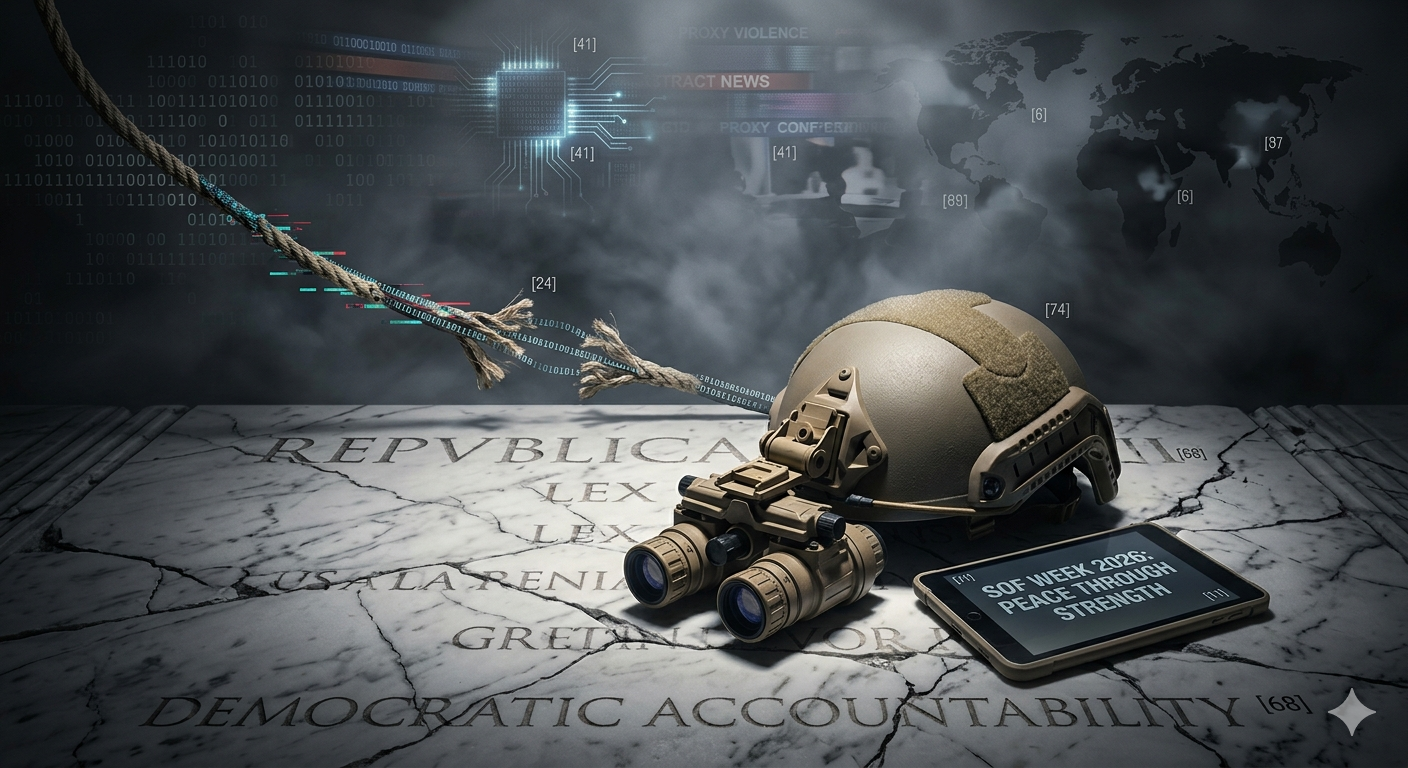
This year’s 2026 gathering—bringing together representatives from more than seventy allied nations and tens of thousands from across the global special operations enterprise—was wrapped in a theme that felt both familiar and newly charged: “Peace Through Strength.”
At one level, the phrase is uncontroversial. Every serious state must possess credible means of defense and deterrence. Weakness can invite aggression. Capability matters. Readiness matters. Partnerships matter. Adm. Frank “Mitch” Bradley, the current commander of U.S. Special Operations Command, articulated this logic clearly in his keynote address, arguing that deterrence succeeds not merely through punishment, but by convincing adversaries that aggression itself will fail. He emphasized resilience, alliances, technological adaptation, interoperability, and above all the human-centered excellence of SOF professionals—the “irreplaceable advantage” of the force.
On this point, I agree deeply.
I have spent much of my professional life around this community—not merely adjacent to it institutionally, but intellectually, operationally, educationally, and personally intertwined with it. I know many of these men and women. I have worked alongside them in war rooms and planning cells, in classrooms and strategy sessions, in moments of triumph and moments of terrible loss. I have seen firsthand their discipline, humility, creativity, courage, and relentless professionalism. I served as president of the Joint Special Operations University during a period of intense reflection and transition within the force itself—a period in which many inside the community were wrestling seriously with the future identity, purpose, and ethical obligations of Special Operations Forces in an increasingly ambiguous world.
My admiration for the SOF profession is genuine and hard-earned.
But so too is my unease.
Because there is another side to this year’s SOF Week conversation—one less visible amid the celebration of tactical virtuosity, emerging technologies, and “peace through strength.” It is the quieter, harder question of what happens when extraordinary operational capability becomes politically untethered from clear legal, moral, and constitutional restraint.
Or more dangerously still: when tactical excellence itself begins to substitute for strategic legitimacy.
That concern sharpened for me listening to Admiral Bradley describe Operation Absolute Resolve—the January 2026 seizure of Venezuelan President Nicolás Maduro—as “the most sophisticated integrated interagency joint force raid ever conducted” and “a new standard for power projection.” Operationally speaking, perhaps he is correct. By all accounts, it was an extraordinary demonstration of integration, intelligence fusion, technological synchronization, precision targeting, and interagency execution.
But that is precisely the paradox now confronting the republic.
The more operationally exquisite our capabilities become, the more vigilant we must become regarding the purposes for which they are employed.
For the Venezuela operation was not merely a tactical event. It represented something much larger and more consequential: the continued migration of U.S. Special Operations capabilities into an increasingly gray space between warfighting, law enforcement, intelligence activity, covert action, political coercion, and unilateral executive enforcement power. As I argued elsewhere shortly after the operation, the central legal and constitutional questions surrounding that mission remain deeply contested under both international law and the American constitutional tradition.
This is not an abstract concern.
The post-9/11 era gradually normalized a strategic environment in which elite military power became increasingly detached from formal declarations of war, clear geographic boundaries, and even coherent definitions of victory itself. Raids blurred into campaigns. Counterterrorism blurred into counter-network warfare. Security cooperation blurred into proxy conflict management. Intelligence collection blurred into persistent targeting architectures. The gray zone expanded because the instruments available to operate inside it became more capable, more precise, more politically usable, and—perhaps most dangerously—more publicly celebrated.
And now, under the newly released 2026 U.S. Counterterrorism Strategy, that grayness threatens to deepen further still. The strategy reflects a noticeable shift toward a sovereignty-centered, coercion-oriented conception of counterterrorism—one emphasizing direct disruption, unilateral action, and expanded threat framing while compressing earlier emphasis on systemic political conditions, governance environments, and multilateral legitimacy. The result is a strategic logic increasingly comfortable with persistent operations across blurred legal and political boundaries.
In fairness, many of the dangers driving this evolution are real. Cartels are not merely criminal enterprises; some increasingly resemble transnational insurgent-commercial hybrids. State and non-state adversaries alike now weaponize cyber systems, migration flows, information ecosystems, maritime commerce, artificial intelligence, and proxy violence simultaneously. Contemporary conflict is indeed “compound” in character—converging across domains once treated separately.
But recognizing complexity does not absolve republics from the burden of restraint. Indeed, complexity heightens that burden.
Because the more ambiguous conflict becomes, the more tempting it becomes for political leaders to rely on elite instruments capable of operating below traditional thresholds of democratic friction and public scrutiny. SOF, by design, possesses precisely those capabilities. That is their strategic value. But it is also why their use demands extraordinary political and civic seriousness.
This is the deeper tension I carry into this essay.
I do not worry that SOF professionals lack ethics. Quite the opposite. Many of the most ethically serious military thinkers I know come from within this community itself. Nor do I question the courage or legitimacy of the profession as such. What worries me is the broader political ecosystem increasingly surrounding the profession: a national security culture drifting toward a subtle glorification of capability itself—a civic fascination with operational brilliance detached from equally rigorous interrogation of political purpose.
The danger is not that SOF becomes too powerful tactically.
The danger is that the republic becomes seduced by that power.
Because republics do not preserve themselves merely by producing elite warriors. They preserve themselves by ensuring that even their most elite warriors remain subordinate to law, constitutional restraint, ethical purpose, and democratic accountability.
That distinction matters profoundly in an age where “peace through strength” risks quietly mutating into something older and more dangerous: peace through dominance; peace through unilateral coercion; peace through permanent exception.
History offers uncomfortable warnings here. Great powers rarely abandon legality all at once. Rather, they slowly acclimate themselves to increasingly elastic interpretations of necessity. Tactical success normalizes operational precedent. Exceptional cases become routine practices. The public, dazzled by competence, begins confusing effectiveness with righteousness. Eventually, the republic ceases asking not merely can we do this? but should we?
That is the conversation I hope this essay contributes to.
Not an indictment of Special Operations Forces.
Not a dismissal of their necessity.
Not a denial of the dangerous world we inhabit.
But rather a plea for strategic, constitutional, and moral sobriety amid our understandable admiration for one of the most capable military communities ever assembled.
For in the end, the true test of a liberal democratic republic is not whether it can produce extraordinary instruments of force.
It is whether it retains the wisdom, restraint, and civic discipline necessary to govern them rightly.
The Perils of Confusing Power with Principle
There is a dangerous temptation in democratic republics at war: the temptation to confuse exquisite competence with strategic righteousness.
No military institution in modern American history has earned more admiration for disciplined excellence, adaptive leadership, courage under conditions of ambiguity, and operational effectiveness than the United States Special Operations Forces community. That admiration is deserved. Indeed, it is difficult to overstate the remarkable achievements of America’s SOF leader-operators over the last quarter century. From Afghanistan in the immediate aftermath of 9/11, to counterterrorism campaigns across Iraq and Syria, to hostage rescue operations, intelligence fusion, unconventional warfare, partner-force development, and precision strike capabilities, SOF became for many Americans the embodiment of modern military professionalism itself.
They became, in effect, the republic’s strategic craftsmen.
Their tactical and operational virtuosity was not mythologized into existence. It was earned—in blood, discipline, intellect, sacrifice, and sustained performance under extraordinary pressures. In an era where large institutions often appeared rigid, bureaucratic, and slow, SOF organizations projected adaptability, initiative, and mission-focused seriousness. They appeared to solve problems that conventional institutions struggled even to frame.
And therein lies the danger.
For over time, especially in the years following September 11, the United States began to drift toward a subtle but profound conflation: the conflation of operational excellence with strategic wisdom; the conflation of capability with legitimacy; the conflation of tactical effectiveness with moral and political rightness.
This is not the fault of SOF alone. Nor is it principally a military problem. It is, more fundamentally, a political and civic problem—a republic-level problem. It reflects the growing tendency of modern liberal democracies to seek politically antiseptic forms of force application: force that is precise, professional, limited in visibility, and low in domestic political friction. In this regard, Special Operations Forces became uniquely attractive instruments not only because they were effective, but because they appeared to promise something democracies have historically desired but rarely achieved: the ability to exercise violence cleanly, efficiently, and without broader societal mobilization.
But war does not become morally cleaner merely because it becomes operationally precise.
Nor does strategic wisdom emerge automatically from tactical mastery.
Indeed, history repeatedly warns us that the more operationally proficient a state becomes, the more vulnerable it may become to strategic overuse of force—especially when political leaders mistake the availability of elite capability for the existence of strategic necessity.
This was one of the deeper lessons of the post-9/11 era. The United States became extraordinarily proficient at conducting raids, decapitation strikes, intelligence-driven manhunts, partner-enabled campaigns, and transregional counterterrorism operations. The American national security system developed an unprecedented capacity for persistent global pursuit. Yet simultaneously, fundamental questions regarding political purpose, legal authorization, strategic proportionality, democratic accountability, and the moral logic of endless campaigning often remained dangerously underexamined.
The problem was never whether SOF could execute missions. The problem was increasingly whether the nation itself remained sufficiently disciplined in deciding which missions ought to exist in the first place.
This distinction matters immensely.
A liberal democratic republic cannot afford to allow admiration for the tactical virtuosity of its military professionals to evolve into an implicit doctrine that effectiveness itself legitimizes force. That path risks producing a quiet but profound corruption of republican civil-military relations: a gradual slide toward a “might-makes-right” logic masked beneath the language of precision, professionalism, and national security necessity.
The strategic issue, therefore, is not whether Special Operations Forces are valuable. They unquestionably are. Nor is the issue whether elite military organizations should exist. History suggests they are indispensable under certain conditions of modern conflict and competition. Rather, the issue is whether the republic retains the civic, constitutional, and moral seriousness necessary to subordinate even its most capable instruments of violence to clearly articulated political purposes anchored in legality, ethics, and democratic accountability.
This concern becomes especially acute in what might be called the emerging era of compound security competition—a security environment characterized not simply by war and peace as distinct conditions, but by their convergence. In such an environment, states increasingly operate within blurred zones: persistent competition below traditional thresholds of declared war; overlapping informational, economic, cyber, proxy, and irregular conflicts; transregional coercion campaigns; and diffuse struggles over legitimacy itself. As argued in work on the “compound security dilemma,” contemporary geopolitical competition increasingly merges traditional military concerns with economic, social, technological, and political vulnerabilities.
Under such conditions, SOF capabilities naturally become even more attractive to policymakers precisely because they appear uniquely suited for ambiguity. They offer responsiveness below the threshold of large-scale mobilization. They provide deniability, agility, discretion, and strategic optionality. They can shape environments without necessarily triggering overt escalation.
But ambiguity is precisely where republics must exercise their greatest caution.
For the more ambiguous the battlespace becomes, the more essential political clarity becomes.
A democracy cannot permit the tactical sophistication of force to obscure the moral burden of deciding when force should be used. Nor can it permit operational secrecy to evolve into strategic insulation from democratic scrutiny. Elite military formations may execute missions with extraordinary discipline and integrity while the political system directing those missions drifts into strategic incoherence, legal elasticity, or moral exhaustion.
Indeed, one of the defining paradoxes of the post-9/11 period is that America often demonstrated extraordinary operational competence amid profound uncertainty regarding strategic end states. The nation became exceptionally skilled at campaigning tactically while frequently struggling to articulate sustainable political outcomes. As years passed, the operational became increasingly detached from the political. Means became more refined while ends became less certain.
Clausewitz warned that war is never autonomous from politics. Yet modern democracies increasingly flirt with the illusion that technologically enabled precision operations can somehow bypass politics altogether. They cannot. Military action always remains embedded within political meaning, whether acknowledged or not.
This is especially important because SOF culture itself—at its best—has historically understood this truth better than many civilian observers. The finest SOF professionals rarely romanticize violence. They understand friction, consequence, ambiguity, and unintended effects intimately. They understand that tactical success can coexist alongside strategic failure. They understand that raids alone do not produce political order. They understand that killing enemies and building durable peace are not synonymous endeavors.
Many learned this painfully across Iraq and Afghanistan.
One of the enduring ironies of the post-9/11 era is that some of the deepest strategic skepticism regarding the utility of force emerged not from civilian critics far removed from war, but from experienced military practitioners closest to its realities. Operational exposure often produced greater—not lesser—awareness of force’s limits.
This distinction deserves preservation.
Because what is most dangerous is not the existence of elite military capability. What is dangerous is the civic temptation to elevate capability itself into strategic philosophy.
That temptation grows strongest during periods of geopolitical anxiety. Democracies facing disorder naturally seek instruments promising control, precision, and responsiveness. Yet republics endure not merely because they possess power, but because they discipline power. Constitutional orders survive because they restrain the seductions of expediency. The central question is never whether force can be used effectively. The central question is whether force serves legitimate political purposes consistent with the constitutional and moral order the republic claims to defend.
This is why strategic discourse surrounding SOF requires greater—not lesser—moral seriousness.
Celebration of courage is appropriate. Admiration for competence is appropriate. Respect for sacrifice is essential. But praise must remain situated within a larger framework of political accountability and ethical restraint. Otherwise, democratic societies risk normalizing a conception of power untethered from republican purpose.
And history suggests republics rarely decline because their warriors become too capable. They decline when political communities lose the civic discipline necessary to govern capability wisely.
The challenge ahead, therefore, is not to diminish SOF. It is to recontextualize SOF properly within a constitutional order.
America does not need less strategic competence. It needs greater strategic coherence. It does not need fewer elite operators. It needs more disciplined political thinking regarding the purposes for which those operators are employed.
And above all, it needs to recover an older republican understanding: that the moral legitimacy of force does not derive from precision, professionalism, or effectiveness alone. It derives from whether force remains subordinated to lawful authority, just political purpose, ethical restraint, and the preservation of a constitutional order worthy of defense in the first place. That is the harder burden. And ultimately, it is not a burden borne by Special Operations Forces alone. It is borne by the republic itself.