





The Value of EURO-SOF
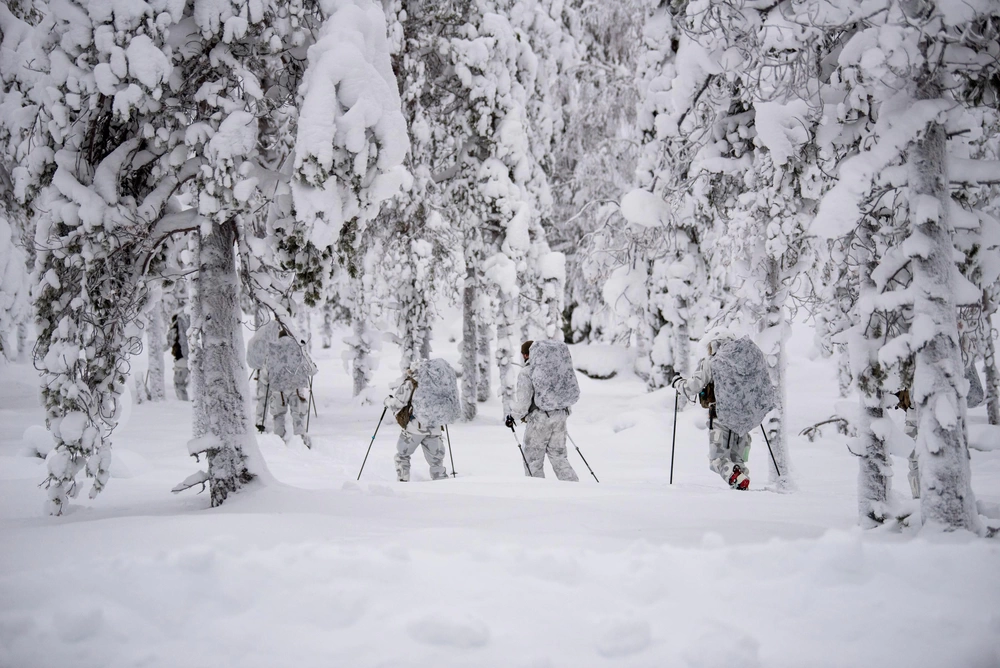

Global conflict simultaneity remains a real possibility. Because of this, the U.S. joint force has been tasked by American leadership to be ready, peace through strength. While in Europe the persistent Russian threat is an interdependent piece of the larger global threat, the recently released 2026 U.S. Department of War National Defense Strategy makes it clear American strategic leaders are de-prioritizing Russia against other global threats. This context makes it necessary for Special Operations Forces assigned and deployed to Europe to demonstrate their value.
SOF in Europe’s value proposition is deterrence by denial and deterrence by cost imposition. Deterrence by denial is being in the right place, at the right time, with the right partner and capabilities to hold decisional and positional advantage and conversely deny the same to any adversary. Deterrence by cost imposition is the ability of SOF to hold adversary critical capabilities at risk. If deterrence were to fail, and crisis or conflict occurred, SOF can rapidly deliver unacceptable costs against the adversary. This value proposition in support to the larger U.S. joint and NATO Allied force is a critical layer to deterrence and the defense of the U.S. homeland and Alliance. SOF buys down risk at the front end with its unique positioning.
To achieve this proposition, SOF in Europe uses a guiding logic provided by the dual-hatted Commanding General of U.S. Special Operations Command Europe (U.S. SOCEUR), and Allied Special Operations Forces Command (NATO SOFCOM). The foundation of the theory of victory is SOF domain awareness. Awareness is having transparency to see and understand the entirety of SOF campaigning activities in the theater. Awareness then allows for SOF domain coherence. Coherence is the alignment, synchronization, coordination, and deconfliction in time, space, and purpose of all SOF, including U.S joint, allied, partner, and irregular forces, to achieve objectives.
U.S. SOF in Europe capitalizes on conditions to gain and maintain enduring advantages. These advantages underwrite the deterrence of Russia against the homeland and Alliance. The key to this statement is understanding what “advantages” means. These are the conditions in which friendly forces can operate freely across the theater, anywhere, at any time political leaders require, while the adversary cannot. They reflect the capability and capacity to act effectively in every domain: from space and the electromagnetic spectrum to the air, land, sea, subsurface, seafloor, digital networks, and within human communities.
Advantageous conditions also include knowing what the adversary is doing while denying them insight into friendly forces actions. Finally, advantage is having plans that are ready, rehearsed, and executable at a moment’s notice. Plans designed to rapidly disintegrate the enemy’s center of gravity, while enabling the joint force across all domains. By clearly communicating both the capability and the will to dominate across the joint competition continuum, these conditions generate a powerful deterrent effect.
SOF secures these advantages through an exquisite irregular warfare concept which includes persistent presence, access, and influence. U.S. SOF uses its agility to set the theater in advance of any crisis or conflict. Right now, SOF is at the edge, the last covered and concealed position possible prior to any crisis or conflict. This posture makes SOF uniquely prepared to provide flexible options upstream.
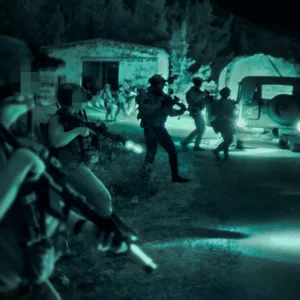
This value proposition and theory of victory for SOF in Europe is in lockstep with the U.S. National Defense Strategy. U.S. SOF’s first focus in Europe is defending the U.S. homeland. Forces are achieving this by defending forward, protecting the approaches to the U.S., and ensuring Russia is fixed, remaining primarily a threat to Europe. The range of actual operations, activities, and investments is broad, but largely fits into three categories of inform, influence, and effect. U.S. Army Special Operations, Naval Special Warfare, and U.S. Air Force Special Operations each bring domain specific capabilities to the theater. However, domain convergence, or in doctrinal terms multi-domain operations, is the special sauce for achieving objectives in the modern era. By integrating domains at all echelons, the effects achieved are greater than the sum of their parts. Through this method SOF contributes to the U.S. Joint Force preparation to defend against any potential Russian threats to the homeland by playing a vital role in NATO.
SOF in Europe is also a factor in deterring China’s goal of global hegemony. Europe, Africa, and the Middle East are adjacent to the main threat in the Indo-Pacific and Americas. However, China has designs on the European continent through diplomatic, information, military, and economic means. The clearest example of this in the military sphere is support between China and Russia, in both directions, albeit with friction. America’s global adversaries: China, Russia, Iran, and North Korea are working together in Europe. Again, SOF is uniquely postured to disrupt any nexus in Europe, simultaneously degrading the achievement of adversary global conflict simultaneity. This disruption is also achieved by SOF through deterrence by denial and deterrence by cost imposition.
When it comes to increasing burden sharing, U.S. SOF’s north star in Europe is to seamlessly align with the continent’s highly capable Allied and Partner SOF formations. U.S. SOF guides planning, thickens capacity, and strengthens capability. Deterrence by denial and deterrence by cost imposition is primarily achieved by the robust, mature, and highly capable Allied Special Operations Forces. U.S. SOF in Europe is a metaphorical flywheel transferring tactical, operational, and strategic inertia through enablement to Allied SOF.
U.S. SOCEUR, synchronized with NATO SOFCOM, is setting the theater architecture and delivering sensitive or compartmentalized effects in support to the Alliance and the United States. It is also informing further capability development, evolutionary training, and revolutionary innovation. U.S. SOF provides the operations, activities, and investments in Europe only U.S. SOF can provide. In exercises such as Adamant Serpent or Trojan Footprint allied SOF train a coordinated approach to modern warfare techniques. It is an exquisite fusion of intelligence, planning, infiltration, and targeting. By doing this, U.S. SOF increases burden sharing and contributes to the redistribution of U.S. capacity to other priorities.
Finally, SOF in Europe is a catalyst to supercharging the U.S. defense industrial base through transformation. Transformation is an imperative of all SOF, and U.S. SOCEUR drives transformation which is all domain, joint warfighting function focused, and plans based. These efforts seek the theory of victory, domain awareness and coherence. SOF does this by aggressively working to innovate how it informs, influences, and effects the operational environment.
Innovation includes but is not limited to machine-man automation, artificial intelligence, and autonomous technology. SOF in Europe’s proximity to the war in Ukraine enables the transfer of critical information and knowledge back to the U.S., the Department of War enterprise, and the defense industrial base. Understanding how to penetrate the complex EM environment, the use of fiber optics, and the usage of robotic medevacs are examples of rapid innovations being seen and used by Ukraine and Russia. Europe is an ongoing battle-lab, SOF’s positioning is essential to turning lessons learned into lessons applied. Transformation also ensures SOF in Europe will be postured to dominate in any phase and across the entire joint competition continuum now and into the future.
Moving a fathom deeper than the National Defense Strategy, combined joint SOF in Europe is conducting comprehensive multi-domain special operations throughout the theater. These include sensitive special operations from space to the sea floor for tactical, operational, and strategic objectives, all activities are intrinsic to the irregular warfare concept. It is an evolutionary shift of SOF in Europe from a counterterrorism and counterinsurgency expeditionary focus, towards a large-scale war against peer and near-pear adversaries focus. Counterterrorism and the disruption of Salafi jihadist’s attacks in Europe and America, before they happen, remains a priority for SOF. However, efforts internally and externally by multinational partners are efficiently coordinated and allow for the current dual focus.
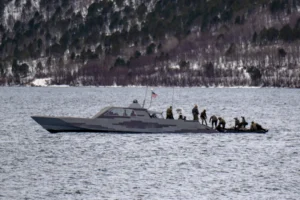
Because Russia is the primary threat in Europe. SOF’s value proposition, deterrence by denial and deterrence by cost imposition, is designed specifically by operational leaders for the challenge of Russian mass. The potential line of contact in Eastern Europe is larger and longer than during the Cold War. Concurrently, the limited depth of terrain, particularly in the Baltic Nations, is not optimal to absorb Russian mass. As such, SOF in Europe must be ready to operate in the Allied rear, across the full line of contact, and into the deep. Sequentially these are resilience, resistance, and deep strike.
True to their doctrine and history, Russia will, prior to any maneuver into Allied territory, conduct destabilizing activities. An irregular warfare campaign of their own to gain positional and decisional advantage. Russia seeks to set conditions during competition, and prior to crisis or conflict. Conditions intended to allow large scale follow-on operations by Russian mass to succeed. Open-source reporting is full of actions to include border intrusions, sabotage, cyber-attack, active measures, and intelligence activities already being conducted by Russia.
Countering this threat means SOF winning the counter-reconnaissance fight. This is done by deterring destabilizing activity through the building of a comprehensive Allied intelligence picture, by using predictive analysis to get ahead of Russian action, and by using targeted activities to disrupt ahead of execution. SOF seeks to insulate allied nations from and build their resilience to Russian destabilization. If done successfully the Alliance and U.S. joint force will be in a better position of advantage. SOF is now postured to sufficiently increase European national resilience to this hybrid-warfare threat.
If deterrence and resilience were to fail, SOF is also positioned to support national resistance, enabling countries to fight back. A good mental model with significant advancements would be Ukraine’s 2022 light lethal resistance which defeated Russia’s initial efforts to secure objectives quickly. Resistance is all available national assets creating a military dilemma where the costs significantly and sufficiently outweigh the gains. Concurrently SOF’s capability to strike deep against critical capabilities is ready to support the Joint and Allied Forces.
In conclusion Special Operations Forces’ value proposition in Europe is clear. Be in the right place, at the right time, with the right partner and capability to provide deterrence by denial through resilience and resistance and if necessary, deterrence by cost imposition through deep strike. Peace through strength.



I too am a fan of NATO SOF (though I suspect your assessment of their contributions to deterrence by denial and cost imposition are a bit overstated).
I am curious, how do you juxtapose your admiration for NATO SOF and disdain/concerns for US Special Forces in these recent pieces?
I completely agree that US SF is off azimuth and long overdue for a major re-set. We’ll have our differences of opinion on why the former, and how the latter. Always good to give some future OPT on the topic more to consider!
Keep up the fires!