





Information as the New High Ground: The Cognitive Fight in the Indo-Pacific
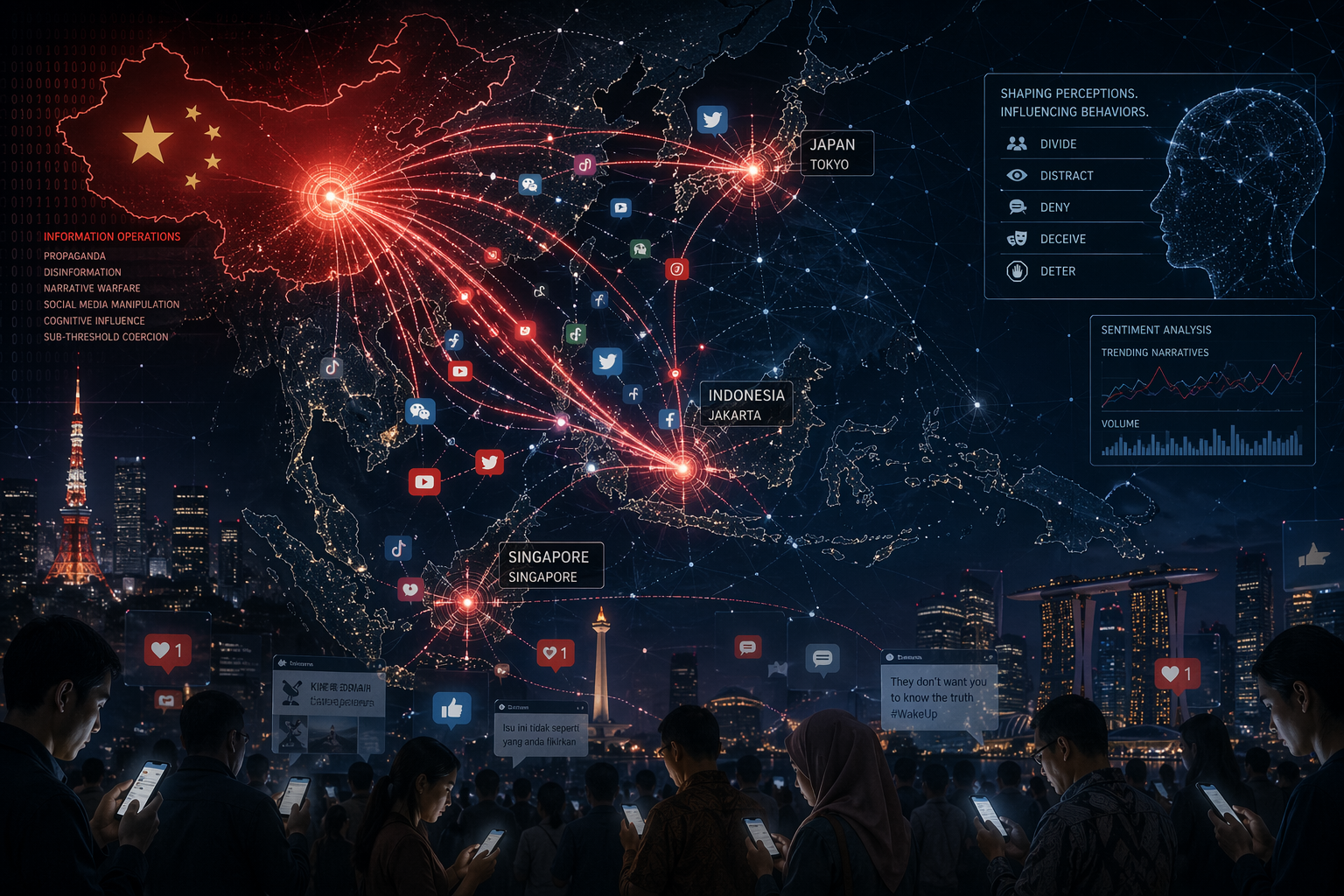

Conflict today is no longer solely defined by the control of the physical terrain with kinetic warfare. It is increasingly shaped by the influence of the cognitive terrain: the perceptions, the beliefs, and the expectations that guide how societies and leaders interpret events and respond to them. Achieving information dominance through social media is a foundational prerequisite for effective regional deterrence in the 21st century. Kinetic and non-kinetic power projection are both reliant on a favorable information landscape. Using the People’s Republic of China (PRC) as a primary model, we will demonstrate how information operations are the bedrock of a broader “all-domain dominance” strategy against threats to a free and open Indo-Pacific. Through case studies examining China’s information campaigns against Japan and Indonesia’s sub-threshold information efforts concerning Singapore, this paper will illustrate the tactics and objectives of state-led social media influence. Finally, it will propose a framework to implement a proactive, data-centric framework for the United States and its allies to counter these threats, build resilience, and leverage the information domain to strengthen deterrence in the Indo-Pacific and beyond.
Information as the New High Ground: The Cognitive Fight in the Indo-Pacific
The first shots of the next conflict will not be fired by artillery launchers, but delivered into the global consciousness through billions of screens. They will not come in the form of hypersonic missiles, but viral memes. They will not target ships or airfields, but the cognitive foundations of alliances, the trust between populations and their governments, and the very will of a nation to fight. This war is not theoretical; it is already underway.
From Russia’s systematic erosion of trust and information integrity in the Baltic States before its 2022 invasion of Ukraine, to China’s relentless narrative pressure on Taiwan’s frontline neighbors, and the subtle, sub-threshold competition shaping Southeast Asia, the modern battlefield is being defined and dominated before a physical blow is struck. In this new environment, the United States and its allies risk planning for a kinetic war they may never fight, because the decisive battle will have already been lost on the cognitive high ground.
To effectively deter conflict, the United States must move beyond simply analyzing adversary campaigns and proactively shape and control the information environment. By assessing how competitors of the United States are already advancing their efforts, this provides a data-centric framework seize the initiative, ensuring that deterrence holds and that if conflict comes, the United States and its allies are positioned to win.
Deterrence in the Information Age
Deterrence on the modern battlefield requires moving beyond the traditional calculus definition of denial by punishment and cost. The ability to understand, shape, and counter complex information campaigns is now the foundational prerequisite for effective regional deterrence. Achieving information advantage allows a state to mold an adversary’s perceptions, will, and decision-making long before conflict can begin, prompting them to question their ability to fight and win.
The Chinese Communist Party’s concept of Three Warfares—Public Opinion, Psychological, and Legal—exemplifies this paradigm. China’s pursuit of dominance across all domains is predicated on first achieving an information advantage. Unlike kinetic operations, where effects are immediately visible and measurable, information operations are subtle, dispersed, and deliberately hidden with the torrent of global digital content. Planners now face a staggering signal-to-noise ratio, where malicious, state-sponsored campaigns are embedded within digital chatter and global pop culture.
While we understand the destructive effects of a hypersonic missile, modern defense planners must ask: what is the cognitive “blast radius” of an effective meme, and how does it propagate? Without tools to distinguish malicious state-sponsored campaigns from benign “digital chaff” in real-time, defensive postures will be overwhelmed. The following case studies provide insight into how social media is leveraged to isolate, intimidate, and divide regional allies, starting with the playbook Russia employed in Europe.
In Hindsight: Lithuania and Russia
To better understand potential activities China might utilize within the First island Chain, it is useful to first examine the playbook Russia used before eventual conflict in Ukraine. Within the context of the emerging CRINK (China-Russia-Iran-North Korea) alliance, China has been increasingly adopting Russian-inspired information operations to shape the environment ahead of a potential Taiwan contingency with a possibility of direct coordination in messaging. Russian social media efforts were not contained to Ukraine but carried out within the eastern flank of NATO. Russia conducted persistent narrative operations in Lithuania designed to erode public trust, amplify societal divisions, and seed doubt about NATO’s credibility. These pre-conflict campaigns were a deliberate effort to isolate, intimidate, and divide a key regional ally to set favorable conditions for war. This Baltic case study offers a clear model to understand the information warfare being waged in the Indo-Pacific today through three primary lines of effort:
- Weaponizing History to Isolate: Russia systematically distorted Lithuania’s national history and identity to delegitimize its sovereign existence. By spreading narratives accusing Lithuania of historical revisionism, Nazism, and Russophobia, Moscow sought to isolate the country as an unreliable ally, aiming to weaken regional cohesion on NATO’s eastern.
- Amplifying Societal Divisions: Russia exploited social fractures to sow internal dissent, using a “Firehose of Falsehood” model to amplify divisive narratives, such as blaming resident NATO forces for spreading COVID-19. By recycling identical narratives across proxy websites and social media, this tactic aimed to divide the public against its government and manufacture internal paralysis to distract and weaken Lithuania’s national resolve ahead of the main effort in Ukraine.
- Undermining Alliances to Intimidate: Moscow relentlessly spread recurring narrative themes challenging NATO’s credibility and willingness to defend Lithuania. Russian narratives were engineered to intimidate the Lithuanian populace into passivity by suggesting they would be abandoned by NATO in crisis while simultaneously framing defensive exercises in the Baltics as provocations. By attacking the credibility of the collective security guarantee, Russia’s goal was to paralyze a potential NATO response to its planned actions in Ukraine.
China Narrative Warfare Against Japan
In the Indo-Pacific, the Chinese Communist Party is executing a sophisticated, multi-front information campaign against Japan that mirrors components of Russia’s playbook used in the lead-up to its 2022 invasion. Beijing’s overarching goals are to weaken Japanese public resolve, complicate Tokyo’s diplomatic posture, and raise the political and economic costs of opposing China’s ambitions, particularly regarding Taiwan. By weaponizing history, undermining leadership, and fracturing alliances, the People’s Republic of China are signaling to Tokyo and its allies the consequences of resisting the “One China” narrative. Simultaneously, they are shaping the cognitive battlefield to ensure that domestic and international constraints align with their operational objectives long before a conflict begins.
- Delegitimizing Japan’s Strategic Posture through Historical and Territorial
Narratives: Beijing routinely weaponizes history and disputes present-day sovereignty to undermine Japan’s strategic credibility. It amplifies narratives around World War II atrocities to delegitimize Japan’s defensive modernization and strategic repositioning of forces. This messaging, often embedded in viral social media posts, surges during bilateral flashpoints. For example, following the Japanese government’s purchase of the Senkaku Islands (known as the Diaoyu Islands in China) from a private Japanese landowner, there were surges in Weibo discussion timed with real-world escalatory moments. These posts generate significantly higher engagement rates than routine foreign policy topics, suggesting not spontaneous public anger, but a deliberate amplification aligned with diplomatic pressure. This tactic has increased in recent years, aiming to pressure Japanese policymakers domestically and erode international confidence in Tokyo’s territorial claims.
- Undermining Japanese Leadership and National Will: Analysis of social media posts by Chinese officialsshows systematic criticism of leaders and policies that support Japan’s right to collective self-defense and expanded security cooperation with the United States. These official narratives are often paired with surges of virulent, state-condoned anti-Japanese sentiment This dual approach—official criticism combined with grassroots vitriol—is designed to intimidate policymakers and erode the national will to resist Chinese pressure.
- Fracturing Alliances and Regional Cohesion: Just as Russia sought to weaken NATO, China uses a “soft-wedging” approach to exaggerate tensions between Japan and its most critical regional partner, South Korea. Beijing selectively amplifies re-existing bilateral tensions to discourage deeper Japan-South Korea-United States trilateral alignment. During periods of heightened security cooperation, Chinese-affiliated media reliably reference unresolved historical disputes between Tokyo and Seoul, such as wartime labor or Yasukine Shrine symbolism, discouraging ongoing trilateral agreements to ensure regional powers are divided and less capable of a coherent response.
- Coercing through Economic Pressure: China leverages economic dependencies to reinforce its narrative campaigns. During political tension, state-controlled social media calls for consumer boycotts and informal trade restrictions to amplify the economic consequences of defying Beijing. These campaigns have tangible effects. For example, Japanese automobile sales in China experienced sharp declines of up to 40 percent following online calls for boycotts. This economic coercion serves as a powerful, real-world consequence that reinforces China’s narrative that resistance is futile—and costly.
Sub-Threshold Competition: Indonesia and Singapore
The information threat is not limited to overt coercion by major powers. Even between close neighbors, subtle, sub-threshold competition creates a vulnerable information ecosystem that China can exploit. The relationship between Indonesia and Singapore illustrates how persistent, low-level information operations can be manipulated to threaten a free and open Indo-Pacific.
- Sowing Internal Division by Exploiting Social Fault Lines: Just as Russia targets societal fractures, online actors in Southeast Asia amplify ethnic, religious, and regional divisions to shape public sentiment and created domestic pressure. Studies of Indonesian online activity document the organized use of “cyber troops” to push identity-based narratives during politically sensitive periods. This tactic weakens national cohesion from within, making a country more susceptible to both internal instability and external influence.
- Generating Bilateral Friction for Political Leverage: Economic and nationalist narratives are weaponized to create friction and external leverage. Tensions between Indonesia and Singapore reliably intensify around resource disputes like transboundary haze, maritime boundaries, and labor flow, with media content analysis showing spikes in nationalist framing and blame attribution. Similarly, narratives around sovereignty and national dignity are regularly activated during periods of tension, functioning as low-cost signaling efforts to influence policy debates and public perception.
- Weaponizing Culture to Erode Social Cohesion: Even seemingly minor cultural disputes are leveraged to create social friction. Controversies over the origins of traditional dances, batik, or culinary heritage can trigger widespread social media outrage, which is then rapidly amplified by coordinated nationalist networks. These campaigns, while not state-directed in the same way as those from Russia or China, demonstrate how easily cultural pride can be manipulated to generate grassroots animosity, damaging people-to-people ties and weakening regional stability.
Individually, all this content may appear minor, but collectively, it creates measurable shifts in perception, decision-making, and readiness. Much like dispersed kinetic effects on a contested battlefield, these efforts precondition regional populations, creating fertile ground for coercive campaigns by major powers.
Countering and Competing: A Data-Centric Framework for U.S. Information Deterrence
The preceding examples reveal a clear and repeatable playbook for modern information warfare—one that shapes the battlefield long before conflict begins. To counter this, however, requires more than strategic intent; the United States and its allies cannot remain reactive and must instead seize the initiative. Doing so requires moving from simple observation to proactive engagement, a shift made possible by adopting a structured analytical model like the SAGES framework to understand, anticipate, and act on emerging narratives in the information environment before they manifest into real-world actions.
Maintaining a free and open Indo-Pacific demands that the United States and its allies move beyond a reactive posture to one of proactive information dominance. By leveraging data strategically, the United States can shift from simply analyzing adversary campaigns to anticipating, shaping, and ultimately controlling the information environment, preserving regional stability and deterring malign influence before it manifests.
To achieve this, the first step is developing comprehensive awareness of the information environment. This begins with analysis with the SAGES framework which models how narratives are introduced through five distinct stages:
- Seeding: The initial introduction of adversarial information into the information ecosystem.
- Amplification: The increase in a narrative’s visibility and engagement, often through coordinated methods like bot networks.
- Galvanization: The point at which digital discourse inspires an emotional or identity-based response, priming audiences for real-world mobilization.
- Expansion: The moment the narrative breaks out and manifests into concrete real-world actions, such as protests or policy changes.
- Stickiness: The final stage where the narrative becomes entrenched in a society’s culture and beliefs, persisting long after the initial campaign ends.
Applying this framework, the United States and its allies can move from a reactive to a proactive posture through three coordinated lines of effort:
- Create Anticipatory Awareness. The first step is to achieve a shared, comprehensive understanding of the information environment. Using AI-enabled analytics to identify key nodes of influence, detect botnet structures, and track narratives as they move through the stages of SAGES, the United States and regional partners—such as Japan,Australia, South Korea, the Philippines, and Singapore—can develop a common operating picture. This allows them to identify early seeding activity, detect abnormal amplification patterns, and predict signals of imminent galvanization long before narratives go viral or manifest into real-world effects.
- Proactively Shape the Battlespace. With shared awareness, the alliance can shift from countering adversary narratives to actively shaping the information environment—the digital equivalent of Suppression of Enemy Air Defenses (SEAD), preparing the battlespace before the campaign begins. By forecasting which narratives will persist, decision-makers can pre-emptively flood the environment with factual, countervailing content. This proactive messaging reinforces the vision of a free and open Indo-Pacific, inoculating populations against disinformation and creating a more resilient regional information ecosystem.
- Expose and Impose Costs. Finally, the alliance must systematically expose and impose costs on malicious actors. Shared intelligence and data reveal adversary networks and tactics, disrupting their operations and creating reputational consequences. These efforts must then be paired with broader instruments of statecraft, such as coordinated sanctions against the individuals and entities behind these campaigns, ensuring those manipulate the information environment face unacceptable.
Conclusion
The era of deterrence defined by a physical show of force alone is obsolete—a dial-up modem strategy in an age of hypersonic information. As China and Russia operationalize playbooks designed to exploit these cognitive vulnerabilities, the United States must adopt a data-centric framework for deterrence, like the SAGES framework. This framework is vital for countering hostile information efforts and reinforcing the pillars of an effective contemporary deterrence. The security of the United States and its allies no longer rests solely on the number of missiles in its arsenal or ships in its fleet. Those are merely the final, brutal arbiters of a conflict, an indicator that deterrence has already failed. The decisive battle is being waged now in the cognitive domain, where the will to fight can be defeated long before the first shot is ever fired.
This is the modern embodiment of Secretary Pete Hegseth’s warning, if adversaries choose to test these limits, they will find out what happens. True deterrence is achieved when the story of U.S. strength, the reach of its alliances, and the certainty of its response becomes an inescapable truth in the minds of our enemies. It is about total information dominance—proactively shaping the battlespace of perception so thoroughly that the very idea of challenging the United States and its partners becomes strategically unthinkable.
Ceding this cognitive high ground is not an option; it is a preemptive act of surrender and forfeiture of unfettered access to the global commons. To secure a lasting peace, the United States and its allies and partners must not simply prepare for the next war but win it now by seizing control of the information environment with such unwavering resolve that the fight is over before it can even be imagined.


