The National Defense Strategy Demands Strong Allies
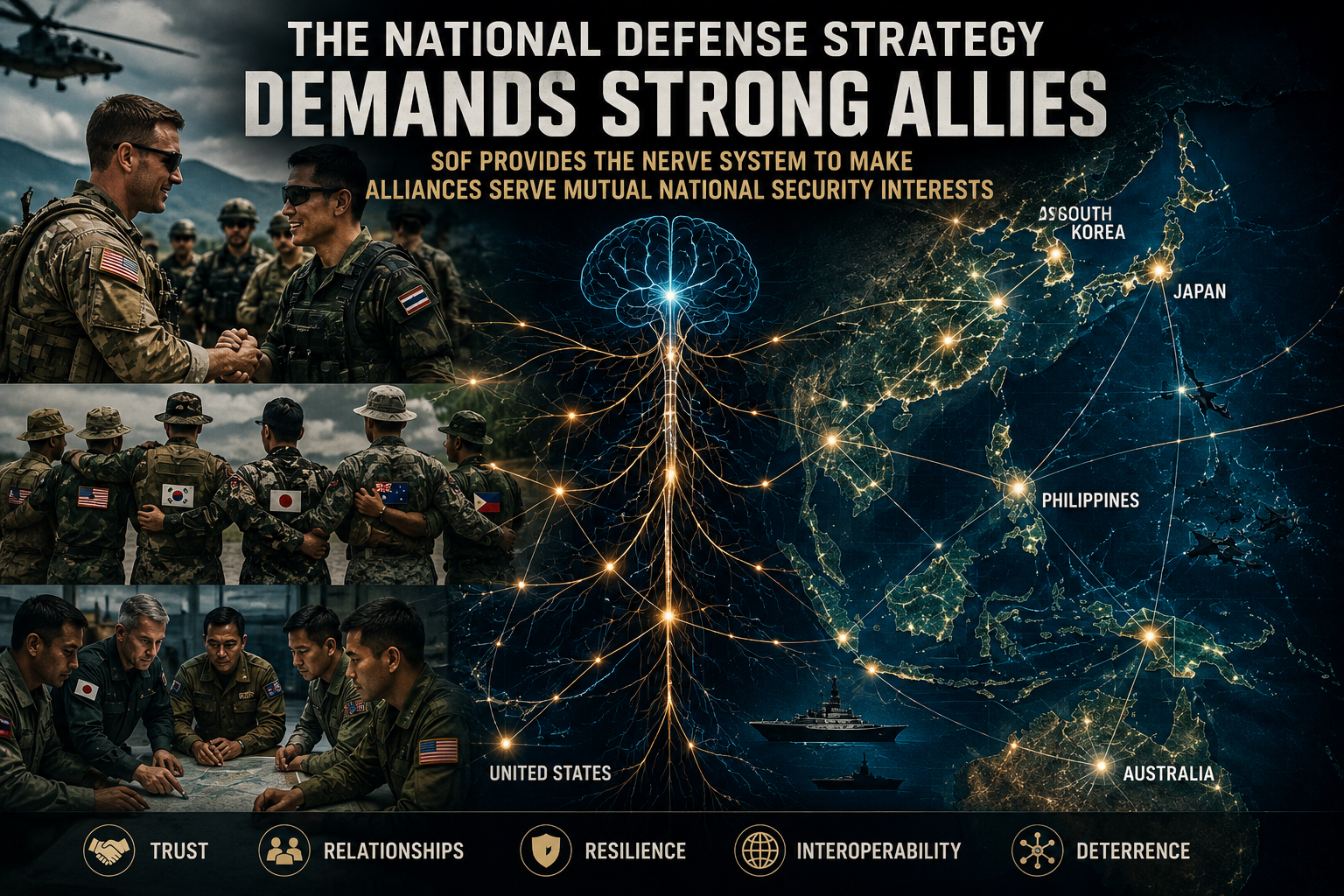

SOF Provides the Nerve System to Make Alliances Serve Mutual National Security Interests
The new U.S. National Defense Strategy recognizes an uncomfortable truth. The United States cannot secure its interests alone. The era of uncontested American primacy is over. China, Russia, Iran, and north Korea (CRInK) challenge the international order simultaneously and across every domain: military, economic, cyber, informational, political, and psychological. They seek to fracture alliances because they understand a simple strategic fact. America’s alliances are its center of gravity.
The CRInk is coordinating, collaborating, and colluding for four reasons: fear, weakness, desperation, and envy. They fear the silk web of alliances the free world has constructed. They are weak due to the inherent contradictions within their brittle political systems that leave them vulnerable to resistance. They are desperate for external support, militarily, diplomatically, and economically. Lastly, they envy the unmatched strength and power of alliances. This alone validates the value the free world places in alliances.
America’s alliances are its center of gravity.
The United States possesses unmatched military power, but power without trusted allies cannot be effectively employed. Alliances provide legitimacy, access, basing, intelligence, logistics, industrial capacity, and political support. They create strategic depth. Most importantly, they complicate adversary calculations by presenting a unified coalition rather than isolated states vulnerable to coercion.
Yet alliances do not sustain themselves through communiqués, summit declarations, or formal treaties alone. Alliances are human enterprises. They endure because of relationships built over decades between soldiers, diplomats, intelligence officers, aid workers, policymakers, and political leaders. This is where U.S. Special Operations Forces (SOF) provide a unique and often underappreciated strategic advantage. SOF functions as a metaphorical nervous system of American alliances. It creates connective tissue between nations and keeps alliances operationally alive long after political rhetoric fades.
Alliances Are Operational, Not Ceremonial
Too often, alliance discussions occur at the abstract strategic level. Policymakers speak about burden sharing, interoperability, and deterrence architecture. Those concepts matter, but alliances become meaningful only when military organizations trust one another enough to fight together under stress and uncertainty.
Trust cannot be surged during crisis. It must be cultivated long before conflict begins.
This is why the National Defense Strategy’s emphasis on deterrence and peace through strength depends heavily on enduring allied relationships. The emphasis on strengthening allies to be responsible for self-defense is not meant to lessen the U.S. commitment but instead to improve their military capabilities and capacities to strengthen the entire alliance structure. Integration requires more than compatible weapons systems. It requires shared understanding, habitual cooperation, and confidence developed through repeated interaction. Nations do not place their security in the hands of strangers.
Trust cannot be surged during crisis. It must be cultivated long before conflict begins.
Special Operations Forces excel precisely because they operate persistently and relationally. Conventional forces often rotate through short duration but very important exercises or episodic deployments. SOF, by contrast, develops long-term human networks. Green Berets, SEALs, Air Commandos, Marine Raiders, and special operations enablers routinely work with foreign counterparts over years and decades. Many officers and NCOs return repeatedly to the same countries and regions throughout their careers. They become trusted professionals rather than temporary visitors.
This matters strategically because adversaries pursue long-term political warfare campaigns designed to weaken allied cohesion. China uses economic coercion, legal warfare, media manipulation, and elite capture to separate allies from Washington. Russia exploits energy dependence, corruption, and disinformation. Iran and north Korea leverage proxies, illicit networks, cyber operations, and strategic intimidation. Their objective is not always battlefield victory. It is political fragmentation.
SOF counters this through consistent campaigning and generational relationships.
SOF as Strategic Human Infrastructure
Special Operations Forces provide more than tactical capability. They create strategic human infrastructure.
The relationships built through foreign internal defense, unconventional warfare preparation, security force assistance, counterterrorism cooperation, intelligence sharing, and combined training generate reservoirs of trust that national leaders can draw upon during crisis. When conflict looms, established SOF relationships, again, generational relationships, often become the first operational channels activated between allies.
SOF functions as a metaphorical nervous system of American alliances.
These relationships are especially important in the Asia-Indo-Pacific region, where geography, history, and political sensitivities complicate alliance management. In Korea, Japan, the Philippines, Thailand, Australia, and increasingly with Taiwan partners, SOF relationships help create operational familiarity beneath the political level. This reduces friction during crisis and enhances coalition responsiveness.
The strategic value of these relationships becomes most visible when governments change. Political administrations come and go. Public sentiment fluctuates. Yet military-to-military and SOF-to-SOF relationships often endure across generations. A retired Korean, Philippine, Thai, or Japanese, or Australian special operations commander may still maintain close personal ties with American SOF counterparts decades after serving together. Those relationships become informal diplomatic channels during periods of uncertainty.
Retired SOF personnel, as do many retired military personnel from all branches, therefore remain part of the alliance ecosystem long after leaving active service.
This is an overlooked strategic advantage. Retired SOF and other military professionals continue to engage allies through advisory roles, think tanks, academic institutions, veterans’ organizations, and informal professional networks. They preserve continuity across administrations and maintain institutional memory that civilian political systems frequently lose. In many allied countries, retired officers carry substantial influence within national security circles. Their relationships with former American counterparts often sustain confidence in the alliance during moments of political tension.
The alliance is therefore not merely a treaty structure. It is a living network of human relationships accumulated over generations.
SOF and the Credibility of Deterrence
Deterrence depends on credibility. Credibility depends on confidence. Confidence depends on relationships.
Adversaries study alliance cohesion carefully. They search for political fractures, weak commitments, and signs of strategic hesitation. If allies doubt America’s reliability, deterrence weakens. If allies trust American commitment, deterrence strengthens because adversaries must assume coalition unity in crisis.
SOF contributes directly to this credibility because persistent campaigning demonstrates commitment in tangible ways. A rotational bomber deployment may signal resolve temporarily. A multi-decade SOF partnership signals enduring commitment at the human level.
The future fight may ultimately depend less on who possesses the most advanced weapons and more on whose alliances remain strongest when tested by crisis and war.
This is particularly important in gray zone (or the better description from the Philippines: Illegal, Coercive, Aggressive, and Deceptive activities (ICAD)) competition below the threshold of war. China’s unrestricted warfare approach seeks to isolate targets politically before military conflict occurs. Beijing understands that alliances are vulnerable to erosion from within. Therefore, America requires institutions and forces capable of sustaining alliance confidence continuously, not episodically.
SOF fills this role because it operates in the political-military space where trust, legitimacy, and influence matter as much as firepower.
George Kennan understood this principle in his 1948 memorandum on the inauguration political warfare. He argued that the United States needed organized political warfare capabilities to compete short of war. Today’s SOF community, in support of political warfare, performs much of that function through sustained engagement with allies and partners. It reassures friends, counters adversary narratives, strengthens local resilience, and creates human networks resistant to coercion.
Paradoxically, the CRInK has adopted and adapted Kennan’s political warfare and is aggressively conducting it while many policy makers and political leaders are afraid to do so.
The Strategic Question
The National Defense Strategy assumes strong alliances will remain available in future crises. That assumption deserves scrutiny.
Alliances weaken when neglected. They weaken when reduced to transactional burden-sharing debates detached from shared interests and values. They weaken when operational relationships atrophy. They weaken when America appears strategically distracted or politically divided.
The deeper question is not whether the United States needs allies. It clearly does. The deeper question is whether America is investing sufficiently in the human architecture that keeps alliances functional under stress.
Weapons systems can be purchased quickly. Trust cannot.
SOF provides a unique strategic capability to support the 2026 National Defense Strategy (NDS) as well as the National Security Strategy because it develops trust systematically over decades through shared hardship, professional respect, and sustained engagement. It connects allied militaries at the operational and human levels where real coalition effectiveness is built.
Conclusion
The NDS correctly recognizes that America’s competitive advantage lies not only in military power, but in alliances and partnerships unmatched by any adversary coalition. Yet alliances are not self-executing documents. They are living systems sustained by trust, familiarity, and enduring human and generational relationships.
Special Operations Forces provide the nervous system that keeps those alliances alive and operational. Through generational engagement by both active-duty and retired personnel, SOF creates the connective tissue linking allied nations together in pursuit of mutual national security interests.
America’s adversaries understand the importance of alliances and seek relentlessly to fracture them. The United States should therefore recognize SOF not merely as a tactical force optimized for raids or counterterrorism operations, but as a strategic alliance force essential to long-term competition.
The future fight may ultimately depend less on who possesses the most advanced weapons and more on whose alliances remain strongest when tested by crisis and war.