





Africa After the 2025 National Security Strategy: Burden Sharing, Extremism, and New Sovereignty Politics
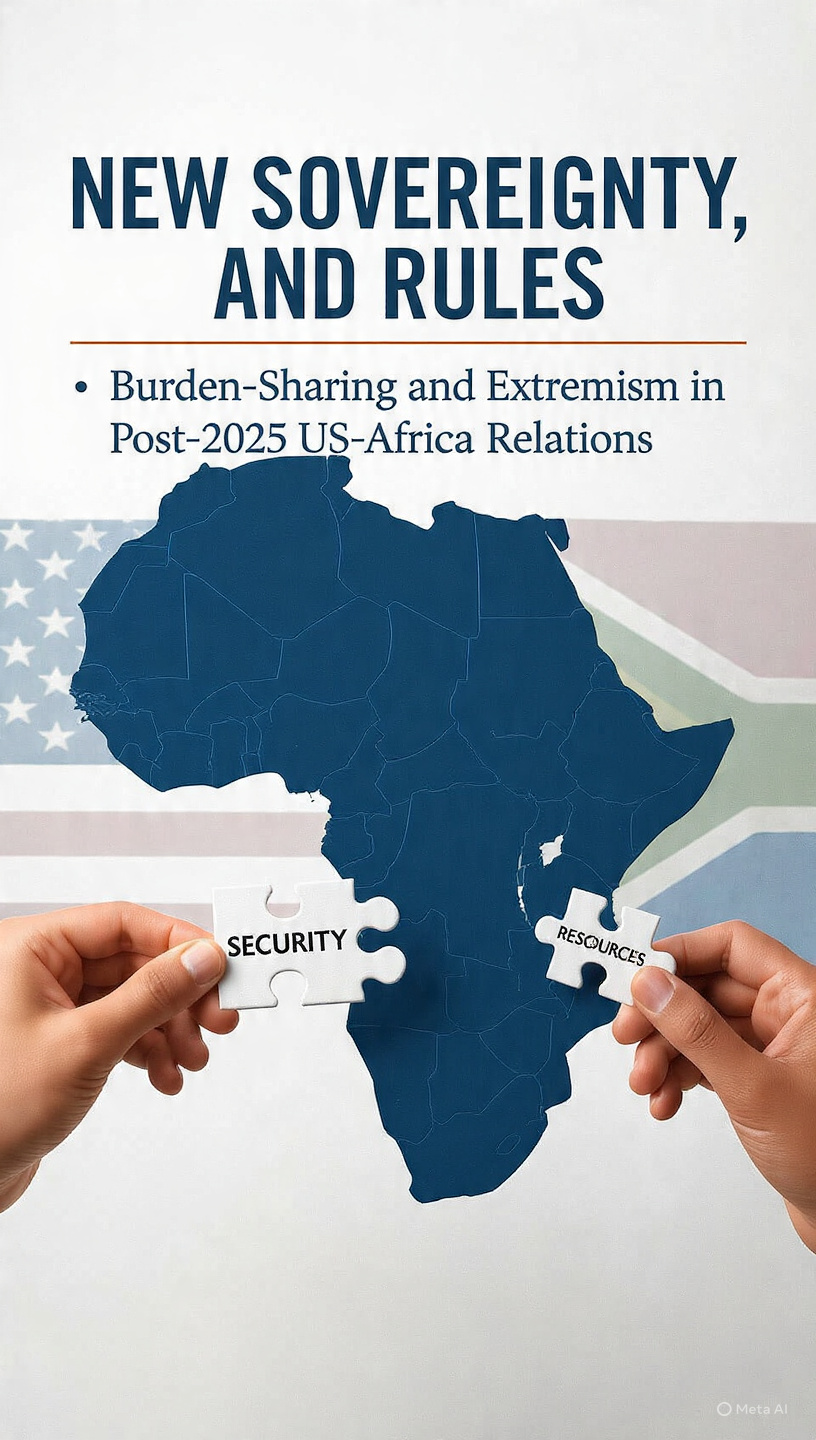

Introduction
The National Security Strategy (NSS) marks a decisive shift in Washington’s view of the world and Africa. The document’s “America First” orientation is not a rhetorical flourish; it signals a structural repositioning. Africa is no longer framed as a region requiring broad governance support or long‑term stabilization. Instead, it is treated as a secondary theater where U.S. engagement occurs only when American interests, security containment, critical minerals, migration management, or great‑power competition are directly implicated.
For African policymakers, this is a strategic inflection point. Extremism is now framed narrowly as a counterterrorism challenge tied to homeland defense. Governance deficits, economic fragility, social grievances, and the drivers of extremism are pushed to the periphery. The result is clear: Africa must assume greater responsibility for its own security, negotiate harder for fair resource partnerships, and manage displacement pressures with limited external support. The continent’s sovereignty politics are being fundamentally reshaped. To understand how this shift impacts lands on the continent, the first pressure point is security, specifically the growing pressure on African regional institutions to assume operational, financial, and political responsibility for security provision as external engagement narrows. This expectation emerges precisely as African states face their most acute capacity constraints, widening the gap between required autonomy and available capability.
Burden‑Sharing and the Rise of Security Autonomy
The NSS is explicit: the U.S. will no longer carry the weight of global security. Burden‑sharing is not a request, but a requirement. For Africa, this means that regional organizations such as the African Union (AU), Economic Community of West African States (ECOWAS), the Southern African Development Community (SADC), and the Inter-governmental Authority on Development (IGAD) must shift from coordination bodies to primary security actors.
This shift is occurring as extremism intensifies across the Sahel, the Horn of Africa, the Lake Chad Basin, the DRC, and northern Mozambique. Yet U.S. engagement will be episodic, conditional, and narrowly focused on preventing spillovers that could affect American interests. If extremism becomes endemic under these conditions, African states will face escalating security burdens, deeper fiscal strain, and heightened political instability as they are compelled to confront expanding militant threats with limited and inconsistent external support.
Africa must build its own security backbone, funded, coordinated, and resilient. That means strengthening the African Peace and Security Architecture (APSA) of the African Union, developing sustainable financing for counterterrorism missions, and negotiating partnerships that preserve African agency. Together, these initiatives enhance the capacity of African states to contain extremist networks, protect territorial integrity, and sustain the levels of governance and societal development necessary for long‑term stability. A second pressure point lies in the economic domain, where resource politics and extremism intersect.
Resource Access, Extremism, and Economic Sovereignty
Economic security is central to the 2025 NSS, and Africa’s mineral wealth, cobalt, lithium, and rare earths, features prominently. But the framing is transactional: Africa’s resources matter primarily as inputs into U.S. reindustrialization and supply‑chain resilience.
This intersects directly with extremism. Many of Africa’s resource‑rich regions, the Sahel, Great Lakes, the DRC, and northern Mozambique, are also conflict zones where militant groups exploit weak governance and illicit trade.
Africa cannot afford to treat resource governance and extremism as separate issues. It must operationalize the African Mining Vision, integrate conflict‑sensitive approaches into extractive industry management, and leverage mineral wealth to negotiate fairer trade and industrialization partnerships. Minerals are not just commodities; they are political leverage. Used well, they strengthen sovereignty. Used poorly, they deepen fragility. A third pressure point appears in the NSS framing of migration, which carries its own strategic consequences. Strategic autonomy in this domain strengthens Africa’s bargaining position rather than replacing the need for external partnerships.
Migration, Securitization, and Governance Stability
The NSS frames mass migration as a direct threat to U.S. national security and sovereignty. This has profound implications for Africa, where conflict, extremism, and climate shocks drive displacement across the Sahel, Horn, and Great Lakes.
Under the new U.S. posture, external resettlement options will shrink, African states will face growing pressure to contain displacement internally, and humanitarian space may narrow as migration becomes increasingly securitized. Extremist violence is a major driver of displacement in Somalia, DRC, northern Mozambique, Nigeria, and the Sahel. Yet the NSS focuses on containment rather than root causes, reflecting a broader shift toward expecting regional actors to manage evolving security challenges with increasingly limited external support. This dynamic risks incentivizing securitized responses that can erode the governance legitimacy required for long‑term stability.
African policymakers must therefore strengthen African‑led humanitarian frameworks, including the African Union Migration Policy Framework for Africa and Plan of Action (2018 – 2030), and protect democratic norms to prevent instability that fuels radicalization. Migration management cannot be divorced from governance legitimacy. Taken together, these three pressure points reveal a more selective and transactional American posture toward Africa.
Strategic Implications: A More Selective America
The 2025 NSS signals a future in which U.S. engagement with Africa will be:
- Selective — driven by minerals, migration, and security containment
- Episodic — activated only when American interests are at stake
- Transactional — based on burden‑sharing and cost‑effectiveness
- Conditional — tied to alignment with U.S. priorities
This is not a retreat; it is a recalibration. It represents a withdrawal from expansive stabilization roles, even as targeted strategic engagement continues. But it means Africa must prepare for a world in which external support is neither guaranteed nor comprehensive. To navigate this landscape, Africa should coordinate regionally, embed governance legitimacy into security and economic strategies, and build resilience against shocks that extremist groups can exploit. The era of dependency is over. The era of strategic autonomy has begun. Yet this transition unfolds at a moment when African institutions face significant capacity constraints, making proactive planning even more essential. Planning for this future requires anticipating how extremism and U.S. engagement may evolve in tandem.
A Scenario Matrix for Extremism and U.S. Engagement
To plan effectively, African policymakers must anticipate how extremism and U.S. engagement may evolve. These two variables, extremism intensity and external support, will shape the continent’s security environment through the 21st century. Although some scenarios are increasingly improbable under the NSS, they remain analytically useful for stress‑testing African planning assumptions.
A scenario matrix helps policymakers move from reactive crisis management to proactive strategy. Four plausible futures emerge:
1. High Extremism + High U.S. Engagement
Support is available, but risks dependency and external agenda‑setting. However, the 2025 NSS makes sustained, high‑intensity engagement increasingly improbable, as its emphasis on selective involvement and burden‑shifting limits the likelihood of a return to expansive U.S. security commitments.
2. High Extremism + Low U.S. Engagement
Africa faces overstretch, requiring rapid regional coordination and innovation in security financing. This will demand not only new financing models but also a coherent strategy and strengthened operational capabilities, the core challenges of implementing a multi‑state security architecture across such a vast and diverse region.
3. Low Extremism + High U.S. Engagement
Opportunity for long-term capacity-building if the African agency is protected. However, the 2025 NSS’s emphasis on selective engagement and burden-shifting makes sustained, high-intensity involvement increasingly unlikely, limiting the practical feasibility of this scenario.
4. Low Extremism + Low U.S. Engagement
Maximum sovereignty but maximum responsibility; governance legitimacy becomes decisive. Even with reduced extremist activity, the responsibility for maintaining stability lies entirely with African institutions.
Scenario planning allows African leaders to stress‑test institutions, identify resilience gaps, and design flexible strategies that can withstand shocks. Ultimately, Africa’s response must shift from reactive adaptation to proactive strategy.
Toward a Proactive African Strategy
Africa must transition from being a reactive participant in global strategy to a proactive architect of its own future in security and governance. This requires:
- Adaptive, scenario‑based planning
- Continental solidarity through the AU and regional economic communities
- Conflict‑sensitive resource governance
- Humanitarian frameworks that resist securitization pressures
- Embedding legitimacy into all security and economic strategies
The 2025 NSS is not a threat; it is a signal. It tells Africa that the global environment is shifting toward selective engagement and transactional partnerships. The question is whether Africa will adapt by strengthening autonomy or remain vulnerable to external priorities. The answer will define the continent’s security trajectory for the next decade.



A solid assessment of the new guidance. As the US Joint SOF Ministry of Defense Advisor to Tunisia for the past 18 months, it has been interesting to watch this transition develop. While I think the new guidance is largely sound, and much of it long overdue, what strikes me most is how tied our Africa-focused defense professionals are to the past. How we have long thought of threats. How we have long thought of our various lines of effort. How we have long thought of relationships with regional partners, and with our NATO allies who hold far greater interests in Africa than does the US.
To my peers working this challenging mission in this era of tremendous change (technology, relationships, policy, etc.,) I offer a few pieces of advice to consider:
Rethink. Reframe. Listen. Focus on understanding political grievance. See the opportunity in the new strategic guidance.