A Memorandum Is Not a Strategy: What the Iran MoU Must Contain to Be More Than a Deferral

Abstract
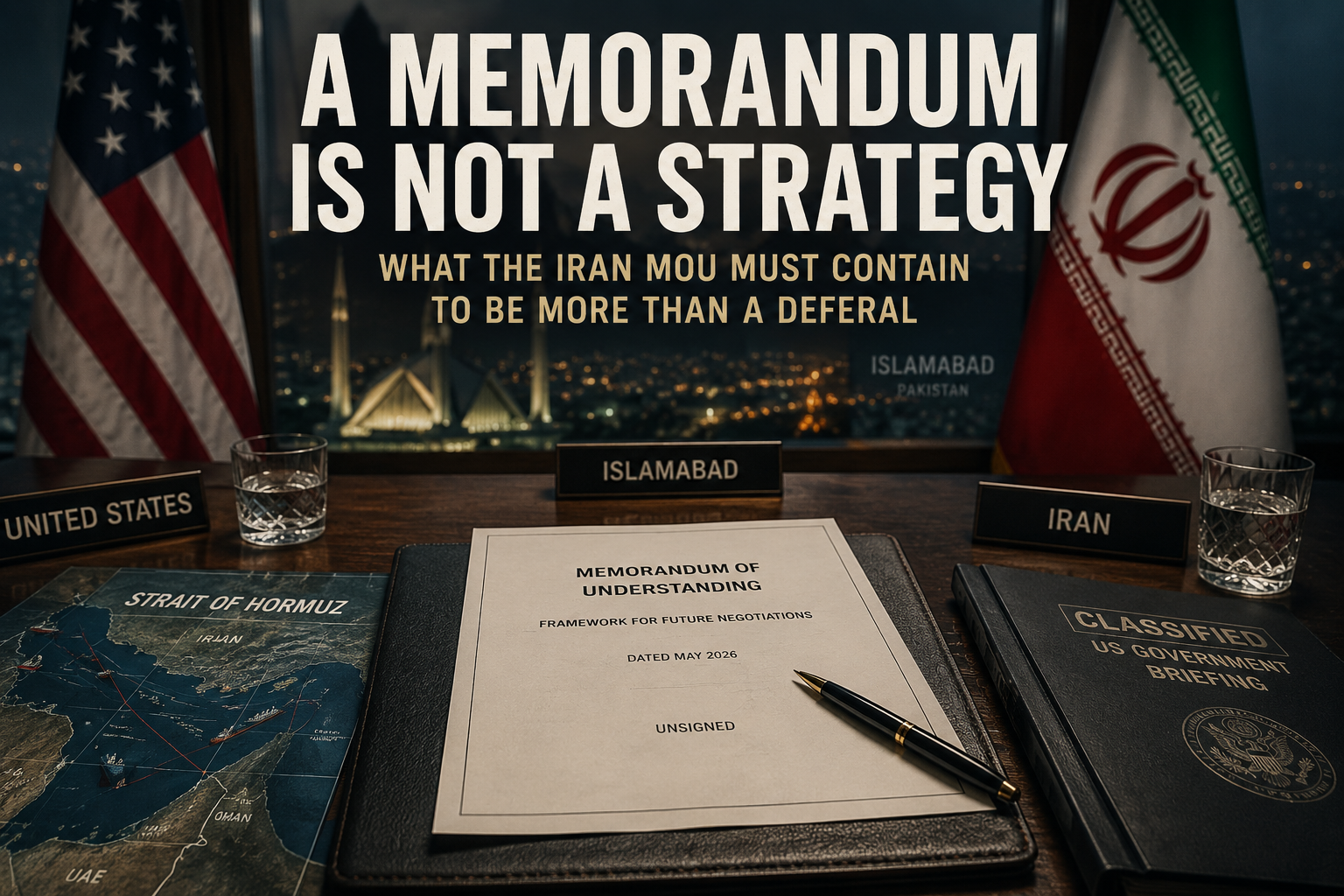
The administration’s pivot to a one-page memorandum of understanding (MoU) with Iran represents meaningful de-escalation, but it also risks codifying the same strategic deficit that bipartisan members of Congress pressed Defense Secretary Pete Hegseth and Joint Chiefs Chairman General Dan Caine to address in May 12 testimony. This article argues that an MoU framework, in the absence of a coherent theory of victory and a functioning interagency process, is not a settlement but a deferral, and it identifies five specific elements any final document must contain to constitute strategic resolution rather than strategic suspension.
Introduction: The Question Congress Just Asked the Pentagon
On May 12, 2026, Defense Secretary Pete Hegseth and General Dan Caine, Chairman of the Joint Chiefs of Staff, testified before back-to-back House and Senate appropriations subcommittees on the proposed 2027 defense budget and the Iran war. The questions were unusually unified. Representative Rosa DeLauro, ranking Democrat on the House Appropriations Committee, told Hegseth that the administration “has not presented Congress with any kind of clear or coherent strategy week to week, day to day, hour to hour. The rationale shifts, the objectives change. The end game is ill-defined when it is defined at all.” Senator Susan Collins, Republican of Maine, pressed General Caine on whether the Pentagon had anticipated Iran’s ability to close the Strait of Hormuz. The Pentagon comptroller confirmed that the cost of Operation Epic Fury had climbed from $25 billion to approximately $29 billion. The day before, the President himself described the ceasefire as on “massive life support.”
This is the moment to ask a question that has been deferred for 10 weeks: what does the United States actually want from this conflict, and will the document now being drafted in Islamabad produce that outcome, or merely defer the question again?
A theory of victory specifies not only what we will do if Iran moves toward a weapon, but how the document now being drafted will prevent that movement in the first place.
I write this not as an outside critic, but as someone who has sat in the rooms where these decisions are shaped. As I argued in this journal in April, the United States entered this conflict without a coherent theory of victory. The bipartisan questioning at today’s hearings indicates that Congress has reached a similar conclusion. The administration now has a finite window to demonstrate otherwise, and the document being drafted in Islamabad is the place that demonstration will either occur or fail to occur.
What Changed Between March and May
The shift in the administration’s posture over the past 60 days is one of the most significant strategic pivots of the past decade. In late March, US negotiators delivered to Tehran a 15-point proposal demanding the dismantlement of nuclear facilities at Natanz, Isfahan, and Fordow, the surrender of all highly enriched uranium to the International Atomic Energy Agency (IAEA), and the permanent prohibition of nuclear weapons development. The proposal reflected the four campaign objectives Secretary Rubio himself had outlined at the war’s outset: destroying Iran’s ballistic missile capabilities, dismantling its navy, severing support for armed proxies, and ensuring Iran never obtained a nuclear weapon.
By May 5, those objectives had been quietly reframed. Operation Epic Fury, Rubio told reporters, had destroyed the “conventional shield” behind which Iran concealed its nuclear program. What Washington now sought was a memorandum of understanding “for future negotiations” that touched on “all the key topics that have to be addressed.” Nuclear material, he conceded, “has to be addressed” and is “being addressed in the negotiation.” He declined to elaborate.
The work that should have preceded the first strike must now be done, with the same rigor and the same urgency, before the last signature.
Secretary Hegseth’s May 12 testimony framed the same strategic question in a different register. “The theory of the entire case,” he told the Senate appropriations subcommittee, “is to prevent Iran from having a nuclear weapon, and if that has to be done kinetically and militarily, the Department of War is locked and loaded and ready to do that.” That is a coherent statement of an instrument. It is not a coherent statement of a theory of victory. A theory of victory specifies not only what we will do if Iran moves toward a weapon, but how the document now being drafted will prevent that movement in the first place, what we will exchange to secure that prevention, and what verification will tell us the prevention has held. None of those questions was answered in two days of testimony.
Andreas Krieg of King’s College London characterized the shift with precision: “Washington has accepted that the simultaneous resolution of the war, Hormuz, and the nuclear file in one final package is not currently feasible. Diplomatically, this is a concession to Tehran.”
The administration’s framing of this concession is sophisticated. It is being presented not as a retreat but as a confidence-building measure, a sequenced approach that preserves diplomatic momentum while reserving the harder questions for a later phase. There is merit in that framing. The alternative, sustained kinetic operations against a fractured but still capable adversary, would almost certainly produce worse outcomes. De-escalation discipline is a legitimate strategic choice.
But the strategic discipline of pausing is not the same as the strategic architecture of finishing. The difference between the two is precisely what the next document must address, and it is precisely what bipartisan members of Congress spent six hours today asking the Secretary and the Chairman to define.
What a Memorandum Cannot Do
A memorandum of understanding is, in international practice, a statement of intent. It does not bind. It does not verify. It does not enforce. It signals that parties have agreed to negotiate further on specified topics. The Carnegie Endowment recently observed that the current dynamic resembles “the treatment of disarmament in the Hezbollah and Hamas negotiations with Israel, where the issue was deferred to future steps after a ceasefire, which in practice has meant indefinitely.”
That parallel is the warning. In strategic negotiation, what is deferred is often what is conceded. The 2015 Joint Comprehensive Plan of Action, whatever its merits, did not defer the nuclear question. It implemented verification, established uranium stockpile limits, and tied sanctions relief to documented compliance. The agreement now being contemplated would, by Iranian Foreign Ministry spokesman Esmaeil Baghaei’s own explicit statement, exclude nuclear questions entirely at this stage. “At this stage,” he said on May 6, “we do not have nuclear negotiations.”
This is the structural problem. A memorandum of understanding that brings the war to a close without confronting the core issue, Iran’s nuclear program, not only accomplishes three distinct outcomes, but also introduces a significant risk that cannot be ignored. It ends a war the administration has now publicly characterized as militarily complete. It lifts the cost of the US naval blockade on the global energy market, a market that is now visibly distorted: General Caine testified on May 12 that Iran is “choosing to hold the world’s economy hostage” through the Strait. It allows Iran’s domestic position to stabilize after the loss of its supreme leader and substantial portions of its conventional military capacity. What it risks is converting the strategic question that the war was ostensibly fought to resolve into a permanent open file, addressable only through future kinetic episodes or future deferred memoranda.
IAEA Director-General Rafael Grossi has been direct on this point: any agreement that does not include provisions for international inspections will be “an illusion of an agreement.” The IAEA has not been able to verify the extent of damage to Iran’s nuclear program since the June 2025 strikes. It has even less visibility today. The buried uranium that Rubio acknowledged remains “deep somewhere” is not a footnote to the negotiation. It is the negotiation.
There is a second structural problem that compounds the first. The administration is now conducting its strategic diplomacy through Pakistani mediation, with Saudi support, against a backdrop of Chinese economic counter-pressure on US sanctions. The MoU framework being shaped is not, in the conventional sense, a US-Iran agreement. It is a third-party-brokered framework that the United States has accepted in lieu of direct bilateral architecture. This is not in itself problematic. Third-party mediation has long-standing precedent. But it does mean that the resulting document will reflect what the mediator can extract rather than what the United States can verify. The two are not the same.
What the Administration Got Right
Fairness requires acknowledging what the administration has accomplished in the past two weeks. The decision to declare Operation Epic Fury concluded, rather than expand it into a regime-change campaign, was strategically disciplined. The willingness to pause Project Freedom at Pakistani and Saudi request, rather than escalate into a direct naval confrontation in the Strait, was an act of restraint that deserves recognition. General Caine’s characterization of recent Iranian missile and drone strikes on the United Arab Emeratis as below the threshold of restarting major combat operations reflects exactly the kind of escalation calibration that prevents a contained conflict from becoming an uncontained one.
The administration has also begun, in the past week, to build the multilateral architecture that any durable Hormuz solution requires. On May 12, the United Kingdom announced that it would contribute HMS Dragon, Typhoon fighter jets, and autonomous mine-hunting systems, backed by £115 million in new funding, to a defensive mission for shipping in the Strait. The announcement followed the first ministerial meeting of a 40-nation coalition convened virtually that day. This is the kind of coalition action that the early phase of the war notably lacked, and it suggests that the international system is now organizing around a multilateral solution to the maritime problem that bilateral US-Iran diplomacy has been unable to resolve.
The administration has further recognized that an MoU is preferable to no agreement. A document, even an imperfect document, creates a baseline from which subsequent negotiation can proceed. The alternative is open-ended conflict at a moment when the proxy network is, by recent Belfer Center assessment, already substantially degraded: Hezbollah in terminal decline, the Houthis in strategic retrenchment, Hamas operationally irrelevant. The kinetic environment has produced a moment of regional malleability that further escalation could foreclose.
These are not trivial accomplishments. The military instrument has been wielded with effect, then sheathed with restraint. What remains is the harder work that the kinetic campaign was never going to do on its own: converting military facts on the ground into a verified, sequenced, durable strategic outcome. That work is now downstream of an MoU. The question is what the MoU must contain to make that work possible.
Five Elements an MoU Must Contain
If the document being drafted in Islamabad is to constitute strategic resolution rather than strategic suspension, it must include at minimum the following five elements. None of them are exotic. All of them are achievable. Their absence, however, would convert an MoU into the very thing the Carnegie analysis warned about: a deferral that becomes a permanence.
- A defined timeline for the resumption of IAEA verification access at Natanz, Isfahan, Fordow, and any newly identified sites. The Washington Institute’s recent analysis of ceasefire-compatible nuclear restrictions identifies verification as the irreducible minimum. A memorandum that does not commit Iran to a verification calendar, with consequences for non-compliance, is a memorandum that has accepted opacity as the price of peace.
- A specified disposition of Iran’s existing highly enriched uranium stockpile. Secretary Rubio himself acknowledged that the material “buried deep somewhere” remains the unresolved question. Secretary Hegseth’s May 12 reaffirmation that the “theory of the case” is prevention through credible threat does not, by itself, dispose of the existing stockpile. Deferring that question into a future negotiation, without a stockpile freeze or a custody arrangement in the interim, means accepting that Iran retains the capacity to break out at a time of its choosing. The 2015 JCPOA addressed this through stockpile limits and IAEA custody. The 2026 MoU cannot afford to address it through silence.
- A clear, sequenced relationship between Iranian compliance and US sanctions relief, including the lifting of the naval blockade. The current Iranian proposal calls for ending the war within 30 days, lifting the blockade, releasing frozen assets, removing sanctions, and demanding war reparations. President Trump has described that proposal as “totally unacceptable.” The US position must therefore specify what verified Iranian actions trigger what specific relief, and on what calendar. Sanctions architecture is leverage. The Pentagon comptroller’s May 12 update that the war has cost approximately $29 billion underscores what that leverage cost to create. Lifting it without a corresponding compliance architecture is the unilateral surrender of leverage the war was fought to generate.
- A defined international mechanism for the Strait of Hormuz, not a bilateral US-Iran arrangement. Iran’s proposal contemplates a new mechanism governing the Strait. Secretary Rubio has been clear that the United States cannot accept paying a toll to Iran for passage. Both positions are reconcilable only through a multilateral framework, and the United Kingdom’s May 12 contribution of HMS Dragon and the convening of a 40-nation coalition demonstrate that such a framework is now achievable. The MoU should formally hand the Strait’s management to that multilateral coalition, ideally in coordination with the Gulf Cooperation Council and the International Maritime Organization. The absence of such a framework would mean the Strait remains contested, and the next closure would be only a political decision away.
- A defined timeline for the negotiation of the deferred nuclear file, with specified consequences for non-engagement. An MoU that lists the topics to be negotiated, without specifying when negotiations begin, how progress is measured, or what happens if they collapse, is not a memorandum of understanding. It is a memorandum of intention to remain undecided.
Together, these five elements would constitute the strategic architecture the conflict has lacked from its first day. They would convert a one-page diplomatic exit into the foundation for a durable settlement. Their absence would convert an MoU into the diplomatic equivalent of Rubio’s “concluded”: a declaration of completion that neither the strategic record, nor the bipartisan testimony of today’s hearings, would support.
The Council Function the President Still Needs
Behind the substance of the document is a procedural question that today’s testimony brought into sharp focus. When Senator Collins asked General Caine whether the military had anticipated Iran’s ability to blockade the Strait of Hormuz, the Chairman responded that the Pentagon’s briefings to the administration “cover and consider the full range of things all the time in our careful consideration of military actions.” Collins followed with criticism of the administration’s shifting strategy. Both halves of that exchange are revealing. The Pentagon has presented the analysis. The interagency synthesis of that analysis, the function the National Security Council (NSC) exists to perform, has not produced the strategy Congress, in both parties, is now requesting.
The Council on Foreign Relations observed on May 6 that this conflict has surfaced lessons that “should shape the deals negotiators aim to reach.” The most consequential of those lessons is institutional. The National Security Council process, as the Strategy Bridge framework on national security reform has long established, exists precisely to ensure that documents like the one now being drafted are stress-tested against realistic adversary responses before they are signed.
Reactivating that function does not require legislation. It requires a deliberate decision by the President to ask the NSC to red-team the MoU draft, to convene Treasury, Energy, and the intelligence community as co-equal voices in the assessment, and to map the second-order effects of each provision before the document is finalized. The same discipline that was absent before the first strike must now be present before the last signature. The opportunity to apply it is short. The cost of declining to apply it is the very risk Representative DeLauro identified on the record this morning: tactical action without strategic resolution.
Conclusion: The Work That Must Still Be Done
The Iran conflict is not lost. It is also not, contrary to Secretary Rubio’s recent framing, concluded. What has concluded is the offensive phase of the kinetic campaign. What remains is the strategic phase, the phase that converts military facts into political outcomes. That phase, in the President’s own May 11 characterization of a ceasefire on “massive life support,” has barely begun.
The MoU now being drafted is an opportunity. It is also a risk. The opportunity is to build, retroactively, the strategic architecture that should have preceded the first strike: a defined political end-state, a sequenced multi-instrument strategy, an integrated interagency process, and a verification regime that converts military pressure into durable compliance. The risk is that the MoU instead becomes a face-saving exit, a one-page document that ends a war without resolving the question the war was fought to answer, at a cost of $29 billion and a 90 percent reduction in shipping through one of the most consequential waterways in the world.
As Clausewitz warned, military victory absent the transformation of the adversary’s political calculus is not the end of war. It is the prelude to the next one. The document now being drafted will determine which of those the Iran conflict becomes. Senior leaders, in both the executive branch and the bipartisan congressional majorities that pressed Secretary Hegseth and General Caine today, still have time to ensure it becomes the former. The work that should have preceded the first strike must now be done, with the same rigor and the same urgency, before the last signature.