War Without a Theory of Victory: How the United States Lost the Strategic Thread in Iran
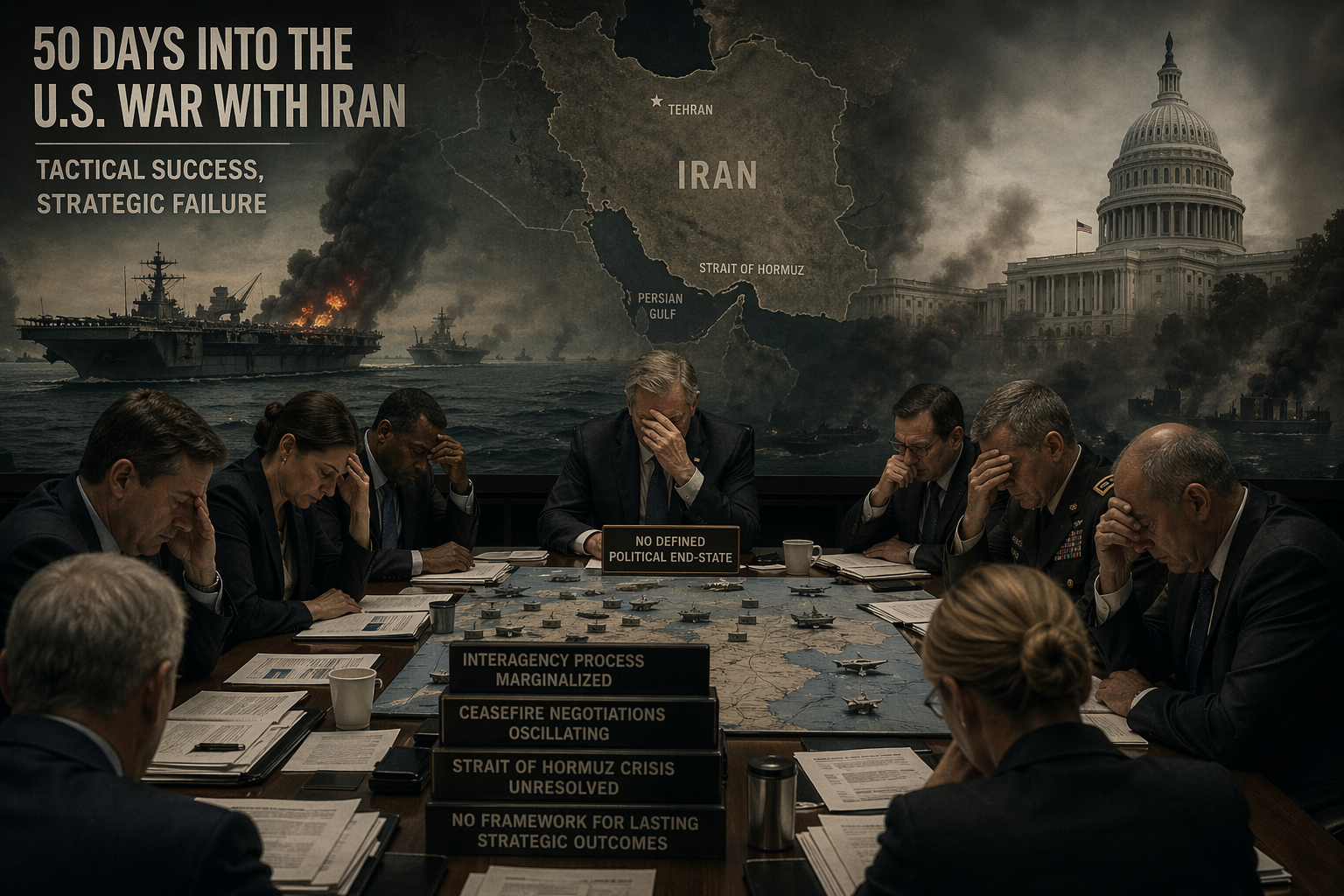

Fifty days into the US war with Iran, a pattern has emerged that is both familiar and alarming: tactical military success has not produced strategic coherence, and the absence of a credible theory of victory has left the United States reactive, economically exposed, and diplomatically isolated. United States entered the Iran conflict without a defined political end-state. The national security interagency process was structurally marginalized in the lead-up to and execution of the campaign. The resulting deficit is now visible in the oscillating ceasefire negotiations, the unresolved Strait of Hormuz crisis, and the absence of any articulated framework for translating battlefield gains into lasting strategic outcomes. Corrective action is both necessary and still possible, but it requires restoring the interagency function that sound strategy demands.
The Gap Between Striking and Winning
On February 28, 2026, United States and Israeli forces launched Operation Epic Fury, striking nuclear infrastructure, missile production facilities, and regime leadership targets across Iran. The operation was tactically impressive and militarily significant. Supreme Leader Ali Khamenei was killed. Nuclear enrichment facilities were damaged or destroyed. Iran’s conventional military capacity was substantially degraded.
And yet, as April 2026 draws to a close, the United States finds itself locked in a ceasefire that both parties are violating, negotiating in Islamabad through a Pakistani intermediary, watching the Strait of Hormuz open and close with each day’s news cycle, and absorbing domestic economic pain from gasoline prices exceeding $4 per gallon and inflation running above the Federal Reserve’s target. The question is no longer whether Operation Epic Fury achieved its tactical objectives. The question is what strategic objective it was designed to achieve, and whether anyone in authority could articulate that objective with precision before the bombs fell.
The answer, based on the available public record and the internal logic of how this conflict has unfolded, is deeply unsettling. The United States did not enter the Iran conflict with a coherent theory of victory. It entered with military capability, political will, and tactical clarity, but without the strategic architecture that converts military action into durable political outcomes. That architecture is the product of a functioning national security interagency process. And that process, by multiple credible accounts, was systematically marginalized in the critical months before and during the campaign.
I write this not as an outside critic but as someone who has served inside the process, as Director of Strategic Planning for the National Security Council and as Special Assistant to the Chairman of the Joint Chiefs of Staff. I have sat in the rooms where these decisions are shaped, argued through the interagency debates that stress-test assumptions, and watched firsthand what happens when those debates are bypassed. What is unfolding in the Iran conflict is recognizable. And it is correctable, but only if we are willing to name the failure with precision.
What a Theory of Victory Requires
The theory of victory is not a term of art invented by academics. It is the practical intellectual thread that connects military action to political purpose. As War on the Rocks has argued, a theory of victory is “a set of propositions about how and why the behavior of one belligerent in war or conflict short of war will or might affect the behavior of another belligerent in a desired manner.” It is, in short, the causal logic that explains why what we are doing will produce the outcome we want.
Clausewitz was the first to insist that this logic must exist and must be explicit. In On War, he argued that a lasting peace, the true end of war, requires not merely the disabling of an adversary’s will but its transformation: the enemy must be “convinced that he has a stake in the peace, not just be temporarily disabled.” Military victory absent this transformation is not strategic success; it is merely the opening condition of the next conflict. The US Army War College has extended this framework, noting that a comprehensive theory of victory must account not only for military means but for the economic and informational instruments of power, precisely the DIME (Diplomatic, Information, Military, Economic) framework that has guided US strategic planning for a generation.
Applied to the Iran conflict, a theory of victory would have required the administration to specify, before the first strike, answers to five questions. What political end-state does the US want with Iran? What does a post-conflict Iranian government, nuclear posture, or regional orientation look like? How does kinetic action produce that outcome rather than simply displacing it? What are the red lines and off-ramps that prevent escalation from consuming our strategic aims? And what instruments beyond military force, diplomatic, economic, informational, will we employ in what sequence to consolidate military gains? These are not bureaucratic questions. They are the irreducible requirements of any strategy worthy of the name.
There is no public evidence that these questions were answered, or even seriously asked, before Operation Epic Fury commenced. The administration’s stated aims in Iran shifted from nuclear disarmament to regime change, to compliance, to a negotiated settlement, sometimes within the same press conference. That oscillation is not a communications problem. It is a strategy problem.
The Interagency Failure: A Process Bypassed
The national security interagency process exists precisely to prevent this kind of strategic drift. Its function, coordinating the Departments of State, Defense, Treasury, Energy, the intelligence community, and the National Security Council (NSC) staff, is to ensure that before a president makes a decision of war or peace, every relevant instrument of national power has been analyzed, every realistic adversary response has been war-gamed, and every proposed course of action has been stress-tested against realistic best-case, expected-case, and worst-case assumptions. This is not bureaucratic obstruction. It is the intellectual infrastructure of sound strategy.
The public record in the Iran conflict reveals a process that was present in form but absent in function. According to reporting by CNN, the Pentagon and NSC “significantly underestimated Iran’s willingness to close the Strait of Hormuz in response to US military strikes.” Officials from Treasury and Energy were present at some planning meetings, but their “agency analysis and forecasts that would be integral elements of the decision-making process in past administrations were secondary considerations.” The administration believed Iran would not close the Strait because doing so would hurt Iran more than the United States, a judgment that was both analytically contestable and demonstrably wrong.
When this reporting surfaced, a senior US official told CNN that “the NSC used to be the final synthesizer before going to deputy or principal meetings for approvals. Without a real interagency process led by the NSC, the planning falls apart.” The White House press secretary responded that “the president doesn’t need layers and layers of bureaucrats providing papers to him to make foreign policy statements and decisions.” Both statements are revealing. The official is describing a process that, by his own account, was not functioning as designed. The spokesperson is describing a decision-making culture that has confused responsiveness with rigor.
The CSIS Beyond Goldwater-Nichols study, the most comprehensive review of national security enterprise reform in the post-Cold War era, is unambiguous: “only the NSC can play the role of the honest broker in coordinating the planning and oversight of interagency operations at the strategic level.” When that honest broker function is sidelined, individual agencies’ analysis is not synthesized, second-order effects are not mapped, and the critical question, “how does this military action serve our political end-state?” is never fully answered. The Hormuz closure was not an intelligence failure. It was a planning failure, the direct consequence of an interagency process that was present but not empowered.
This is not a partisan observation. The structural problem of presidents bypassing interagency deliberation to rely on tight circles of trusted advisers is a recurring feature of the American national security system, documented across administrations of both parties. What changes is the domain and the cost. In this case, the cost has been a global energy shock that the International Energy Agency characterized as the “greatest global energy security challenge in history,” a ceasefire negotiated through a third-country intermediary rather than through direct US diplomatic architecture, and a strategic posture that is reactive rather than purposeful.
The Negotiating Deficit: Strategy Without an Endgame
The ceasefire and subsequent negotiating dynamics reveal a second, related failure: the absence of a pre-developed diplomatic endgame. A theory of victory must specify not only how military action will be applied but what negotiated outcome it is designed to enable. Without that specification, negotiators enter talks without clear priorities, red lines, or a concept of what “winning” the diplomatic phase looks like.
The public record of the Islamabad negotiations is instructive. The United States proposed a 20-year pause on Iranian uranium enrichment; Iran rejected this, insisting on five years. The President publicly declared that Iran had “agreed to everything,” including shipping enriched uranium to the United States, a claim that senior Iranian officials immediately contradicted, calling it “alternative facts” and warning that such public assertions could “complicate ongoing diplomacy.” In a single press session, the President offered three different answers to five questions about whether he would extend the ceasefire. These are not the hallmarks of a negotiating team operating from a prepared and agreed position.
The deeper problem is structural. The negotiating posture reflects the same underlying deficit as the military planning: a preference for decisive action over deliberate strategy, for momentum over method, for the appearance of progress over the architecture of outcomes. Alan Eyre, a former member of the US team that negotiated the 2015 Iran nuclear deal, identified the core problem with precision: “Until, and unless the US negotiating team rids itself of the misconception that military victory equals strategic dominance, we’re not going to get to a solution.”
That misconception is not a personality flaw. It is a structural consequence of entering a conflict without a theory of victory, and then expecting the negotiating table to produce the strategic clarity that the planning process failed to provide.
A Balanced Assessment: What the Process Got Right — and What It Must Recover
Fairness requires acknowledging that the administration achieved what it set out to achieve militarily. Operation Epic Fury degraded Iran’s nuclear program, eliminated its supreme leader, and substantially reduced its conventional military capacity. These are not trivial accomplishments. The economic pressure of the naval blockade has produced genuine leverage in negotiations. Iran’s military position is considerably weaker than it was before February 28. And the administration correctly identified nuclear Iran as a strategic problem that years of diplomacy had failed to resolve. The use of force was not irrational.
What was irrational, or more precisely, strategically incomplete, was the failure to connect military action to a coherent political end-state, and the marginalization of the institutional processes designed to ensure that connection is made. The military instrument was wielded effectively. The diplomatic, economic, and informational instruments were not integrated with it. The result is a situation in which the United States has created significant military facts on the ground that it does not yet know how to convert into durable strategic outcomes.
The interagency process, when it functions as designed, is not a check on presidential authority. It is an amplifier of presidential effectiveness. It ensures that when the president makes a decision, it is informed by the full range of instruments available to American power, tested against realistic adversary responses, and connected to a sequence of post-kinetic actions that consolidate rather than erode the gains of military force. The Goldwater-Nichols Act codified jointness for the military precisely because uncoordinated service action produces waste and failure. The same principle applies to the interagency: uncoordinated departmental action, or the subordination of departmental expertise to a small circle of presidential advisers, produces the same result at the national strategic level.
The Way Forward: Restoring Strategic Architecture
The ceasefire is fragile. A second round of talks is uncertain. The Strait of Hormuz remains contested. The economic pressure on the United States and global markets continues. The administration still has an opportunity to construct, retroactively, the strategic architecture that was absent at the outset. Four steps are essential.
First, the administration must define its political end-state with Iran in terms specific enough to guide negotiating priorities. Not “denuclearization” as a rhetorical aspiration, but a concrete specification of what post-conflict Iranian nuclear posture, verification architecture, and regional behavior the United States is prepared to accept and enforce. Without this specification, negotiators will continue to improvise and contradict each other, and Iran will continue to exploit the ambiguity.
Second, the NSC must be re-empowered as the honest broker of interagency deliberation, not bypassed in favor of a tight advisory circle. This does not require structural legislation. It requires a deliberate restoration of the principal and deputy committee functions, the reintegration of Treasury and Energy as actors, not just spectators in strategic planning, and the systematic use of red-teaming and worst-case scenario analysis before irreversible decisions are made. The lesson of the Hormuz closure is that second-order economic effects are not secondary considerations; they are central strategic variables.
Third, the administration must develop and publicly commit to a sequenced post-kinetic strategy that integrates the diplomatic, informational, military, and economic instruments of national power. Military pressure without a diplomatic track creates an adversary with no incentive to make concessions. Economic pressure without a clear offramp incentivizes defiance rather than compliance. Iran’s proxy network, Hezbollah in Lebanon, the Houthis in Yemen, Kataib Hezbollah in Iraq, will not be addressed by the kinetic campaign. Dismantling it requires a sustained, multi-instrument strategy that has not yet been articulated.
Fourth, the administration must resist the temptation to declare victory prematurely. A ceasefire is not a settlement. Degraded nuclear infrastructure is not denuclearization. A weakened Islamic Revolutionary Guard Corps (IRGC) is not a transformed strategic posture. As Clausewitz warned, military victory absent the transformation of the enemy’s political calculus is not the end of war; it is a prelude to the next one. The United States has an opportunity to make this conflict’s end more durable than its predecessors. Seizing that opportunity requires doing the strategic work that should have preceded the first strike.
Conclusion
The Iran conflict is not lost. But it is, at this writing, strategically adrift, and the reason it is adrift is not the quality of American military power, which performed as designed. The reason is the absence of the intellectual and institutional architecture that converts military power into strategic outcomes. A theory of victory. A functioning interagency process. A defined political end-state. A sequenced multi-instrument strategy.
These are not the concerns of the cautious or the timid. They are the professional obligations of anyone who has responsibility for American strategy. I have seen, from inside the NSC and the Pentagon, what rigorous interagency deliberation produces: harder questions, better-stress-tested assumptions, and decisions that are more likely to achieve their intended strategic effects. I have also seen what its absence produces.
We are seeing it now. The corrective action is available. The question is whether the administration has the strategic self-awareness, and the institutional discipline, to apply it before the ceasefire expires, the negotiations collapse, and the next phase of this conflict begins without a theory of victory any more coherent than the last.