Chinese Eyes, Iranian Missiles: Intelligence Cooperation in the US/Israel–Iran War 2026

Introduction
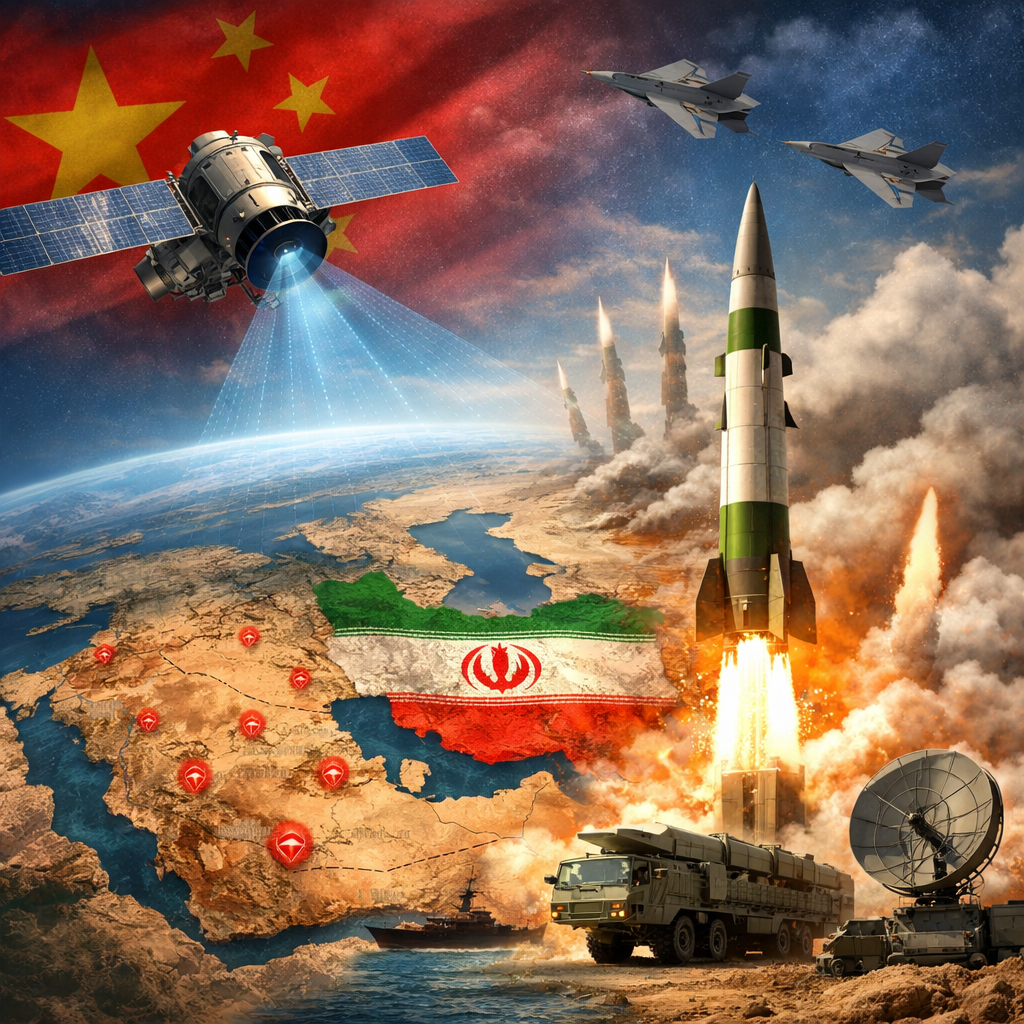
The 2026 war involving the United States, Israel, and Iran exemplifies one of the most technologically intricate wars in contemporary Middle Eastern history. The capability of Iran to execute accurate missile and drone strikes on Israeli urban centers and American military installations in the Gulf region astonished numerous military analysts. The accuracy unveiled in these missions indicates the existence of advanced targeting systems, satellite navigation, and real-time intelligence networks. Despite Iran’s development of an indigenous missile program over the past thirty years, critics increasingly contend that its recent operational achievements cannot be attributed purely to domestic technological capabilities. A burgeoning corpus of evidence indicates that China has significantly contributed intelligence support, satellite navigation, radar systems, and electronic warfare technologies that augment Iran’s targeting capabilities.
The alliance between China and Iran is founded on extensive geopolitical interests. Iran is a pivotal ally in China’s Belt and Road Initiative (BRI), a significant energy provider, and a crucial geopolitical counterbalance to U.S. dominance in the Middle East. China’s technology collaboration, especially in space-based information and navigation systems, may facilitate Iran’s execution of precision warfare against the US and Israeli sites while circumventing direct military engagement.
This essay analyzes the developing intelligence alliance between China and Iran amid the current war. This cooperation encompasses four key dimensions: satellite intelligence, BeiDou navigation systems, advanced radar networks, and electronic warfare capabilities. The paper also examines the wider strategic ramifications for the power equilibrium in the Middle East and for great-power rivalry between China and the United States.
Strategic Foundations of China–Iran Military Cooperation
The strategic alliance between China and Iran has developed markedly over the last twenty years, influenced by aligned geopolitical interests, economic interdependence, and mutual apprehensions regarding the US dominance in the Middle East. Both nations perceive their relationship not solely as a bilateral cooperation framework but as an integral component of a larger initiative to redefine regional and global power dynamics. The signing of the 25-year China–Iran Comprehensive Strategic Partnership agreement in 2021 marked a significant milestone in this partnership, establishing a framework for enduring collaboration in energy, infrastructure, security, and technological advancement. The agreement reportedly anticipates significant Chinese investment in Iran’s economy while enhancing collaboration in strategic sectors, including telecommunications, transportation infrastructure, and defense technologies.
Iran’s strategic geopolitical position renders it a highly valuable ally for Beijing. Located at the intersection of Central Asia, the Persian Gulf, and the Middle East, Iran functions as a pivotal hub in China’s Belt and Road Initiative (BRI). The nation offers terrestrial and maritime pathways connecting East Asia to Europe and the Mediterranean, while also regulating access to the Strait of Hormuz, a conduit for approximately one-fifth of the global oil supply. For China, the world’s foremost energy importer, sustaining stable relations with Tehran is crucial for guaranteeing long-term oil supplies and ensuring uninterrupted maritime trade routes. Despite Western sanctions, Iran has continued to be a crucial energy partner for China, as Chinese refineries persist in importing substantial quantities of Iranian crude oil via indirect routes.
In addition to economic collaboration, the relationship has progressively extended into military and technological spheres. In the last ten years, China and Iran have enhanced their cooperation in missile technology development, satellite and space initiatives, intelligence sharing, cybersecurity, and electronic warfare. Joint military exercises involving China, Iran, and Russia in the Indian Ocean and Gulf of Oman since 2019 have underscored an increasing degree of strategic coordination. These exercises indicate a mutual interest in challenging Western naval supremacy while facilitating operational learning and technological exchange.
From China’s viewpoint, collaboration with Iran presents an opportunity to monitor and evaluate Western military capabilities in actual operational contexts. Conflicts involving Iran and its regional adversaries enable Chinese strategists to gather critical intelligence on the efficacy of U.S. missile defense systems, stealth aircraft, precision strike capabilities, and electronic warfare operations. These observations are especially significant for the People’s Liberation Army (PLA), which is swiftly modernizing its military technologies in anticipation of potential future conflicts with technologically advanced opponents.
The partnership provides Iran with access to advanced technologies that would otherwise be challenging to acquire due to decades of international sanctions. Chinese support in satellite surveillance, navigation systems, radar technologies, and cyber capabilities could substantially augment Iran’s military efficacy. These technologies enhance the accuracy of Iranian missile systems, fortify its air defense networks, and augment its capacity to monitor regional military operations.
The China–Iran relationship operates as a strategic symbiosis.
Iran acquires advanced technological capabilities and intelligence networks that augment its operational efficacy, while China secures a strategically located ally that offers energy security, geopolitical influence in the Middle East, and the chance to analyze Western military systems in practical scenarios. As great-power competition escalates, this partnership is expected to gain significance for both nations, influencing the changing strategic dynamics of the Middle East and the wider international framework.
Chinese Satellite Intelligence and the Iranian Targeting Network
Modern warfare relies more on space-based intelligence systems that let militaries watch, track, and hit targets with an accuracy that has never been seen before. Satellites are very important for modern military operations because they can provide high-resolution images, electronic signals intelligence (SIGINT), radar mapping, and real-time tracking of military assets. These technologies are the foundation of modern intelligence, surveillance, and reconnaissance (ISR) networks. They let countries keep an eye on enemy movements and plan precise strikes over long distances. In wars that use long-range missiles and drones, satellite intelligence is often the first link in the “kill chain”, finding targets and directing weapons toward them.
Iran’s own space program has made slow but steady progress over the past ten years, but it still doesn’t have as many capabilities as the major space powers. The Noor series of military and reconnaissance satellites, which are run by the Islamic Revolutionary Guard Corps (IRGC), are just a few of the satellites the country has launched. These satellites can see the Earth from space, which lets Iran keep an eye on what is going on in the region, but they do not have the global coverage and advanced sensing technologies needed for constant battlefield surveillance. Because of this, Iran’s own satellite infrastructure likely won’t be able to hit targets as accurately as it did in recent missile and drone attacks.
On the other hand, China has one of the biggest and most advanced satellite networks in the world. The Yaogan reconnaissance satellites and the Jilin-1 commercial imaging network are two examples of Chinese constellations that can take high-resolution pictures and SAR observations of large areas of the world on a regular basis. These systems can find and keep an eye on military bases, keep track of naval movements, and make detailed maps of possible targets. Analysts say that having access to this kind of satellite data could greatly improve Iran’s targeting abilities by making it easier to find airbases, ports, radar stations, and logistical hubs in the Middle East.
Several defense studies say that Chinese satellite systems can keep near-continuous surveillance using a mix of optical, radar, and infrared sensors.
This feature lets you get live updates on troop movements, ship deployments, and aircraft activity, which makes military operations much safer. In this context, a modern operational “kill chain” takes shape, with Chinese satellites providing surveillance and targeting intelligence and Iranian missiles and drones carrying out the kinetic strike.
So, combining space-based intelligence with missile forces is a big change in how wars are fought in the region. Iran can use advanced satellite data to make up for the shortcomings of its own surveillance technology and carry out more precise long-range strikes against important targets throughout the region.
Iran’s Missile Guidance Systems
| Missile System | Type/Range | Estimated Guidance System |
| Fateh-110 | Short-Range Ballistic Missile (SRBM) | Western analysts believe it uses GNSS. Iranian state media mentions inertial & electro-optical terminal guidance for some variants. The Zolfaghar variant is believed to use commercial GNSS. |
| Fath-360 | Short-Range Ballistic Missile (SRBM) | Inertial navigation system (INS) and satellite navigation (GNSS). |
| Emad | Medium-Range Ballistic Missile (MRBM) | Likely integrates inertial and satellite navigation systems with a guided re-entry vehicle. |
| Ghadr-110 | Medium-Range Ballistic Missile (MRBM) | Inertial guidance and Global Positioning System (GPS). |
| Qasem Basir | Medium-Range Ballistic Missile (MRBM) | Inertial Navigation System (INS) independent of GPS, with an optical-electronic homing system. |
BeiDou Navigation System and Precision Missile Guidance
One of the most important technological things China could give Iran is access to the BeiDou Navigation Satellite System (BDS), which is China’s global satellite navigation and positioning network. Like the Global Positioning System (GPS) in the US and the Galileo system in the EU, BeiDou provides accurate positioning, navigation, and timing services for both military and civilian users. The system became fully operational around the world in 2020. Now, it includes a network of more than thirty satellites that cover the entire planet. Encrypted BeiDou signals can give military applications very precise location data—sometimes within a meter or even a centimeter under the best conditions—greatly improving the targeting abilities of modern missile and drone systems.
Iran places a lot of strategic importance on having access to another satellite navigation system. For a long time, Iranian missile systems used inertial navigation systems along with GPS signals that anyone could get. The United States still controls GPS signals, though, and they could be weakened or blocked during military conflicts. Because of this, Iranian defense planners have looked for other navigation systems that would make them less reliant on technologies controlled by the West. Recent studies show that Iran has been using BeiDou navigation services more in parts of its military architecture. This means that its weapons systems can use Chinese satellite signals instead of GPS networks controlled by the US.
This change has several operational benefits. First, BeiDou’s encrypted military signals are thought to be less vulnerable to Western electronic warfare and jamming attempts, which makes them more reliable in electromagnetic environments where there is a lot of competition. Second, BeiDou has a special short-message communication feature that lets users send encrypted data through satellite links even when regular communications networks are down during war. This feature can help missile units, command centers, and reconnaissance platforms work together better. Third, satellite-based navigation makes precision strike systems much more accurate. It is thought that Iranian missiles like the Fateh-110, Fath-360, and longer-range systems like the Emad and Ghadr ballistic missiles use guidance systems that mix Global Navigation Satellite System (GNSS) signals with inertial navigation technologies.
These hybrid guidance systems let missiles stay on a steady flight path during the midcourse phase and change their path during the terminal phase of flight using satellite navigation updates. Because of this, the circular error probable (CEP), which shows how accurate a missile is, can be greatly lowered. Integrating BeiDou into Iran’s missile system is a big step forward in technology. It lets Iranian forces carry out more accurate long-range strikes against important targets like military bases, air defense systems, and logistical infrastructure throughout the region.
Chinese Radar Systems and Air Defense Support
China could also help Iran’s military by giving them advanced radar technologies and air defense support, in addition to satellite intelligence and navigation systems. Modern integrated air defense networks rely heavily on radar systems because they let countries find, follow, and shoot down enemy planes, missiles, and drones before they hit their targets. For a long time, Iran’s top priority has been to improve its radar coverage. This is especially important because of the repeated Israeli air strikes in Syria and the presence of advanced U.S. air power in the Persian Gulf region. Tehran can therefore improve its early warning systems and make its military infrastructure less vulnerable by working with China on radar technology.
The YLC-8B anti-stealth radar is a Chinese very-high-frequency (VHF) radar that is often talked about in defense analyses. It is meant to find aircraft that are hard to see. The U.S. F-35 Lightning II and F-22 Raptor are examples of stealth aircraft that use radar-absorbing materials and special airframe designs to make them less visible to regular radar systems that work in higher frequency bands. However, VHF radars can partially counter these stealth features by picking up on the larger electromagnetic signatures that aircraft make at lower frequencies. These kinds of systems might not be as good at targeting as regular fire-control radars, but they can send out early warning signals that tell other radar systems and air defense batteries what to do. Reports say that Iran has investigated or used Chinese radar technologies that can find stealthy planes and combine radar data with its larger air defense system.
These radar systems have several important roles to play in Iran’s defense network. First, they improve early warning systems by spotting incoming air strikes from farther away. Second, they make it easier to find stealthy planes, which takes away some of the operational advantages that advanced Western fighter jets have. Third, modern radar systems make it easier to track cruise missiles and unmanned aerial vehicles, which are becoming more and more common in modern warfare. Finally, radar networks let missile defense systems work together so that surface-to-air missile batteries can quickly attack targets that have been found.
China has also made advanced long-range air defense systems, like the HQ-9B surface-to-air missile system, which can intercept targets at ranges similar to Russia’s S-300 or S-400 systems. If they were connected to modern radar networks and backed up by satellite-based surveillance, these kinds of systems could make Iran’s ability to build a multi-layered air defense system much stronger. Iran would be better able to find, follow, and respond to U.S. and Israeli military operations in the region if it had radar coverage, missile defense systems, and information from outside sources.
Electronic Warfare and Cyber Targeting Networks
Electronic warfare is now a key part of modern military operations, especially in wars that use advanced missile systems, drones, and network-centric warfare. Electronic warfare is the use of operations in the electromagnetic spectrum to find, intercept, disrupt, or change an enemy’s communications, radar systems, and navigation technologies. In modern conflicts, control of the electromagnetic spectrum can have a big effect on the outcome of battles because it affects command and control, targeting accuracy, and the effectiveness of defensive systems. China and Iran have both spent a lot of resources on improving their electronic warfare skills because they know that having better technology in this area can make up for weaknesses in other areas of the military.
It is widely believed that China is one of the leading countries in the world when it comes to electronic warfare and cyber operations. The People’s Liberation Army (PLA), especially through its Strategic Support Force, has become very good at signal intelligence, cyber operations, and electronic countermeasures that are meant to mess up enemy command networks and surveillance systems. Iran has also built up its own electronic warfare infrastructure, especially since decades of sanctions forced Tehran to rely on its own ideas and strategies that aren’t always fair. Increasingly, experts are saying that Iran has added electronic warfare methods to its missile targeting and reconnaissance systems.
These abilities include intercepting communications, gathering signal intelligence, and using cyber-enabled targeting networks to get real-time information about what the enemy is doing. Iranian forces can find the locations of radar installations, air defense systems, or military bases by intercepting communications and keeping an eye on electronic emissions. In some cases, telecommunications networks and digital infrastructure may also give geolocation data that can help with operational planning and missile targeting. These networks make it easy for reconnaissance units, command centers, and missile launch platforms to send targeting information to each other quickly.
These abilities may get even better with Chinese technological know-how. Advanced electronic warfare support could help Iran fight back against Western GPS jamming, keep missile guidance signals from being blocked, and mess up enemy radar systems during military operations. Iranian forces are better able to coordinate missile launches and drone operations even though the US. and Israeli forces are trying to mess up their communications and navigation systems. This is because they can work well in a crowded electromagnetic environment. As a result, electronic warfare and cyber targeting networks have become important parts of Iran’s changing military strategy. This makes it harder to defend itself and makes its precision strike capabilities more effective.
Strategic Implications for the Middle East and Global Power Politics
The growing intelligence and technological partnership between China and Iran has big effects on both the security of the Middle East and the way power politics works around the world. At its most basic level, this partnership shows how modern warfare relies more on information dominance than on just military strength. In today’s wars, the ability to gather, process, and use real-time intelligence through satellites, navigation systems, cyber networks, and electronic warfare can be just as important as the number of missiles or planes used. Iran can make its missile and drone strikes more accurate and effective by using outside intelligence support in its military operations, even though its enemies have better technology.
Second, the increasing cooperation shows how major powers can influence conflicts without sending troops by providing technological support instead. China has been very careful not to get directly involved in military conflicts in the Middle East. However, by providing satellite data, navigation infrastructure, and electronic warfare expertise, China can change the strategic balance without sending its own troops. This kind of indirect support helps China strengthen an important partner in the region while lowering the risks that come with directly confronting the United States. In this way, working together on technology gives China a strategic advantage that lets it increase its geopolitical power in the area.
Iran can also use China’s support to fight against the military superiority of the US and Israel in new ways. Iran doesn’t have the same kind of military power as these countries, but having access to advanced intelligence networks and navigation technologies can help make up for this. Iranian forces can hit high-value military targets more effectively because they have better missile guidance systems, better electronic warfare capabilities, and satellite data that helps them aim more accurately.
Third, the ongoing conflict gives China a chance to see and study the US and Israeli military technologies in real combat situations. Data collected from these conflicts can yield significant insights into the operational efficacy of missile defense systems, stealth aircraft, electronic warfare systems, and network-centric warfare capabilities. These observations could help the Chinese military plan, especially when they are up against technologically advanced enemies.
Finally, the growing technological partnership between China and Iran is a sign of a bigger change toward a multipolar international system, where regional conflicts are becoming more linked to competition between great powers. As the balance of power changes around the world, technological alliances and networks for sharing intelligence are likely to become more important in shaping the balance of power in important geopolitical areas.
Strategic Agreements and Frameworks Between China and Iran:
| Agreement / Framework | Year | Key Features |
| Comprehensive Strategic Partnership (25-year plan) | 2021 (signed); reaffirmed 2025 | Long-term cooperation in energy, infrastructure, technology, and security; emphasized in April 2025 Beijing consultations |
| Draft 25-year Cooperation Framework | 2020–2021 | Large-scale investment proposals; long-term supply guarantees; classified implementation details |
| Military & Security Coordination (Cyber/EW/Radar) | 2025–2026 | Strengthening Iranian digital sovereignty; Chinese MSS involvement; anti-stealth radar deployment |
| Defense Diplomatic Engagement (Naval & Joint Drills) | 2023–2026 | Joint naval exercises; intelligence coordination; strategic signaling in multilateral platforms |
| Advanced Weapons & Air-Defense Interests | 2025 | Iranian pursuit of HQ-9, Chinese anti-stealth radars, and deep-strike missile technology |
Conclusion
The 2026 war led by the US and Israel against Iran illustrates an evolving pattern of indirect great-power involvement in regional conflicts.
While Iran remains the primary military actor confronting U.S. and Israeli forces on the battlefield, China’s technological and intelligence support appears to play an important enabling role in strengthening Tehran’s operational effectiveness. Access to advanced satellite intelligence, the BeiDou navigation system, modern radar technologies, and electronic warfare expertise can significantly enhance Iran’s ability to conduct more precise missile and drone strikes while improving its capacity to defend against sophisticated air campaigns.
This cooperation reflects a broader transformation in warfare, where success increasingly depends on integrated technological ecosystems rather than individual weapons platforms. Intelligence networks, space-based surveillance, navigation systems, and cyber capabilities now operate together to create a comprehensive operational architecture that supports modern precision warfare. In this context, technological partnerships between states can dramatically alter the strategic balance even when one partner is not directly involved in combat operations.
For the United States and its regional allies, the conflict offers an important strategic lesson. Future wars may not necessarily involve direct military confrontation between great powers; instead, they may unfold through indirect competition, proxy conflicts, and technological support to regional actors. Understanding the evolving intelligence and technological cooperation between China and Iran is therefore essential for analyzing the changing balance of power in the Middle East and the wider trajectory of global strategic competition in the twenty-first century.