The Hidden Subsidy of the Citizen Soldier

I grew up in Bartonville, Illinois, a small town stitched to the perimeter of the 182nd Airlift Wing, an Air National Guard base that has been flying C-130s since 1995 and deployed aircraft and over 350 personnel to the Middle East for Operation Iraqi Freedom. Those planes flew over my house. They carried one of my best friends. However, like most people in the town and country, I had little connection to why they flew. When I commissioned as an infantry officer in 2014, like many in the combat arms, I almost had disdain for the Army National Guard or Army Reserve as a serious path. When I left Active Duty after four years — years that included Ranger School and a Best Ranger competition — I was still drunk on this indoctrination — i.e., “you’re the tip of the spear, everything else is an afterthought.” Components Two and Three (the National Guard and Reserves, respectively) were, in my mind, something other than the real Army.
I was wrong.
The fact that I — an infantry officer who grew up in the shadow of a National Guard base — could spend years in uniform without grasping the centrality of these components to how America actually fights tells you something important about a structural blind spot that runs far deeper than one lieutenant’s ignorance, however far a depth of ignorance I may have!
I serve now in the Army Reserve as a military intelligence officer in a cyber warfare role. I recently returned from an exercise in Korea. I have seen the Army from the Active-Duty combat arms side and the Reserve non-kinetic side: they are the same Army, bound by the same doctrine, and governed by the same operational demands, but understood by the public and priced by policymakers as though they were not. The citizen soldier is a subsidy. Communities, employers, and states bear the cost of the nation’s wars in ways that never appear on the Department of War’s balance sheet. As Guard and Reserve Soldiers are heavily engaged in Operation Epic Fury, we are watching the bill come due again.
The Familiar Pattern
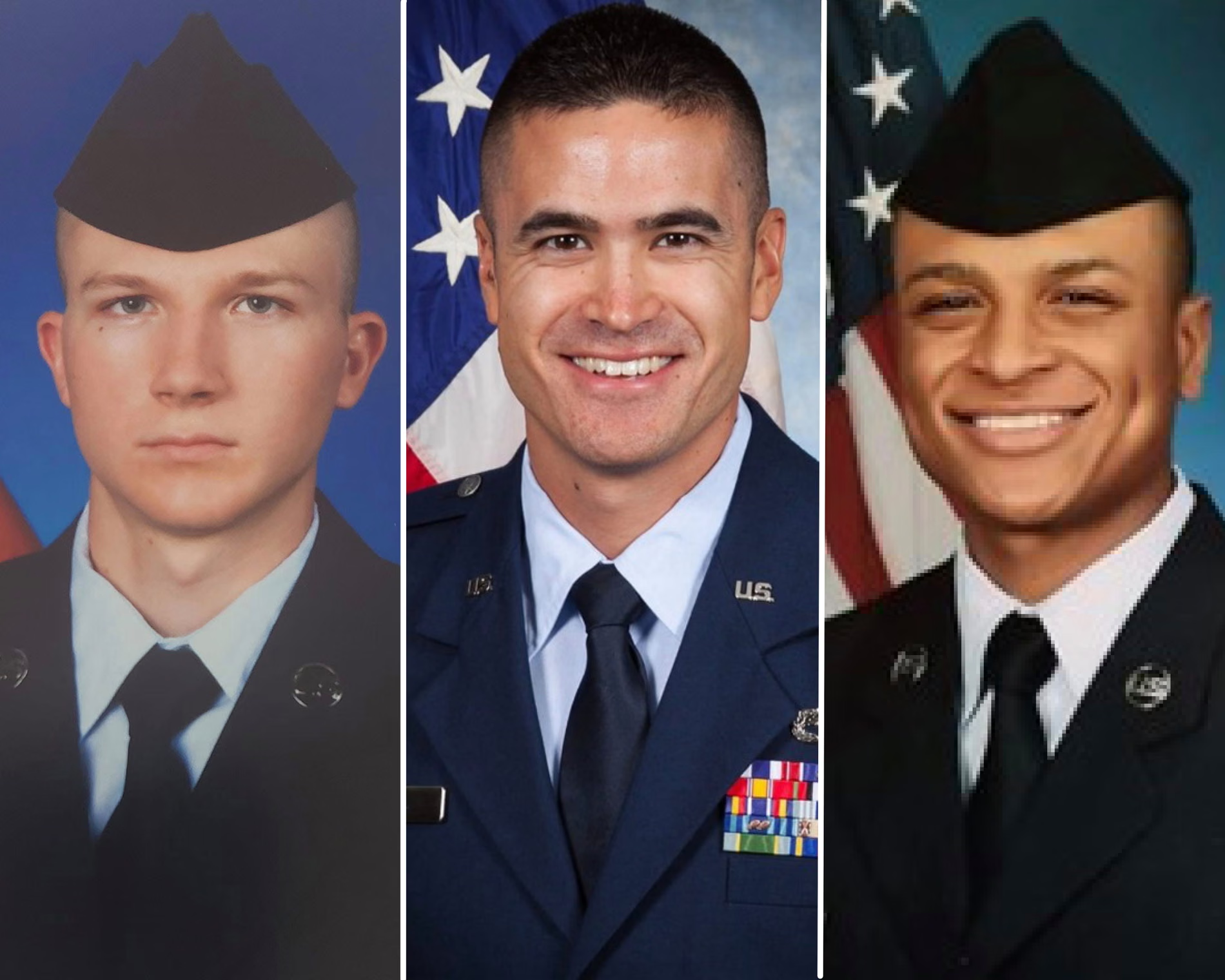
On March 12, a KC-135 Stratotanker went down over western Iraq. All six crew members were killed. Three — Captain Seth Koval, Captain Curtis Angst, and Technical Sergeant Tyler Simmons — were assigned to the 121st Air Refueling Wing at Rickenbacker Air National Guard Base in Columbus, Ohio. They were citizen soldiers.
They are not the only citizen soldiers in the fight. The Wisconsin Army National Guard is operating in Kuwait and Iraq. Air National Guard units from Vermont and Virginia were mobilized, some diverted mid-deployment from other operations. Mississippi’s 186th Air Refueling Wing, 172nd Airlift Wing, and 2-20th Special Forces Battalion deployed in late February. The Chairman of the Joint Chiefs publicly cited the use of “integrated Reserve and National Guard forces” as demonstrative of the value of reserve components. The Air Force’s tanker fleet — the backbone of the air campaign — includes 163 KC-135s in the Air National Guard and 62 in the Air Force Reserve, compared to 151 on Active Duty. The math is inescapable: the nation cannot sustain this operation without citizen soldiers.
This is not new. It is by design.
A Structure Built to Distribute Cost
After Vietnam, General Creighton Abrams and Secretary of Defense Melvin Laird restructured the force so the Army’s combat support and sustainment capabilities — logistics, military police, engineers, transportation — resided primarily in the Reserve components. The functional effect was that no president could sustain a major operation without mobilizing the Guard and Reserve, and that no mobilization could occur without reaching into communities across the country. Scholars debate whether Abrams specifically intended to create a political tripwire for presidential power; RAND researchers have found scant evidence that he articulated this goal explicitly. But the structural outcome was clear: the nation’s wars would now distribute cost into the communities that citizen soldiers call home.
When your neighbor deploys, the war is less abstract. That is the democratic value of the model — not merely a manpower solution, but a connective tissue between the armed forces and the society it serves.
There is a deeper logic here that extends beyond force management. As Kori Schake argues in The State and the Soldier, the health of American civil-military relations depends not just on the military’s subordination to civilian authority but on civilian willingness to remain engaged and accountable for the use of military force. Citizen soldiers are one mechanism by which that accountability is supposed to work. When your neighbor deploys, the war is less abstract. That is the democratic value of the model — not merely a manpower solution, but a connective tissue between the armed forces and the society it serves.
The theory was that this distribution would make war politically expensive, that the public would feel the mobilization and demand accountability. The post-9/11 era revealed something closer to the opposite.
The tripwire was thinner than Abrams assumed. Pentagon data show that roughly 80 percent of new recruits across the services have a close relative who has served — parent, grandparent, sibling, aunt, uncle, or cousin — and more than a quarter have a parent who did. The service clusters in families, and the families cluster in places: southern and rural states produce a disproportionate share of enlistees, and veterans settle near installations, creating self-reinforcing recruitment corridors. Pew Research Center data tell the same story in aggregate — only one-third of adults under 30 now have an immediate family member who has served, against more than three-quarters of those over 50. The connective tissue is thinning. For a growing share of the country, no neighbor deploys at all.
What Twenty Years of Data Shows
During the wars in Iraq and Afghanistan, Guard and Reserve units comprised roughly 45 percent of the total deployed force. Over 500,000 reservists were mobilized — the largest reserve call-up since the Second World War. By 2005, National Guard soldiers saw combat at levels not seen in modern times, far exceeding their participation in Vietnam or Korea.
At one point, more than half the combat brigades in Iraq were Army National Guard, a proportion that an Army historian noted exceeded anything in World War I or World War II.
The casualty trend is the part that should alarm policymakers. During the 2003 invasion, Guard and Reserve forces accounted for 10 percent of U.S. deaths. By 2004, the figure was 20 percent. For the first nine months of 2005, it hit 36 percent. In August and September of that year, it reached 56 percent — the first time citizen soldier casualties exceeded those of the active force in consecutive months. At one point, more than half the combat brigades in Iraq were Army National Guard, a proportion that an Army historian noted exceeded anything in World War I or World War II. Nearly 500 Guard members were killed in Iraq between 2003 and 2021.
These figures were public, available from the Defense Casualty Analysis System and Pentagon briefings. But they were rarely reported by component. The public saw aggregate tallies: “2,000 American service members killed.” The accelerating share borne by citizen soldiers — and what it meant for the communities absorbing those losses — went largely unexamined.
The Costs That Never Reach the Ledger
When a Guard or Reserve member deploys, the costs radiate outward. An employer loses a trained worker. A small business loses its owner. A school district loses a teacher. A rural fire department loses a first responder.
When an Active-Duty soldier deploys, the institutional costs are largely contained within the Department of War. The soldier is already on the payroll, housed on an installation, and embedded in a unit that will absorb and reintegrate them.
When a Guard or Reserve member deploys, the costs radiate outward. An employer loses a trained worker. A small business loses its owner. A school district loses a teacher. A rural fire department loses a first responder. A family often takes a pay cut when the soldier’s civilian salary exceeds military compensation at their rank, and in every case absorbs the logistics of running a single-parent household through a combat deployment. These costs are real, recurrent, diffuse, and almost entirely untracked by those ordering the deployment.
There is also the cost to the states responsible for the deploying unit. The Guard exists in a dual federal-state role; overseas combat and domestic emergency response draw from the same pool. This is not a hypothetical trade-off.
Oregon’s Guard was pulled off firefighting duty during its worst wildfire season in state history and sent to Afghanistan, taking helicopters the state needed to fight fires. When Hurricane Katrina struck in August 2005, approximately 35 percent of the Louisiana National Guard was deployed to Iraq. A confidential Pentagon report later concluded that Guard depletion was a major factor in the delayed response to Hurricane Katrina. Louisiana’s 256th Infantry Brigade — a year into their deployment to Baghdad — watched the storm from 7,000 miles away while their families waded through floodwater. Across the country, a Government Accountability Office report found that fifteen states had 40 percent or more of their Guard force mobilized or deployed. These are the predictable second-order effects of a force structure that draws from the same well for both overseas combat and domestic emergencies, costs that never appear on the Department of War’s balance sheet.
This Time Could Be Worse
The conditions that drove these deployments post-9/11 have not eased. They have intensified. The Active Duty Army has shrunk by more than 11 percent over the past decade. Only 23 percent of Americans aged 17 to 24 qualify for military service without a waiver. The Center for a New American Security projects a 13 percent decline in Americans reaching military age between 2025 and 2041. The traditional recruiting pool is physically shrinking. The Reserve component’s share of the burden is not.
If Operation Epic Fury extends beyond an air campaign into a sustained presence (the history of American military operations in the Middle East suggests this is more likely than not), the Guard and Reserve will bear an increasing share. The trajectory from 10 percent to 56 percent took two years in Iraq. There is no structural reason it would not happen again.
Pricing the Subsidy
None of this is an argument against the citizen soldier. Quite the opposite. As Schake and General Jim Mattis documented in their earlier collaboration Warriors and Citizens, the growing disconnect between the American public and its military is itself a threat to democratic governance. The citizen soldier is one of the better structural correctives to this disconnect: the person who lives in both worlds carries the war home to a community that must then reckon with it. The Reserve component’s role in combat is not a problem to be solved. It is a democratic feature that we must protect. We negated its original purpose by making the costs invisible.
Any mobilization drawing on the Reserve component should be accompanied by a certification that all deploying units have been resourced to the same standard or a public explanation of why they have not.
Given adequate training, Reserve component units repeatedly prove that they perform at the same level as their Active Duty counterparts. The citizen soldiers serving in Epic Fury right now are doing exactly what the nation has asked of them. The failure is not theirs. It is ours — the civilians, policymakers, and institutions that consume the subsidy without accounting for it.
The argument is that a cost which cannot be seen cannot be weighed. Two measures would change this, neither technically difficult but both politically overdue.
- The Department of War technically tracks casualties by component in the Defense Casualty Analysis System, providing data which can be queried for historical conflicts. In practice, mobilized Guard and Reserve members are counted under the “active duty” category in official reports. No Department of War public affairs product disaggregates casualties by component during an ongoing operation even though the information exists in the system. Putting it in front of the public in real time and in a format that enters discourse is not a technical challenge, it is a choice; one we should make.
- Every mobilization order that draws Guard units from a state should require a domestic readiness impact assessment: a brief accounting of what that state loses in emergency response capacity and plans to mitigate that loss. Governors and the public deserve to know. This assessment should include a Congressionally-mandated post-conflict Reserve component cost review for any operation exceeding 180 days, documenting the economic and readiness effects on the communities and states from which citizen soldiers are drawn. If we can audit weapons systems, we can audit the human cost of drawing down the reserve.
Furthermore, if the nation asks Guard and Reserve units to perform the same missions as their Active-Duty counterparts, it must resource them accordingly. The post-9/11 era exposed deep shortfalls, with Guard units deploying to Iraq with less than a third of their required equipment and soldiers shuffled between units to fill formations. While the Army has invested heavily in modernization since, this pattern of unequal resourcing persists. A July 2024 GAO report found that the Army fielded new priority equipment to units before completing key planning elements like facilities, personnel assignments, and training. The same report also found that equipment transferred to National Guard units under the Army’s readiness model was often in poor condition. In one case, 138 Bradley Fighting Vehicles transferred to the Tennessee Army National Guard arrived in such disrepair that the unit faced unexpected costs and training delays to restore them to mission-capable status. A September 2025 GAO assessment found that the Army’s ground combat vehicle fleet did not meet its mission-capable rate goals in fiscal year 2024 and that rates had declined for 16 of the 18 vehicle types reviewed since 2015. The Heritage Foundation’s post-9/11 analysis demonstrated the inverse: when Guard and Reserve units were given adequate time and resources to train to Active Duty standards, they performed at parity. The lesson is straightforward: comparable missions require comparable investment. Any mobilization drawing on the Reserve component should be accompanied by a certification that all deploying units have been resourced to the same standard or a public explanation of why they have not.
I spent four years on Active Duty before I properly understood the Reserve component. I grew up next to a Guard base but never saw them. That blindness is not personal — it is institutional. It is baked into how we report casualties, how we frame readiness, and how we account for the cost of war. The citizen soldiers of the 121st Air Refueling Wing, the Wisconsin Army National Guard, the Mississippi Guard’s 2-20th Special Forces Battalion, and every other Guard and Reserve unit now operating in the Central Command area of responsibility are subsidizing this operation with their careers, their communities, and, in some cases, their lives. The least we owe them is an honest ledger.