





Learning Under Fire at Home: The Pentagon Rehearses Ukraine’s Drone War | Defense One
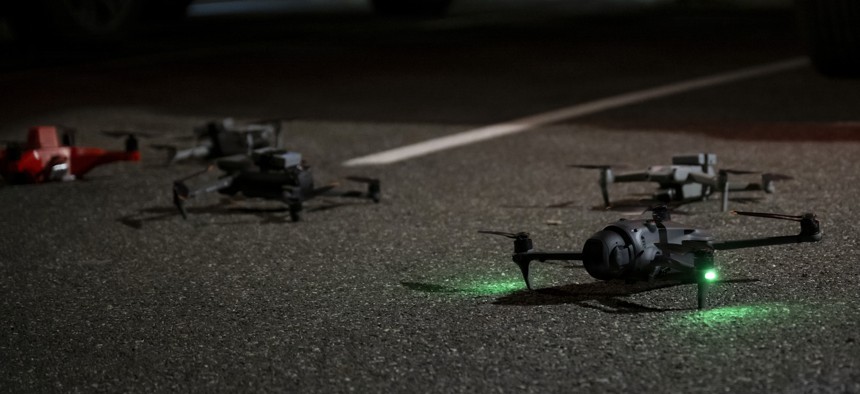

At Eglin Air Force Base, the Pentagon staged a rehearsal drawn straight from Ukraine’s drone war. Special operators replicated a layered assault using commercial quadcopters, frequency-hopping links, fiber-optic tethers, and LTE-enabled remote launches. The point, as Defense One reports, was less demonstration than diagnosis.
The result cut against years of counter-drone development. U.S. forces have possessed capable tools, yet lack integration. Dozens of exercises across services have produced data silos rather than comparative insight. Systems perform in isolation, while the battlefield demands convergence under pressure, across domains, and at speed.
Operation Clear Horizon highlights the criticality of adopting a different approach. This time, instead of idealized testing conditions, planners leaned on Ukrainian combat data and recent observation of Kyiv’s defenses. The emerging model centers on a shared air picture, where sensors and interceptors connect through a common interface, enabling track continuity across installations and commands.
“We were over in Ukraine about six weeks ago, talking to the Unmanned Systems Force [sic], watching how they defend Kyiv on any given night, understanding what they have along the forward line of troops,” Ross said. “Then we’ve looked at those most promising technologies and we referenced their performance data in Ukraine instead of internal department testing and evaluation.”
The exercise also sharpened the cost dilemma. High-end missiles remain effective against individual threats, but falter against scale. The response that Clear Horizon emphasizes is one of layered defenses and low-cost interceptor drones, paired with long-range surveillance against higher-value systems targeting command nodes and logistics.
Underlying all of this sits a tempo problem. Drone warfare evolves through commercial innovation and iteration cycles. Military acquisition moves slower. The Florida exercise marks a replacement of controlled experimentation by the emulation of real combat. In this landscape, integration will be the center of gravity.
Read the original piece by Patrick Tucker here: “The Pentagon replicated a Ukrainian-style drone attack in Florida. Now it’s changing its counter-drone strategy.”
While you’re here, check out this provocative piece by Bill Edwards on the necessity of keeping counter UAS training at pace with the development of fancy new gadgets: “Stop Chasing the Shiny Object: Focus First on a Comprehensive Counter-UAS Training Program.”

