





Book Review | Multidomain Operations: The Pursuit of Battlefield Dominance in the 21st Century
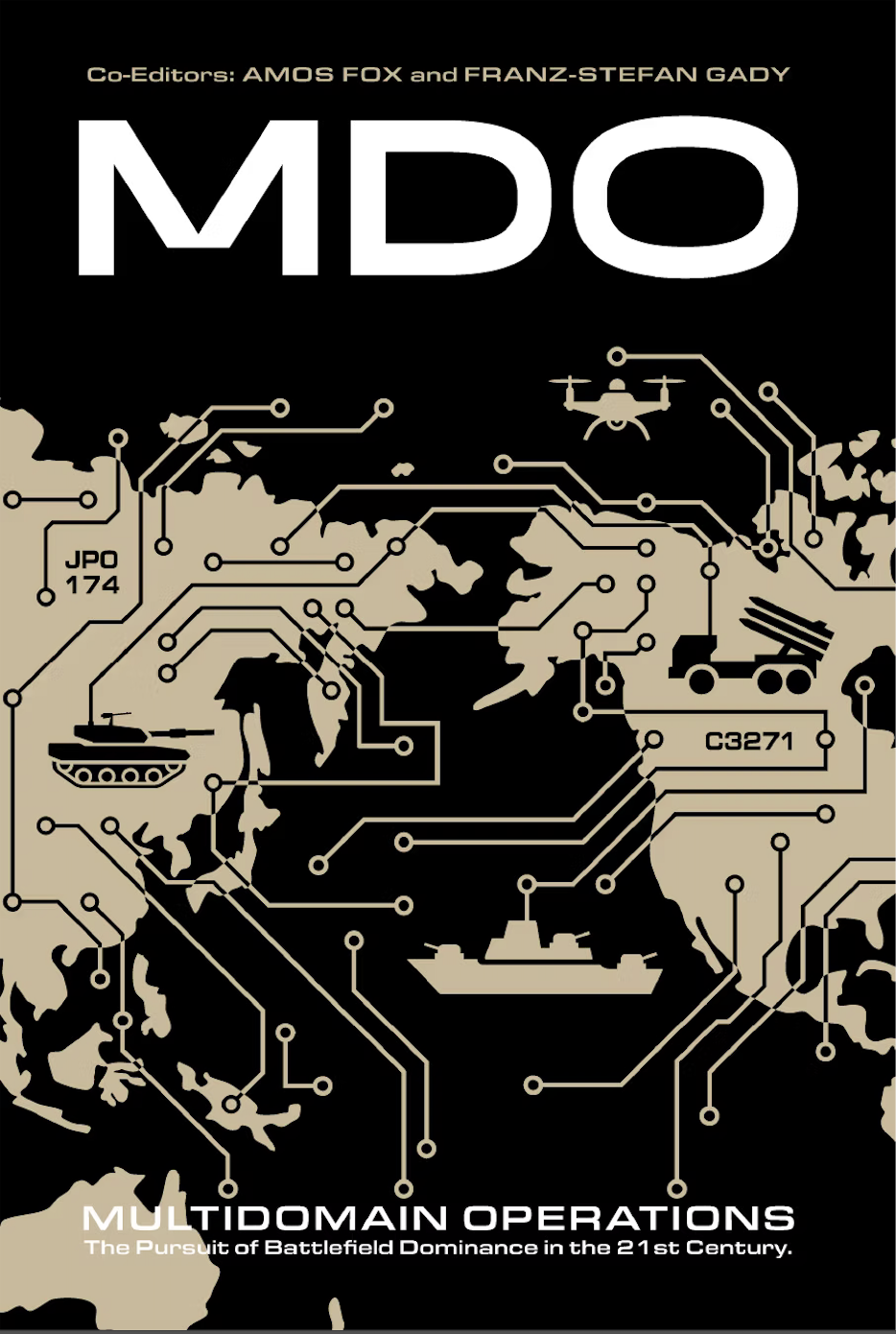

Multidomain Operations: The Pursuit of Battlefield Dominance in the 21st Century. Edited By: Amos C. Fox and Franz-Stefan Gady.
Havant, New Hampshire: Howgate Publishing Limited, 2026. ISBN: 978-1-912440-80-1. pp. vii, 338. $29.99.
Are you a currently serving field-grade officer or military civilian? Does your daily grind consist of staff work on DOTMLPF-P related issues while completing your master’s degree and attempting to publish in a professional journal simultaneously? Do you want to speak knowledgeably about current military doctrine and its potential to deliver effects in dynamic security environments? If you answered yes to any of the above, then Multidomain Operations: The Pursuit of Battlefield Dominance in the 21st Century is an essential text. It’s an expert’s take on the limitations of Multidomain Operations (MDO) doctrine to win future conflicts presented in edited volume form. It is replete with acronyms, contextual assumptions, and euphemisms that only a military professional, a military-related academic, or a policy wonk will appreciate. Far from merely an American perspective, the book addresses regional considerations and includes perspectives on NATO, Japanese, and Australian MDO doctrine from multinational authors.
First, a primer for those unfamiliar with the development of military doctrine. To develop a new doctrine, one must formulate a warfighting concept or theory for integrating new technologies to achieve specific effects in a projected future combat scenario. After that, planners develop a doctrine, or the detailed way in which a military force will fight an enemy in a given environment. A feasible, acceptable, and suitable doctrine must directly connect to the warfighting concept. Thus, doctrine shapes the force structure, capabilities, training, and employment required to achieve results through the military instrument of national power.
For example, France during World War II had more advanced, capable tanks than the German Wehrmacht, but they did not develop a doctrine that effectively utilized them, leading to German victory. Another example is how both Japan and the US developed naval doctrines that used carriers with aircraft capable of out-ranging even the most powerful battleships of the time, making them ineffective by the war’s end. History has repeatedly shown that technology alone is not enough; how that technology is employed is just as important.
Returning to the volume at hand, the authors argue that MDO is neither a clear concept nor a fully formed doctrine but a flawed mix of both. Born of an imperfect doctrine-development system, MDO is a satisficing solution for all threats and environments, yet tailored for none. Originally designed to counter Russia on the European plains, the work explains how MDO quickly became a diluted solution with negative global implications. MDO’s current state leaves American and allied military forces unprepared for large-scale, attritional combat against a near peer threat such as Russia or China. Although it was developed for a single theater and one specific threat, MDO is now being applied universally, irrespective of the threat, environment, or strategic objectives sought.
The central question of the work is whether MDO is appropriate as a 21st-century military doctrine. However, the book’s alternating conceptual framing can be hard to follow. Initially, it appears to be a discussion of doctrinal failures in the US Army’s MDO. But then, the tone shifts as it explores joint operations, expanding the MDO approach across the entire DoD. Ultimately, international perspectives present MDO as a broader, whole-of-alliance concept rooted in the United States. Nevertheless, resource differences among partner countries, a lack of doctrinal coherence, and the difficulty required to quickly adapt doctrine pose natural challenges to integrating MDO into partners’ and allies’ warfighting capabilities. Friction also exists because MDO doctrine is not plug and play; that is, it doesn’t allow for partners and allies to easily complement one another in its implementation.
Renowned military strategist Frank Hoffman sets the tone in a foreword describing MDO as an imperfect but necessary step in the evolution of 21st-century military doctrine. Hoffman also notes that although MDO lacks a clear theory of victory and does not fully address the human domain, its integration of technology across time and space offers a glimpse into the future. In Chapter 6, Heather Venable provides a thoughtful critique of MDO as a product of interservice rivalry, where the U.S. Army struggles to catch up with its sister services, ultimately harming the broader DoD. In Chapter 9, Michael Kofman and Franz-Stefan Gady analyze the modern Ukrainian battlefield and contend that maneuver, the core of MDO, does not live up to its reputation. Since MDO was designed to counter Russia but has failed to produce a Ukrainian victory, it is an irony that should trigger concern in Western capitals.
The volume is divided into four parts:
- Part I: Origins, Evolution, and Mainstreaming examines the leadership, bureaucratic, and environmental factors that shaped MDO as a concept.
- Part II: Practical Considerations offers a practitioner’s perspective on MDO. Some of the examples from the Ukraine-Russia War are overly broad, but the main point is clear: MDO doctrine has led to significant trade-offs in the Army’s close-combat forces, prioritizing maneuver over attrition.
- Part III: Tensions with Contemporary Conflict and Future Developments highlights the similarities between MDO and the previous concept of joint operations, examined from both scholarly and analytical viewpoints. This section includes some of the book’s most well-written chapters. If you are short on time but want to understand the shortcomings of MDO, this section is a must-read.
- Part IV: International and Alliance Perspectives provides insights, reflections, and recommendations from non-American viewpoints on MDO and on how allies and partners should expect to integrate into MDO’s American way of war.
In the introduction and conclusion, the co-editors guide the reader through the book’s arguments in an analysis that could stand on its own. These sections are well-written, thoughtful, and have an accessible tone that is easy to follow while remaining authoritative and professional. The co-editors are expert analysts and offer several realistic recommendations to improve the doctrine.
In summary, this book emphasizes the superficial nature of Western armies’ current leading concept, noting that MDO is “all façade and no filler.” Although it is narrowly focused and unlikely to appeal to those outside the national security sphere, this does not lessen its significance. The authors issue a clear warning that advanced, industrialized nations might be relying on a concept that fails to adequately prepare for future conflicts. History has shown that technological superiority alone, when applied through rigid concepts, does not bode well for success. At times, the reading can be disjointed and may require some intestinal fortitude to finish due to its doctrinal terminology and confusing conceptual layout, but the core message is vital for those involved in planning and executing future conflicts. Without a coherent doctrine, victory remains uncertain.


