The School of Advanced Military Studies: Educated to Win

Graduates of the School of Advanced Military Studies (SAMS) have a well-earned reputation as skilled planners. However, the mission of SAMS, the U.S. Army’s premier institution for warfighter education, is not to produce planning specialists. A rigorous education in history, theory, doctrine, and the practical application thereof, makes SAMS graduates integral to operational and strategic planning staffs. Their success as planners is an added benefit rather than the intent of a SAMS education. SAMS’ purpose is to educate skilled practitioners of Operational Art, some of whom would become senior commanders or strategic leaders. In short SAMS develops multi-domain warfighters who can lead, fight, and win in any environment.
The late retired U.S. Army Brigadier General Huba Wass De Czege (1941-2025), was the founding visionary of SAMS. In his early writings on officer education, Wass De Czege, noted that selected officers, who graduated the second year of studies, between 1929 and 1936, at the Army’s Command and General Staff School (CGSS) were over-represented among division and corps commanders during World War II. Wass De Czege was also struck by the paucity of Professional Military Education for US Army officers in the 1970s compared to their allies and probable opponents. At the time, seemingly few officers saw a need, or had a desire, to undertake an in-depth study of war itself. Seeing the gap in advanced military education as a potential risk during war-time, Wass De Czege, with the backing of Lieutenant General William R. Richardson (former Commander of U.S. Army Training and Doctrine Command), proposed a second year of education for highly selected graduates of the CGSS course. In this second year, students delve into the history and theories of war and current doctrine. The additional year of advanced warfighter education would deepen students’ understanding of the complexities of war and equip them to meet the challenges of an unknown future. After the graduates gained experience through future command and staff assignments, ideally, some would eventually rise to command divisions and corps, as had their World War II predecessors.
An integral part of the education was their follow-on assignments to divisions, corps, and Army Service Component Commands as operational planners. These assignments were like internships, better acquainting them with how to fight a division or corps (authors note: From interview with Major General Crosbie B. Saint, quoted in Benson, “Commemorative History,” p. 7). That experience was envisioned as a vital phase of their education, not the goal. While at SAMS, students were immersed in academic seminars led by former battalion commanders who had taken the Advanced Operational Art Studies Fellowship (AOASF) under respected civilian academics the previous year. Junior field-grade officers, who were students in the Advanced Military Studies Program (AMSP) would concentrate on history and theory, have lively classroom debates on the meaning of what they read, and participate in exercises. Students were to become masters of doctrine without becoming indoctrinated.
The first SAMS class graduated in 1984. Since then, the school has consistently produced graduates who are skilled practitioners of operational art and doctrine, serving in every conflict and contingency operation involving the United States Army. Notable examples include Operation JUST CAUSE (1989) in which SAMS graduates crafted plans that overwhelmed Manuel Noriega’s Panamanian forces, and later during Operation DESERT SHIELD/STORM (1990-91), General Norman Schwarkopf specifically asked for SAMS graduates—the “Jedi Knights”—to plan the Liberation of Kuwait. Their achievements demonstrated the value of a SAMS education and solidified the reputation of the school. The apprehension of the officer corps to a second year of field grade education, instead of time with the troops, faded as SAMS graduates became selected for battalion, brigade, and higher commands at a high rate. Several SAMS graduates have since fulfilled Wass De Czege’s larger vision by becoming division, corps, and senior Army commanders, such as Lieutenant General Charlie Costanza, Gen. Vincent Brooks, and late generals Charles Jacoby, and Charles “Hondo” Campbell.
Initially organized as a department within the CGSS, SAMS became a separate school under the Command and General Staff College in 1985. Originally, SAMS was exclusively for U.S. Army officers, mostly from the Combat Arms branches. Starting in the late 1980s SAMS admitted other military services – the first U.S. Marine Corps students graduated in 1989, and, later, international and interagency students who have added to the educational experiences of annual cohorts. The exceptional civilian faculty (including many retired officers) went from serving mainly as course authors, to becoming primary instructors on a combined military and civilian teaching team. SAMS regularly evaluates its curriculum and teaching approach, ensuring the school stays attuned to emerging trends in Operational Art and changes to the character of war. The school’s teaching team model and applied warfighter education approach prepares graduates to lead, fight, and win anywhere through the competition, crisis, or conflict continuum. 
SAMS consists of three highly competitive programs to meet the Army’s and joint force’s expectations for educated warfighters. Graduates are critical and creative thinkers, agile and adaptive leaders and skilled practitioners of doctrine and Operational Art, who enable senior leaders to achieve favorable strategic, operational and tactical outcomes. All selectees are high-performing officers in their respective military branches who voluntarily apply for a spot in the school.
Advanced Military Studies Program (AMSP)
AMSP educates 115 field-grade officers each year. The program integrates history, theory, and doctrine, with practice to develop skilled Operational Artists. Graduates serve a utilization tour as operational planning team (OPT) leads, G/J-5 officers, and commanders. In the longer term, they have the educational depth to serve the Army, joint force, and the nation at ever higher levels of command.
The curriculum emphasizes critical thinking, decision-making, and the application of Operational Art. 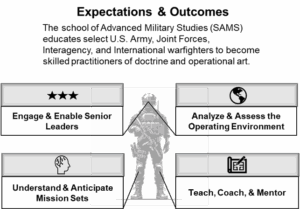 Students study and evaluate historical campaigns, assess the theory and practice of multidomain operations, and use Design and Systems Thinking to generate options and innovative solutions to military problems. Students undertake a week-long Western Theater Staff Ride studying General Ulysses S. Grant’s 1863 Vicksburg Campaign that, combined with classroom lessons and readings, gives students better understanding of the linkage between tactical actions and strategic outcomes, the essence of Operational Art. AMSP includes six exercises, including division and corps-level Large Scale Combat Operations (LSCO) planning and joint task force multidomain operations (JTF MDO). Some students participate in operational practicums which offer students short-duration, hands-on experience working with units in the field. Additionally, students research and write a 10,000-word publication-worthy monograph on an operational-level topic. Graduates earn a Master of Arts in Military Operations.
Advanced Strategic Leadership Studies Program (ASLSP)
Also known as the Marshall Scholars program, is the successor to Advanced Operational Art Studies Fellowship (AOASF). It is a two-year senior service college program that combines strategic education with practical application. The curriculum includes modules on strategy, regional studies, joint warfighting, strategic leadership, and 21st-century conflict. They too research and write a monograph of 10,000 words, albeit one focused on the strategic level. The Marshall Scholars undertake extensive field studies to all Regional and Global Combatant Commands, as well as to select allies and partners. Students engage in five exercises annually, applying joint doctrine to campaign planning and design, with a focus on LSCO and multidomain operations. Graduates are Military Education Level 1 (MEL 1) I and Joint Professional Military Education Level II (JPME II) qualified.
In their second year, Marshall Scholars serve as seminar leaders for AMSP and as SAMS teaching faculty. Graduates are uniquely positioned to engage and enable senior leaders, analyze and assess operating environments, and anticipate and adapt to emerging missions. Their ability to communicate succinctly, assess risk, and generate options makes them invaluable advisors to commanders at the highest levels. Marshall Scholars serve in some of the Army’s most demanding staff assignments, and many are selected for senior-level commands.
Advanced Strategic Planning and Policy Program (ASP3)
The ASP3, also known as Goodpaster Scholars, is multi-year program that combines academic rigor with practical application. Scholars attend a six-week long summer session at Fort Leavenworth before beginning their formal graduate education at a top-tier civilian university to earn a Ph.D. in a field relevant to the Army’s strategic priorities. Goodpaster Scholars serve tours as advisors to Army senior leaders and as operational unit commanders. Scholars are equipped to address the challenges of the future operating environment, such as integrating artificial intelligence and machine learning into military operations.

Conclusion
The contemporary operating environment is dynamic and complex, stretching the creativity and critical thinking of the most experienced military professionals; future operating environments will be even more demanding. Military leaders face multifaceted challenges, ranging from supporting U.S. allies and partners in ongoing conflicts in Europe and the Middle East, to deterring strategic competitors, especially China, and solving strategic challenges in the Western Hemisphere. The complexities of these environments are compounded by adversaries who “employ myriad available technologies (low cost and high-end), they continuously adapt and innovate seeking asymmetries to U.S. strengths.” The U.S. Army and joint force must have warfighters who are ready for these evolving operational and strategic threats. The School of Advanced Military Studies educates warfighters who can lead, fight, and win in any environment, at any level of war. SAMS graduates have the mental agility, creativity, and foresight that “helps commanders in the operational force to understand, visualize, describe, direct, lead, and assess operations in a complex environment, and create war-winning solutions” now and in the future (author’s note: quote from SAMS PowerPoint briefing slide, “Applied Warfighter Education,” November 20, 2025).
Check out all of the articles from Small Wars Journal and the U.S. Army’s Command and General Staff College partnership.