





SWJ–El Centro Book Review – Challenged Sovereignty: The Impact of Drugs, Crime, Terrorism, and Cyber Threats in the Caribbean
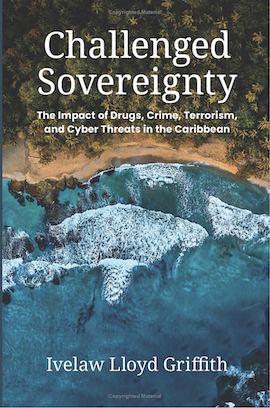

Ivelaw Lloyd Griffith, Challenged Sovereignty: The Impact of Drugs, Crime, Terrorism, and Cyber Threats in the Caribbean. Champaign: University of Illinois Press, 2024. [ISBN: 978-0252087776, Paper, 336 pages]
Challenged Sovereignty written by Ivelaw Lloyd Griffith is a critical study of security issues plaguing the sovereign states of the Caribbean. Griffith is a Fellow with the Caribbean Policy Consortium and Global Americans and a Senior Associate with the Center for Strategic and International Studies (CSIS). He is also the author of Strategy and Security in the Caribbean (Praeger, 1991), Drugs and Security in the Caribbean(Penn State University Press, 1997), and Caribbean Security in the Age of Terror (Ian Randle Publishers, 2004).
The work centers on the concepts of security and sovereignty in relation to “Problems Without Passports” (Shortened to PWP in the book and hereby used as a shorthand in this review), focusing on drugs, crime, terrorism, and cyber threats that have been and continue to be eroding the sovereignty of Caribbean nations:
Thus, the harsh reality is that sovereignty is not sovereign. Indeed, as will be argued later, the sovereignty of Caribbean countries had already been compromised – from their birth as nations. The threats exposed by drugs, crime, and other PWPs have been exacerbating their vulnerability, pushing their ships of security into turbulent seas and presenting a circumstance of challenged sovereignty. Thus, sadly, the Caribbean, a region of small and subordinate states, is a good candidate for empirical analysis of these interdependence issues that confront states and societies the world over (p. 10).
Structure of the Book
The book consists of eight chapters, an appendix consisting of the extradition treaty between Jamaica and the United States, and notes and bibliography for references. Of the eight chapters, they are divided into four parts: The first part describes the contexts, concepts, and definitions that Griffith uses throughout the book, giving his attention to understanding PWP and the terms “security” and “sovereignty.” The second part studies the specific PWPs such as drugs, crime, terrorism, and cyber threats. The third part examines controversial cases in the Caribbean and how Griffiths concepts overlay on these cases to extrapolate more information and data. The fourth and final part of the book brings forth responses to the crucial question posed by Griffith: How secure is security, and how sovereign is sovereignty in the Caribbean?
Part I – Contexts and Concepts: Introduction to the concept of PWPs and their manifestations are revealed here. Griffith also introduces six objectives he sets to achieve through the book. The second chapter and later half clarify the usages of “security”, “vulnerability”, and “sovereignty.”
Part II – Problem Without Passports: The title PWPs are examined. The geonarcotics framework is introduced to guide the reader through Griffith’s perspectives. This also includes how the Caribbean’s physical and social geography aids in trafficking operations. Next, the book centers on the crime of homicide and its effects on society such as economic and social costs that stress sovereign states in the Caribbean such as costs to healthcare, prisons, and how corruption affects public health. The second half showcases terrorism and cyber threats that have occurred in the Caribbean and how these events affect geopolitical and geoeconomic ramifications. Griffith adds a special section specifically to Trinidad and Tobago in relation to terrorism.
Part III – Controversial Cases: This part delves into three events that brought the respective countries to exhaustion with respect to security and sovereignty. The initial case is the 2010 Christopher “Dudus” Coke fiasco in Jamaica, and the second case is the 2011 State of Emergency in Trinidad in Tobago. The third case, focusing on Desi Bouterse’s election in 2010 Suriname, is given its own chapter in the second half of Part III.
Part IV – Crucial Contemplation: The final part of the book summarizes the findings and conclusions from the previous chapters to describe the status of Caribbean security and sovereignty. Griffith also utilizes some space to make recommendations for both Caribbean states and international organizations to work together to reduce the growing PWP threats.
Analysis and Critique
The book functions as a large case-study with historical-driven data that educates the reader on many international security issues surrounding the Caribbean. The greatest strength of the book comes from Griffith’s multi-decade knowledge and experience of crime in the Caribbean. The sheer number of citations and references of the data that Griffith uses to bolster his perspectives makes this book one of the greatest resources for any audience interested in understanding the dynamics of crime taking place in the Caribbean.
The biggest weakness of the book is the lack of attention to cyber threats. Of the four PWPs that Griffith elaborates, both terrorism and cyber have their own individual chapter in the second part of the book while drugs and crime are lumped together. Furthermore, the cyber portion is also severely smaller than the terrorism portion which does not do it justice given that it is highlighted in the book’s subtitle.
Conclusion
In conclusion, Challenged Sovereignty offers a comprehensive and incisive examination of how “Problems Without Passports” continue to undermine security and sovereignty in the Caribbean. Drawing on decades of expertise, Ivelaw Lloyd Griffith effectively situates drugs, crime, terrorism, and cyber threats (to a lesser extent) within a broader historical and geopolitical framework, demonstrating that Caribbean sovereignty has long been constrained and remains deeply vulnerable. The book’s clear structure and extensive use of empirical data allow it to function as a robust case study of regional insecurity, reinforced by detailed analyses of controversial national crises.
El Centro readers can additionally draw upon the work: “Third Generation Gangs Strategic Note No. 41: Criminal Insurgency and ‘Revolution’ in Haiti?” for a resource that focuses on a Caribbean nation-state increasingly under siege by armed criminal groups.


