





A Shield Made up of Well-directed Blows: Clausewitz and the New Logic of America’s Counter-Narcotics Campaign


ABSTRACT
Given the scale of death and disruption drugs now cause, narcotics increasingly function as a strategic threat rather than a conventional crime problem. This article suggests that America’s modern counter-narcotics campaign reflects a new form of active defense inspired by Clausewitz’s theory that protection can require offensive action. It traces how U.S. policy evolved from the limits of the Posse Comitatus Act to current military operations, targeting drug-trafficking boats. By viewing narcotics, such as fentanyl, as a strategic threat, the paper explains how the U.S. now seeks to defend the homeland through preemptive, outward-focused actions.
On November 10, 2025, Secretary of War Pete Hegseth announced on X that U.S. forces had conducted another lethal strike on two drug-trafficking boats in the Pacific. According to Hegseth, the two vessels were operated by a designated terrorist organization. “Under President Trump, we are protecting the homeland and killing these cartel terrorists who wish to harm our country and its people,” he wrote. In another post, he affirmed that the United States, “would continue to track them, map them, hunt them, and kill them.” Beyond the headlines, these operations appear to reflect a deeper strategic logic. These strikes preserve the defender’s interests by disrupting traffickers’ ability to deliver mass-casualty producing narcotics before the threat fully forms. This illustrates what Carl von Clausewitz called “a shield made up of well-directed blows.” His idea is that true defense is not passive but composed of offensive actions that seize initiative. By striking drug traffickers beyond its borders, the U.S. appears to be implementing the Prussian strategist’s idea of active defense. As he reminds readers, “for we may find it advantageous to await the charge against our bayonets and the attack on our position… but if we are really waging war, we must return the enemy’s blows; Thus a defensive campaign can be fought with offensive battles…” Today, the enemy’s blows take the form of fentanyl, whose lethality and foreign sourcing produce effects akin to a sustained strategic attack on the American population. Yet applying this logic to counter-narcotics operations strains the legal frameworks that long separated military and law-enforcement roles. Translating this modern interpretation of active defense into strategy has required a rethinking of those boundaries. This evolution has unfolded mostly over the past few decades but traces its roots back to the Posse Comitatus Act.
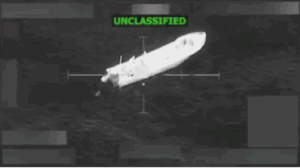
Strikes on drug-trafficking boats like this one, posted by Secretary Hegseth on October 10, 2025, are becoming more frequent. Pentagon Image
From Posse Comitatus to Active Defense
The American aversion to military involvement in domestic law enforcement has deep historical roots. The Posse Comitatus Act of 1878 was enacted in response to public backlash against the use of federal troops to enforce laws, particularly in the Reconstruction-South and on the western frontier. The Act established a strict divide between civil and military authority, prohibiting the use of federal armed forces to execute domestic law unless expressly authorized by Congress or other exceptions, such as an insurrection. Because counter-narcotics was historically viewed as a law-enforcement issue, this principle constrained the military’s role for nearly a century. These early restrictions made an active defense impossible. Narcotics were treated as criminal problems, and the military was legally confined to a supporting role rather than permitted to conduct the kind of forward, offensive actions that an active defense requires.
The escalating drug problem of the late twentieth century began to blur those distinctions. When President Richard Nixon declared drugs “public enemy number one” in 1971, the “war on drugs” began as a law-enforcement and public-health campaign. The military’s role was limited to logistics, surveillance, and intelligence support. It also lacked authority to detect, pursue, or interdict traffickers, actions that would later become central to a strategy of active defense.
That began to change with the Military Cooperation with Civilian Law Enforcement Agencies Act of 1981, which amended Posse Comitatus to allow the armed forces to share information, equipment, and training with civilian agencies. This change laid the groundwork for integrating military capabilities into counter-narcotics operations. By enabling military assets to support drug-interdiction missions, the Act introduced surveillance and detection capabilities that civilian agencies lacked and expanded the range at which traffickers could be identified and targeted. A General Accounting Office report, for example, later credited this act with dramatically increasing military involvement in interdiction missions, including the use of Navy E-2C radar aircraft, Army Cobra helicopters, and Air Force aerostat sensors. This growing fusion of law enforcement and defense created a foundation for a modern application of Clausewitz’s active defense, in which well-directed blows are delivered early against threats.
By the mid-1980s, the shift was unmistakable. President Ronald Reagan’s National Security Decision Directive 221 defined international drug trafficking as a national-security threat, not merely a law-enforcement issue. In fact, every president since Reagan has identified drugs as a national security issue in their administration’s National Security Strategy. The National Defense Authorization Act of 1989 went further, designating the Department of Defense as the lead agency for detecting and monitoring drug trafficking into the United States. The creation of Joint Task Force-6 under U.S. Northern Command institutionalized this support role, embedding military assets into counter-narcotics efforts along the southern border. This institutional change established an enduring structure through which the U.S. could operationalize a more active form of defense. Though initially covering domestic territory, it eventually expanded and included a broader mission beyond the continental U.S.
Early manifestations of Clausewitz’s active defense can be observed during this expansion era of the 1980s and 1990s. Operations such as Blast Furnace in Bolivia and Plan Colombia extended the mission into source and transit zones, pushing U.S. involvement from surveillance and training toward limited operational support. These initiatives marked the first sustained attempt to preempt threats abroad rather than merely react to them at home. Though their success in reducing overall drug flow was limited, they laid the conceptual groundwork for the defense model witnessed today; a strategy that treats narcotics not merely as a law enforcement issue, but as a national security threat requiring depth.
Drugs as Weapons and the Strategic Logic of Defense-in-Depth
If the legitimacy of an active defense strategy depends on the severity of the threat, the current drug crisis more than qualifies. American life expectancy has declined in recent years, largely due to opioids, which are the deadliest category of drugs in terms of deaths. Between 2019 and 2022, for example, life expectancy fell each year. In 2023 alone, over 105,000 Americans died from overdoses with 76% involving synthetic opioids such as fentanyl. The surge in drug overdose deaths in the last 25 years has risen to more than 100 times their 1999 levels. These numbers capture only direct deaths, not the broader social and economic toll that compounds their impact, such as the costs of addiction treatment and incarceration, and long-term health care issues resulting from addiction.
The scale of lethality is staggering. Conceptually, the U.S. now suffers the equivalent of a Halabja-scale chemical attack every two weeks. Saddam Hussein’s 1988 chemical assault on Halabja killed roughly 5,000 Kurdish civilians; the U.S. loses that many to fentanyl every couple of weeks. At this scale, drug lethality and its effects on U.S. national interests elevate narcotics beyond a matter of crime or public health. Their magnitude raises them to the level of a strategic threat. With only two milligrams capable of killing an adult and one kilogram enough to kill half a million, fentanyl’s destructive potential rivals that of battlefield chemical agents.
Given this combination of lethality, deliberate distribution, and foreign sourcing, the comparison to chemical weapons is not just metaphorical. Joint Publication 3-11, Operations in Chemical, Biological, Radiological, and Nuclear Environments, defines a chemical weapon as “a munition or device designed to cause death or harm through chemical agents.” While fentanyl is not militarized in form, its mass employment by transnational actors against U.S. civilians satisfies the functional criteria of a weapon of mass destruction. In 2003, General James Hill, then Commander of U.S. Southern Command, warned that the drug trade already constituted a destructive force on the scale of such weapons.
This framing is crucial to understanding the strategic shift. Consider a hypothetical scenario: a U.S. intelligence asset detects an inbound small vessel known to be carrying a crude radiological “dirty bomb” toward an American port. Its detonation would kill numerous citizens, poison the surrounding area, damage infrastructure, and wreak havoc. The consequences of such a threat are comparable to the effects of fentanyl. For example, both cause mass death, inflict significant societal costs, and produce cascading secondary problems. While the mechanisms are different, the value of this analogy lies in the shared strategic problem both threats present: preventing a mass-casualty event before it is absorbed at the point of impact. Faced with such a threat, the critical question is posed: Would we wait for that vessel to detonate its bomb at an American port, or act by striking the threat before it arrives? The answer seems clear: the threat’s lethality and imminence would justify an immediate, preemptive defensive counterstroke. The same logic applies to the threat of fentanyl.
This framing as a form of chemical warfare has increasingly influenced U.S. policy. The current administration has characterized the fentanyl epidemic as a deliberate attack on the American people. That interpretation remains contested: international critics, such as the UN High Commissioner for Human Rights, have described lethal maritime strikes against traffickers as potential extrajudicial actions. Yet from a strategic standpoint, understanding narcotics as a destructive chemical weapon aids in clarifying why such forward operations are justified under an active defense paradigm.
If narcotics function as a weapon, then the strategic logic of active defense becomes more comprehensible. Striking traffickers’ vessels, labs, and logistics chains before their chemical payloads reach U.S. shores can be viewed not as merely interdiction, but as an effort to defend. This understanding aligns with Clausewitz’s “shield made up of well-directed blows” metaphor.
Clausewitz and the Logic of Active Defense
Clausewitz’s On War offers a lens through which this interpretation makes sense. “The defensive form of warfare is intrinsically stronger than the offensive,” he wrote, but it must not be confused with mere passivity. True defense, for Clausewitz, is a dynamic equilibrium of restraint and counterstroke. By stopping narcotics before they enter the U.S., interdiction becomes the defender’s counterstroke, neutralizing the threat at its weakest point. The defender must strike where the enemy is most exposed, not to conquer, but to preserve.
In this sense, America’s counter-narcotics campaign at sea and abroad may reflect a modern adaptation of that principle. When U.S. forces strike high-speed boats ferrying fentanyl precursors across the Caribbean, they are not necessarily waging an offensive war; they are executing a defensive counterstroke that prevents a chemical weapon’s delivery system from reaching the homeland. Each action, or each “well-directed blow,” reinforces the shield that guards the nation. The defense, then, is not absorbed by a blow, but by delivering one that preempted a threat. Clausewitz likened this to a shield that strikes as it guards.
Critics might argue that such actions, lethal strikes, stretch the definition of defense. Yet Clausewitz anticipated this tension. “The object of defense,” he wrote, “is preservation.” The destruction of narco-terrorist vessels achieves precisely that purpose; it is a well-directed blow meant to prevent further harm to the American people.
That insight has renewed relevance today. America’s counter-narcotics campaign reflects the principles of active defense; a campaign that relies on offensive execution. Understood this way, then, targeted maritime strikes can be viewed not as acts of aggression or even extrajudicial killing but as components of a layered defense designed to protect the homeland by striking threats before they reach our shores.
Taken together, these elements, including the logic of active defense, timely counterstrokes, and forward interdiction, show that America’s approach to counter-narcotics is increasingly defined by a strategy of active defense. This shift also reflects a broader change in how the United States views defense in response to an evolving threat.
Conclusion
America’s evolving counter-narcotics campaign suggests that defense can no longer be understood as a passive stance but as an ongoing process of preservation defined by active defense. Each interdicted vessel, each disrupted network, forms an additional layer in a shield by blunting the enemy and striking him first. The U.S. did not stumble onto active defense. It was pushed in that direction by the character of the threat itself, including its lethality, its transnational networks, and its ability to inflict mass harm once inside the country, pressures that steadily expanded the military’s role in counter-narcotics since the 1970s. The destructiveness of drugs, such as fentanyl, can be compared to a weapon of mass destruction. Against such a threat, passive defense falls short. Clausewitz warned that the strength of defense lies not in passivity but in the freedom it creates for counterattack. In Prussian strategist’s terms, the nation is building a shield made of well-directed blows.
Clausewitz reminds readers that the purpose of defense is to gain time and to preserve one’s strength until the threat itself loses momentum. The question that remains is whether America can sustain such a shield of well-directed blows without mistaking perpetual defense for endless war. As Hegseth’s declaration implied, the U.S. is no longer waiting for the next shipment to arrive. It is meeting the threat where it begins (or at least in transit). Yet, this raises a deeper question, one Clausewitz himself might ask. If the purpose of defense is to regain the capacity to strike, then what comes next? The answer will shape whether America’s active defense continues as targeted blows meant to blunt specific threats or evolves into a broader, more enduring posture that reshapes America’s role in the Western Hemisphere. America may indeed be building a shield made of well-directed blows, but to end in pure defense, Clausewitz warned, would be to contradict the very nature of war itself.
Disclaimer: The views expressed in this article are those of the author and are not an official policy or position of the National Defense University, the Defense Department, or the U.S. government.


