Ukraine at the Negotiation Crossroads: Strategic Takeaways from Five Conflicts

Abstract
How large-scale interstate wars end has profound implications for political order, territorial control, and long-term stability. This article addresses: What pathways of war termination are plausible in the current phase of the Russia — Ukraine war, and what strategic risks or opportunities do they generate for Ukraine and the wider European security architecture? To answer this, the article develops a comparative, historically grounded framework that synthesizes five war-termination models — burnout, armistice, Finlandization, recurring crisis dynamics, and hybrid occupation, drawn from well-documented historical cases of protracted conflict. Using structured focused comparison, each model is analyzed in terms of its termination mechanisms, territorial outcomes, post-war security architecture, and equilibrium stability, then mapped onto a two-dimensional spectrum (territorial change vs. stability).
The analysis demonstrates that these models produce qualitatively different strategic trajectories, ranging from sovereignty-preserving equilibria to outcomes that institutionalize instability or external influence. A central finding is that most endgames pose significant risks for Ukraine unless anchored in strong and enduring Western security guarantees. The article contributes to war-termination scholarship by adapting classical models to hybrid interstate conflict and offering a framework for evaluating negotiation outcomes in real time.
Introduction
As Ukraine enters a phase of intensified negotiations, five historical conflict models show that its long-term security depends not only on how the war ends, but also on how the West structures the subsequent peace. The question of how large interstate wars terminate remains an underexamined problem in international security studies, and Ukraine’s case now carries global implications for the future of European and transatlantic stability.
According to an analysis by the American Enterprise Institute, a Russian victory would force the United States to spend an additional $808 billion over five years to reinforce NATO. This is nearly seven times the current $112 billion in U.S. support for Ukraine, and it would create a 2,600-mile militarized frontier on Europe’s eastern border, underscoring the broader geopolitical stakes of Ukraine’s endgame.
This article therefore asks: How do historical war-termination models illuminate the range of plausible endgames in Ukraine, and what strategic risks or opportunities do they imply for sovereignty, reconstruction, and the Euro-Atlantic security architecture? By comparing these models and extracting cross-cutting lessons, the paper offers a structured framework for assessing negotiation risks and determining the conditions necessary for achieving a lasting and strategically sound peace.
Evaluating Five Models of Conflict Termination
The conflict burnout model, drawn from the Iran–Iraq War (1980–1988), describes a prolonged, attritional conflict that ends only when both sides are too exhausted politically, economically, and militarily to continue. The war termination was not driven by diplomatic compromise but by mutual depletion and the realization that further fighting risks regime or state collapse. Each side clings to maximalist goals until exhaustion forces a ceasefire, which usually restores the status quo rather than producing a decisive victory.
For Ukraine, such a burnout-driven resolution carries profound risks: frozen lines, incomplete sovereignty restoration, and gradual erosion of reform momentum. Sustained Western aid remains decisive, and its decline would accelerate the burnout process, undermining Ukraine’s resilience. If the war ends due to exhaustion rather than a clear victory or political compromise, Europe will face a prolonged crisis characterized by entrenched front lines. Prolonged insecurity and unfinished sovereignty will challenge the continent’s vision of Ukraine’s strategic integration within the EU and NATO.
The Korean-style armistice model is based on the historical experience of the Korean War (1950–1953). The war ended with a military agreement that suspended active hostilities instead of a political peace treaty. This agreement established a line of demarcation and a buffer zone that is monitored by neutral or joint security mechanisms. Historically, the 1953 Korean Armistice emerged only after a prolonged military stalemate, with both sides recognizing that battlefield victory was unattainable at acceptable cost. Negotiations unfolded under fire, and the resulting agreement separated military suspension from political settlement, producing stability through deterrence rather than reconciliation.
For Ukraine, an armistice could reduce daily attrition and open limited space for reconstruction behind a secure zone, but it would come with serious strategic costs — loss of the territorial integrity, incomplete sovereignty restoration and legitimization of occupation and annexation.
Its long-term viability would depend on a combination of Ukraine’s own border security and credible Western-backed deterrence to prevent Russia from testing the line. Therefore, without Western guarantees, especially strong U.S. security commitments, a demarcation line could become unstable and vulnerable to renewed coercion. Stability on the Korean Peninsula, for example, relies on sustained U.S. – ROK deterrence structures. A state of war on the continent would require Europe to maintain defense expenditures and security commitments indefinitely toward a non-NATO state and accept a heavily militarized frontier with Russia. Additionally, this scenario would delay Ukraine’s integration with the EU.
A Finlandization-style settlement following the Winter War (1939–1940), envisions Ukraine preserving its statehood but conceding parts of its territory in exchange for an end to large-scale hostilities and a guarantee of formal sovereignty (“Finlandization” in Western debate refers to a state that remains formally sovereign but is strategically constrained and politically self-restrained to accommodate the interests of a more powerful neighboring adversary). Historically, Finland accepted substantial territorial losses and adopted long-term neutrality under Soviet pressure remaining democratic but exercising strict self-restraint in foreign and security policy to accommodate Moscow’s interests.
According to this scenario, territorial concessions would legitimize Russia’s gains, undermine the principle of sovereignty, and destabilize Ukrainian domestic politics, where public support for EU and NATO membership has risen sharply since 2022. A Finlandized Ukraine would face enduring limits on military cooperation and pressure to adopt a long-term neutrality, an outcome that is politically unlikely given public opinion trends. Without strong Western security guarantees, such an arrangement would normalize a Russian sphere of influence within Europe and erode the foundations of Euro-Atlantic security.
The India-Pakistan model describes a pattern in which unresolved sovereignty disputes produce recurring cycles of escalation, short, limited wars, and crisis bargaining rather than a definitive settlement. This dynamic described as the “resolve paradox” allows both sides to de-escalate once they believe they have demonstrated sufficient resolve, even as it reinforces the drivers of the next confrontation. Diplomatically, the pattern highlights the critical role of external powers, notably the United States, which repeatedly intervenes to impose temporary ceasefires and halt escalation, as seen in the most recent crisis where Washington mediated to prevent a potential war between the two nuclear-armed states.
Applied to Ukraine, this model becomes plausible if the war ends without a political resolution and contested borders harden into a militarized frontier. In such a scenario, periodic flare-ups — drone attacks, artillery exchanges, and sabotage could replace full-scale offensives, requiring constant Western mediation to avoid uncontrolled escalation. Such a pattern would trap Ukraine in a cycle of instability, force sustained defense mobilization, and embed a long-term security fault line inside Europe, diverting resources, complicating reconstruction and integration into NATO or EU structures, as well as broader strategic predictability.
A Georgian scenario envisions Russia maintaining control over part of Ukraine without full annexation, while simultaneously cultivating or installing a pro-Russian government in Kyiv to secure long-term leverage. This case mirrors Russia’s strategy in Georgia, where Moscow combined military occupation with deep political influence, using proxy authorities, economic coercion, and information operations to shape the country’s trajectory. In Abkhazia and South Ossetia, Russia has exercised continuous effective control for decades, embedding itself as both occupier and political arbiter while manipulating peacekeeping mechanisms to its advantage. Hybrid tactics, such as border shifts, intimidation, transferring strategic assets to Russian control, and psychological operations, further eroded Georgian sovereignty and promoted the perception that Russian dominance was unavoidable.
For Ukraine, such an outcome would mean formal independence paired with deep strategic vulnerability. The country would become further fragmented and subject to ongoing territorial pressure and internal political capture. Such a scenario would jeopardize reconstruction efforts, weaken democratic institutions, and undermine Ukraine’s aspirations to join the EU and NATO. Western support could diminish if Kyiv’s leadership drifted toward Moscow’s orbit, echoing Georgia’s experience, normalizing partial occupation and entrenching a long-term security fracture within Europe.
Endgame Models in Comparative Perspective
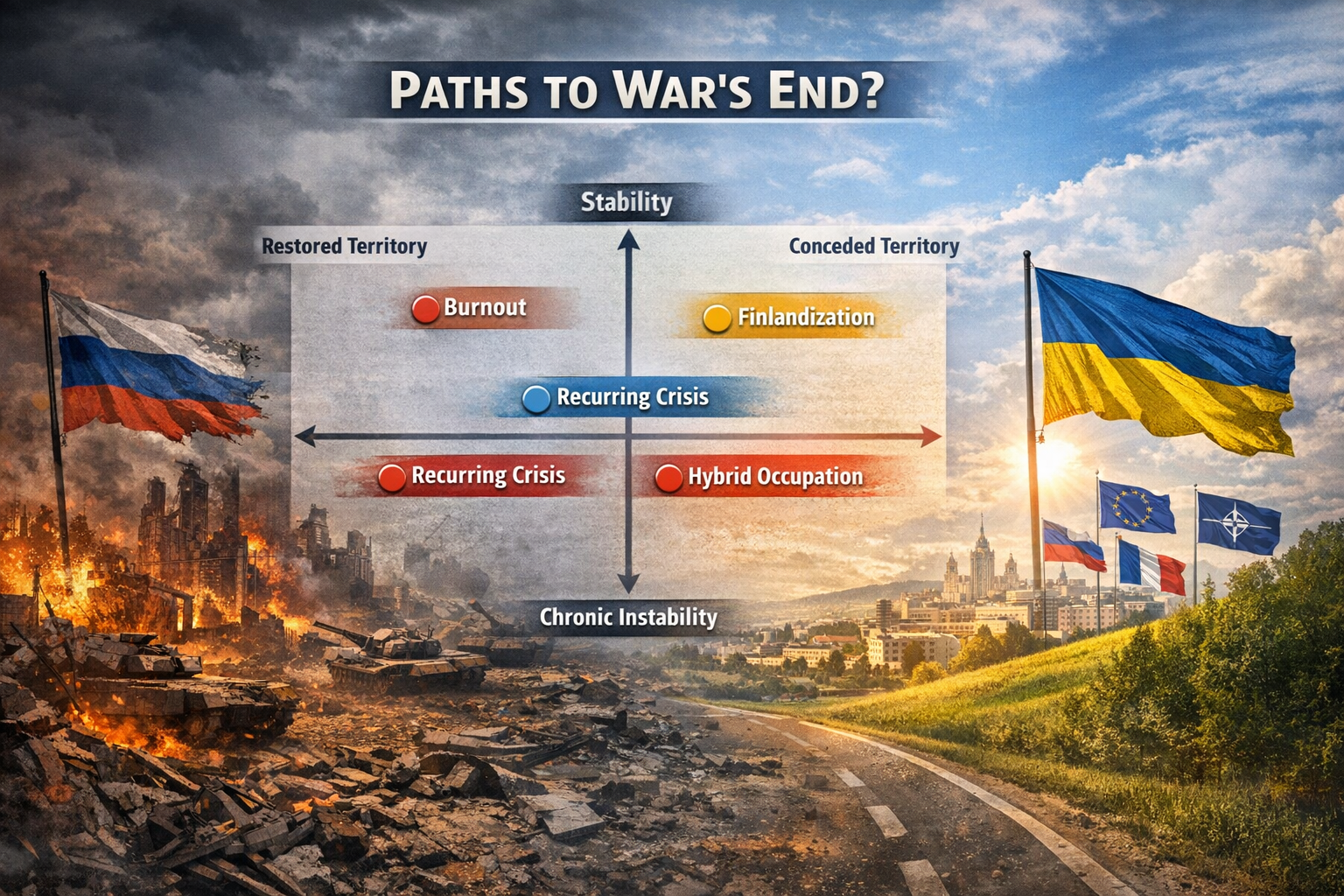
The comparative value of the analysis is most evident when these five war-termination models are considered in relation to one another, complementing the individual case research. Figure 1 presents a two-axis spectrum mapping each model according to two salient analytical dimensions for Ukraine: territorial outcome (ranging from restored to conceded territory) and post-war stability (from durable equilibrium to chronic instability). The goal is not to make predictions, but rather to make structured comparisons, identify patterns, constraints, and strategic consequences that consistently reappear across different models, and apply these insights to Ukraine’s contemporary negotiation environment. This spectrum was developed by examining four termination mechanisms: (1) the process by which hostilities ceased, (2) the extent of territorial change, (3) the security architecture that emerged after the cessation of violence, and (4) the durability of the resulting equilibrium. Each case was then abstracted into a core conflict-ending logic and placed in a two-dimensional matrix.

Figure 1. Spectrum of War Termination Models
When placed on this spectrum, the models reveal distinct strategic trajectories. Burnout and Armistice represent outcomes in which fighting stops but the political conflict is unresolved, producing frozen front lines with varying degrees of territorial cost and long-term stability. Finlandization reflects a settlement based on territorial concession and externally constrained neutrality, resulting in a politically sovereign but strategically limited state. The India — Pakistan pattern illustrates how unresolved sovereignty disputes can crystallize into recurring crisis dynamics, creating an unstable and militarized equilibrium over decades. At the far end of the spectrum is the Georgian scenario, representing the most adverse outcome of partial occupation combined with hybrid political influence that hollows out formal sovereignty and stalls integration into wider security communities, such as NATO and the EU.
This mapping reveals that most endgames pose significant vulnerabilities for Ukraine unless they are backed by robust and lasting Western security guarantees. Models that preserve sovereignty and are backed by credible deterrence strategies provide the most promising path to long-term stability. Conversely, outcomes involving territorial concessions, externally imposed neutrality, or low-deterrence equilibria risk perpetuating instability and limiting Ukraine’s future strategic choices.
Strategic Lessons for Ukraine
First, Ukraine must retain full agency in shaping any settlement. Historical experience from Finlandization to the Georgian case shows that outcomes imposed externally, or negotiated over the head of the victim state, produce fragile arrangements that erode sovereignty over time. A settlement perceived as coerced or externally designed risks destabilizing Ukrainian domestic politics, fracturing public trust, and weakening long-term resilience.
Second, strategic clarity is essential because ambiguity breeds vulnerability. The experience of the Baltic states whose unequivocal commitment to Western political, military, and economic integration strengthened their security stands in sharp contrast to the Balkans, where prolonged strategic ambiguity contributed to instability and external coercion. This reinforces the lesson from every scenario: ambiguity is dangerous, and Ukraine’s security depends on unambiguous Western anchoring, not “neutrality-for-peace” arrangements that historically erode sovereignty.
Third, no settlement should legitimize territorial losses or transform de facto lines into de jure borders. In every relevant case, freezing lines without resolving claims (Korea, Kashmir, Georgia) produced permanent instability. Diplomatic insights reinforce that Ukraine must uphold strict non-recognition of Russian occupation, preserving legal sovereignty and future leverage, just as the Baltic states did during fifty years of Soviet control.
Fourth, any future settlement will endure only if anchored in strong, institutionalized Western, above all European security guarantees. Historical precedents show that armistices and exhaustion-based ceasefires collapse without credible deterrence. The current war has demonstrated that Russia’s aims are revisionist rather than defensive. Ukraine therefore cannot rely on Russian restraint; its long-term security depends on embedding itself within European-led security structures. Europe has shifted from a supporting role to the central driver of Ukraine’s security, making Ukraine’s sovereignty inseparable from its own strategic stability. Only a robust, Europe-backed deterrence architecture can prevent renewed coercion and sustain a negotiated end to the war.
Finally, Ukraine must strengthen a resilient interim state while preserving the path to full restoration. Historical conflicts demonstrate that unresolved wars often enter prolonged transitional phases, but societies that continue reforming, rebuilding, and integrating during these periods emerge stronger and with greater leverage. As several diplomatic practitioners noted, Ukraine cannot afford to delay economic recovery, institutional reform, or progress toward EU accession until a perfect peace is achieved. Therefore, the priority is an interim strategy that enables recovery under imperfect security conditions, ensuring that no temporary arrangement becomes a permanent constraint. A democratic Ukraine anchored in the EU is the strongest foundation for safeguarding sovereignty today and achieving full territorial reintegration tomorrow.
Conclusions
This analysis shows that the war in Ukraine could end in several ways, but the implications of these outcomes for sovereignty, stability, and the European and global security order vary widely. Historical models show that outcomes which erode agency, concede territory without credible guarantees, or rely on weak deterrence tend to perpetuate long-term vulnerability. Conversely, settlements anchored in strong external commitments and preserved sovereignty tend to produce more durable equilibria.
At the same time, the analysis underscores the vulnerability of any settlement that depends disproportionately on sustained U.S. engagement, particularly given signals of strategic retrenchment and political variability. This reinforces the need for a more European-led, institutionalized security architecture, capable of providing durable guarantees even as U.S. commitments fluctuate. The comparative spectrum developed here shows that Ukraine’s future security trajectory and its place within the Euro-Atlantic architecture will be determined by the strategic quality of peace, not merely the cessation of hostilities. The decisive question is not when the war ends, but what kind of order follows it.
Read all of Small Wars Journal’s great content on the Russia-Ukraine War.