





Implementing Policies for Ukrainian Protection of Minority Languages: Been There, Done That, Got the T-shirt

It was surprising to see the Ukrainian implementation of European Union rules on religious tolerance and protection of linguistic minorities as a piece of the proposed peace deal presented on November 19, 2025. Not only does the Ukrainian Constitution already protect “all indigenous peoples and national minorities”, but Ukraine already adopted the European Charter for Regional or Minority Languages about 20 years ago. Why is this even included in peace talks?
Ukraine doesn’t need another policy to ensure fairness. Fair policies exist, and they’ve been affirmed as good policies – in written form. However, the actualization of these policies did not meet the written intention. The policies are not the issue at hand; incongruencies between the policies and societal impacts are the challenge that leaders need to address.
Ukraine’s initial adoption of the European Charter was rife with translation challenges, especially in differentiating a minority language that needed protection, versus a prolific non-state language, such as Russian. Now, Ukraine has removed Russian from “protected minority language” status on December 3, 2025, but was it even a minority language that needed protecting?
Protection of National Minority Languages: It Has Existed Since the Beginning
Protection of national minority languages has been mandated in Ukraine since the beginning: Even the constitution declares “all” indigenous peoples and national minorities of Ukraine as protected. The Ukrainian Constitution states (emphasis added):
- Article 10: Ukrainian is the State Language
- Article 10: In Ukraine, the free development, use and protection of Russian, and other languages of national minorities of Ukraine, is guaranteed.
- Article 11: The State promotes the consolidation and development of the Ukrainian nation… and also the development of the ethnic, cultural, linguistic and religious identity of all indigenous peoples and national minorities of Ukraine.
It’s hard to argue that “all” is an insufficient number of those granted protection.
Ukrainian identity has experienced evolution since Ukraine became independent and enshrined its Constitution. Ukrainian society adopted a civic, rather than ethnic, concept of what it meant to be “Ukrainian”, which is actually key to understanding the subsequent frustration along language lines. Language wasn’t divisive, as identity didn’t come from your native tongue. During the first two decades of Ukraine’s independence, Russian and Ukrainian languages began to merge, and bilingualism was increasingly the norm. It was not until the European law to protect minority languages was actualized in conjunction with a Russian power assertion in Ukraine through the Presidential elections (2004, 2010) that language grew into more of an indicator of faction and identity to the point of instigating contention. Regardless of direct causation, there was noted growth in social identification through linguistic alignment upon implementing this law. The increased societal clustering appears to have eaten away at the prior linguistic fusion and civic national identity that had evolved before the law was implemented, setting the stage for subsequent conflict.
The European Charter for Regional or Minority languages was adopted in convention as a condition of becoming a new member state of the Council of Europe in 1998. Ratifying this Charter was formally proposed in the Ukrainian Rada in 1999. Ukraine finally ratified a version of this agreement on September 19, 2003, which came into effect on January 1, 2006. The cumbersome passage of this law reflects the struggle to align this Charter with the Ukrainian Constitution and mindset; the European language policy was seen as a multilingual model that could set the stage for nationalist revolutions.
The European Charter focused on preserving the historical uniqueness of the many smaller cultures within larger nation-states. The intention was, and remains, to help preserve the heritage of minority populations within member states. Under Article 1, “… ‘regional or minority languages’ means languages that are both:
- Traditionally used within a given territory of a State by nationals of that State who form a group numerically smaller than the rest of the State population; and
- Different from the official language(s) of that state. It does not include either dialects of the official language(s) of the State or the languages of migrants.” (emphasis added)
These regional languages would be eligible to obtain “regional language status”. Hungarian, Romanian, and even the language of Crimean Tatars would all qualify as regional languages according to the language of this Charter. However, Russian was a language of migrants and not “traditionally used” in Ukrainian territory.
The Charter did not clarify what comprised a “regional language” or what rights were included in this designation. According to this law, there was no clear demographic benchmark to determine what would qualify as a regional language; it also did not identify requirements for regional leadership to use (or not use) the regional language. Rather, it merely permitted the use of regional languages in regions where the population demographic justifies the use of that regional language.
How Did the Russian Language and a Hot War Get All Mixed Up Here?
Russian language presented an odd challenge. Russian language speakers were not a minority culture group within Ukraine, like the Roma or the Tatars; Russian was a widely spoken language. While the Tatars’ language was clearly a regionally aligned language in Crimea, Russian language presence was primarily the result of externally imposed cultural alignment with Russia and was strongest wherever the Russians (either the Russian Empire or the United Soviet Socialist Republic, USSR) had established a community. Russian language was the official language of the USSR, and Russia relocated possibly millions of people from sites across the Russian Empire and then USSR to areas like Ukraine’s eastern mining regions and southern port cities. For many Ukrainians, permitting the use of the Russian language was not a concern – continued social dominance of the Russian language and marginalization of the official Ukrainian State language, especially in Russian-dominant regions, was the concern.
Vitaliy Radchuk of the Ukrainian Academy of Sciences noted that some of the terminology of the Charter was not compliant with the Ukrainian Constitution. The differences were small, but they further emphasized a balance between language and national identity within the Ukrainian mindset, specifically in the Ukrainian implementation of “language of a national minority” versus “minority language”. Ukrainian legal policies used terms such as “state language” and “languages of the national minorities,” whereas the Charter Ratification used “regional language group”, “language group”, and “minority language”. Small nuances can have huge impacts. However, even though the legal discrepancies were identified, this Charter went into effect on January 1, 2006.
Russian language within Ukraine had an odd position. First, Russian Language did not meet the status, quantitatively, of being a minority language: more people in Ukraine spoke Russian as a first, second, or third language than they did Ukrainian. Second, the spirit of the European Charter was intended to protect endangered languages, and Russian language was not endangered in Ukraine. And third, the term “traditional” ought not, historically, be applied to Russian language for Ukrainians: Russian language was brought to Ukraine by Russians.
Russian was spoken across Ukraine. As neither the state language nor a minority language, by definition, how did Russian language fit into Ukraine within the parameters of this law? Russian language began changing into a “minority” language rather than a language of commerce and trade. Even though Russian was protected as a minority language, this was a step down from its prior status. Following the contentious 2004 presidential election, 2006’s implementation was contentious: The Orange Party, led by President Viktor Yushchenko, sought to increase Ukrainian language use across Ukraine while the anti-Orange group, championed by Prime Minister Viktor Yanukovych, sought to increase the legal standing of Russian language.
Balanced policies could have enabled unity; however, this unity may not have come through enforcing a “pure Ukrainian” language. Ukraine experienced a nearly 20-year linguistic merging, rather than growth, of Ukrainian language. To commemorate Ukraine’s 19th anniversary, fourteen different Ukrainian ethnic groups performed a brief skit and then sang the Ukrainian national anthem in their own language. Non-Ukrainian language materials received Ukrainian subtitles, and the screen’s text stated, “We are diverse, but we are united.” The Razumkov Center conducted various sociological surveys on “native language” between 2006 and 2008. Over these years, the percentage of Ukrainians claiming Ukrainian as their sole “native tongue” (specifically by asking, “яка мова для Вас Є рідною?” directly translated as “What language is of you naturally?”) decreased by around 8%, and Ukrainians who claimed Russian as their sole “native tongue” also decreased by more than 4%. However, the percentage of those who claimed both languages, together, as their native tongue increased by over 13%. This change was negligible in the Western regions, where Ukrainian was clearly the dominant language. Below are tables, created from survey data directly following the implementation of this law, (1) showing native language evolution by regions and (2) emphasizing that Russian language was neither endangered nor a minority in most of the country.
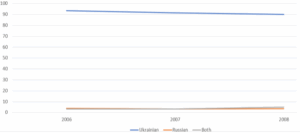
Graph 1: Russian and Ukrainian Language: Evolution in Western Ukraine 2006-2008
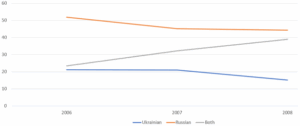
Graph 2: Russian and Ukrainian Language: Evolution in Central Ukraine 2006-2008
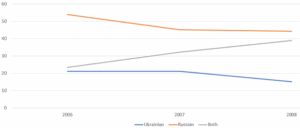
Graph 3: Russian and Ukrainian Language: Evolution in Eastern Ukraine 2006-2008
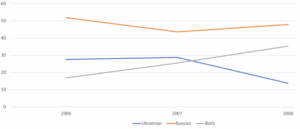
Graph 4: Russian and Ukrainian Language: Evolution in Southern Ukraine 2006-2008
In 2011, the Venice Commission (March 25-26, 2011, 86th Plenary Session) upheld the legitimacy and balanced writing of the Law on Ratification of the European Charter for Regional or Minority Languages. However, they also emphasized that a “central state language can be of the utmost importance” in maintaining cohesion between different linguistic groups of a country. The Venice Commission further emphasized, in concern, that “the Russian language was provided the same level of protection as the Ukrainian State language” under several articles. This detracted from the intent of the law.
Russian language marginalization was not a problem in 2004 when the “South-East Ukrainian Autonomous Region” advocated for independence once again. The principal driver for independence (1980s-2000s) was frustration with government corruption, with a perception that the region itself was marginalized. This is the same region that advocated for separation in 2014, but by that time, language and identity politics had become choice weapons to justify regional marginalization.
There was another parallel situation developing in Ukraine: that of Russian involvement in elections. In the 2004 presidential election, President Putin traveled to Ukraine to guide Ukrainians to vote for Viktor Yanukovych; Russia assumed that Ukraine was hers to influence. Election results were divisive: Exit polls demonstrated Viktor Yushenko (Orange Party) won the election while Viktor Yanukovych claimed victory. This triggered the Orange Revolution, a societal push from the Kremlin which apparently insulted President Putin. It was during Viktor Yushenko’s term that Ukraine experienced a notable fusion of language and identity. And it was the 2010 Presidential election, wherein Viktor Yanukovych won, when we started to see language and identity used as a political weapon, using the well-intentioned protections provided by Ukrainian laws shaped into the highly divisive 2012 “On the Principles of State Language Policy in Ukraine” (informally known as the “Kivalov-Kolesnichenko Law” or the “KK Law”).
If Ukraine Has Already Ratified Europe’s Policy, Why is Language Still An Issue?
There was a recent peace plan, admittedly considered a “living, breathing document” by US Secretary of State Rubio, that proposed adopting European rules on religious tolerance and the protection of linguistic minorities. Further, the Europeans also submitted their own proposal, which also included this same stipulation. But why? Not only does the Ukrainian Constitution enshrine protecting national minority languages, but subsequent legislation, inclusive of the ratification of the European Charter for Regional or Minority Languages, has also addressed this same topic.
There are plenty of laws on the books, seeking to create a system of what looks like a nationalistic counterbalance amidst Ukraine’s current politicized linguistic factionalization. The KK Law began digging legal trenches in the battlefield of culture and identity within Ukraine. Authors publicly promoted the idea of Russian Language as a second state language; however, they were aware that such a move could not garner the needed votes to amend the Ukrainian Constitution’s assertion that Ukrainian is the state language of Ukraine. This law used the language of the European Charter but was more directly used to expand the official use and legitimacy of Russian language within Ukraine, marginalizing the Ukrainian language and limiting the expansion of the Ukrainian language in “civil service, justice, education, mass media, culture, and entertainment.”
In 2019, Ukraine passed a law “On protecting the functioning of the Ukrainian language as the State language.” This new law replaced the contentious 2012 KK Law, which had been declared unconstitutional in February 2018, with the justification that “the procedure for the consideration and adoption of the law established by the Constitution was violated.” The intention of this new Law was to “strengthen the role of the Ukrainian language in state-building, ensuring the territorial integrity of Ukraine, and promoting national security.” (emphasis added) Security was perceived as part of a unified national identity; the Ukrainian language was the point of fusion for Ukrainian nationalism. Consequently, the Ukrainian language needed to be preserved and taught even in parts of Ukraine with other dominant languages, “in the exercise of powers by public authorities and local self-government bodies, as well as in other spheres of public life, as defined by” this 2019 law.
A new legal provision to the 2019 law was passed by Ukraine’s Rada and entered into force on January 16, 2022: Article 25, in particular, has been scrutinized by Human Rights watchers through its emphasis on ensuring all official publications should be published in Ukrainian; in the case of regional minorities, such as the Tatars of Crimea, publications would be in both languages. The 2019 Language Law and its 2022 provision were widely viewed as a harsh marginalization of non-Ukrainian language speakers.
Oh, So the Charter Must No Longer Be Active in Ukraine…
On December 3, 2025, Ukraine passed an amendment to the European Charter for the Protection of Regional and Minority Languages, removing Russian language from being listed as a “minority” language. This emerged from the work of the prior year. Ukraine’s Ministry of Culture emphasized, in 2024, that there is a clear difference between a “minority” and a “national minority.” A national minority is a sub-group that is culturally different from the dominant state culture, such as the Tatars of Crimea. However, a “minority” is a numerical association. This numerical allocation does not apply to Russian speakers in Ukraine.
OK, So the Policies as Proposed Requirements in the Peace Plan Already Exist…
In conclusion, it was very surprising to see the inclusion of language policy in the November proposal and then again in the European counterproposal. When we see a peace plan including the implementation of an already established policy for a country whose constitution includes “all” languages and ethnic groups, it becomes more than a bit curious.
Ukraine doesn’t need more policies. Outsiders telling Ukraine to implement redundant policies is not helpful. The human experience of the policies has affected policy actualization and realization, not the need for more policies. Yet the human experience is another, more nuanced and complicated topic for another day.


