





Past the Line of Disorder: Counter-Logistics as a Special Operations Capability

There exists an open secret in the military and policy circles that effectiveness alone does not determine the success of new ideas. While concepts like precision sustainment and predictive logistics have deservedly found their way into doctrine, this was not purely by merit. The truth is that such ideas “brief well” within communities already primed to support them. Who wouldn’t want all the support they need without having to ask for it? Furthermore, the rise of the information age has turned military thinkers and commanders onto any concept with ties to AI, cyber, or big data. Aside from the convenience and popularity associated with ideas, one must also consider their palatability. Put plainly, some ideas are simply too hard for leaders to swallow upon first inspection, and they suffer for it accordingly.
One such idea has gone under several aliases within military doctrine and research articles but has failed to stick long-term. Counter-logistics (c-LOG) can ostensibly be defined as the analysis of enemy support systems and supply chains for the purpose of degradation, destruction, or exploitation. This article will argue for the incorporation of c-LOG into the planning and experimentation of units across the joint force from the tactical level and up, with a particular emphasis on special operations forces (SOF). The historical precedence will be covered, the gap in current capabilities will be identified, and recommendations will be presented and deliberated.
Historical Precedence
While c-LOG, as this article aims to conceptualize it, remains an untested concept, analogs have existed since before the start of organized warfare. Raiding parties since pre-history have primarily targeted other forces or peoples for access to their supplies or stockpiled goods. The Assyrians created dedicated units to recon for horses across the empire and neighboring lands to “acquire” for their army’s chariot force. Ancient Greeks set about disrupting Persian supply lines in the Peloponnesian War, and Hannibal frequently sought to destroy Roman depots during the Second Punic War. Much later, similar tactics would be used by guerrilla forces in the Peninsular War to disorient Napoleon’s forces in Spain by disrupting their lines of communication and supply.
The number of such analogs increased dramatically during the previous century, with the two world wars serving as the pinnacle of such tactics. The First World War saw German agents causing explosions across the U.S. at strategic locations like Black Tom Island, just south of Manhattan. These attacks were meticulously planned, well-executed, and covert in nature. Yet, they were ultimately outdone in both scope and scale by the events of the Second World War. Multiple nations organized agencies and units specifically tasked with exploiting strategic logistical targets. The Office of Strategic Services (OSS) and Special Operations Executive (SOE) established Jedburgh Teams to disrupt Nazi German supply lines and depots across occupied France and beyond. Such units ran training programs for partisans in occupied nations, which taught them to identify key targets and execute isolated attacks. Finally, individual operations proved to have outsized effects, such as the SOE’s Operation Jaywick, wherein agents disguised as Malay fishermen managed to sink 30,000 tons of Japanese shipping in Singapore Harbor.
Gap Identification
The current gap in capabilities in regard to c-LOG has much to do with the split between planning and execution. The records of all the previously shared historical analogs focus almost entirely on strategic sabotage. There is no discussion of the planning process that led to the identification of targets or of the considerations made before operations began. With recent successes in Ukraine, the efficacy of targeting enemy logistics is clear; planning efforts must be given equal attention. Some have recently argued for the collaboration of intelligence and logistics personnel to focus on this problem set, but even this may not be enough. The modern age calls for a far more robust system of collaboration to identify enemy support targets and execute effective attacks.
The problem of underrepresentation persists today, as open-source articles and doctrine fail to cover the benefits of logistics targeting, preplanned interdiction (tactical sabotage), and related concepts. Without the tipping of this first domino, planning and experimentation remain far less likely. Tactical-level units can research historical cases and attempt to apply lessons learned, but large-scale change is needed and most often happens at the strategic level.
The Army and joint force are in need of doctrine, funding, and dedicated units aimed at the identification, degradation, destruction, and exploitation of enemy support assets. Predatory logistics can bolster a system already spread too thin in large-scale combat operations (LSCO), and lessons learned from enemy logistical analysis can be utilized to strengthen friendly support networks. Interdiction is too circumstantial, strategic sabotage is too limited, and logistical targeting is only a half-measure; now is the time to pursue counter-logistics with an eye on the future fight.
Recommendations
Three recommendations can be offered. First, doctrine and further research must drive efforts toward planning and experimentation. Waves of military ink have already been spilled discussing the importance of preparing support systems and personnel for the next conflict. The Army alone has put immense emphasis on the development of support equipment and tactics for performing logistics in a contested environment. Efforts like the Contested Logistics-Cross Functional Team and Project Convergence are already making notable progress since their creation. Additionally, emerging logistical technology is being experimented on within CASCOM, the Battle Lab, and the Sustainment Capability Development Integration Directorate (SCDID). Placing an emphasis on c-LOG efforts during commiserate planning and experimentation could have outsized effects in the next conflict.
Secondly, a robust effort must be made toward creating integrated teams dedicated to analyzing and applying c-LOG in contingency plans (CONPLAN) and operations. The sensitive nature of these operations and the suite of capabilities needed to plan them make Army Special Operations Forces (ARSOF) an ideal home for such teams. A proposed model for c-LOG operations teams would center on logistics personnel with experience in non-standard logistics and intel personnel proficient in targeting. The spokes around this hub would include Psychological Operations (PSYOP) Soldiers to handle the information operations (IO) and military deception (MILDEC) aspects, Civil Affairs (CA) to analyze civil considerations, engineers to advise on infrastructure and demolition, and Cyber to incorporate emerging technologies. Integration with Special Forces (SF) teams would allow for the execution of c-LOG plans and solve the persistent issue of access and placement (A&P).
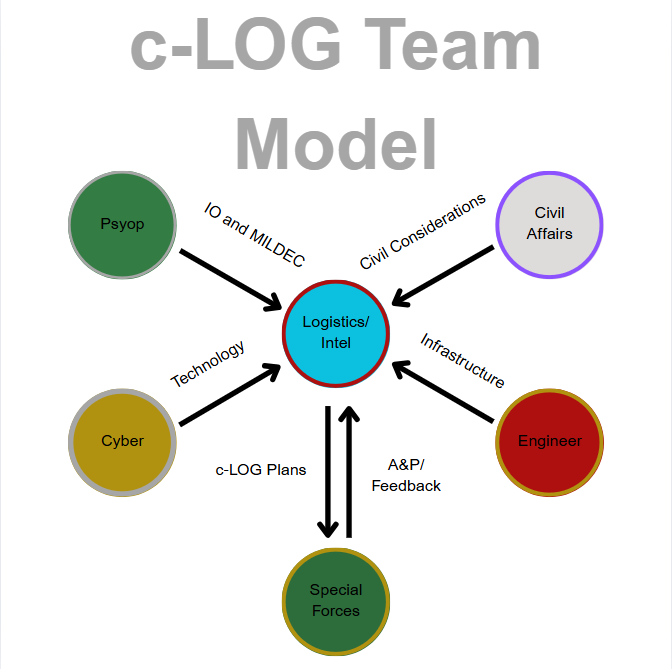
Figure 1. Proposed c-LOG Cross-Functional Team Model. The structure is noted, but individual manning is left ambiguous.
Finally, it is up to individuals and units at the lowest level to push for the change this article is advocating for. While strategic level change is needed in the long term, innovation in the realm of logistical targeting and predatory logistics has always taken place in the tactical realm. Let this be a call to those in this realm to study the logistics of nations like China and Russia, to integrate preplanned interdiction into their field training, and to advocate to their leadership for investment into c-LOG. Those whose lives will depend on it most must call for support for this concept, despite its lack of convenience, popularity, or palatability. Though it might not “brief well”, it is time to push the enemy past the line of disorder.
The views expressed are those of the author alone and do not reflect the official position of Small Wars Journal, the 528th SB (SO) (A), the United States Army, or the United States Government.


