





A Strategic Opening: Fighting Haiti’s Criminal Insurgency
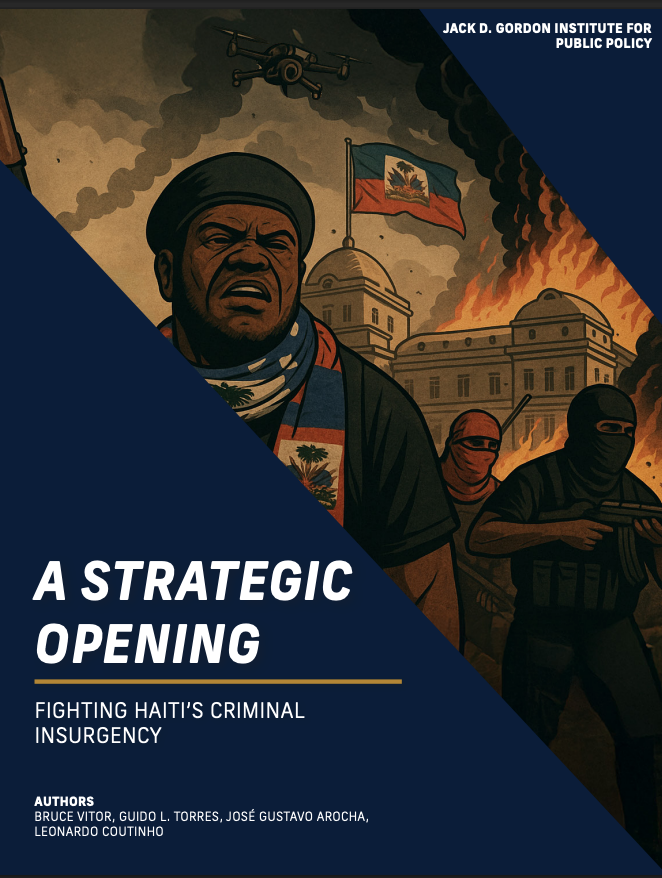

A Strategic Opening: Fighting Haiti’s Criminal Insurgency by Bruce Vitor (Florida International University), Guido L. Torres (Irregular Warfare Initiative), José Gustavo Arocha (Center for a Secure Free Society), and Leonardo Coutinho (Center for a Secure Free Society)
EXECUTIVE SUMMARY
Haiti is experiencing the most severe security collapse in its modern history with gangs consolidating territorial control, degrading state authority, and evolving into what Max G. Manwaring defines as “third-generation gangs,” criminal-insurgent hybrids that challenge the state’s monopoly on force. As of September 2025, armed groups control approximately 85 percent of Port-au-Prince, govern critical routes in Artibonite and Centre, regulate economic life through taxation and extortion, and conduct coordinated military-style assaults against state institutions.1 The result is a de facto criminal state within the state. Haiti’s instability now represents an acute threat to regional security, migration management, and U.S. strategic interests in the Caribbean. The crisis exemplifies an irregular warfare environment in which nonstate actors contest the state’s legitimacy through armed coercion, economic predation, and information manipulation—blurring the line between criminality and insurgency.
The 2024 Multinational Security Support (MSS) mission achieved limited tactical and strategic gains, retaking key sites and supporting Haitian National Police training but proved under-resourced and undermanned. With only US$113 million of the US$600 million required and fewer than 1,000 of 2,500 authorized personnel deployed, the mission lacked logistical reach, intelligence, surveillance, and reconnaissance, and political cohesion to reverse Haiti’s slide toward insurgent governance. The deteriorating security conditions prompted the United Nations Security Council to authorize Resolution 2793 on September 30, 2025, transitioning the MSS into a larger, better-resourced Gang Suppression Force (GSF) with 5,500 authorized personnel and expanded military capabilities.
Haiti’s security institutions remain critically weakened. The Haitian National Police, reduced to approximately 12,500 officers, struggles with attrition, leadership instability, and inadequate coordination.2 Specialized units, such as the Temporary Anti-Gang Unit (Unité Tactique Anti-Gang or UTAG) and Special Weapons and Tactics (SWAT), have demonstrated operational competence but lack scale. The Haitian Armed Forces (FAďH) remain in early-stage rebuilding, with fewer than 1,300 soldiers and minimal training capacity.3 Gangs have transformed into insurgent-like actors through territorial governance, coercive taxation, parallel justice structures, prison breaks, targeted political violence, and sophisticated operational innovations that include drones, encrypted communications, and coordinated multifront assaults. Their financial power rests on kidnapping, extortion, and weapons trafficking, much of it enabled by U.S.-sourced firearms. These networks now exert political influence, challenge state authority, and shape national decision-making. The territorial, economic, and political penetration of gangs has generated mass displacement, deepened humanitarian suffering, and created a permissive environment for malign state actors seeking strategic leverage in the Caribbean.
This report concludes that Haiti is not facing a conventional crime problem but an entrenched insurgency. The country sits at a tipping point: Without rapid, coordinated, and adequately funded international action, Haiti risks fully transitioning into a criminally governed state with profound regional consequences. To reverse this trajectory, the report offers a tiered set of near-term, medium-term, and long-term policy recommendations for the U.S. interagency, regional partners, and the incoming GSF.
Taken together, these measures aim to degrade gang operational capacity, restore state territorial control, protect civilians, and set the conditions required for humanitarian access and credible elections. Without decisive action, the expansion of criminal insurgent governance will further destabilize the region and erode the security architecture of the Western Hemisphere.

