Are Nuclear Weapons Becoming Unusable Against Non-Nuclear States?

Abstract
Russia’s war on Ukraine and the US and Israeli campaign against Iran are the first major interstate wars since the end of the Cold War in which nuclear-armed states have failed to achieve their central objectives against non-nuclear opponents. Both are being fought amid explicit nuclear signaling and the collapse of the arms control architecture that framed earlier conflicts of this kind. This analysis asks whether nuclear weapons are becoming unusable against non-nuclear states. It compares the two current wars with earlier wars between nuclear-armed and non-nuclear states since 1950, then assesses the four constraints usually credited with preventing nuclear use. It finds that the answer depends on what use means. As instruments of warfighting, nuclear weapons have been largely unusable against non-nuclear states since 1945. As instruments of coercion aimed at those states’ nuclear-armed backers, they remain in constant use. What is new is not this usability gap but the condition of the constraints that sustain it. The legal and normative constraints are weakening, which leaves restraint resting increasingly on strategic calculation—the constraint least reliable when a war is going badly.
Introduction
Two of the most consequential wars of the decade thus far share a feature that ought to unsettle strategic theory more than it does. In each, a nuclear-armed state is fighting a state that possesses no nuclear weapons, and in each, the nuclear power has been unable to convert its ultimate advantage into a decisive result. Russia, holder of the world’s largest arsenal, has waged war on a non-nuclear Ukraine since February 2022 without breaking Ukrainian resistance. The United States and Israel have struck a non-nuclear Iran repeatedly since June 2025, most heavily in the campaign that began on February 28, 2026, without ending the program those strikes were meant to eliminate.
Nuclear-armed states have fought non-nuclear states before, so it is fair to ask why these two wars warrant fresh attention. The answer lies in a combination of features that no earlier case shared. First, both are interstate wars in which the nuclear-armed side has so far failed to achieve its central objective, unlike the Gulf War of 1991, the Iraq War of 2003, or Russia’s war with Georgia in 2008. Second, nuclear signaling has been explicit rather than implicit. In October 2022, President Joe Biden warned that, for the first time since the Cuban Missile Crisis, the world faced a direct threat of nuclear use, as the Foundation for Strategic Research (FRS) recorded at the time. Third, the non-nuclear belligerents are backed by nuclear-armed patrons, the precise circumstance that the exclusion clauses in several nuclear-weapon states’ security assurances were written to cover. Fourth, these wars are unfolding as the arms control architecture that framed earlier conflicts collapses. The last US-Russian strategic arms treaty expired in February 2026, and three successive review conferences of the nuclear Non-Proliferation Treaty have now failed to agree on an outcome. Earlier wars of this type occurred while that architecture was being built. These are occurring while it is being dismantled.
This analysis therefore asks whether nuclear weapons are becoming unusable against non-nuclear states, and its answer turns on a distinction between two meanings of use. As instruments of warfighting, meaning detonation to achieve a military result, nuclear weapons appear close to unusable against non-nuclear states and have been for most of the nuclear age. As instruments of coercion, meaning the manipulation of risk to shape the behavior of others, they remain very much in use, but their main audience is the non-nuclear state’s nuclear-armed backers rather than the non-nuclear state itself. Nuclear weapons are therefore not becoming irrelevant. They continue to deter direct great-power intervention, to shape every rung of the escalation ladder, and to define the outer limits of what belligerents dare attempt. What these wars expose is a gap between the possession of overwhelming nuclear superiority and the ability to convert it into victory against an adversary that has forsworn the bomb.
The analysis proceeds in three steps. It first sets out the two current cases and compares them with earlier wars between nuclear-armed and non-nuclear states since 1950 to establish whether the usability gap is new. It then examines how the arsenals are still being used in the current wars, despite never being detonated. Finally, it assesses the four constraints usually credited with keeping nuclear weapons unused. The doctrinal constraint consists of nuclear-armed states’ declared commitments not to use nuclear weapons against non-nuclear states. The normative constraint is the taboo against nuclear use that has developed since 1945. The military constraint is the judgment that conventional forces can achieve whatever is militarily necessary, so nuclear weapons add little. The strategic constraint is the calculation that the costs of nuclear use, including escalation, isolation, and precedent, would exceed any gain.
This approach yields three principal findings. First, the usability gap is longstanding rather than new, since outcomes in these wars have tracked the conventional balance and the opponent’s resolve rather than the nuclear balance. Second, the arsenals remain in active coercive use, with nuclear-armed patrons as their primary audience. Third, the four constraints are of unequal strength: the doctrinal and normative constraints are the weakest in these cases, and the evidence suggests that they are also the ones eroding over time. Restraint thus rests increasingly on military and strategic calculation, which is most vulnerable in what this analysis calls the frustration scenario, in which a nuclear power faces defeat. The final sections examine that scenario and its implications for proliferation.
The Two Cases: Superiority Without Victory
The asymmetry between the two sides is stark. The Stockholm International Peace Research Institute (SIPRI) estimates that, at the start of 2026, the nine nuclear-armed states together held some 12,187 warheads, of which around 9,745 sat in military stockpiles for potential use. According to the Federation of American Scientists (FAS), Russia and the United States between them account for roughly 86% of that inventory, with Russia holding about 5,420 warheads and the United States about 5,040. Against this stand the arsenals of Ukraine and Iran, both of which are empty.
Chart 1: Approximate Total Nuclear Warhead Inventories, Early 2026

Sources: FAS, Status of World Nuclear Forces 2026; SIPRI Yearbook 2026.
If military outcomes were a simple function of destructive capacity, both wars would already be over, and the fact that they are not shows that nuclear superiority does not convert easily into results against non-nuclear states. The imbalance is also misleading in another respect. Of the warheads in global military stockpiles, around 4,000 are deployed, and between 2,100 and 2,200 are on high alert; almost all of them are Russian, American, British, or French. This readiness is configured overwhelmingly for one purpose, which is deterring other nuclear powers. It was never designed for the coercion of a determined non-nuclear adversary on the ground.
Ukraine’s position is often described as doubly instructive, because it emerged from the Soviet collapse with the world’s third-largest nuclear arsenal. Under the 1994 Budapest Memorandum, Kyiv transferred those warheads to Russia and acceded to the Treaty on the Non-Proliferation of Nuclear Weapons (NPT) in exchange for assurances from Russia, the United States, and the United Kingdom to respect its sovereignty and borders. The popular claim that Ukraine thereby gave up its deterrent needs careful handling, however. Under the 1991 Minsk agreement, charge of the former Soviet arsenal passed to the Russian government, with Kyiv holding (at most) veto power over use, so what Ukraine surrendered was latent leverage and the option of an independent force rather than a ready deterrent. Those assurances were broken in 2014 and again in 2022. Even so, Ukraine has fought Russia to an attritional standstill along much of the front, has struck deep into Russia, including in a mass drone attack on Moscow in May 2026, and remains undefeated.
Iran presents the mirror image: a state that never acquired the bomb and has been bombed to stop what Israel and the United States allege was an advance toward the nuclear threshold. Tehran denies seeking nuclear weapons, and in June 2025, the Director General of the International Atomic Energy Agency (IAEA) said that the agency had no proof of a systematic Iranian effort to build one, even as it found Iran in breach of its safeguards obligations. The June 2025 strikes, which included the first combat use of the largest conventional bomb in the US arsenal against the buried Fordow enrichment plant, inflicted severe damage. Yet both the IAEA Director General and a leaked US intelligence assessment judged that the program had been set back by months, and the International Institute for Strategic Studies (IISS) concluded that the strikes disrupted Iran’s program without destroying its key facilities. Iran then legislated an end to cooperation with the IAEA. A far heavier US and Israeli campaign from February 2026 killed the Supreme Leader and widened into a regional war, during which Iran’s effective closure of the Strait of Hormuz produced a global energy shock. According to the Council on Foreign Relations (CFR) conflict tracker, a Pakistan-mediated interim deal in June halted large-scale fighting, but both sides have since traded strikes over alleged violations, and the tracker now rates the conflict as worsening. In October, Washington accused Tehran of once again enriching uranium to 60%.
Table 1: A Comparative Anatomy of the Two Conflicts
| Dimension | Russia and Ukraine | United States/Israel and Iran |
|---|---|---|
| Nuclear-armed belligerent | Russia (approx. 5,420 warheads) | United States and Israel (approx. 5,130 warheads combined) |
| Non-nuclear belligerent | Ukraine (0; inherited Soviet weapons were under Moscow's operational control and were returned by 1996) | Iran (0; NPT party found in breach of its safeguards obligations by the IAEA in June 2025; denies seeking nuclear weapons) |
| Negative security assurance | Russia's pledge excludes non-nuclear states that attack it in association with a nuclear-weapon state. | US and UK pledges exclude non-compliant states; Israel has issued none. |
| External support to the nuclear-armed belligerent | North Korean troops (confirmed by NATO in October 2024), munitions, and Iranian-designed drones | Extensive US military support to Israel and direct US participation in strikes |
| External support to the non-nuclear belligerent | Extensive military and financial support from the United States, the United Kingdom, France, and other Western states, three of which are nuclear-armed | Alleged support from Russia and China, both nuclear-armed |
| Nuclear signaling | Repeated threats; doctrine revised in late 2024; strategic nuclear exercises in May 2026 | Limited; strikes aimed at preventing, not using, nuclear weapons |
| Non-nuclear counter-leverage | Deep drone strikes, including on Moscow, in May 2026 | Closure of the Strait of Hormuz and a global energy shock |
| Nuclear weapons used? | No | No |
| Outcome so far | Attritional war; no Russian victory | Program damaged but not eliminated; interim deal eroding; conflict rated as worsening |
Both nuclear-armed belligerents also receive outside support. Russia draws on North Korean troops and munitions and on Iranian-designed drones, and Israel relies heavily on the United States, which has fought alongside it. What distinguishes the support flowing to the non-nuclear side is that it comes from nuclear-armed states. Ukraine’s principal backers include three of the five nuclear-weapon states recognized by the NPT, and Iran’s alleged backers, Russia and China, are both nuclear-armed. This matters for two reasons developed below. It places both non-nuclear belligerents inside the exclusion clauses of the relevant security assurances, and it makes the patrons, rather than the belligerents themselves, the primary audience for nuclear coercion. Support to the nuclear-armed side, by contrast, does not alter the nuclear balance. The structural situation is therefore one that classical deterrence theory treats as especially dangerous: a nuclear power facing frustration and possibly defeat at the hands of a state it could in principle devastate within minutes, while that state’s backers are themselves nuclear-armed.
A Longstanding Gap: The Historical Baseline
Before treating Ukraine and Iran as evidence of change, it is worth asking whether nuclear weapons were ever usable against non-nuclear states. Table 2 lists the major interstate wars since 1950 in which a nuclear-armed state fought a non-nuclear state directly. It is illustrative rather than exhaustive. It excludes counterinsurgency campaigns against non-state actors, crises that did not become wars, and proxy conflicts, and it treats Israel as nuclear-armed from the late 1960s, as most open-source assessments do.
Table 2: Nuclear-Armed States Against Non-Nuclear Opponents Since 1950
| Conflict | Nuclear-armed party | Non-nuclear opponent | Outcome |
|---|---|---|---|
| Korean War, 1950–1953 | United States | North Korea; China (non-nuclear until 1964) | Stalemate and armistice; nuclear options discussed but not used |
| Vietnam War, 1965–1973 | United States | North Vietnam | US withdrawal; North Vietnamese victory in 1975 |
| Yom Kippur War, 1973 | Israel (undeclared) | Egypt and Syria | Non-nuclear states initiated the war; Israel recovered conventionally |
| Sino-Vietnamese War, 1979 | China | Vietnam | Chinese withdrawal after about a month; inconclusive |
| Falklands War, 1982 | United Kingdom | Argentina | Non-nuclear state initiated the war; British conventional victory |
| Gulf War, 1991 | United States, United Kingdom, and France (in coalition) | Iraq | Decisive coalition conventional victory; ambiguous US warning against Iraqi chemical use |
| Iraq War, 2003 | United States and United Kingdom | Iraq | Regime overthrown by conventional force; prolonged insurgency followed |
| Russia–Georgia War, 2008 | Russia | Georgia | Rapid Russian conventional victory |
| Russia–Ukraine War, 2022–present | Russia | Ukraine | Ongoing; no Russian victory |
| United States/Israel–Iran, 2025–present | United States and Israel | Iran | Ongoing; program not eliminated |
The record shows that nuclear-armed states have both won and lost such wars, and that in neither case were nuclear weapons the deciding instrument. As Michael Gerson observed in Parameters, nuclear weapons gave the United States no significant advantage before or during the Korean and Vietnam wars, did not dissuade Egypt from attacking Israel in 1973, and did not deter Argentina from seizing the Falkland Islands in 1982. The evidence from the Egyptian and Argentine cases suggests that their leaders calculated, correctly, that the taboo against nuclear use would protect them. Where nuclear-armed states did prevail, as in the Gulf War, the 2003 invasion of Iraq, and Russia’s war with Georgia, they did so with conventional forces that were decisively superior to those of their opponents. The Gulf War also shows that nuclear coercion did not disappear in those cases. Before the war, Secretary of State James Baker warned Iraq’s foreign minister that any use of chemical or biological weapons would bring a response that the Arms Control Association (ACA) notes was broad enough to include every weapon the United States possessed.
Two inferences follow from this record. The first is that the usability gap is not new but a structural feature of the nuclear age, visible within a decade of Hiroshima. Across these cases, outcomes have tracked the conventional balance, the opponent’s resolve, and the nuclear power’s political objectives rather than the nuclear balance. The second inference sets the agenda for the rest of this analysis. If the gap is old, then what may be new in 2026 is not the gap itself but the condition of the constraints that sustain it. Whether those constraints are in fact weakening is an empirical question, and the evidence for it is set out below.
A further qualification is needed, since the quantitative literature does not show nuclear weapons to be worthless against non-nuclear states. Kyle Beardsley and Victor Asal, cited in the FRS analysis, found that nuclear actors are more likely to prevail in crises with non-nuclear opponents. The apparent contradiction dissolves once crises are distinguished from wars. The shadow of the bomb may induce caution before fighting begins, yet it loses much of its force once a non-nuclear opponent has concluded that it is fighting for national survival and is prepared to bear the costs. Ukraine since 2022 and Iran under sustained bombardment are precisely such opponents.
Coercion Without Detonation: What the Arsenals Still Do
The unusability thesis is strongest if use means detonation and weakest if use means coercion, and here the Ukraine case is more ambiguous than it first appears. Russia’s arsenal has not intimidated Kyiv, but it has shaped the conduct of Kyiv’s backers. The FRS observes that Russian deterrence against the United States and the North Atlantic Treaty Organization (NATO) has worked, describing the result as a form of aggressive sanctuarization. The nuclear shield did not win the war, but it allowed a large conventional war of aggression to be fought without direct NATO intervention, and Moscow’s warnings over long-range systems have plainly entered Western calculations about what to supply and when.
In this sense, the weapons are used continuously and in ways consistent with how Thomas Schelling understood and articulated the idea of the manipulation of risk. Their audience is not the non-nuclear belligerent, but its nuclear-armed patrons, and their mechanism is the threat that leaves something to chance rather than the delivery of warheads. Moscow has blurred the line further by firing nuclear-capable systems armed with conventional warheads. SIPRI records that dual-capable Oreshnik missiles were used against Ukraine as recently as May 2026, and the German Council on Foreign Relations (DGAP) notes that the heavy Russian strike on Kyiv on May 24 employed numerous nuclear-capable weapons with conventional payloads. Such strikes are designed to remind every audience that the next payload could be different.
The Iran case differs in an important respect. There, the objective of the United States and Israel was counterproliferation, and counterproliferation has strong reasons to be pursued with conventional means. Using nuclear weapons to stop a state from acquiring them would destroy the very norm the strikes claim to enforce and would hand Tehran and other aspiring proliferators the strongest possible argument for the bomb. Nuclear strikes on enrichment and conversion sites would also add fallout to whatever radiological and chemical hazards those facilities already pose. For Israel, nuclear use would end the policy of deliberate ambiguity on which its own deterrent rests. And US planners judged that conventional penetrating munitions could do the job, at least at Fordow.
Whether anyone sought nuclear options against Iran cannot be known with certainty. There is no public evidence that nuclear use was considered, but classified planning cannot be ruled out, and the same uncertainty applies to Russian planning over Ukraine. The safer conclusion is that the Iran case tests the limits of conventional counterproliferation more than it tests the usability of nuclear weapons. Its main lesson concerns those limits against a dispersed, buried, and reconstitutable program, a point that bears directly on the military constraint discussed below. Taken together, the two cases confirm the distinction drawn at the outset. Nuclear weapons are close to unusable against non-nuclear states as instruments of warfighting, yet remain highly usable against those states’ patrons as instruments of coercion.
The Four Constraints Assessed
If nuclear weapons remain coercively useful, the question becomes why their owners have not gone further. Restraint against non-nuclear states is usually attributed to the four reinforcing constraints defined above. Examined against the two current wars, however, these constraints are not of equal weight, and the one most often cited proves to be the weakest.
The doctrinal constraint holds that nuclear-armed states have committed themselves, through declared policy, not to use nuclear weapons against non-nuclear states. Its core is the set of negative security assurances issued by the five NPT nuclear-weapon states and noted by the UN Security Council in Resolution 984 of 1995. These pledges are non-binding, and their exclusions cover both current wars. Russia’s assurance has long excluded non-nuclear states that attack it in association or alliance with a nuclear-weapon state, an exception reaffirmed in its late-2024 doctrine, and Ukraine fights with the backing of three nuclear powers. The US assurance, as the 2022 Nuclear Posture Review restates, applies only to non-nuclear NPT states in compliance with their non-proliferation obligations, and Secretary of Defense Robert Gates made clear in 2010 that for non-compliant states all options remain on the table. The IAEA’s June 2025 finding against Iran places Tehran outside both the US and the British assurances, while Israel has never issued one. Declaratory policy, in other words, largely permits what restraint has so far prevented, and the explanation for non-use must lie elsewhere.
The normative constraint holds that nuclear use has become illegitimate, so that leaders refrain even where declared policy would permit it. This is the tradition of non-use that has held since 1945, otherwise known as the nuclear taboo. Its strength, however, is genuinely contested. Nina Tannenwald, the taboo’s principal theorist, acknowledges that its influence is hard to disentangle from deterrence, fear of escalation, and simple lack of military utility. The survey experiments of Scott Sagan, Daryl Press, and Benjamin Valentino, discussed in the same study, found that American and Indian publics would support nuclear first use under certain hypothetical conditions, which suggests that public aversion is shallower than official rhetoric implies. The taboo may therefore restrain leaders more through anticipated reputational costs than through conviction, which makes it only as strong as the penalties others are willing to impose. Tannenwald’s further observation that the taboo has made nuclear threats against non-nuclear states steadily less credible helps explain why Kyiv has repeatedly crossed Russian red lines without nuclear consequence.
The military constraint holds that, against a non-nuclear opponent, conventional forces can do every necessary job, so there is no military reason to cross the threshold. In Ukraine, this logic largely holds. Dispersed infantry, mobile air defenses, and command posts offer no concentrated target worth a warhead, and the operational signs of preparation are absent. DGAP observed that during the May 2026 strategic exercise, Russia did not pull back its combat forces, which made a frontline tactical nuclear strike impractical. Iran is different, and it exposes a crack in the logic. The ACA reported that the Chairman of the Joint Chiefs of Staff told senators in June 2025 that the United States lacked the capability to destroy the deeply buried facilities at Isfahan. In October 2026, according to a report cited by the CFR tracker, Washington was weighing use of the largest blast weapon in its conventional inventory against Iran, an indication of how far up the conventional ladder planners have climbed. Deeply buried and hardened sites are precisely the target set for which nuclear earth-penetrating weapons have long been argued to offer a unique effect. The premise that conventional forces can do every necessary job therefore did not hold for every target in this war. The military constraint is strongest in Ukraine and weakest in Iran, the reverse of the doctrinal pattern.
The strategic constraint holds that, whatever its military effect, nuclear use would cost the user more than it could gain. This is the most robust of the four. A nuclear power that struck a non-nuclear state would invite responses it could not bound. It would set a precedent for first use against a non-nuclear state, and hand other nuclear-armed states a justification for lowering their own thresholds in their own regional disputes. It would also demolish the core argument of the non-proliferation regime, that forgoing the bomb is safer than acquiring it. If Russia were to use a nuclear weapon against Ukraine, it would give the United States and its allies reason to discard restraints of their own. The economic costs would also be severe. The FRS argues that nuclear use would probably push states that still trade with Moscow, including China and India, to cut their ties, possibly under the pressure of Western secondary sanctions. For a Russia whose wartime economy depends on Asian markets, this may be the decisive brake.
The overall pattern is therefore uneven. In these two cases, restraint appears to rest less on law and norm than on military and strategic calculation, which is a sturdy foundation in ordinary circumstances but a brittle one when a leadership’s calculations change. Whether this marks a change over time, rather than a feature of these particular wars, is a separate claim, and the next section sets out the evidence for it. Figure 1 summarizes the assessment.
Figure 1: The Usability Gap
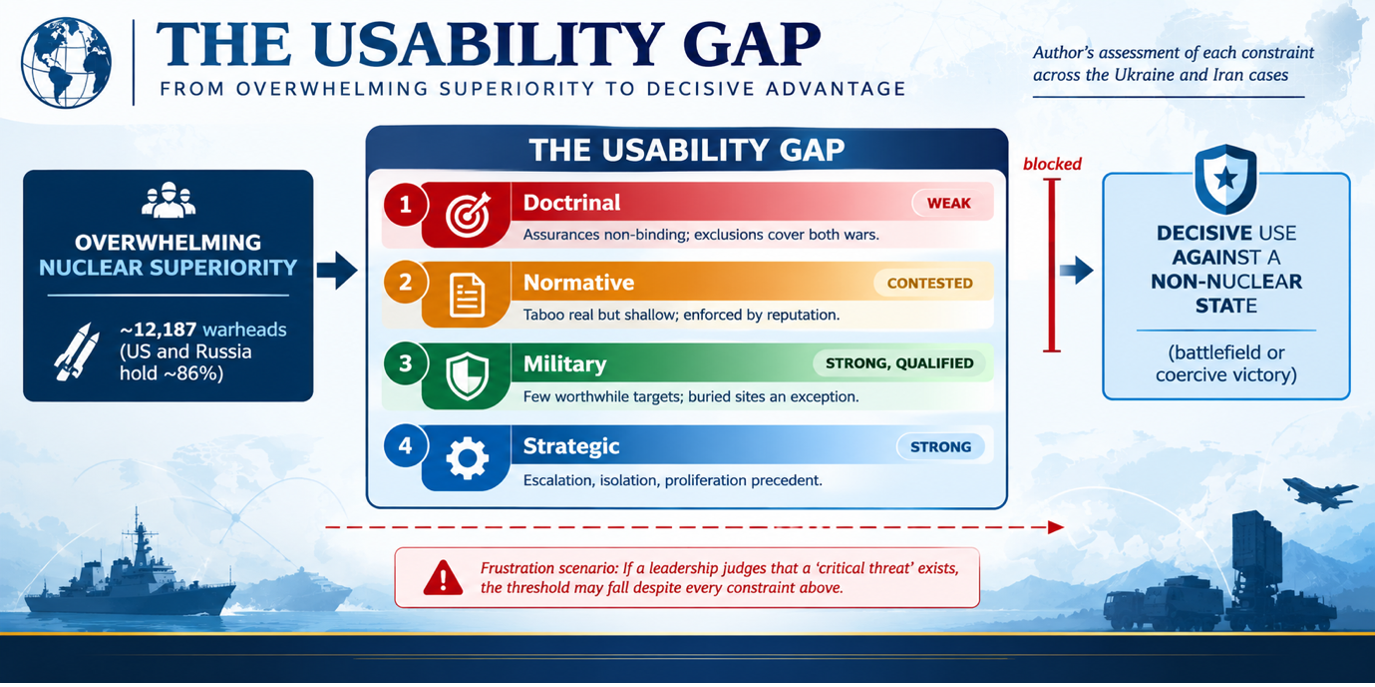
Four constraints separating nuclear possession from use against a non-nuclear state, with the author’s assessment of their strength in the two current cases.
What Has Changed: The Erosion of the Constraints
Four strands of evidence suggest that the doctrinal and normative constraints are weaker in 2026 than they were in the decades after the Cold War. The first strand of evidence is doctrinal. As the ACA notes, Russia’s revised Fundamentals of State Policy on Nuclear Deterrence, issued in late 2024, lowered the bar for nuclear retaliation against conventional aggression. The standard articulated in 2010 and reiterated in 2020 reserved such retaliation for cases in which the very existence of the state was threatened, whereas the new test is a critical threat to the sovereignty or territorial integrity of Russia or Belarus. The ACA concludes that the new wording suggests a willingness to use nuclear weapons against non-nuclear states even in response to less serious military setbacks. The trend is not uniform across nuclear-armed states. The 2022 US Nuclear Posture Review removed a caveat, added in 2018, that had reserved the right to amend the US assurance, but Tannenwald observes that several nuclear-armed states, including the United States, appear to be lowering their thresholds for use.
The second strand of evidence is institutional. The 2010 NPT Review Conference agreed on a final document containing an action plan on disarmament. The conferences of 2015, 2022, and 2026 all failed to do so, and SIPRI describes the 2026 failure as another blow to the grand bargain at the heart of the treaty. The New Strategic Arms Reduction Treaty (New START) expired on February 5, 2026, with no successor in prospect, ending verified limits on US and Russian strategic forces for the first time in decades.
The third strand concerns the role nuclear weapons play in national strategy. SIPRI finds that states are increasingly relying on nuclear weapons as instruments of national power, reversing decades of efforts to reduce their numbers and role. France announced an increase in its warhead numbers in March 2026, and the United Kingdom intends to join NATO’s nuclear-sharing arrangements with nuclear-capable F-35A aircraft. The fourth strand concerns the norm itself. Explicit nuclear threats against the backers of a non-nuclear state, and the repeated use of dual-capable missiles with conventional warheads, erode the sharp line between nuclear and conventional weapons on which the taboo depends. Tannenwald concludes that, as nuclear-armed states pursue nuclear excess rather than restraint, the taboo appears to be at risk everywhere.
This evidence needs to be read with care. It shows that the doctrinal and normative constraints are weakening, but not that nuclear use has become measurably more likely, and non-use has held through more than four years of war. The military and strategic constraints remain strong. The more defensible conclusion is that the margin of restraint is narrowing, because the constraints that do not depend on a leadership’s calculations at the moment of decision are the ones in decline.
The Frustration Scenario
None of this means the threshold is fixed. The uncomfortable core of the title question is what happens when a nuclear power faces not stalemate but the prospect of defeat. Two features of Russia’s revised doctrine deserve emphasis here. Moscow regards the four Ukrainian regions it claims to have annexed as Russian territory under its own constitution, so a successful Ukrainian offensive to recover them could be framed, within the Kremlin’s logic, as a critical threat to Russian territorial integrity. In addition, the word “critical” is undefined, which leaves the threshold wherever the leadership chooses to place it at the moment of decision.
Prospect theory, developed by Daniel Kahneman and Amos Tversky, adds a psychological dimension. Decision-makers facing losses tend to accept far greater risks than those pursuing gains, a dynamic that helps explain Ukraine’s resolve but could equally explain Russian risk-taking as losses mount. For a cornered leadership, refraining from nuclear use in the face of total defeat may come to seem the one outcome more unacceptable than the catastrophe of use.
The empirical pattern is consistent with this concern. DGAP has documented a close correlation between Russian battlefield or political humiliations and Russian nuclear signaling. In May 2026, a Victory Day parade held without military vehicles for fear of drone attack, followed by a mass Ukrainian drone strike on Moscow on May 17, was answered within two days by a sudden strategic nuclear exercise involving some 64,000 personnel.
A counterargument deserves weight here. Russia’s threats since 2022 have repeatedly gone unfulfilled when its declared red lines were crossed, from the attacks on the Crimean Bridge to Western-supplied long-range strikes, and the FRS notes that the frequent use of deterrent threats leads to their exhaustion. On this reading, the signaling is evidence of bluff rather than intent. The difficulty is that exhausted credibility creates its own pressure. A leadership aware that its threats are no longer believed may conclude that only action can restore them, which is why repeated unfulfilled threats may make the frustration scenario more, rather than less, dangerous.
A contrasting example from South Asia sharpens the point, though it must be handled cautiously. The brief armed clash between India and Pakistan in May 2025 saw India strike Pakistani bases that were likely to have nuclear-related roles, yet SIPRI found that both sides took steps to avoid escalation. Where both belligerents possess the bomb, mutual vulnerability disciplines behavior at the top of the escalation ladder, even if, in line with the stability-instability paradox, it permits risk-taking below it. Where only one side possesses the bomb, that mutual discipline is absent. The non-nuclear opponent probes because it calculates, so far correctly, that the constraints will hold, while the nuclear power faces no retaliation in kind to check a decision to escalate. This is an inference from a small number of cases rather than an established finding, and the historical record in Table 2 contains no instance of nuclear use in an asymmetric war. The narrower claim is that, in the asymmetric dyad, restraint lacks the mutual vulnerability that reinforces it in symmetric ones, and so depends more heavily on the constraints assessed above, including those now weakening.
Implications for Proliferation
The lesson most often drawn from these wars is that Ukraine gave up its weapons and was invaded, while Iran never built them and was bombed. That lesson is persuasive but incomplete. Ukraine never held operational control of the arsenal on its soil, and Iran was attacked not because it lacked the bomb but because its adversaries judged that it was approaching one. The record from Osirak in 1981 to Fordow in 2025 suggests that the most dangerous position for a state is the threshold itself, where preventive war becomes thinkable for its adversaries. The more precise lesson available to aspiring proliferators is therefore not simply to acquire the bomb, but to acquire it covertly and quickly, which is the most destabilizing lesson of all. The ACA reported that the 2025 strikes had already prompted debate in Tehran about the value of remaining in the NPT.
The two cases also show that non-nuclear states are not defenseless. Ukraine has imposed costs deep inside Russia, and Iran’s closure of the Strait of Hormuz inflicted pain on the entire world economy. Gerson’s observation that proliferation is often an asymmetric response to conventional superiority is borne out by this logic, because conventional and economic counter-leverage, rather than nuclear weapons, is what has kept both non-nuclear states in the fight. Meanwhile, the nuclear-armed states are themselves signaling a growing reliance on the bomb, as the evidence above shows, and several European states have explored new nuclear arrangements with Paris and London. A regime that asks others to forgo nuclear weapons while its own members lean more heavily on them is unlikely to retain its persuasive force indefinitely. For nuclear-armed states that champion the non-proliferation regime while expanding their own arsenals, the implication is sobering. Nuclear weapons are hard to use against non-nuclear states, yet the visible erosion of security assurances, arms control, and the taboo are making them more attractive to precisely the states the regime most needs to reassure.
Conclusion
The evidence supports a qualified and partly inverted answer to the question in the title. As weapons of war against non-nuclear opponents, nuclear weapons have been largely unusable since 1945, and Ukraine and Iran confirm rather than reveal that fact. As instruments of coercion against the patrons of those opponents, they remain very much in use. What has changed is the condition of the constraints. The doctrinal and normative constraints that have helped keep nuclear weapons in the first category are weaker in 2026 than at any point since the end of the Cold War, leaving the military and strategic constraints to carry an ever-greater share of the load.
The most accurate answer is therefore not that nuclear weapons are becoming unusable, but that they always largely were, and that the foundations of that condition may now be narrowing. The policy task follows directly from this assessment. The doctrinal and normative constraints should be rebuilt before a frustrated nuclear power tests how much weight the remaining constraints can bear. That means converting conditional and non-binding assurances into legally binding negative security assurances, a step China and others have long urged, and pursuing a renewed risk-reduction agenda in the absence of New START. Without such measures, the record of non-use will continue to rest on calculation alone, and calculation is exactly what changes when wars go badly.