





Lessons from Hamas’ Playbook: The Psychology of Captivity, Hostage Exploitation, and the Manipulation of Western Audiences

Abstract
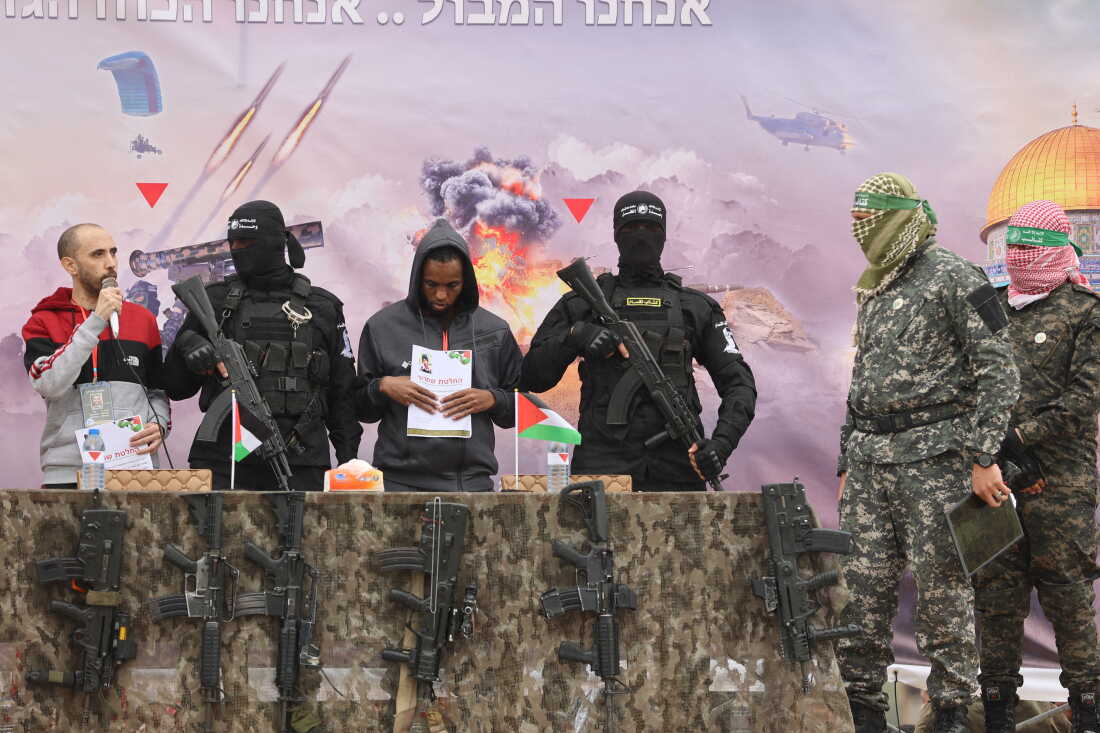
This article examines the psychology of hostage handling and exploitation and how this was used by Hamas after October 7 to manipulate Western audiences, especially in the realm of social media. It is written from the perspective of a US Army PSYOP veteran and former Human Terrain Team (HTT) member with an OIF/OEF background. It draws on insights across PSYOP and the wider SOF (Special Operations Forces) community to break down the dual dynamics of individual psychological manipulation and broader information warfare.
Specifically, this article discusses the optics of some of the post-October 7 Hamas hostages, including instances where captive and released hostages appeared to display bonding with or affectionate rapport towards their captors.
Using the Hamas hostage situation as a key example, it examines how the general public and key sectors (such as media and political circles) can become more aware of these dynamics and less prone to manipulation. More broadly, it proposes a framework – a baseline “toolkit” of sorts – for observers and analysts to understand contemporary hostage situations in which captors may seek not only to control detainees but also to influence external audiences.
It discusses the application of knowledge derived from military resistance training and Survival, Evasion, Resistance, and Escape (SERE) programs to the analysis of hostage exploitation and psychological warfare. Elite Special Operations Forces, including U.S. and allied military units, have extensively studied the physical, psychological, and neurophysiological effects of captivity, coercion, isolation, and resistance.
It suggests that such tools can help the wider public, media, and political spheres to better understand how hostages can be exploited by insurgent and terror groups for propaganda, public relations, and narrative warfare.
Creative and manipulative ways to exploit prisoners have been studied extensively in resistance training across elite Special Operations Forces (SOF) such as Navy SEALS, Army Rangers, Army Green Berets (Special Forces), and various Marine Corps and Air Force Special Operations, as well as military pilots. At Camp Mackall near Fort Liberty (formerly Fort Bragg), NC, there is the infamous Survival, Evasion, Resistance, and Escape (SERE) school for teaching trainees about the stressors and realities of being a Prisoner of War (P.O.W.) or hostage detainee, with several other counterparts around the US. This includes the Resistance Training Laboratory (RTL), where the physical and psychological aspects of confinement and resistance are studied in depth, down to the level of neurophysiology. These training areas, like many others used by elite units around the world such as the British Special Air Service (SAS), act as incubators for this understanding.
This wider body of knowledge can provide some framework to better analyze situations where groups like Hamas take hostages and exploit them for propaganda and public image. There is an important element of psychological warfare in play here – both in how hostages in these situations can be manipulated, and how public perception itself can be manipulated.
A prime example of this would be the publicized release of Danielle Aloni and her daughter, who were violently kidnapped and held against their will by Hamas. A surprising number of people seemed to be buying into the optics. Some platforms, as well as comments, posts, etc., were practically glorifying Hamas for their allegedly kind treatment of her and her daughter. The main reason was a letter indicating that she found solace with her captors:
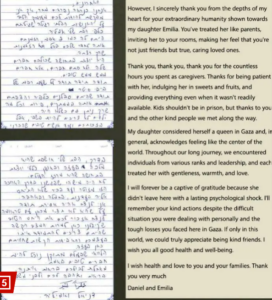
In November of 2023, this letter was published by the Hamas-affiliated Shebab Agency in Hebrew and Arabic. It spread on social media and expressed a high level of gratitude for Hamas’ humane and kind treatment of a woman’s daughter while they were both in captivity, allegedly written to the al-Qassim Brigades upon her release. This was seen by some on social media as a sign that Hamas was far more humane than portrayed.
This is fairly easy to debunk – or at minimum, to approach with skepticism – using a basic understanding of hostage-captor dynamics, hostage exploitation, and the psychology of media manipulation. This letter seemed to be written by Aloni, and she later confirmed in an interview that she was coerced into writing it under duress. She revealed that being held hostage was like a terrifying horror movie. Her real experience was far from what Hamas tried to portray it to be. This is unsurprising to someone who understands basic hostage treatment and exploitation tactics. However, many people unfamiliar with these matters can be easily persuaded by such forms of hostage exploitation.
Another captive, an elderly woman, was seen extending her hand to a Hamas militant in a seemingly friendly fashion, and the comments section of such videos tended to show just how eager people can be to conclude that this shows that Hamas treats hostages humanely. These incidents reveal a massive gap in how our society understands the nature of hostage captivity and exploitation. This has considerable consequences for the information environment and the PSYWAR battlespace, so to speak, because it can shape public and media perceptions as well as those of various formal and informal influencers and political actors.
This warrants a closer examination of these examples to explain the grim psychological reality of common hostage experiences as well as to expose the propaganda tricks behind the curtain.
In the above case, such letters or hand gestures (or statements of affection for one’s captors or their cause, as we see in forced hostage statements captured on video) can be made for a number of reasons. The first and most likely is physical or psychological coercion (or a combination). Several years ago, for example, Hamas released a propaganda video showing three female Israeli hostages appearing to be under duress. They were claiming on video that their lives were in danger – from Israeli bombings and tank shells, rather than from Hamas. While this could certainly be a genuine message and concern, the fact that all three were speaking to the camera in this way indicates a much greater likelihood of coercion to voice a particular message useful to the captors.
A second explanation could be the psychological vulnerabilities one can experience when they (much less with family members) are in captivity, and how captors can exploit their emotional reaction to develop a false sense of rapport and comfort. In her case, it was the former. The naïve reactions to these incidents are a teachable moment, and a very important one that the general public needs to learn from.
In order to analyze a situation where hostages held by an insurgent group or hostile government (Hamas having a history as both) are making such statements, there are things one should immediately look at.
- First, an ironclad rule of analyzing any hostage video or statement that shows affinity for one’s captors is to immediately look at the most likely possibilities:
- That such ‘rapport’ with captors or their cause is coerced – in this case, it could easily be due to leverage on the mother prior to the daughter’s release, or via Hamas’s holding of other hostages. Footage has shown Hamas members signaling hostages to act a certain way during their release, for example.
- That their seeming expressions of solidarity are due to psychological reactions to captivity, exploited by skilled hostage handlers to build a false reassurance or even a bond with their captors. More on this momentarily.
- A third (and less likely) possibility is that the captive has legitimately ideologically sided with their captors and is cooperating in a sincere way.
- Secondly, one can look at the events of the kidnapping and (as details become available) at their experience and treatment in captivity.
- This should include the experiences of any other hostages (whose disturbing testimony is becoming increasingly available), and – especially if we don’t have this information – a history of how the kidnapping organization treats captives.
- A basic understanding of human experience shows how unlikely it would be for someone kidnapped alongside their family amidst traumatizing violence to have a genuine rapport with their captors, especially as a woman kidnapped by men. Such assumptions seem to be quite insulting to victims of abusive relationships everywhere (an Instagram video makes a strong case for this).
- We must also apply common-sense distinctions: There is a difference between an organization’s members and the organization as a whole. Individual guards can build a friendly rapport with captives even without ulterior motives, because they’re – after all – human. Some individual Hamas guards might indeed be nice to captives, especially children and the elderly. They may have children themselves; they may be orphans who joined Hamas out of desperation and a need for community and hope; or they may simply be bored out of their minds hiding in these tunnels and enjoy small interactions and gestures of kindness with hostages. This can easily explain why one hostage had such interactions during periods of exercise (such as friendly arm wrestling or guards being nice to her). None of this means all or most hostages are treated well, nor that Hamas operates in a humanitarian manner.
- Finally, members of a hostage’s family and close friends may have insight into the sincerity of their statements while in captivity. Aloni’s family had reportedly stated that the letter’s sincerity should not be believed.
It is very helpful to take a closer look at the deeper psychology of hostage captivity, in case we do come across any situations like this one (now or in future kidnappings by Hamas or any similar group or government). Let’s assume for a moment that we discover that a hostage releases a statement of support for (or fondness for) their captors, their ideology, or the government or organization detaining them. Let us assume that it appears they were indeed not mistreated physically, and it seems that they weren’t manipulated psychologically.
Former hostage Yocheved Lifshitz (an elderly Israeli woman) has, for example, described how she was treated well at times in multiple videos, with similar reactions in the comments sections crediting Hamas for this. Perhaps we even have good reason to believe that they really were treated with a surprising level of humanity. Doesn’t this prove Hamas is benevolent and humane?
One can examine this from the perspective of hostage exploitation. Why would a group like Hamas be ‘nice’ to its captives? As anyone trained in surviving captivity knows, there are reasons why, none of them rooted in moral altruism or kindness.
1. Pragmatism and Optics
A main reason for this would be optics, which is part of any hostile government or insurgent group’s wider scheme of psychological warfare and information ops (which complements their military campaign). Hamas is a sophisticated organization that very likely understands the practical merits of employing different approaches to hostage treatment. For a militant group seeking to pragmatically rehabilitate their image after a horrific shock-and-awe attack (such as October 7), it is often more useful and effective to use psychological methods of persuasion and influence on detainees than overt physical brutality. In some cases, even treating a hostage well might be more useful to them than to mistreat or neglect their well-being. From an analyst’s perspective, it could be reasonable to suspect that the political wing of the organization has been pushing the more reckless and overtly violent military wing (the al-Qassim Brigades) to moderate their optics, especially with the hostage situation. One of Hamas’ main ‘psyop objectives’ (loosely speaking) is the promotion of their narrative as gatekeepers of legitimate resistance, as well as the maintenance of ‘legitimacy’ in the eyes of not only the local population but also among segments of the global community. Hence, humane treatment of certain hostages (especially the elderly, knowing that they, along with children, would be among the first released during negotiations) makes sense – societies around the world tend to have a deeply visceral reaction to the mistreatment of children and the elderly, as well as a desire to show them kindness. Additionally, having someone state that they were treated well could be all the more advantageous for Hamas.
2. Nonviolent methods can often elicit cooperation effectively
As mentioned, one aspect of hostage exploitation can be eliciting cooperation, which could be in the form of verbal or written statements, acting a certain way in front of a camera, or remaining silent upon release about their actual experience. There are multiple ways to do this that need not involve physical brutality. For example, modern, alternative models emphasize that a sound combination of psychological approaches (including the mind games discussed here) and environmental stressors (sleep and light deprivation, prolonged isolation, etc.) can lead to detainee cooperation. A sophisticated, experienced organization like Hamas very likely understands these methods and is capable of using them as an alternative to the stereotypical torture we would envision.
3. The psychological effects of captivity can be exploited by skilled captors
Resistance training as well as historic cases have been used to extensively study creative ways to manipulate and exploit prisoners during conflicts. This gives a better idea of why some hostages may have seemed to bond with their captors (if, in fact, such displays were not outright coerced by threat to them or other hostages). Our minds will sometimes go to great lengths to feel safe and seek beliefs that give us some momentary respite. This can even include clinging to (or excessive dependence on) the captors for comfort. As a longer-term psychological coping mechanism during captivity, one’s brain is seeking to reduce the overwhelming emotional dissonance of their situation by rationalizing a safer, ideal, and psychologically comforting alternative. As the US Department of Justice’s Victims Responses to Terror (from the Annals of the New York Academy of Sciences) explains, “Traumatic infantilism, the response to survival with the early adaptive behavior of childhood, compels victims to cling to the very person endangering their lives and accounts for the obedient, placid, compliant, and submissive behavior seen in frozen fright.” This effect can be considerably amplified and exploited by captors who are trained and adept at the art of hostage manipulation through subtle or overt rapport building. This can involve fostering a sense of common ground and shared humanity with the captive. “We are all in this struggle together; we want you to be safe and free as much as you do” can be a line of persuasion (as Psyop’ers sometimes call it) to exploit their vulnerabilities. Trainees from the military and intelligence community who undergo various levels of survival and resistance training learn about well-established approaches to exploit one’s psychological reactions to captivity.
For example, there is friendly interrogation, which tactically lowers the defenses of the captive through feigned displays of courtesies and a respectful or kind demeanor (a good historical example can be found by reading Hans Scharff, The Nazi Interrogator Who Revealed the Value of Kindness). This can include feigned empathy, where displays of understanding for the detainee’s situation are weaponized to get them to lower their resistance to cooperation and open a door to bonding – a technique used in some police interrogations but which can also be used to build a “bond” with hostages by weaponizing empathy, so to speak. There is the classic Threat and Rescue (“Good Cop/Bad Cop”), where skilled captors are essentially easing the captive into cooperation by providing a ‘way out’ in their minds. In short, a good hostage handler can find the person’s vulnerabilities and personality traits to ease them into feeling more comfortable in their captivity, which can lead to better cooperation that is beneficial to the group’s aims (such as exploiting the hostages in front of a camera).
Concluding Thoughts and Lessons Learned
This wider set of tools can help the wider public, media, and political spheres to better understand how hostages can be exploited by insurgent and terror groups for propaganda, public relations, and narrative warfare. Captors may exploit hostages’ physical and psychological vulnerability while simultaneously using their circumstances to shape media narratives, public emotions, and political perceptions.
Onlookers should remember that a lack of physical harm does not automatically indicate humane treatment, nor negate the lifetime of trauma and coping that many of these hostages will no doubt face. It is important – from an ethical and humane angle as well as a practical, analytical one – that awareness and understanding of this topic are more readily available.
A recommended way forward could involve more public awareness of this issue, with experts in PSYOP, information warfare, meme and cyber warfare, and human behavior having a stronger presence in academia and mainstream media. Helping harden populations against propaganda and malign influence is an uphill battle. However, when scaled up, even small things, from short educational videos and social media reels to academic and popular content, can make a big difference.


