





The Next Little Green Man: AI, Ambiguity, and the Future of Strategic Surprise

Abstract
Russia’s 2014 annexation of Crimea from Ukraine demonstrated how a relatively simple campaign of deception and ambiguity could exploit the deliberate decision-making process of liberal democracies, delaying any meaningful response long enough for the operation to achieve its objective. Over a decade later, advancements in technology, specifically generative artificial intelligence (AI), now threaten to magnify that vulnerability by allowing adversaries to rapidly produce convincing synthetic video, audio, imagery, and other forms of manipulated media at an unprecedented scale. The next “Little Green Man” may not appear as an unmarked soldier, but as an information environment so saturated with competing versions of reality that democratic leaders struggle to determine when and how to respond. This article argues that liberal democracies must prepare now by adapting doctrine, training decision-makers to operate under uncertainty, and developing rapid authentication and attribution capabilities that reduce an adversary’s ability to turn uncertainty into strategic advantage.
The Little Green Men
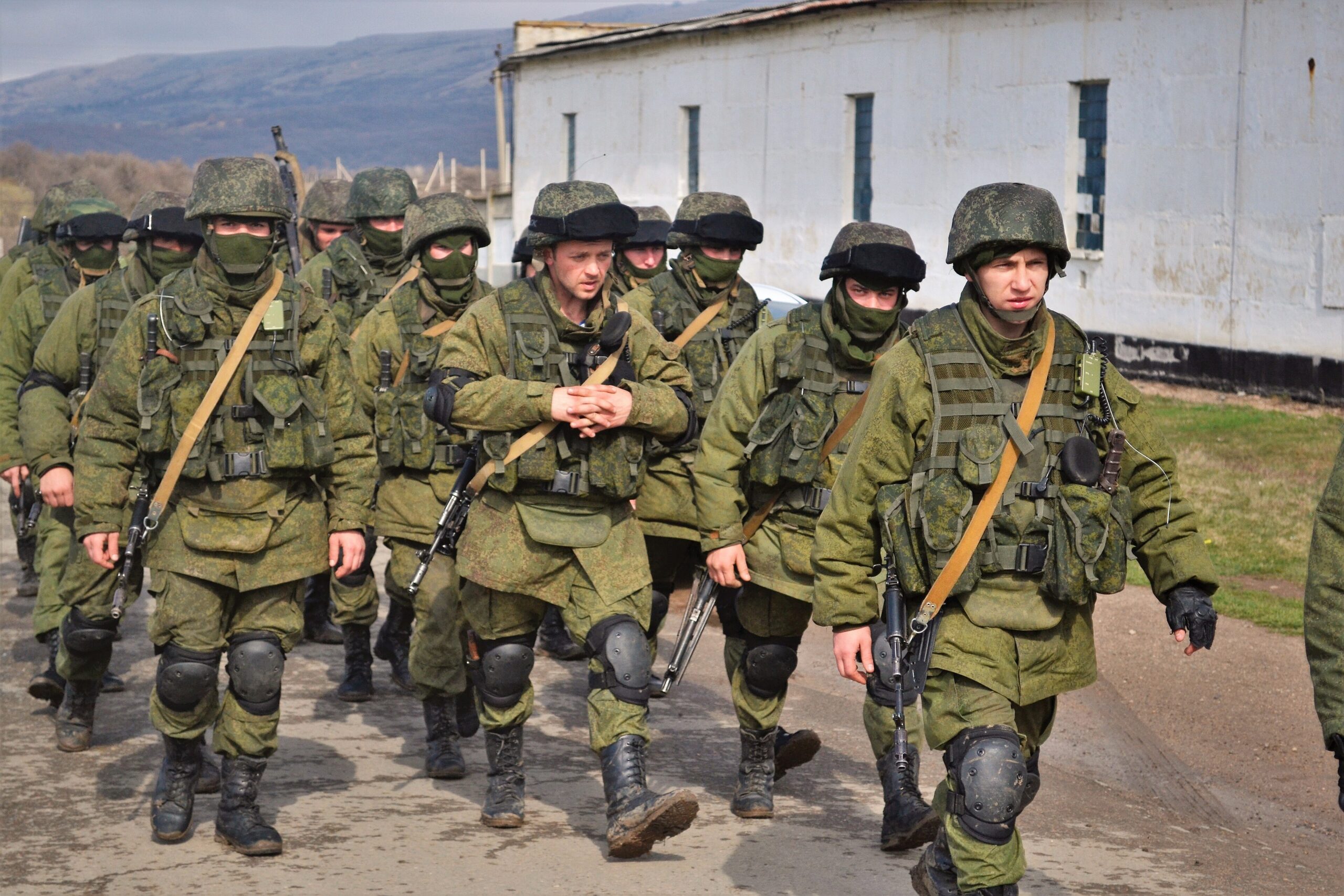
In 2014, Russia conducted an operation to annex the Crimean peninsula from Ukraine. It was over before the rest of the world even knew it had begun, because it was shrouded in disinformation. The Kremlin began by quietly sending thousands of soldiers to Russian bases on or near the Ukrainian border. Initially, checkpoints were set up along the two major roadways connecting mainland Ukraine to Crimea. The soldiers working the checkpoints were seen wearing Ukrainian Army, Ukrainian Police, and generic camouflage without national insignia. Russian soldiers simultaneously seized airports, the Crimean Parliament building, and blocked Ukrainian military bases located on the peninsula. While this military operation was being conducted, a pro-Russian Crimean parliament voted to hold a referendum to then join Russia. The vote was conducted without any state voting observation and with armed Russian soldiers posted at polling locations.
The operation fell perfectly in line with the Russian tactic of deception, maskirovka. It was pure confusion, uncertainty, and ambiguity for approximately four weeks, from the time the appeared until March 18, 2014, when Russian President Putin signed Crimea into Russia. The plan wasn’t overly complex, Russian troops entered Crimea, secured airports and established controlled entry and exit points for the major roadways that led in and out of the peninsula. It was a run-of-the-mill cordon-and-control military tactic for securing and seizing a region. Russian troops could have used plain-clothes operatives, adapted guerrilla warfare tactics, but simply chose to remove Russian identifiers from their current military uniforms at the time. They could have chosen to use different dialects but were observed by many using their native Russian tongue. When asked, President Putin simply said they were pro-Russian “defenders”, not a complex alibi. The operation itself was a success and took coordination and planning beforehand, but the plan itself was very simple, almost too simple, yet it still worked.
This was just the first step of the Russian plan to fold Ukraine back into the Russian state, which just eight years later led to the first war on the continent of Europe since World War II. But how was this successful? Amidst the uncertainty, the only suspects for the tactical takeover of the Crimean peninsula were the Russians, yet no one acted. Europe and the United States struggled to agree on what they were witnessing. Was Crimea experiencing a civil uprising, an irregular intervention, or was this indeed a Russian invasion? By the time that confirmation came, the operation was done and Crimea was now formally signed back into Russian control by a highly contested vote. How did an otherwise elementary disinformation campaign fool the powers of the West?
Democratic Paralysis
This strategic defeat exposed a fundamental vulnerability within liberal democracies’ ability to respond quickly and decisively to ambiguity. A problem that was exploited by Moscow in 2014 and still exists today against similar tactics in gray zone warfare. Liberal democracies require attribution, legal justification, and political consensus before they can take decisive action. Democratic leadership seeks evidence before committing to significant military action or statecraft. The cogs of the machine consist of legislatures debating authority and consequences, allies communicating amongst themselves to build consensus, legal advisors assessing legitimacy, and intelligence partners seeking corroboration. These moving parts work together to ultimately build an engine that produces safe outcomes that are justified, mitigated, and based in fact. The flaws are that they are easily delayed or blocked by ambiguity. Adversarial obscurity doesn’t have to defeat democratic systems and institutions; it just needs to weaponize it to achieve tactical success.
The problem the West faced in Crimea in 2014 was not that policymakers lacked suspicions, as few observers genuinely believed that heavily armed men carrying Russian weapons, speaking Russian, and executing basic military tactics had spontaneously emerged from local neighborhood watch groups; the problem was that there was no smoking gun right away to act on. As Democratic states are designed to deliberate thoughtfully before acting. Every additional question a democratically elected leader asks before acting only delays consensus, every competing explanation given only extends this decision cycle, and every demand for greater certainty just buys more success for disinformation operations.
The annexation of Crimea was a very simple operation, relatively speaking. The deception displayed was neither flawless nor complex, but it was sufficient. It delayed meaningful response long enough for the operation to achieve objectives that would prove too difficult to reverse. By the time certainty broke through the chaos, Crimea was lost.
The AI Problem
In 2014, when confusion spread through traditional media platforms, information cycles were measured in hours and days. Journalists traveled to Crimea and interviewed witnesses on-site, officials released statements, and analysts pieced together fragmented evidence as events continued to unfold. Today, generative artificial intelligence (AI) can produce convincing images, videos, audio recordings; it can falsify eyewitness testimony, spin political narratives, and manipulate social media algorithms at unprecedented speed and scale. The question becomes not if another Crimea happens, but when. What could it look like?
This danger is not theoretical; examples of this danger already exist. In March 2022, during the opening weeks of Russia’s full-scale invasion of Ukraine, a manipulated video appeared online depicting Ukrainian President Volodymyr Zelensky urging Ukrainian forces to surrender. The video was quickly identified as fraudulent and removed from major platforms, but its strategic intent was clear: sow chaos and confusion into an overloaded cognitive domain of warfare to further undermine confidence in legitimate leadership. The deepfake video is crude by today’s standards, which only goes to show how quickly generative AI has come in four years.
By 2024, generative AI had advanced to the point where a political consultant used an AI-cloned version of President Joe Biden’s voice to place robocalls to New Hampshire voters, falsely urging them not to participate in the state’s upcoming primary elections. The incident was investigated and eventually led to criminal charges, but it further demonstrates the dangers of modern disinformation through a 15-second audio clip of someone’s voice that was produced with alarming accuracy.
These implications extend well beyond elections. A future adversary can flood the information domain with thousands of deepfake battlefield videos, fabricated intercepted communications, synthetic satellite imagery, and AI-generated eyewitness testimonies, all orchestrated like a symphony by bot social media accounts numbering in the thousands. For every video or spam social media account identified as false, dozens of others continue flooding the information space, challenging the public to determine what is really happening. Authentic news is dismissed as fabricated while falsified evidence is defended as authentic, deepening the fog of war. Every new piece of information requires time and resources for forensic examination before action can be taken. Modern disinformation does not need to convince billions; it merely needs to weaponize uncertainty to delay collective action.
The Next Little Green Man
The deception tactics used to annex Crimea were effective, but it was remarkably ordinary. Removing insignia and denying involvement was unfortunately enough to exploit democratic systems in the West to succeed. Liberal democracies cannot abandon the safeguards that distinguish themselves from authoritarian systems. Evidence, legality, and consensus remain essential to decision-making, but we must recognize that the institutions put in place to enforce optimized decision-making have weaknesses that must be addressed.
As with any well-crafted doctrine or legislation, an adversary will always seek ways to manipulate it. In 2014, Russia took advantage of the lack of doctrine for responding quickly to ambiguity; similarly, an adversary could exploit doctrine that calls for more decisive action under comparable conditions of uncertainty. AI-generated media, for instance, could be used to provoke a premature or disproportionate response from the United States. Preparing to act under ambiguity therefore cannot mean lowering evidentiary standards or reacting impulsively to individual pieces of information. Instead, predefined thresholds must account for multiple indicators, intelligence disciplines, and observable adversary behaviors, allowing decision-makers to distinguish between uncertainty created by an unfolding crisis and manufactured uncertainty designed to trigger a specific response. These thresholds should also be routinely reevaluated to account for emerging technologies and evolving adversarial tactics.
The second step is organizational. Intelligence agencies, lawmakers, and military leadership must train to operate in modern information environments saturated with deception. Just as the armed forces conduct training exercises under simulated conditions of electronic warfare and degraded communications, democratic institutions should train to make sound decisions amid challenged information environments. The important goal of this training is not to work faster to eliminate uncertainty, but to build confidence in making timely decisions despite it.
A third step is investing in rapid cyber response teams dedicated to authentication and attribution capabilities. A cyber intelligence Quick Reaction Force (QRF), if you will. Even as democratic leaders become more comfortable making decisions in contested information environments, governments should simultaneously seek to reduce uncertainty wherever possible. This requires building and resourcing teams capable of quickly validating digital evidence, identifying manipulated media, tracing coordinated influence campaigns, and corroborating emerging reporting through technical and open-source means. In future conflicts, the speed at which institutions can distinguish authenticity from manufactured falsehood may prove just as important as military capabilities.
The next Little Green Man is coming. The question is whether open societies will recognize that waiting for certainty is, in itself, a decision, and one our adversaries are counting on us to make.


