





Water Scarcity in the Colorado River Basin: A National Security Assessment
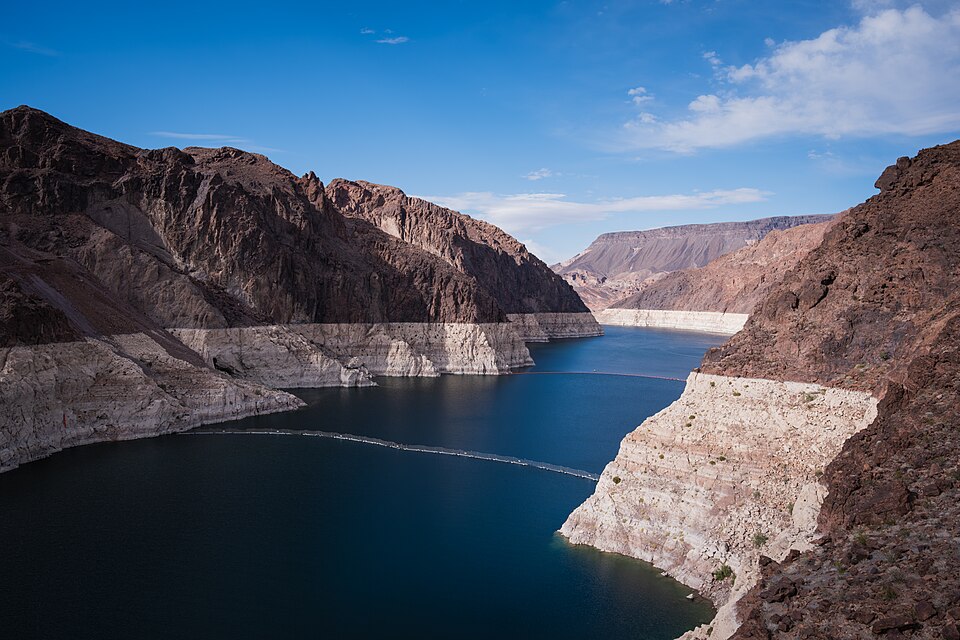

The Colorado River system provides water to around 40 million people and supplies 5 million acres of farmland in the American southwest. But it’s been drying up for twenty years, the worst dry spell in the southwest for 1200 years, according to Scientists. And this year, there’s not enough.
That’s bad. In this Discourse, we look at what this means from a national security perspective: the risks to military bases in the region, inter-state tensions, and U.S. industrial policy.
Background
The system is made up of two main reservoirs: Lake Powell and Lake Mead, which are fed by snow melt from the Rockies. Warming winters have reduced annual meltwater volumes. This past winter was particularly dry: snow water equivalent at the typical April 1 peak was between 32 and 53% lower (depending on location) than any prior record.
Overuse also has lowered reservoir levels over the past two decades. States have tried to agree on restrictive policies, but they’ve often come to naught.
Alarm bells have gone off in Washington. On August 21, 2026, Interior Secretary Doug Burgum signed 2027–2028 Operating Guidelines plus a 10-year framework for Lake Powell and Lake Mead. The framework obligates Lower Basin states to cut 1.25 million acre-feet in both 2027 and 2028: Arizona takes the deepest cut at 760,000 acre-feet, California 440,000, and Nevada 50,000. These numbers were negotiated down from more extreme cuts, a reflection of the intense short-term crunch these states are in– and risking even bigger, long-term problems.
We won’t go into the many stats cited on current water levels. But suffice it to say that half-century-long records are being broken in the reservoir water-levels and river streamflow. In the words of Colorado River researcher at Utah State Jack Schmidt, “We are in uncharted territory.”m
So what are the risks?
He are some concrete, defense-focused risks, as well as some bigger picture ones:
Base water vulnerability: The GAO estimates more than 100 U.S. military bases globally face water-scarcity threats, including installations inside the Colorado River Basin. These bases depend on the same water that civilians do.
Hydropower dependency and grid fragility: These bases draw power from the same civilian grid, which is fed by Hoover and Glen Canyon dam hydropower. Hoover Dam’s generation capacity would drop 70% if Lake Mead falls just 5 more feet. Generation has already fallen roughly 30%, forcing a shift to costlier, less reliable natural-gas backup power that raises base energy costs and reduces base resilience.
Groundwater depletion and infrastructure damage: As agriculture and cities rely more on groundwater to offset river shortages, aquifer depletion causes land subsidence. This has been documented around Luke Air Force Base in Arizona, cracking roads, damaging utility lines, and threatening runway integrity.
Domestic legal fragmentation as a stability risk: Real interstate water conflicts are already playing out. This dynamic would intensify if the Colorado River’s governing framework weakens.
Diplomatic risk with Mexico: The 1944 Water Treaty links U.S. Colorado River deliveries to Mexico with Mexico’s Rio Grande deliveries to the U.S. The U.S. withheld a scheduled 2025 delivery over Mexican non-compliance, and the current binational Colorado River shortage-sharing framework expires at the end of this year. A failure to renegotiate could strain the U.S.-Mexico bilateral relationship, which hasn’t been at its best.
Strategic industry exposure: Deepening water cuts to Arizona has put pressure on the CHIPS Act’s semiconductor build-out that is the foundation of U.S. domestic chip-manufacturing and supply-chain resilience policy. You have a national security priority clashing with a resources issue, and that’s likely to heat up.
Fundamentally, we know drastic cuts are coming down the pike, even with recent federally-mandated regulations. The question is how bad they’ll be, and how those states and their 40 million residents will cope.
Bigger picture
Following Iran’s cyberattack campaign against water infrastructure earlier this month, it also begs the question: how do we prevent foreign adversaries form targeting resources of this level of concentrated criticality? Hacker attempts to penetrate dams are well documented, for example. The Colorado river dams– as well as water treatment for the downstream regions– should be considered critical infrastructure and be defended. The situation is too close to the breaking point as it is to let cyber security be the weakpoint.
—
This Discourse draws on this CNN piece, this American Security Project report, and this NYT piece, and uses the following sources:
“Aseismic Multifissure Modeling in Unfaulted Heavily Pumped Basins: Mechanisms and Applications”

