





Investing in Rings: Leveraging U.S. Military Education in Diplomacy with Cambodia and Thailand
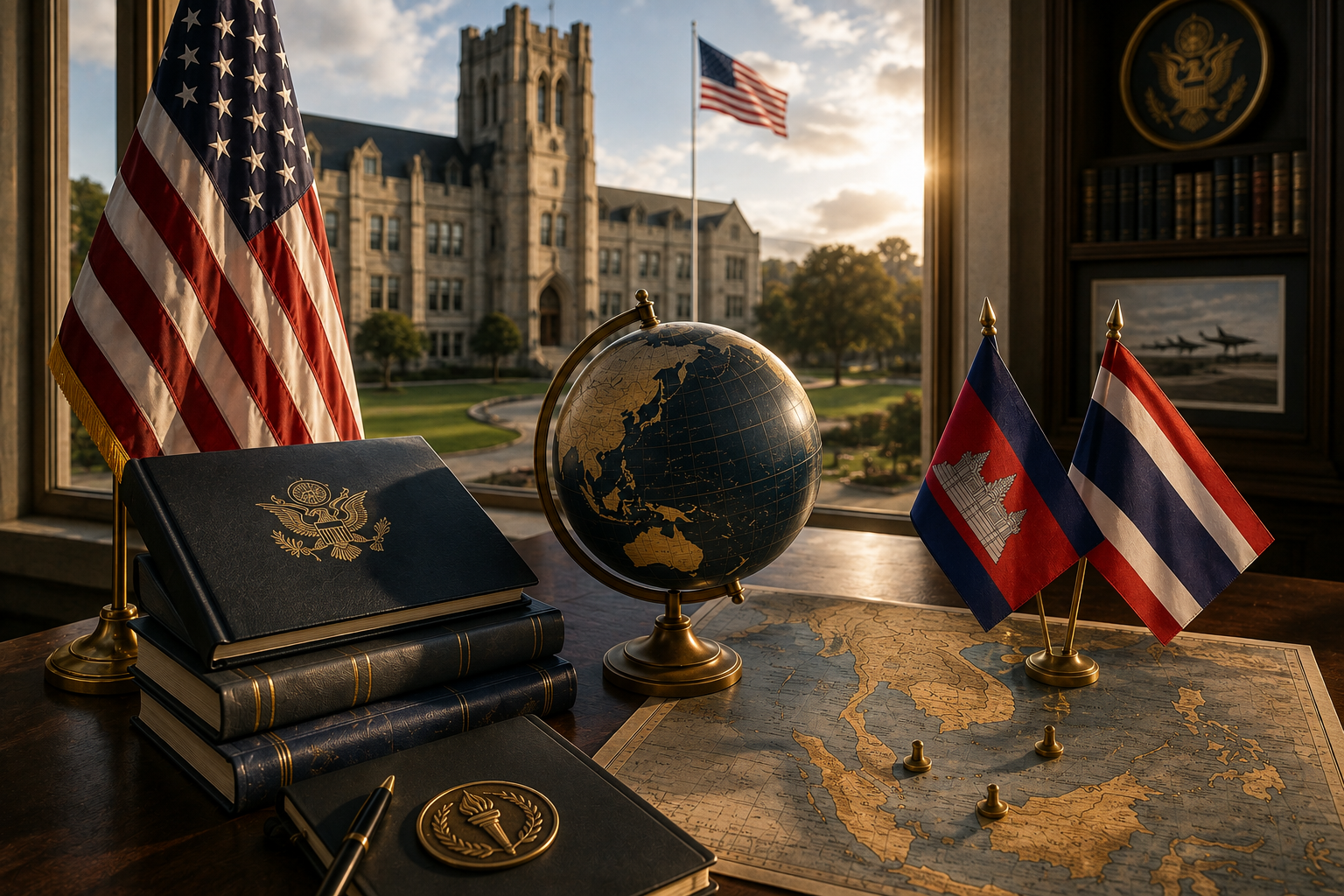

What happens when you put a U.S. Navy officer in charge of a joint contingent of West Point and United States Air Force Academy cadets on a landlocked mission in mainland Southeast Asia? It sounds like the setup to a punchline whispered over drinks at an officers’ club. Yet, instead of giving helm commands on a destroyer, the most senior Naval officer in the region was put in charge of 12 cadets in the chaotic traffic and unfamiliar culture of Phnom Penh and Bangkok.
While day-to-day tasks were focused on mixing concrete and stacking bricks for a rural primary school in efforts to build them a library, the team had the privilege of also sitting in high-level briefings with Ambassadors, Attaches, high ranking U.S and foreign military leaders, and even Cambodian Military cadets. The mission becomes a little more clear at that point, The United States possesses a quiet, deeply influential diplomatic network in the Indo-Pacific built not on treaties or trade deals, but on the shared identity of its military service academies. To effectively mitigate regional friction and solidify strategic partnerships in mainland Southeast Asia, Washington must aggressively leverage, fund, and expand these unique international alumni networks as an instrument of integrated deterrence. By shifting strategic focus toward this novel institutional-network framework, the operational force can cultivate long-term access at the highest echelons of foreign command.
The Institutional-Network Framework
Traditional security literature such as the Australia, New Zealand, United States Security Treaty (ANZUS Treaty), and Australia–UK–US (AUKUS Treaty) and other bilateral agreements with nations in the region concerning mainland Southeast Asia and INDOPACOM as a whole heavily emphasizes formal treaty structures, maritime domain awareness, and material hardware transfers (like nuclear submarines to Australia or Stryker’s to Thailand) as means to deter aggression and uphold U.S leadership in the region, with the largest focus being on the South China Sea and a potential conflict with the People’s Republic of China (as seen in the 2025 National Security Strategy). While physical deterrence is necessary, it often overlooks the human architecture that underpins diplomacy. Security cooperation is ultimately built on trust, and trust requires a shared vocabulary.
An institutional-network framework evaluates how long-term educational exchanges yield asymmetric strategic advantages. When international officers study within the U.S. military educational system, they do not just absorb tactical doctrine; they internalize an institutional culture, a standard of professional ethics, and bring back with them an enduring network of American peers. In a contested theater like the Indo-Pacific, where bilateral agreements (especially between smaller nations) are constantly caught in the gravitational pull of great power competition, these human networks function as resilient, built-in diplomatic bridges that persist even when formal political channels break down.
Field Observations: Cambodia and Peer-to-Peer Reality
The utility of this framework was clear during a mission in Cambodia. An Air Force Academy and West Point sponsored summer Cultural Immersion Trip. Embedded with an organization ‘Projects Abroad’ the purpose was as a baseline, community engagement, through that of shovels and work gloves. Building a library for a local school just outside the Capital on a small island called Silk Island. Breaks continually consisted of playing soccer and volleyball with curious local children who likely had never seen an American before. It was a tangible and human demonstration of American leadership on the ground. Outside the labor part of this the immersion brought the team to a plethora of cultural activities: Khmer Boxing, tours of Angkor Watt and the Royal Palace, and an abundance of Khmer food. However, analyzing Cambodia’s contemporary security calculus requires confronting its historical trauma. Visits to the Tuol Sleng Genocide Museum—the notorious torture facility known as Security Prison 21—and the Killing Fields execution sites provided a visceral lesson in the consequences of failed governance and institutionalized cruelty through that of communism. For the cadets, it goes past just abstract theory they learn in a classroom to that of a moral and human weight to process as officers.
Breaking the Script
The tactical execution of peer-to-peer diplomacy culminated during our visit to the Cambodian Military Academy. Starting the day at the U.S Embassy, the delegation was welcomed with open arms by the Charge de affairs who at the time was the highest-ranking American in the country as we await a formal confirmation of an ambassador. Graciously the group was educated and briefed on the inner workings of an embassy, everything from public affairs to visas, to defense attaché work. Escorted north (in an up-armored vehicle) the contingent was received with high honors by the Cambodian Cadet Academy, marked by formal gift exchanges and briefings on their institutional history. The entire event was meticulously choreographed: a drone buzzed overhead capturing imagery of the occasion, and the contingent was entertained by a tactical martial arts demonstration by their students. The genuine strategic breakthrough, however, occurred away from the cameras when the cadets sat down with theirs in the classrooms. Initially, the Cambodian students offered heavily rehearsed answers such as “I want to protect my country”. But as cadets cracked jokes about the universal miseries of basic training, the institutional armor melted. Once the barriers fell, the team found an elite cohort of young people who were genuinely thrilled by an American presence. In that moment, any ideological or cultural divide evaporated, replaced by a mutual understanding of professional duty and that common ground was shared. The Cadets were all of the same age group, and so were the officers on both sides. Badges, covers, pins, patches all found themselves as trading bargains. Even a camouflage bandana from the martial arts display found its way to the other side. This was the whole point. Cadet to Cadet. Peer to Peer. Human to Human. This is how real bonds and connections form. One day one of those Cambodian Cadets and one of the U.S cadets will be at the highest echelon of command and remember this when interacting at the highest levels.
The Strategic Matrix
With the library built and connections made, the delegation transitioned to Bangkok, Thailand. The delegation spent a high-tempo day in the U.S. Embassy in Bangkok, engaging in strategic dialogues with the American Ambassador (his 15min block on the schedule turned to well over an hour), senior defense attachés, and representatives from the Joint United States Military Advisory Group to Thailand (JUSMAGTHAI). The highlight of the Thai itinerary was a briefing with an Air Marshal of the Royal Thai Air Force. . In his briefing he still remembered the code of conduct, and all the sayings and things that the USAFA cadets go through every day. The shared institutional background instantly bypassed standard diplomatic stiffness, fostering a level of candid, strategic dialogue that money can’t buy. Later that evening JUSMAGTHAI hosted the team at their Officers club in a laid-back opportunity for connection and camaraderie. The attendees at this event: Royal Thai Army and Royal Thai Air Force officers who were graduates of USAFA and West Point. This framework develops soft power access but cannot guarantee however geopolitical compliance if and when political survival or regime loyalty are at risk.
The Asymmetry of the Region
When looking at the broader geopolitical map of this subregion post-Vietnam war, two distinct realities emerge. First, deep-seated historical, political, and religious friction continues to fracture the relationship between Cambodia and Thailand. Second, despite their bilateral differences, both nations are highly receptive to deeper American engagement. The connective tissue bridging this regional divide rests within the alumni of U.S service academies. Consider the current alignment of power. Prime Minister Hun Manet of Cambodia is a West Point Graduate (Class of 1999) and Air Marshall Chakkrit as mentioned is a USAFA graduate of 1994. The Prime Minister has continued affinity for Chinese support Ream Naval Base Golden Dragon has shown hints at being open for U.S leadership. Seen in his high-level diplomatic visits with U.S officials and increase access in POW/MIA accounting, while the U.S Embassy has continued to fund restoration projects at religious and cultural sites. The highest levels of political and military power in these friction-prone states are occupied by individuals who spent their formative years absorbing American military culture. Both nations made it clear they want to send more of their best and brightest cadets to study at U.S academies.
An Operational Roadmap
Washington must stop treating international cadet programs as simple educational exchange perks and start treating them as critical components of integrated deterrence. To operationalize the “academy connection” and maintain a competitive advantage in a contested theater, theater security planners should implement a three-part roadmap:
- Expand International Service Academy Allocations: Washington should aggressively increase the number of international cadet slots explicitly set aside for partner nations in Southeast Asia. . These graduates serve as key stakeholders for co-organizing military exercises (ex. Cobra Gold), facilitating status of forces agreements, and streamlining airspace and port call access. In 2023 S Code 347 increased the total of allowed international students at any one time at the academies from 60-80, but countries from which the academies pull from rests at the various service secretaries level with Secretary of Defense approval.
- Institutionalize Recurring Regional Alumni Seminars: The military services should establish a formalized, recurring regional alumni seminar network for foreign service academy graduates. Keeping these officers connected to American networks throughout their careers ensures that lines of communication remain open even when formal diplomatic relationships falter.
- Scale Mid-Career and Cadet Joint-Service Missions: The U.S must scale the deployment of joint-service cadets and junior officer cohorts into key regions. Exposing future American leaders to their foreign counterparts early in their careers builds a foundational cultural and diplomatic tie that will pay strategic dividends down the line.
Leading a joint-service cohort through a land-centric environment demonstrated the power of early interservice integration. Future leaders of the U.S proved that regardless of the color of their service uniforms, they are highly adaptable, empathetic, and strategically minded. By building a school library, engaging face-to-face with foreign peers, and sitting with top-tier diplomats, these young men and women did not just study foreign policy—they actively executed it. As the United States navigates the complexities of the Indo-Pacific and Southeast Asia, the human relationships forged on the ground, anchored by the enduring legacy of the service academies, will remain the greatest asymmetric asset.
Disclaimer: The views expressed in this article are those of the author and do not necessarily reflect the official policy or position of the United States Air Force Academy, the Air Force, the Navy, the Department of Defense, or the U.S. Government.


