





War By Other Means

Abstract
Iran’s closure of the Strait of Hormuz during Operation Epic Fury was achieved not by force but by inducing private war-risk insurers to withdraw coverage, a tactic this article calls insurance-market weaponization. The mechanism produced blockade-equivalent effects without a shot fired at the US Navy and left no legally cognizable state authority, and the same logic is transferable to any chokepoint served by a concentrated insurance market, including Malacca, Bab-el-Mandeb, and the waters around Taiwan.
When Israeli and American forces struck Iran’s Natanz and Fordow enrichment sites on February 28, opening what has become known as Operation Epic Fury, most analysts expected the ensuing crisis to unfold as a familiar contest of missiles, mines, and tanker escorts in the Persian Gulf. Instead, within seventy-two hours, the Strait of Hormuz was effectively closed to commercial shipping without a single Iranian vessel intercepting a tanker and without Tehran ever declaring a blockade.
The mechanism responsible deserves more attention from the security community than it has received. Lloyd’s of London syndicates and the war-risk insurers known as Protection and Indemnity clubs, without whose coverage no commercial vessel can legally load, finance, or sail through a conflict zone, simply withdrew from the Strait days after the strikes began. No tanker owner will risk a cargo and hull worth hundreds of millions of dollars without that coverage. The result was a chokepoint carrying roughly a fifth of the world’s seaborne oil and gas trade shut down not by force, but by actuarial judgment.
The Mechanism: Insurance as a Weapon
Call it insurance-market weaponization: the deliberate use of military action and calibrated threats to make private insurers conclude, on their own commercial logic, that a strategic waterway is no longer worth covering. Iran did not need to sink a ship or lay a mine. It needed only to make the possibility credible enough that underwriters in London would rather walk away than price the risk.
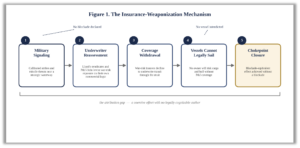
Figure 1. The insurance-weaponization mechanism. The five-stage causal chain by which military signaling induces private underwriters to withdraw war-risk coverage, producing a blockade-equivalent chokepoint closure without a formal declaration of blockade or the interdiction of a single vessel. The dashed bracket marks the attribution gap this sequence opens: a coercive effect that is commercially real but has no legally cognizable state author. Source: Author’s elaboration.
The Attribution Gap
This gap matters because it appears deliberate. The right of transit passage through international straits is guaranteed under the UN Convention on the Law of the Sea, and customary international law bars a blockade of neutral shipping absent a formal declaration of belligerency. None of that reaches a private insurer’s independent decision to stop covering a route it judges too dangerous. Iran issued no blockade declaration and interdicted no vessel. The rules governing when a state can be held responsible for private conduct do not extend to a firm’s own commercial judgment unless a government is shown to be directing it, and Tehran was careful never to cross that line. What results is an attribution gap: a coercive effect that is entirely real but has no legally cognizable author.
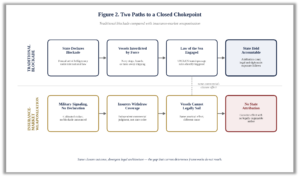
Figure 2. Two paths to a closed chokepoint. A comparative institutional map contrasting the classical blockade pathway, in which a state’s formal act triggers direct attribution under the law of the sea, with the insurance-market pathway demonstrated during Operation Epic Fury, in which the same commercial-closure effect is produced through an underwriter’s independent commercial judgment rather than state action, leaving existing deterrence and accountability frameworks with no point of purchase. Source: Author’s elaboration.
Why the Old Toolkit Doesn’t Work
For planners, this is the part that should be most unsettling. Every tool Washington and its partners normally reach for in a Gulf disruption – strategic reserve releases, emergency production increases, price caps – addresses a shortage of oil. None of it addresses a shortage of insurance. The International Energy Agency’s release of 400 million barrels, the largest in its fifty-year history, and Washington’s commitment of 172 million barrels from the Strategic Petroleum Reserve, barely moved prices, because tankers still could not legally sail without coverage that no longer existed. Goldman Sachs has warned that oil could exceed its 2008 record if the insurance freeze persists, regardless of how much physical crude sits in a reserve somewhere.
Even a ceasefire will not fix this quickly. Lloyd’s syndicates and P&I clubs reassess risk through their own internal governance, on their own timeline, driven by actuarial confidence rather than diplomatic announcements. A war can end at the negotiating table months before insurers are willing to underwrite transit through the strait again, a lag that conflict-termination scholarship has never had to account for, because no earlier coercive instrument worked this way.
The Asymmetric Appeal
What makes the tool attractive to a state like Iran is its asymmetry. A formal blockade risks legal exposure, invites international condemnation, and can be met with naval countermeasures. Sanctions require years of multilateral coordination to bite. Insurance-market weaponization requires none of that. It cost Tehran a handful of strikes, including a drone attack on Qatar’s Ras Laffan liquefied natural gas (LNG) terminal that forced QatarEnergy to declare force majeure on its export contracts, plus enough missile signaling to keep underwriters nervous. In return, Iran achieved the commercial-closure equivalent of a blockade at a fraction of the military and legal price. Iranian Foreign Minister Abbas Araghchi’s insistence that any settlement compensate Tehran for strikes on civilian sites suggests Iran sees time, not territory, as its primary asset: every week the strait stays commercially closed is a week that inflation eats into Washington’s political runway and Beijing’s patience with an unstable oil market wears thinner.
That political runway is shorter than it looks. Goldman Sachs projects that even a six-week disruption would push US inflation about a percentage point above its pre-war forecast, enough to turn energy prices into a domestic political liability. When Treasury Secretary Scott Bessent signaled Washington’s openness to easing sanctions on Iranian oil exports even as strikes continued, that was not mixed messaging. It was an administration managing the gap between military objectives that require months and a domestic economy that can tolerate only weeks.
Israel’s own war aims run on a different clock. Dismantling Iran’s regional proxy network, the stated objective behind the strikes, is a project measured in months, not weeks, a mismatch with Washington’s tolerance for sustained economic pain that has already generated friction inside the coalition. Israel’s own decision to halt offshore gas production at the Karish and Leviathan fields, after Iranian threats, has cut roughly 13 to 14 billion cubic meters of annual gas supply to Jordan and Egypt. That is a reminder that energy infrastructure in this theater carries value well beyond its market price, and that fighting over it will likely outlast any ceasefire in the Gulf.
Collateral Damage Beyond the Gulf
The steepest cost of this new instrument, though, is falling on countries with no stake in the fight. The World Economic Forum and the IEA describe wide swaths of Southeast and South Asia, including the Philippines, Bangladesh, Pakistan, and Sri Lanka, as importing 60 to 95 percent of their crude from the Gulf with no viable alternative in the near term. These are economies that buy oil on the spot market, carry no strategic reserve to draw on, and have none of the institutional access that lets Washington, Tokyo, or Brussels smooth out a shock like this one. When Houthi forces resumed attacks on Suez shipping days after the opening strikes, the same cargoes that might have rerouted around the Gulf lost their fallback route too, forcing tankers onto the far longer Cape of Good Hope passage and pushing freight costs higher still. For a country like Sri Lanka, still recovering from its own recent balance-of-payments crisis, a second oil shock arriving before the first one clears is not a policy problem. It is a fiscal emergency.
A Transferable Blueprint
This should worry planners well beyond the Gulf. The mechanism Iran has demonstrated, using military signaling to induce a private-market withdrawal that produces blockade-equivalent effects without a blockade, is not bound to Hormuz. The same logic applies to any chokepoint served by a concentrated, risk-averse insurance market: the Strait of Malacca, the Bab-el-Mandeb, or the waters around Taiwan. A state contemplating pressure on Taiwan would not need to declare a quarantine or fire on a single ship to achieve much of the same commercial effect. It would need only to make the risk of doing so credible enough that Lloyd’s and its peers price it out of the market. Any strategy for deterring or responding to that kind of coercion has to start with the insurance architecture itself, not just naval posture.
Policy Implications: Closing the Gap
None of the standard levers – reserve releases, diplomatic pressure, even a negotiated ceasefire – reach the actual point of failure, which sits in the underwriting departments of a handful of London firms. Reducing the effectiveness of this instrument in future crises will likely require some mix of state-backed reinsurance for critical straits, faster and less conditional International Monetary Fund (IMF) and World Bank support for the developing economies bearing the worst of the shock, and a serious legal debate over whether existing frameworks, the Law of the Sea, the World Trade Organization (WTO)’s security exceptions, the law of state responsibility, can or should be stretched to reach coercion exercised through private markets rather than state hands. Iran has shown that a determined actor can close one of the world’s most important waterways for a fraction of the cost of a blockade without ever committing what the law recognizes as an act of war. Every future adversary watching this crisis has just been handed the blueprint.


