Assessing Special Operations Forces (SOF) 2040 (Part 3): The Technology Layer – Cyber, Space, and Human-Machine Teaming in 2040
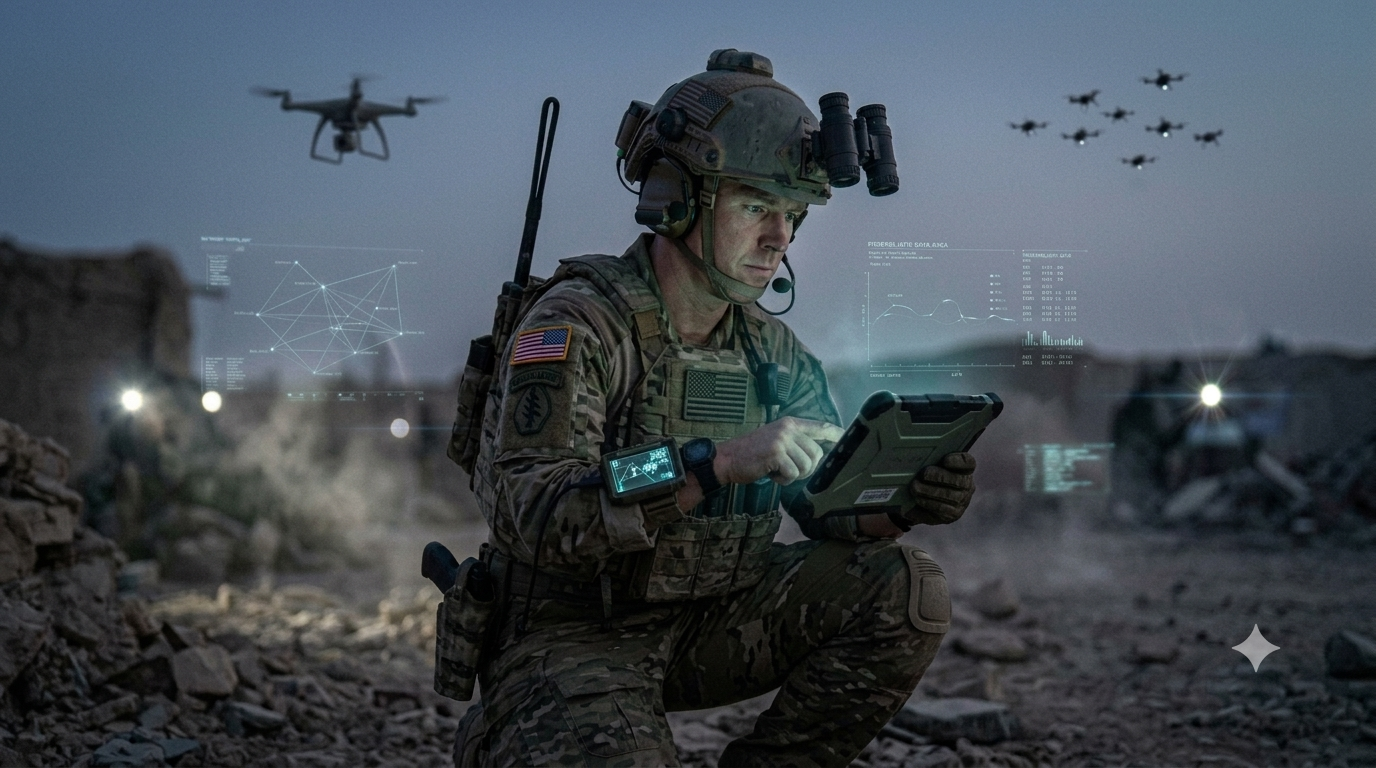

Technological Transformation
The technological shifts introduced in Part 2 (The Two Trinities and the Human-Domain Advantage) should be read against the criterion space established by the two SOF trinities. Cyber integration, space-denied operations, and human-machine teaming matter for SOF selection to the extent that they alter how operators execute unconventional warfare (UW), irregular warfare (IW), and support to political warfare, not because they constitute a free-standing criterion of their own.
Cyber Integration
Cyber capabilities are transitioning from niche enablers to embedded mission components. As examples, consider the recent use of cyber and space capabilities in Midnight Hammer and Absolute Resolve. Operators must increasingly understand digital terrains, integrate technical effects, and operate within contested information ecosystems. This amplifies demands for cognitive flexibility, abstract reasoning, and rapid learning. More specifically, we see three potential “pillars” of cyber integration, including:
- Understanding Digital Terrain: Just as an operator identifies “dead space” or “high ground” in physical topography, they must now visualize the logical and network topology of their environment. This includes identifying the invisible architecture (e.g., Wi-Fi mesh networks, cellular handoffs, and Internet of Things [IoT] sensors) that could either facilitate an infiltration or betray their presence through a digital footprint;
- Integrating Technical Effects: Future lethality is “kinetic-plus.” An operator must be able to synchronize a physical breach with a localized cyber effect, such as spoofing a biometric lock, blinding an artificial intelligence (AI)-driven automated turret, or creating a “digital ghost” to mask a team’s movement. These effects are integrated at the tactical edge, often requiring the operator to deploy and manage autonomous tools in real-time; and
- Operating in Contested Information Ecosystems: In a world of deepfakes and pervasive surveillance, the battlefield is a hall of mirrors. Operators must maintain situational awareness while knowing that their own communications are being harvested and their identities are being hunted by facial recognition algorithms. They must operate under the assumption that the network is compromised, necessitating a Zero Trust mindset in the middle of a firefight.
Space Dependence
In the 2040 operational theater, space is the invisible backbone of the modern warrior. However, because peer- and near-peer-level adversaries view U.S. space dominance as a primary target, the 2040 SOF operator will likely treat orbital support as a luxury rather than a guaranteed utility. The reliance on space-enabled systems for global positioning system (GPS), real-time satellite imagery, and over-the-horizon comms creates a critical vulnerability that requires a return to analog grit fused with high-tech improvisation. More specifically, we see the following as distinct possible battlefield facets.
- Degraded Navigation & Timing: When GPS is jammed or spoofed, precision timing, the pulse of modern encrypted radios and synchronized strikes, withers. Operators must revert to celestial navigation, inertial sensors, and visual pilotage, maintaining high-speed movement without a blue force tracker to guide them.
- Contested ISR (Intelligence, Surveillance, Reconnaissance): In an environment where enemy anti-satellite (ASAT) capabilities or dazzling lasers blind orbital sensors, SOF must generate their own local intelligence. This means leveraging proliferated ISR architectures or rapidly deployable sensing assets or high-altitude long-endurance (HALE) drones to rebuild the “eye in the sky” on the fly.
- Comms Blackout: Operating in a space-denied window forces a shift to low-probability-of-intercept (LPI) burst transmissions and mesh networks. Operators must be comfortable executing complex missions under radio silence, trusting in pre-established commander’s intent.
In terms of the cognitive demands required for operating in intermittent “dark” environments, we see a possible increased need for:
Systems-Level Thinking: Operators must understand the interdependency of the triad. If the space layer fails, they must immediately recognize which cyber or terrestrial alternatives (e.g., signals relay) can be bridged to fill the gap. They are not just using tools; they are diagnosing a global network in real-time.
Adaptive Problem Solving: When the “magic” of high-tech gear stops working, the 2040 operator cannot freeze. They must possess the mechanical and technical curiosity to “MacGyver” solutions, whether that means re-tuning a radio to bounce signals off the ionosphere or utilizing terrain-association software that does not rely on satellites. We emphasize here that such adaptability is nothing new to the SOF world, but the technological landscape in which adaptation will take place may be foreign to today’s SOF operators. This is noteworthy; human adaptability is domain-specific rather than globally transferable.
Improvisation Under Pressure: The psychological disruption that occurs when a high-tech unit suddenly goes “dark” may become a primary tool of the adversary. Assessment, selection, and qualification (ASQ) must identify candidates with a high tolerance for ambiguity, ensuring they remain lethal and decisive even when their most sophisticated sensors are rendered useless.
Human-Machine Teaming
In 2040, the operator-machine relationship will likely evolve from tool use to synthetic partnership. AI does not simplify the mission; it transforms the operator into a systems manager who must navigate a landscape of automated decision-making and robotic teammates. This represents a cognitive shift in what “teaming” means. Accordingly, we see the following facets as critical to consider.
- Monitoring Complexity: Operators may have to manage “swarms” rather than single assets. This requires high attentional control to oversee multiple autonomous feeds, be it drones, sensors, or cyber bots, simultaneously without succumbing to cognitive tunnel vision. Note, military researchers have become increasingly interested in “attention control” as a predictor of performance, beyond current cognitive measures;
- Trust Calibration: Success depends on “appropriate reliance.” Operators must avoid automation bias (blindly following the AI) and distrust (ignoring valid machine insights). Finding the sweet spot where the human knows exactly when to override the algorithm may become a critical selection metric; and
- Judgment Under Algorithmic Uncertainty: AI often provides probabilistic rather than binary answers. Operators must apply human ethics and strategic intuition to resolve black box recommendations when the AI lacks a context of ground truth.
Automation shifts the burden from physical execution to high-stakes cognitive filtering. The 2040 SOF operator is the “ethical circuit breaker” in a possible high-speed, AI-driven kill chain.
Force Modernization and Operational Complexity
As the 2040 SOF mission space matures, force modernization creates a paradox: while technology increases lethality, it exponentially raises operational complexity. This shift demands a move away from rigid hierarchies toward a model of distributed lethality. Such dynamics possibly include:
- Decentralized Autonomy: Mission command is pushed to the lowest echelons, requiring junior operators to make strategic-level decisions previously reserved for senior commanders;
- Temporal Compression: AI-driven sensor-to-shooter links compress decision timelines, leaving zero margin for hesitation;
- The Cognitive Load Paradox: Automation does not lighten the load; it creates cognitive overload as operators process dense data streams in high-consequence environments. This paradox mirrors what we are discovering in domains outside of the military; AI and automation do not reduce workload, they often intensify it; and
- Hyper-Evolution: The half-life of technical skills is shrinking. Rapid skill obsolescence means an operator’s ability to “unlearn” and “re-learn” is more valuable than any single fixed specialty.
Conclusion
The technological demands described above (cyber integration, space-denied operations, human-machine teaming, signature management, and algorithmic judgment) are not a competing criterion to the two SOF trinities. They are the contemporary medium through which UW, IW, and support to political warfare are conducted. A Special Forces team advising a resistance organization in 2040 will still succeed or fail on its ability to read political terrain, build legitimacy, and operate through indigenous partners; but it will do so while managing electronic signatures, contesting AI-enabled surveillance, and integrating autonomous sensing assets. The technology layer raises the floor of competence required to execute the trinities; it does not displace them. To paraphrase Boyd: people, ideas, and hardware—in that order. The SOF selection implication is that human-domain attributes anchor the criterion model, while technology fluency is treated as a necessary enabling capacity rather than a substitute differentiator.
Part 4 (Measuring What Matters – Adaptive Performance and the Next Frontier in SOF Qualification) completes this argument: it proposes adaptive performance as the central organizing construct for future SOF qualification, methods for assessing adaptability and related attributes, weighs the risks of rebalancing the criterion model too far in either direction, sets out a research agenda, and offers a diagnostic framework that answers the more important of the two questions posed at the outset – how do we know when the criterion model has shifted?
Author affiliations
David Dorsey, PhD, HumRRO; Col. David Maxwell, U.S. Army, Ret., Center for Asia Pacific Strategy; Mike Ingerick, HumRRO; Mick Crnkovich, former Director for Irregular Warfare in OSD, and CEO Stratagem Consulting.