





Shaping the Modern Adaptation and Innovation Model: Was Rosen Wrong?

Introduction: The Rosen Debate
Stephen Peter Rosen’s “New Ways of War: Understanding Military Innovation” remains a key study of military innovation. Rosen argues that major innovation is mainly a peacetime activity that needs ongoing support from senior leaders, protected institutional space, and long-term career paths for “mavericks” to reshape military organizations and missions. Because these changes often take decades, he claims that wartime conditions, characterized by chaos, urgency, risk aversion, and organizational stress, are more conducive to adaptation than to true innovation.
This framework has shaped decades of civil-military analysis, but it rests on assumptions that are increasingly challenged by modern warfare. Specifically, Rosen assumes that innovation requires long time horizons and that war disrupts rather than accelerates organizational learning. The Russo-Ukrainian War suggests otherwise. Ukraine has shown that under conditions of existential threat, widespread technological sharing, and continuous battlefield feedback, innovation can happen during war – and quickly. Instead of just adapting, Ukraine has created structural innovation in real time. Equally important, Rosen’s conclusions reflect the technological context of the cases he studied. Industrial-era militaries operated within slow innovation systems: centralized research and development, long testing cycles, and rigid bureaucratic structures. Under these conditions, peacetime was necessary for transformation.
Modern warfare functions differently. Civilian and military technologies now co-evolve, often driven by commercial actors. Information flows almost instantly. Decision-making cycles are shortened by digital systems and decentralized command structures, as Hoffman documents in detail. As a result, not only technological change but also cognitive and organizational learning have sped up. Rosen did not misidentify the nature of innovation – he described the speed limits of a pre-digital era military system. The Ukrainian case shows that those limits no longer apply.
Case Study: Ukraine’s Unmanned Evolution
Ukraine’s conduct in the war since 2022 (with the conflict starting in 2014 and rapidly evolving since the full-scale invasion) has significantly challenged Rosen’s model. Ukrainian Armed Forces have gone beyond basic battlefield adaptation, developing structural innovations focused on unmanned systems during intense fighting.
Starting with Adaptation
At the beginning of the war, Ukraine used commercially available drones as a tactical response to counter Russian numerical superiority. This aligns with Barno and Bensahel’s definition of adaptation as a better fit between an organization and its environment. Units employed drones for reconnaissance, targeting, and limited strikes, quickly adjusting to battlefield conditions. However, adaptation soon expanded. By 2024–2025, drones had become a dominant feature of the battlefield. Ukrainian forces used thousands of unmanned systems daily for reconnaissance and strike missions, especially first-person-view (FPV) drones capable of delivering precise effects at low cost. What started as a tactical workaround turned into a core part of combat power.
Adaptation also spread across different domains. In the maritime environment, Ukraine deployed unmanned surface vessels (USVs), which enabled strikes against high-value Russian naval targets and infrastructure in the Black Sea. These operations helped damage or destroy a large part of the Russian Black Sea Fleet and forced the relocation of key naval assets away from Crimea. At the same time, Ukraine employed long-range unmanned systems to carry out deep strikes on Russian energy infrastructure. By 2024, according to a NATO official cited by Reuters, Ukrainian drone attacks had disrupted up to 15 percent of Russia’s oil-refining capacity, resulting in These developments demonstrate how quickly tactical adaptation can spread across domains and produce operational and strategic effects.
From Adaptation to Innovation
What sets the Ukrainian case apart is that adaptation did not stay isolated or temporary. Instead, successful practices were combined, standardized, and formalized. In February 2024, Ukraine officially created the Unmanned Systems Forces (USF) as a separate branch of its Armed Forces This institutional move represents a fundamental shift: unmanned systems were elevated from supporting tools to a core principle of combat power. This development meets Rosen’s criteria for major military innovation – changes in doctrine, organization, and force structure that transform how a military fights. However, it did not happen over decades but in about two years of large-scale war. Ukraine didn’t just adopt new technologies; it reorganized its military around them.
The Targeting Cycle: Compressing the OODA Loop
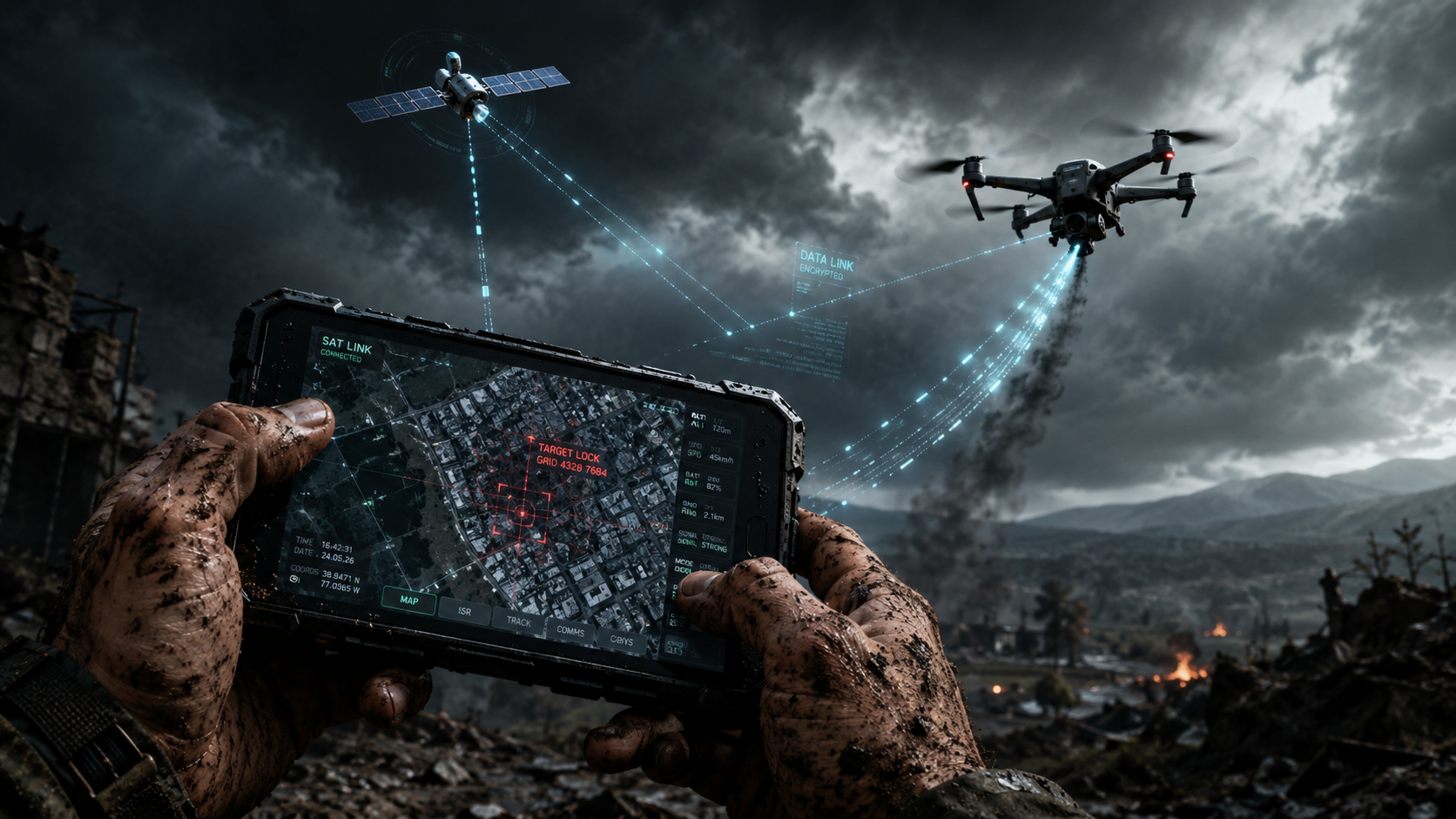
A key driver of this change has been the shortening of the targeting cycle. Ukrainian forces have combined intelligence gathering, target identification, decision-making, and strike execution into near-real-time systems. Systems like the Delta situational awareness platform integrate satellite images, drone footage, and battlefield reports into a single real-time operational picture. This enables quick coordination between sensors and strikers. The result is a significant reduction in the time needed to complete the kill chain, from detection to strike, often within minutes, as documented in an analysis of the Delta battlefield management system. This effectively compresses the OODA loop (a four-step decision-making model—Observe, Orient, Decide, Act—developed by military strategist and US Air Force Colonel John Boyd), reducing the adversary’s ability to respond. As Hoffman states, such processes demonstrate organizational learning in war – the transformation of battlefield feedback into improved operational effectiveness. Ukraine’s innovation is not in individual technologies but in its ability to integrate those technologies into a continuous, high-speed kill chain.
Analysis: Speed, Decentralization, and the New Innovation Model
Speed: From Decades to Months
Rosen’s model suggests that innovation often takes a long time. Ukraine proves that innovation can happen at much faster speeds. Between 2022 and 2025, Ukraine scaled drone production to hundreds of thousands of systems each year, integrated commercial technologies into military operations, developed drone-focused operational concepts, and established these capabilities through new command structures. These changes happened within months to a few years. The main factor is the modern innovation environment: commercial off-the-shelf technologies, rapid prototyping, and ongoing battlefield testing enable quick development cycles. War accelerates innovation by providing immediate feedback and validation, a pattern well-documented in the conflict in Ukraine.
Bottom-Up Innovation and Network Effects
A second deviation from Rosen’s framework is the source of innovation. In Ukraine, innovation has frequently come from decentralized actors. Small units and volunteer networks experimented with drone tactics, while frontline innovators proved effective and attracted funding and institutional backing – most notably Robert “Madyar” Brovdi, whose unit became the template for Ukraine’s drone forces. This led to a distributed innovation system characterized by bottom-up experimentation, rapid validation through combat, and scaling via networks and government adoption. Successful practices were later formalized within military structures, culminating in the development of the USF. This hybrid model blends decentralized experimentation with centralized institutionalization. Senior leadership remains crucial – but as an integrator rather than the main origin of innovation.
Existential Pressure as an Accelerator
The Ukrainian case also demonstrates how existential threats can drive innovation forward. Ukraine faced immediate risks to its survival, high operational losses, and a technologically adaptive adversary. These conditions created strong incentives for quick learning and lowered tolerance for inefficiency. As Hoffman notes, wartime environments speed up change by forcing organizations to confront failure and adapt in real time. In Ukraine’s case, existential pressure reduced bureaucratic friction and enabled rapid innovation cycles.
Conclusion: Redefining Innovation for the 21st Century
Was Rosen wrong? No, but his model is incomplete for modern warfare. Rosen accurately explained how innovation worked in slower, industrial-era systems. His focus on leadership, organizational culture, and institutional support remains relevant. However, the Ukrainian case shows that the link between war and innovation has fundamentally shifted. Today’s military innovation is characterized by compressed timelines, continuous battlefield feedback, the blending of civilian and military technologies, and decentralized experimentation paired with centralized institutionalization. The key factor is no longer just war versus peace; it is the speed of learning, the spread of ideas, and decision-making. In this context, war can serve not only as a driver of adaptation but also as a main force of innovation. Rosen did not mistake the nature of innovation; he described its limits under different technological and organizational conditions. Those limits no longer apply on today’s battlefield.


