The Iran War and El Niño 2026: From Global Crisis to the War of Narratives

Abstract
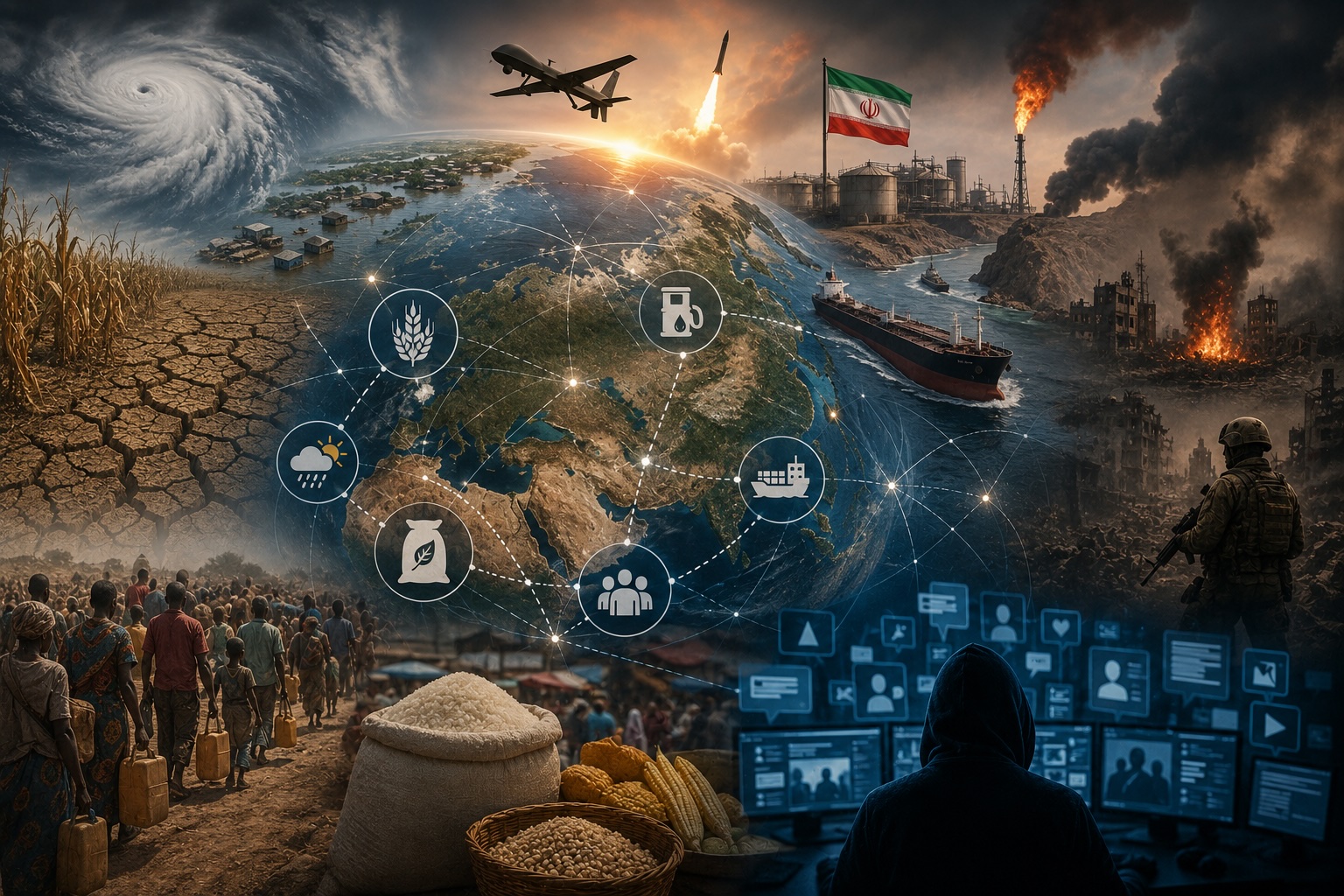
This paper focuses on how the Iran war consequences combine with those of El Niño, triggering a “hypersiege” situation that engulfs societies all around the world. This climate-geopolitics nexus exerts an enormous and complex pressure on the worldwide agri-food systems, turning 2026-2027 into an agricultural danger zone.
This crisis is particularly dangerous in vulnerable spaces, such as the African façade of the Indian Ocean, where it turbocharges the political tensions that turbocharge multiple and overlapping narrative wars that literally weaponize the political field. This is especially true in vulnerable and strategically complex spaces, such as the Democratic Republic of Congo or the African façade of the Indian Ocean.
Thus, states must reinvent themselves to face the new security challenges generated by the hypersiege emerging from the worldwide combination of material, narrative, and political crisis. Especially, new forms of strategic interdependencies appear along new Eurasian logistics corridors, united by geography and common strategic horizons.
El Niño, Geopolitics, and the Global Crisis
As the Iran war triggered the near-closure of the Strait of Hormuz, a particularly powerful El Niño event is unfolding in the Pacific Ocean. These two phenomena are entirely uncorrelated and independent. However, they are triggering cascading geopolitical, industrial, and environmental consequences that are converging to spark a global crisis. This crisis is accompanied by a loss of legitimacy for states and governments—a process amplified by a “war of narratives” playing out at both the national and international levels.
The previous event took place in 2023–2024 and was deemed as being strong . El Niño is a cyclical climate phenomenon that occurs every three to seven years. El Niño is a cyclical climate and oceanic phenomenon that occurs when the surface of the equatorial Pacific Ocean warms over a period of one to three years. This rapid warming of the ocean surface exerts thermal forcing on the atmosphere.
Consequently, El Niño events trigger cascades of extreme weather phenomena worldwide, particularly as they now exacerbate climate change. For instance, during the 2023–2024 El Niño event, prolonged heatwaves in South Asia had devastating effects on grain and rice harvests while simultaneously triggering large-scale weather disasters. However, in 2026, these extreme weather events will impact agricultural regions already suffering from the fertilizer crisis caused by the war involving Iran.
The Iran War and the Agricultural Crisis
In 2026, the Iran War and the blockade of the Strait of Hormuz halted the export of millions of tons of nitrogen-based fertilizers—produced notably with Qatari natural gas—precisely during the Northern Hemisphere planting season. Consequently, the effects of El Niño will impact agricultural regions already strained by a lack of inputs or by the near doubling of their prices. This means there’s a global agricultural-food crisis that is currently unfolding and that will imprint 2026-2027, with all the social, political, and geopolitical consequences it may trigger.
From Global Crisis to the Great War of Narratives
As this global agri-food crisis takes hold, it intertwines with and exacerbates pre-existing national and international tensions in regions of strategic friction—tensions that manifest particularly through a war of narratives. Indeed, the weaponization of narratives allows the conflict to shift into the realm conventionally reserved for politics.
Furthermore, the escalation of this narrative war makes it possible to map the areas where the intersection of the Iran War’s consequences and El Niño’s effects creates particularly destabilizing social, political, and geopolitical impacts. This turns 2026 into the year of the global hypersiege—a historic turning point driven by the convergence of the Iran crisis, war, and climate change.
Hypersiege or the Return of the Climate Bomb
The Return of the Monster
For several years—and particularly since the outbreak of the war in Ukraine in 2022, whose effects compounded with those of El Niño in 2023—contemporary societies have been in a state of hypersiege.
During an El Niño episode, the temperature of the equatorial Pacific Ocean can rise by up to 3°C, causing a warming of the entire atmosphere. However, since the beginning of the 21st century, El Niño has been “turbocharging” the effects of climate change, making the consequences of these episodes increasingly intense and widespread.
Indeed, El Niño has a direct impact on the climatic regions of South America. For instance, over the centuries, El Niño episodes have had severe repercussions in northeastern South America—particularly in Brazil—by triggering prolonged droughts. These impacts have been compounded by the effects of the war in Ukraine. Yet, the consequences of an El Niño event ripple out across the globe.
The tropical world is the first to be heavily affected. Historically, El Niño events have triggered droughts that devastated the Philippines, Indonesia, northern Australia, southern China, Southeast Asia, India, Pakistan, Madagascar, Southern Africa, the Horn of Africa, and the Amazon. Subsequently, the effects can spread to northern China, Iran, southern Russia and Ukraine, the Maghreb, and the northern United States, while also impacting Europe.
El Niño and the Heightened Vulnerability of Societies
As various episodes since the start of the 21st century have demonstrated, the extreme weather events triggered by El Niño are becoming increasingly violent and are extending across a vast scale. The impacts are particularly dangerous for agricultural areas. The resulting yield declines place production systems and global food markets under strain.
In some countries, this translates into rising prices, but in others—such as the Sahel region—access to food and water resources itself is curtailed and threatened, effectively placing this vast region in a situation akin to a semi-continental siege. This is especially perilous in a region where failed states are unable to prevent radical Islamist groups from extending social control over populations, notably by controlling water sources and access to food supplies.
Geopolitics and Extreme Climate: 2023
El Niño events have historically triggered major climate disasters—such as droughts, floods, water stress, and crop failures—worldwide. The interplay between climate change and El Niño was particularly intense in 2023–2024, driven by systemic interactions between a destabilized climate and the major geopolitical upheavals accompanying the war in Ukraine. In particular, restrictions on Russian and Ukrainian grain exports—caused by the war and sanctions—along with constraints on nitrogen fertilizers produced using Russian gas, have affected the food sectors of disadvantaged nations while simultaneously driving global food price inflation.
Iran and El Niño: The 2026 Shock
In 2026, driven by the Iran war, a new El Niño event is reigniting “hypersiege” dynamics. Since early March 2026, the Iranian blockade of the Strait of Hormuz has disrupted daily exports accounting for 20% of global oil production and trade, 19% of natural gas production, and 30% of global nitrogen fertilizer exports. While a significant share of oil and gas is converted into energy, substantial quantities are also used in petrochemicals and nitrogen fertilizer production, with millions of tons passing through the Strait of Hormuz each month. Crucially, the timing of the near-total closure of the Strait of Hormuz coincides with the planting season in the Northern Hemisphere.
Since early March 2026, agricultural systems worldwide have faced pressure to adjust 2026 planting plans in response to surging fertilizer prices, which are rising much faster than food prices. However, this global agricultural vulnerability, triggered by the Iran war, is compounding the current and anticipated effects of the 2026 El Niño. Strategic impacts are intertwined with pre-existing tensions, particularly in vulnerable regions such as the Indian Ocean.
Vulnerable Zones, Arenas of Cognitive Warfare
Vulnerabilities
Amid the convergence of the Iran war and the 2026 El Niño, the Indian Ocean must be viewed as a vulnerable information space in which material crises can be interpreted, instrumentalized, and transformed into security risks. Since March 2026, this “Hormuz shock” has posed an exponentially greater threat to global food security than the 2022 Ukraine shock; meanwhile, the Food and Agriculture Organization (FAO) of the United Nations has warned that fertilizer shortages will jeopardize upcoming harvests in the most vulnerable economies. In parallel, El Niño alters rainfall patterns, intensifies droughts, jeopardizes harvests, and amplifies certain extreme weather events.
El Niño episodes affect more than 70% of the world’s agricultural districts, resulting in significant production losses. In the Southern Africa and Indian Ocean region, over 30 million people are already facing acute food insecurity linked to these climate disruptions. As a result, although the causes of these two phenomena are independent, their effects converge in societies already marked by food dependency, poverty, institutional mistrust, and the rapid spread of rumors on social media.
Africa already offers documented examples of this shift. The Ebola epidemic in the Democratic Republic of the Congo—particularly in the east of the country between 2018 and 2020—demonstrated how a genuine health crisis could escalate into a crisis of confidence and public order. In certain areas, Ebola was perceived not as a medical emergency, but as a political fabrication, a means for NGOs to profit, or a threat introduced by healthcare workers themselves. In eastern DRC, a significant portion of the population also expressed active mistrust of health institutions, refused to believe the disease existed, or attributed the epidemic to political or foreign machinations—perceptions directly linked to refusals of treatment and obstruction of the response effort.
Conflicting Interpretations, Wars, and Epidemics
Political causes behind the epidemic were frequently cited in International Rescue Committee (IRC) community feedback reports throughout 2018 and 2019, particularly in connection with the postponement of local elections in Beni and Butembo. This reinforced the broader perception that the outbreak was politically driven. This interpretation helped shape the wider environment in which the epidemic was understood.
This interpretation had tangible consequences for security. In February 2019, Médecins Sans Frontières (MSF), the French humanitarian NGO, supported Ebola treatment centers in Katwa and Butembo that were attacked and set on fire by unidentified assailants; MSF subsequently suspended its operations in the epidemic’s epicenter in North Kivu.
Furthermore, resistance to response measures—such as refusal to cooperate, clandestine burials, patient flight, and obstruction of vaccination campaigns—was rooted in beliefs that the disease was being used to “test new vaccines from multinational corporations” or to “secure funding for international organizations.” In this way, disinformation did not merely accompany the crisis; it altered operational conditions, transforming a health emergency into a security crisis.
This pattern persists. In May 2026, a new Ebola outbreak in Ituri, Democratic Republic of Congo, is mirroring these same dynamics. Isolation centers in the town of Mongbwalu were set ablaze during disputes over burial rites, and patients fled the facilities. Against this backdrop, OCHA (Office for the Coordination of Humanitarian Affairs) notes that violence is simultaneously hindering the health response and the delivery of humanitarian aid in the province. As in earlier episodes, disinformation acts as a secondary scourge, delaying medical care, fueling attacks on health workers, and undermining the entire operational response.
The food crisis linked to the war in Ukraine also offers an interesting precedent. Following the Russian invasion in February 2022, the surge in wheat, energy, and fertilizer prices—estimated by the FAO at 8%-20%—posed a genuine material crisis for many African nations. Yet this crisis was also transformed into a tool for exerting influence. According to the US State Department, Russia launched a “massive disinformation campaign” targeting African audiences to attribute the shortages to Western sanctions rather than the invasion itself—a factually incorrect narrative, given that no sanctions target Russian grain or fertilizer exports. This shows that a foreign power can exploit a food crisis not by creating the shortage itself, but by seizing control of the political narrative surrounding it.
Framing the Crisis: Political Fragmentation
This mechanism of strategic framing is directly applicable to the Indian Ocean region. Amid a crisis involving rising rice prices, disruptions to fertilizer supplies, high fuel costs, and climate-related uncertainties, an external actor need not manufacture the crisis—it need only manufacture its political meaning: amplifying the notion that the state is incompetent, that elites are hoarding supplies, and that Western partners are to blame. In this logic, the goal is not persuasion but rather to fragment the public sphere, erode trust in authorities, and position oneself as a sovereign or “anti-colonial” alternative.
Madagascar: The Real Crisis and the War of Narratives
Madagascar exemplifies this vulnerability. Exposed to cyclones and droughts, and highly sensitive to rice prices—a staple food and an immediate political barometer—the country experiences the crisis across two timeframes: the urgent reality of food prices and the looming anxiety regarding agricultural production, as rising fertilizer costs weigh on future planting and harvests.
It is in this gap that the crisis becomes a matter of narrative. Citizens do not see fertilizer supply chains, blocked straits, or climate anomalies in the Pacific; instead, they see a more expensive bag of rice, a market with less stock, and an uncertain harvest. In that space between the global cause and the local experience, a battleground opens for disinformation, influence, and competing narratives.
Multiple narratives may then overlap: the State’s failure to anticipate or manage the crisis; predatory elites accused of hoarding or speculation; foreign manipulation of prices and supplies; North-South climate injustice; or even the illusion of food sovereignty. These narratives need not be consistent with one another to have an impact; they can nevertheless converge on the idea that the population is being deceived or exploited.
For instance, a WhatsApp rumor claiming that rice shipments are stuck at the port—reserved for merchants close to the ruling power—can trigger panic buying. These purchases temporarily deplete visible stocks in certain markets, seemingly confirming the initial rumor. Merchants may then be accused of speculation, authorities of concealment, and importers of predatory behavior. In this way, disinformation goes beyond merely describing a perceived shortage; it helps create real market tension and transforms anxiety over food supplies into political mistrust.
Redefining Strategic Power: Adapting to Reality and Managing Perception
How Can Society Be Protected Against Hypersiege?
The convergence of the war in Iran and the 2026 El Niño event necessitates a redefinition of strategic power. In an international environment defined by systemic crises, power is no longer limited to military capability, control of maritime routes, or access to resources. It is also measured by a state’s ability to absorb simultaneous shocks, protect its populations, maintain supply continuity, and preserve public trust.
The primary response remains material. Faced with disruptions in the Strait of Hormuz, rising energy prices, tensions in fertilizer markets, and the climatic impacts of El Niño, states must strengthen their adaptive capacity. This entails diversifying supply sources, securing logistics routes, building strategic stockpiles, identifying the most exposed agricultural sectors, and supporting vulnerable households. In the Indian Ocean, this material resilience is crucial, as many island and coastal states rely on imports for food, energy, and agricultural needs.
The International Redistribution of Power and Security
However, securing states materially against the complex risks arising from the fusion of climate hazards and geopolitical threats highlights disparities in state capacity. Consequently, the shock inflicted on the international system by the combination of El Niño, climate change, and the war in Iran will be better absorbed by China, thanks to the systematic stockpiling of fuel, fertilizer, and grain by the Chinese government. Conversely, if climatic conditions—such as those seen during the 2023–24 El Niño—lead to lower yields in Chinese rice paddies, China will need to increase imports of Vietnamese and Thai rice while navigating a climate of international tensions over agri-food supplies.
New Corridors: International Interactions and Human Security
However, new forms of Eurasian cooperation are also emerging thanks to the launch of new continental logistics corridors. For instance, the International North-South Transport Corridor (INSTC)—under development since 2000 and championed vigorously by Moscow—connects Russia, Central Asian nations, the Persian Gulf, Iran, the Indian Ocean, and India. This link relies on an international intermodal system combining rail and maritime routes, resulting in significant time and efficiency gains for international freight transport.
This logistics corridor also enables the participating countries to bypass supply chains dominated by the United States. Indeed, the INSTC connects Russian agricultural regions with Arab nations, Iran, and India, potentially helping mitigate future food-related shocks across the Middle East, Central Asia, and South Asia. Furthermore, these logistics corridors have the potential to integrate these nations’ human security concerns into new international and national security frameworks, such as the Shanghai Cooperation Group or the Chinese Belt and Road Initiative.
The political dimension of these frameworks centers on the strategic convergence of the participating countries in their shared need to protect their societies while drastically curtailing American influence. However, leveraging these systemic interactions also fosters new forms of strategic solidarity to present a united front against the global threat posed by the coupling of El Niño and climate change, while simultaneously strengthening interdependencies between pivotal states—such as India—and U.S. adversaries like Russia and Iran.
Yet, these emerging forms of security—born of the response to the “climate-geopolitical” siege—also constitute modes of adaptation to climate change. Significant uncertainty remains, however, given the exceptional intensity of the 2026 El Niño event, which threatens to exert unprecedented climatic pressure on the material foundations of contemporary societies for nearly 18 months.
If the impacts of extreme weather events (heatwaves, mega-fires, extreme rainfall, biological invasions, etc.) overwhelm the capacity to absorb shocks, societal breakdowns will occur—manifesting notably as waves of migration from Latin America to North America, from Africa to Europe, and from rural areas to cities. This holds true even if stockpiles of food and medicine are in place to guarantee human security—the erosion of which would inevitably undermine international security.
Securing Populations, Securing Perceptions
Added to this is the fact that a material response is insufficient unless accompanied by a strategy regarding public perception. In a food or energy crisis, taking action is not enough; that action must be made visible and understandable to be credible. A stockpile that exists but remains unexplained may be interpreted as a hidden reserve. A misunderstood stabilization measure may be perceived as manipulation. Legitimate uncertainty may be viewed as a lie. Delayed communication can allow the impression to take hold that the authorities are concealing the true situation, as already seen, for instance, in Madagascar.
This is why transparency is becoming a strategic capability. It involves not merely communicating more, but also explaining the mechanics of the crisis—such as price formation, logistical constraints, external dependencies, climate risks, and the actual scope for public action. In societies permeated by social media and private messaging services, the State can no longer rely solely on top-down communications. It must provide simple, regular, and verifiable explanations, acknowledge uncertainties without appearing powerless, and make visible the measures taken to protect households, farmers, and markets.
Redefining Power to Redefine Security
Strategic power is increasingly becoming informational in nature. States must be capable of mapping rumors, identifying hostile narratives, and understanding how social anxiety transforms into political accusation. A crisis unit can no longer address logistical, economic, climatic, and communicational dimensions in isolation. When a shipment is delayed at a port, the reasons must be communicated proactively — before the delay is interpreted as a cover-up. When the price of rice rises, it is not sufficient to identify the economic cause; it is equally necessary to anticipate how that cause will be perceived by the public.
This imperative calls for an analytical framework that operates not solely at the macro level, but also at the intermediary level and, crucially, at the micro level.
This approach is consistent with Elihu Katz’s two-step flow of communication hypothesis, which shows that public messages do not simply move from institutions or mass media to passive audiences. They are often filtered, interpreted, and legitimized by opinion leaders and trusted intermediaries embedded in everyday social networks. In a crisis context, this means that official communication cannot rely solely on centralized announcements. It must also activate locally recognized actors who can translate, contextualize, and validate the message. Local governments, farmers’ organizations, merchants, transporters, journalists, religious authorities, and civil society actors can therefore play a decisive role in reducing suspicion and preventing official information from being perceived as a message imposed from above.
Foreign influence operations thrive precisely where official communication is weak. An external actor does not need to create a crisis to exploit it; simply steering the narrative surrounding it is enough. By amplifying stories of betrayal, exploitation, injustice, or manipulation, such an actor can undermine trust in the state, delegitimize certain international partners, and position itself as an alternative. The strategic response, therefore, is not merely to denounce interference but to shrink the space available for it through rapid, credible, and socially resonant information.
The convergence of the war in Iran and the 2026 El Niño event illustrates that future crises will be hybrid—not only because they will blend war, climate, energy, and food issues, but also because they will link material reality with public perception. A shortage can be managed. A price hike can be offset. A vulnerable harvest can be supported. However, a crisis perceived as a betrayal, manipulation, or abandonment can deal a lasting blow to a state’s legitimacy.
Redefining strategic power, therefore, entails balancing three capabilities: adapting material systems, managing public perception, and preserving institutional legitimacy.