The Power Trap: Why AI’s Energy Demands Risk Undermining American Operations in the Indo-Pacific

Abstract:
The United States (US) military is rapidly integrating artificial intelligence across operations, yet power, connectivity, and satellite communications infrastructure are struggling to keep pace. At the tactical edge, continuous AI inference workloads sharply increase power consumption and dependence on beyond-line-of-sight links, and in contested environments, electronic warfare can sever these links, forcing platforms onto localized processing that dramatically reduces endurance. This mismatch risks undermining the United States’ decision advantage in the Indo-Pacific. Closing the gap will require treating energy-resilient satcom as a core warfighting requirement, supported by coordinated progress on standards, industrial capacity, and acquisition speed.
The Hidden Infrastructure Burden of Military AI
Artificial intelligence can deliver real operational advantages, but only for as long as the systems that employ it remain powered and connected. In recent US Indo-Pacific Command (INDOPACOM) exercises, US operators have watched a familiar pattern unfold: the power and connectivity infrastructure required to sustain AI systems in contested environments is not keeping pace with the speed, scale, and operational demands of AI integration. This gap is not uniform: it varies systematically by AI function, platform type, and dependence on reachback – the extent to which platforms must rely on distant, centralized systems such as cloud servers or rear-area command centers for data processing and decision support. These systems create distinct “energy-connectivity regimes”: categories of AI systems defined by their power demands and reliance on communication links, which current concepts often fail to account for.
This lag is occurring as the military rapidly integrates artificial intelligence into operations across the Indo-Pacific, the key theater of US-China competition, where the race for decision advantage is already underway in earnest. Unlike legacy intelligence, surveillance, and reconnaissance (ISR) systems that send periodic data bursts, modern AI creates continuous, high-demand inference loops that scale nonlinearly in both compute and bandwidth requirements. In its January 2026 Artificial Intelligence Strategy, the Department of Defense (DoD) directed a full-scale acceleration of AI across every warfighting function, from autonomous systems to real-time decision support, including its flagship Pace-Setting Projects such as Swarm Forge for autonomous drone swarms and The Agent Network for decentralized battle management.
Military AI does not impose a single demand curve; it falls into three distinct energy-connectivity regimes with different operational vulnerabilities. First, pre-computed or mission-parameterized systems, such as swarm coordination tools, operate with relatively low and predictable onboard power demands. Second, edge-dominant systems, such as onboard computer vision for targeting, require sustained but bounded compute power and have limited bandwidth dependence. Third, reachback-dependent systems, such as real-time ISR fusion or decision-support tools enabled by large language models (LLMs), generate continuous, high-bandwidth demand and can degrade quickly when communication links are severed. Most current DoD concepts implicitly assume hybrid edge-cloud architectures, systems that split computing tasks between local devices (edge) and remote servers (cloud), depending on need and connectivity. Yet the supporting infrastructure reliably serves only the extremes: fully disconnected edge systems on one end and rear-area cloud systems on the other, leaving a dangerous middle ground unaddressed. This middle ground — especially hybrid architectures that oscillate between edge-dominant and reachback-dependent modes — creates the most acute power-satellite communications mismatch in the Indo-Pacific.
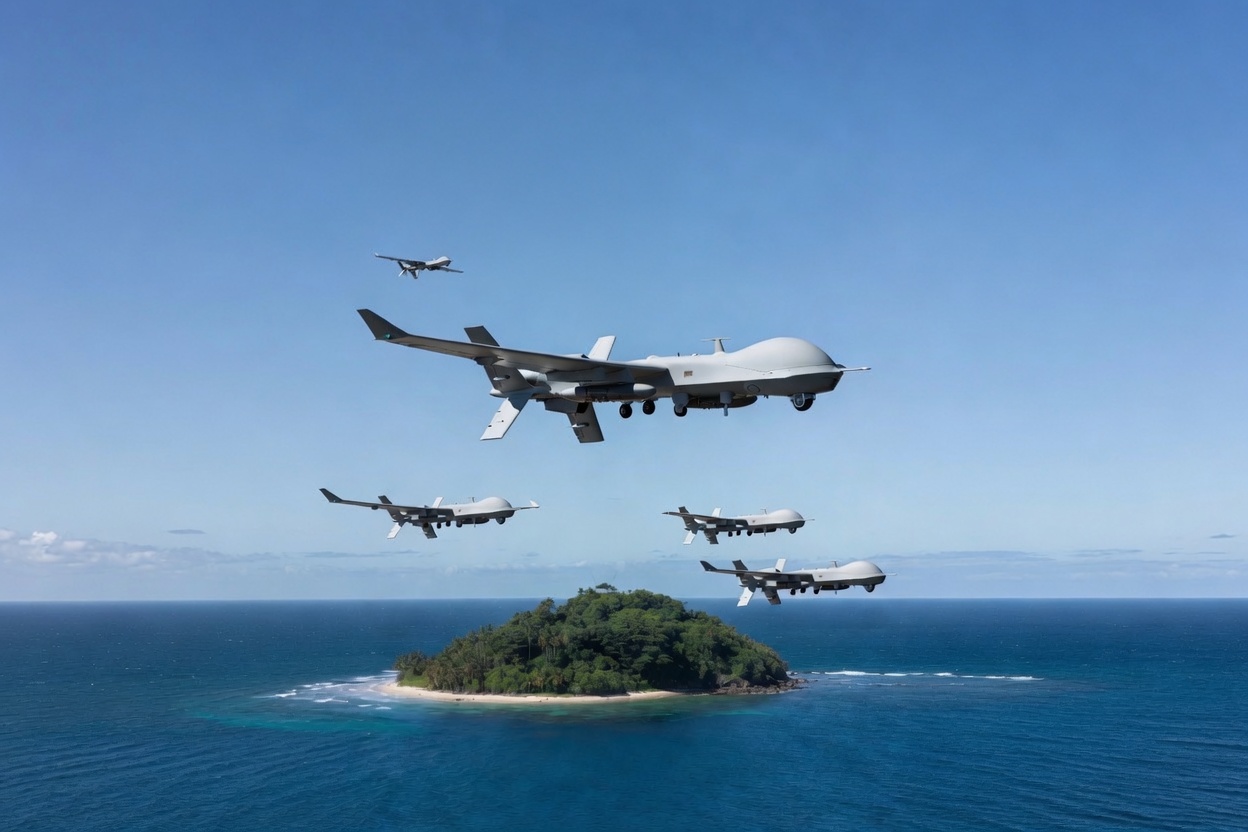
In practice, these regimes map unevenly across platforms. Small ISR drones and unmanned surface vessels operating at range fall into the most stressed category, as they combine limited onboard power with reliance on intermittent satcom reachback. Forward command posts and mobile fires units sit in the middle, where hybrid edge-cloud architectures create volatile demand spikes. By contrast, larger crewed platforms with organic power generation can better absorb onboard inference loads, even when disconnected. This asymmetry means the connectivity gap is most operationally acute not at the high end, but at the proliferated, edge – the large numbers of lower-cost, expendable platforms that current operational concepts increasingly depend on.
Diagnosing the Tactical Edge Connectivity Gap
Edge AI platforms demand constant, high-bandwidth, low-latency connectivity — meaning near-instant data transmission — that current forward infrastructure struggles to sustain under power constraints and electronic warfare pressure. The result is a strategic connectivity gap that risks undercutting the United States’ AI advantage.
The demands of military AI at the tactical edge are creating a clear mismatch with today’s connectivity infrastructure. AI inference engines, systems that apply trained models to real-time data on drones, unmanned vessels, and forward command nodes, require constant high-bandwidth and low-latency data flows. Yet in the Indo-Pacific’s vast distances and contested environments, these platforms typically depend on satellite communications whose terminals must function under severe power limitations during extended operations in austere conditions.
Communication limitations force more processing directly onto individual platforms, which sounds efficient on paper. In practice, it dramatically increases onboard power draw because legacy tactical chips are unoptimized for continuous, heavy inference loops, and when the link drops under jamming, the system is left burning through battery reserves significantly faster. Indeed, the Russo-Ukrainian war has repeatedly demonstrated that forward microgrids, generators, and solar arrays struggle to sustain these loads during extended operations, especially when electronic warfare disrupts links and forces systems to rely on limited battery reserves.
Satcom remains the only reliable beyond-line-of-sight option when terrestrial networks are jammed or unavailable. However, the physics of contested spectrum, combined with the need for cyber-resilient waveforms, adds further energy overhead. The result is a critical mismatch: AI ambitions have raced ahead of the infrastructure needed to keep them powered and connected in the Indo-Pacific. But this mismatch is not inevitable; it reflects the slower development of energy-resilient satcom systems relative to the Pentagon’s AI push.
Operational and Strategic Consequences in the Indo-Pacific
This gap carries direct operational and strategic consequences. In the Indo-Pacific, where distances are vast and adversaries can contest every domain, timely data flows are the difference between coordinated action and fragmented response. Without reliable, energy-resilient satcom, AI-enabled systems at the edge lose the ability to maintain real-time coordination, thus slowing decision cycles and degrading ISR in distributed operations across island chains.
In practice, failure can be sudden: one moment, real-time fusion feeds a coherent common operating picture; the next, that picture collapses because the satcom link cannot deliver the required bandwidth under power constraints. The stakes extend far beyond any single platform, since deterrence in the region depends on the credible ability to project integrated, multi-domain force.
Indeed, alliance dynamics introduce an often under-appreciated constraint, as connectivity shortfall undermines escalation control and allied interoperability, whether through the Quadrilateral Security Dialogue (Quad), the Australia-United Kingdom-United States (AUKUS) security partnership, or broader North Atlantic Treaty Organization (NATO) partnerships. Despite political alignment and deepening interoperability through forums such as the Future Architecture Working Group, interoperability at the waveform and terminal levels remains uneven. Allied systems frequently operate on incompatible or nationally optimized waveforms, limiting the ability to share bandwidth or dynamically reconfigure networks under contested conditions. Even where technical convergence is feasible, classification and releasability restrictions constrain the joint development of common standards, particularly for cyber-resilient waveforms and low-power terminal designs that sit at the intersection of intelligence and communications security. These barriers directly affect whether coalition forces can sustain shared AI-enabled operations when connectivity is degraded. In a theater where coalition operations are the norm, the result is fragmented networks, duplicated energy burdens, and reduced operational coherence. Without deliberate policy action, particularly on waveform standardization, cross-domain classification downgrades, and co-development agreements, these barriers will persist regardless of technical progress.
Institutional Lag and the Enduring Need for Resilient Connectivity
Logistics chains in the Indo-Pacific, already strained by the theater’s geography, become even more vulnerable when AI-driven systems demand constant power and bandwidth. This vulnerability is not theoretical. During recent Indo-Pacific Command exercises, it has been observed that once electronic warfare severs the link between forward AI nodes and rear support, systems rapidly shift to onboard processing and battery power. Drones that once loitered for hours now exhaust their reserves rapidly, forcing operators to choose between mission abort and physical loss of the asset. In a high-intensity Pacific scenario, this degradation would quickly compound across hundreds of autonomous platforms operating across island chains, turning what should be a decisive information advantage into a serious liability.
The institutional dimension compounds the problem. Traditional acquisition timelines (often measured in years rather than months) have struggled to keep pace with the explosive growth of AI capabilities, as acquisition systems were designed for hardware platforms, not the rapid, iterative cycles of software and AI. The DoD often requires years to field new acquisition programs, with average timelines approaching a decade and SATCOM systems typically falling on the longer end of the spectrum. Even routine processes like Federal Risk and Authorization Management Program (FedRAMP) authorization – the mandatory security clearance for cloud technologies – routinely drag on for twelve to eighteen months, creating a stubborn lag between commercial innovation and the speed at which the force can operationalize new AI tools. Worse still are the tactical bottlenecks at the edge, where software must secure a formal Authority to Operate (ATO). The rigid lack of ATO reciprocity across different military branches means software approved by the Air Force often has to completely restart the compliance process to deploy on a Navy vessel. While the Pentagon’s AI Strategy attempted to bypass this by creating a monthly “Barrier Removal Board” to aggressively streamline Continuous ATO pathways, these legacy software certification loops remain a stubborn barrier, creating a highly problematic lag between commercial edge innovation and the speed at which forward operators can deploy new AI tools.
China is pursuing a partially different approach: prioritizing low-power, hardware-software co-design and proliferated, lower-bandwidth architectures over reliance on persistent high-throughput reachback. Chinese military-civil fusion efforts have prioritized energy-efficient edge chips, integrated sensing-processing platforms, and constellations optimized for redundancy rather than peak throughput. By contrast, US concepts remain more dependent on high-performance compute and continuous data flows, increasing exposure to power and connectivity constraints in contested environments.
While the DoD has moved aggressively to field AI tools, the supporting communications architecture has remained tethered to legacy requirements and risk-averse procurement processes. The result is a persistent mismatch: strategic ambition has outrun operational reality. This is more than a technical shortfall; it demands a fundamental shift in how the DoD thinks about connectivity, treating it not as a supporting commodity, but as a foundational warfighting domain on par with fires or maneuver.
A more sobering reality is that constantly pursuing higher connectivity may itself be the wrong paradigm. Emerging operational concepts and AI architectures increasingly emphasize graceful degradation: the ability of systems to maintain useful functionality at a reduced level when links are lost. This approach relies on mission-type orders and onboard decision-making rather than continuous reachback. In practice, energy and spectrum constraints are likely to reinforce mission command, with AI enabling more capable but lower-bandwidth forms of decentralized execution.
This raises a legitimate counterpoint: if emerging operational concepts increasingly emphasize graceful degradation and mission-type orders when links are lost, why prioritize persistent energy-resilient satcom? The answer is not either/or, but neither are the two approaches equally substitutable. The most effective future architectures combine low-power, resilient satcom for critical windows with onboard AI that can truly operate independently. Without a reliable energy-resilient satcom baseline, even well-designed graceful degradation mechanisms collapse when power itself becomes the limiting factor. Even the most robust mission-command architectures depend on intermittent synchronization, model updates, and cross-platform coordination. Without a reliable, energy-resilient satcom baseline to enable these critical windows, graceful degradation becomes progressive isolation rather than controlled autonomy.
Industrial Realities: The Hardware Ecosystem
The good news is that this connectivity gap is a solvable policy challenge, but only if treated simultaneously as an operational, technological, and industrial-base problem. Efforts such as the Defense Innovation Unit’s Hybrid Space Architecture show promising progress toward multi-orbit resilience. However, while hybrid multi-orbit networks improve overall resilience, they do not solve the power problem at the tactical edge, as the added complexity of maintaining links across low Earth orbit (LEO), medium Earth orbit (MEO), and geostationary orbit (GEO) often increases energy demands on portable terminals.
Any credible solution must confront the industrial base and fiscal realities, as low-power chip architectures and energy-efficient satcom terminals do not emerge from software iteration alone. Unlike software, such capabilities require upfront capital investment in fabrication, specialized components, and integration, all of which are highly sensitive to procurement volatility. They depend on a defense-relevant semiconductor ecosystem that includes specialized foundries, advanced packaging, and a limited number of firms willing to invest in hardware with uncertain and episodic procurement demand.
This ecosystem remains thin, particularly for radiation-hardened and militarized components that fall outside high-volume commercial markets. DoD represents only a small fraction of global semiconductor demand, and its buying power is further fragmented across programs and services. As a result, the industry has little incentive to invest in the specialized, low-volume capabilities the Department increasingly requires. Without predictable, multi-year demand signals, firms rationally underinvest; without that investment, the Pentagon cannot field the very systems its strategy assumes will be available. The result is a structural coordination failure that leaves critical elements of the AI-enabled force, from edge processors to resilient terminals, dependent on fragile or foreign supply chains.
Policy Recommendations to Close the Connectivity Gap
In order to solve the connectivity and power gap at the tactical edge, Washington must move beyond fragmented efforts and create structured mechanisms that bring commercial, low-power, energy-efficient connectivity and edge AI capabilities into the Indo-Pacific theater at the pace of commercial innovation, not traditional acquisition cycles.
- Establish joint standards for energy-aware satcom protocols and AI-optimized waveforms. These standards would reduce power overhead while maintaining cyber resilience, giving edge AI systems the reliable bandwidth they need without draining limited forward energy resources.
- Expand targeted research and development programs, building on models like the Defense Innovation Unit’s hybrid space communications initiatives, to fast-track low-power, resilient terminals and energy-efficient edge AI hardware designed for contested environments.
- Streamline acquisition pathways and prioritize commercial solutions. This would allow the armed forces to integrate cutting-edge satcom capabilities far more quickly than traditional procurement cycles permit.
- Deepen allied interoperability frameworks through forums like the Future Architecture Working Group, ensuring that energy-resilient satcom supports not only US forces but also seamless operations with partners across the region.
- Make energy efficiency a formal requirement in concept of operations (CONOPS) validation. AI-enabled systems should not be approved for deployment unless they can demonstrate acceptable performance when operating in power-denied or communication-denied environments. Unlike acquisition reform or standards-setting, this intervention directly constrains system design from the outset, forcing alignment between AI ambition and physical limits, and would force designers to prioritize low-power algorithms and graceful degradation from the outset rather than treating energy as an afterthought.
These steps do not entail reinventing the wheel. They require focused leadership to align government requirements with industry’s ability to deliver at speed. By treating energy-resilient satcom as a critical enabler rather than an afterthought, the Pentagon can turn a strategic vulnerability into a lasting advantage.
Conclusion: From Vulnerability to Lasting Advantage
The connectivity gap is real. Yet it is also solvable. By prioritizing targeted government-industry partnerships today, the DoD can establish energy-resilient satcom as the backbone of American military AI superiority in the Indo-Pacific. In a theater defined by vast distances and capable adversaries, reliable low-power connectivity is no longer a supporting function but a core warfighting requirement and the foundation of deterrence.
Operators in the Pacific cannot afford to wait for perfect infrastructure. If connectivity continues to be treated as a supporting commodity rather than a core warfighting domain, the AI advantage risks being turned into a costly liability the first time the grid goes down under fire. Washington must move now, but above all, it must embed energy constraints into how systems are designed and validated from the outset. The alternative is to allow the United States’ technological edge to erode in the theater where it arguably matters most.