





Train Thy Neighbor, Deny Thy Adversary | RAND
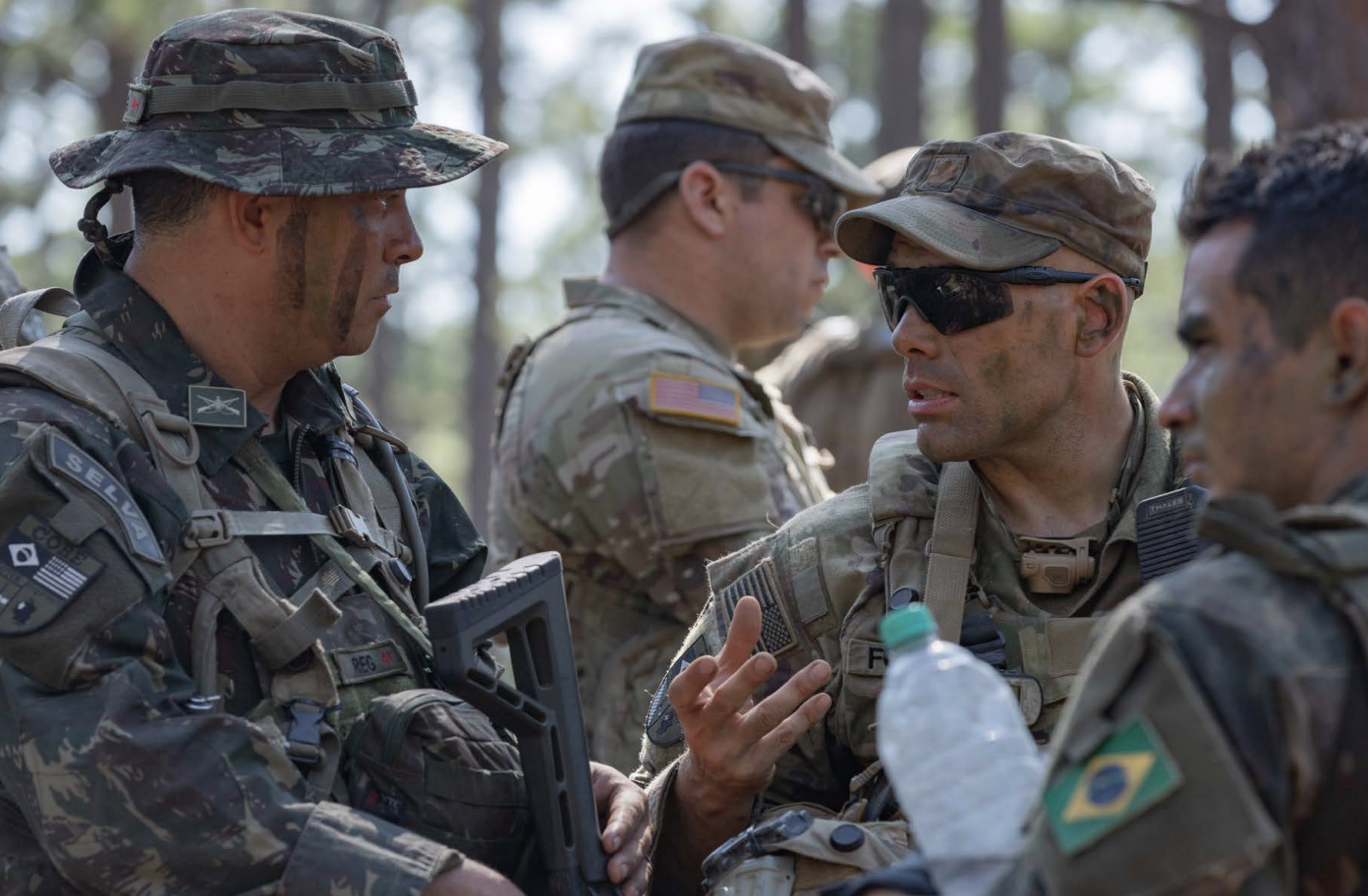

A new RAND report makes the case that Security Force Assistance—the business of training, advising, and equipping partner militaries—is one of the most cost-effective tools the U.S. has for advancing its strategic interests in Latin America.
“Force Multipliers in the Americas” by Irina A. Chindea, Elina Treyger, Tahina Montoya, and Kiki Hunegs presents a threat picture that will be familiar to Small Wars Journal readers:
- China dominates through ports, telecom, critical minerals, and surveillance.
- Russia concentrates leverage in strategic sectors and authoritarian partners.
- Iran operates through Hezbollah’s proxy network
Venezuela, before Maduro’s removal, functioned as a multi-adversary platform where all three converged. It’s worth noting a point the report hammers home, here: the lines between state adversaries and violent non-state actors have blurred to the point where the distinction is analytically less useful than it once was.
Tools to Use
The U.S. can generate significant effects in the region at relatively modest cost by building partner capacity rather than substituting American presence. RAND focuses its analysis on Mexico and Panama, mapping how three formations can reinforce each other.
- ASCG-South drives training initiatives that build partner capacity and reduce corruption underpinning cartel operations, with a particular role in Panama’s Darién region and Canal Zone.
- Special Operations Forces provide the discrete, relationship-intensive engagement that rural communities and politically sensitive environments require, particularly in areas where Chinese influence is advancing through community-based initiatives—western Panama’s Chiriquí province being the current case study.
- The National Guard State Partnership Program sustains reform momentum across political transitions through decades-long trusted partnerships. California’s new SPP pairing with Mexico, approved in December 2025, is a notable development.
The report is careful about what SFA cannot do. Existing security cooperation authorities were not designed to counter economic coercion, which is China’s primary instrument in the region. Think of it this way: Advising a partner military on vetting procedures does not neutralize a $5 billion infrastructure loan. RAND flags this gap explicitly, noting that DOW may need to consider how it contributes to challenges its current legal authorities weren’t built for.
Oh, Oh, Mexico
In Mexico, historical sensitivities around U.S. military presence on Mexican soil mean ASCG and SPP uniformed personnel don’t operate there. Training largely happens on the U.S. side of the border. Without a Status of Forces Agreement or Visiting Forces Agreement, the ceiling on SFA effectiveness in Mexico is low and unlikely to rise without high-level political agreement.
The Bottom Line
It’s worth thinking of SFA (as in, Security Force Assistance) really as a counter-influence tool. Persistent U.S. engagement in areas where China is working to establish community-level presence offers a direct competitive alternative. Replicating that model elsewhere, the report argues, is feasible– as the Missouri National Guard has shown in its 30-year relationship with Panama– but strategically underutilized.
While you’re here…
Alexander Anderson recently wrote an article that corroborates a central current of this RAND report vis-a-vis China. While Latin American states retain agency, he argues, “the United States’ main challenge is to provide credible alternatives to China’s deepening, structurally influential presence.” Check it out here: “Unrestricted Warfare Without War: China’s Below-Threshold Strategy in Latin America.”
Last year, Andrew Haanpaa wrote on the historical parallels between America’s Cold War relationship with Latin America and the age we were entering as Trump’s second term took off. His perspective piece argued for something slightly different than Anderson– a two pronged approach, driven by economic investment and “regional security.” It seems we’ve landed somewhere in between the two, and the results we have yet to fully see. In any case, his view is worth a read, one year out: “Same But Different: Cold War Strategy in 21st Century Latin America.”
Finally, we recently put out a Discourse on the Center for the Study of Democracy’s “Shadow Alliances: Authoritarian Powers and the Hybrid Warfare Nexus in Latin America,” the most comprehensive open-source mapping yet of how Russia, China, and Iran have embedded themselves in Latin America. Take a look.

