Front-Loaded Coercion: Negotiation Logic and the Strategic Risks of Opening-Salvo Statecraft
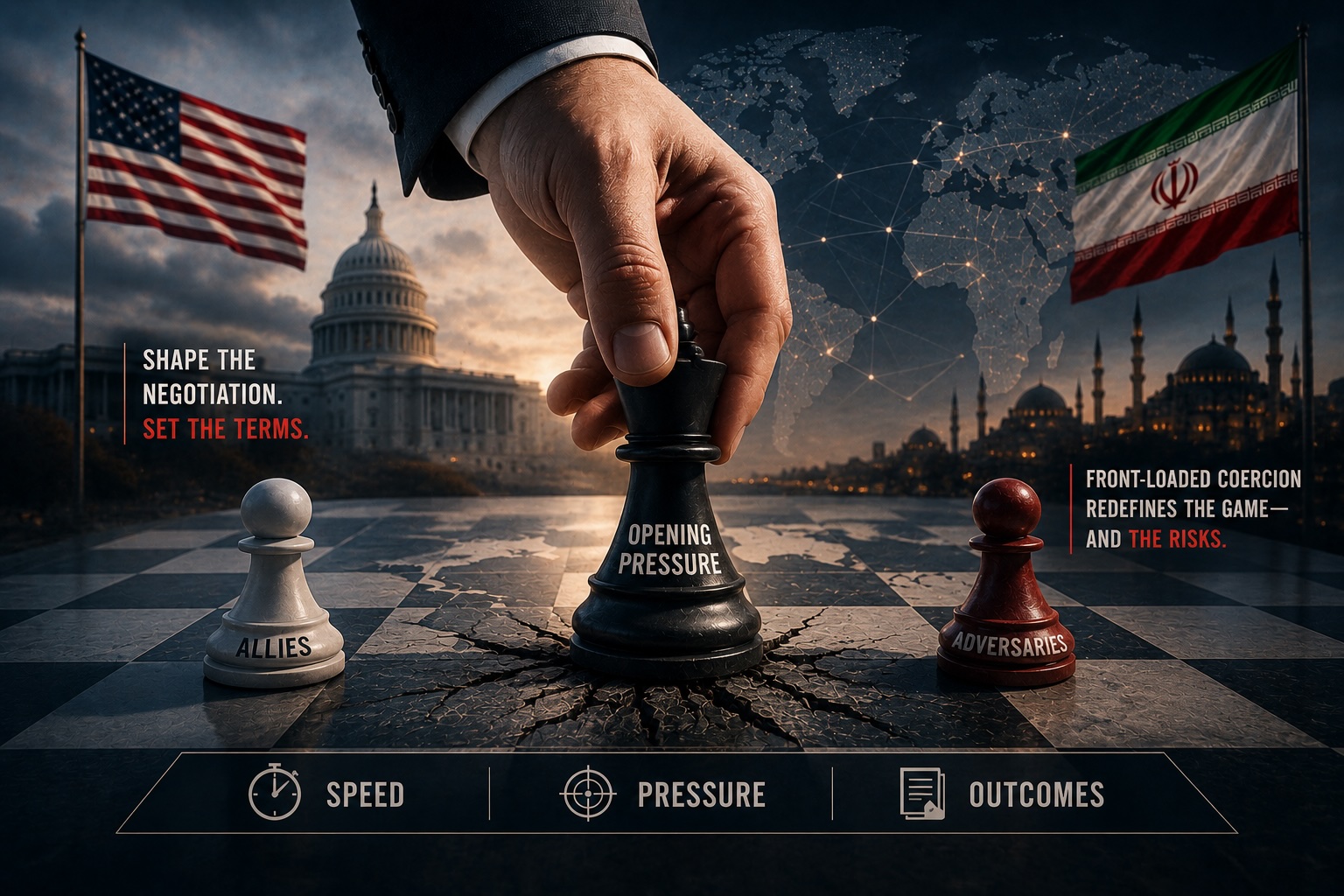

In my professional career, I have spent years studying how leverage, brinksmanship, and coercive pressure shape high-stakes business acquisition transactions. One of the more aggressive tactics involves a buyer deliberately delaying disclosure of a material issue discovered during diligence until late in the process.
The logic is straightforward. The buyer waits until legal fees, management attention, financing commitments, and emotional momentum have accumulated. Then, the buyer claims to have discovered an inadvertently overlooked issue during diligence that materially affects valuation and demands a price concession. The seller, already heavily invested in closing the transaction, must decide whether to absorb the hit or risk blowing up the deal entirely.
The tactic is not admired within the transactional world. Firms that rely on it often develop reputations for bad-faith bargaining. Yet the strategy persists because, under the right conditions, it can work.
What makes the tactic effective is timing.
The coercive pressure is introduced at the point where the counterparty has the least flexibility and the greatest sunk-cost exposure. Over the past several years, however, American foreign policy has periodically displayed a different form of coercive bargaining logic—one that inverts the timing model entirely.
Rather than holding the pressure point until later in the negotiation, the pressure arrives at the beginning.
Large tariff threats are announced before bargaining frameworks fully develop. Alliance commitments are publicly questioned at the outset rather than quietly renegotiated through diplomatic channels. Maximalist demands are introduced immediately, often before coalition management or institutional groundwork has occurred.
The opening move becomes the escalation point.
Under this model, the objective does not appear to be traditional negotiation in the classical diplomatic sense. Instead, the initial escalation functions as a framing mechanism. The opening position shifts the discussion’s center of gravity before counterparties have time to establish alternative assumptions or organizing principles.
The strategic value of the approach lies less in securing the original demand than in redefining the boundaries of the subsequent debate.
Even partial retreats can still produce movement if the negotiating environment has already been reset.
The U.S. administration’s handling of Iran may ultimately illustrate a more complicated version of front-loaded coercion. Public messaging and early operational posture appeared to reflect expectations that concentrated military and economic pressure could rapidly compel strategic concessions and produce a short-duration confrontation. As the conflict became more resistant and regionally destabilizing than anticipated, the emphasis increasingly appeared to shift toward controlling the diplomatic and psychological framing of the negotiations that followed.
In that sense, the subsequent approach reflected the same bargaining logic discussed earlier: reshape the negotiating environment before substantive bargaining fully matures. Public escalation rhetoric, compressed timelines, sanctions pressure, and repeated declarations regarding acceptable outcomes helped define the diplomatic space in which ceasefire and interim negotiations unfolded.
Yet the Iran case also exposes the risks of front-loaded coercive systems when early assumptions prove incorrect. Once escalation exceeds expectations, the same pressure tactics that initially sought to establish leverage can complicate off-ramps, increase allied uncertainty, and encourage counterparties to adapt to the signaling pattern itself rather than the underlying demands.
This helps explain why observers often misread the apparent contradiction between dramatic opening positions and later moderation. The moderation itself may not represent failure. If the negotiating framework has already shifted, the initial escalation may have achieved its primary purpose.
In that sense, front-loaded coercion operates less like conventional bargaining and more like narrative seizure.
The technique can generate advantages. It may disrupt institutional inertia. It can force allied governments to confront long-deferred burden-sharing disputes. It can alter domestic political expectations and compress decision timelines for adversaries unprepared for abrupt escalation. In some circumstances, unpredictability itself may produce tactical leverage by increasing uncertainty regarding future American actions.
But the same approach also introduces structural risks that are often underappreciated.
Coercive opening salvos can impose costs not only on adversaries but also on allies, institutions, and markets attempting to assess the durability of American commitments. If maximalist opening positions become routine, counterparties may begin adapting to the pattern itself rather than to the substance of the demands. Governments may delay concessions while waiting for predictable moderation. Financial markets may begin treating political volatility less as a temporary disruption and more as a recurring structural feature.
Over time, repeated escalation followed by partial retreat can also create signaling fatigue. The more frequently extreme threats are employed, the more difficult it becomes for counterparties to distinguish between tactical positioning and genuine willingness to absorb the costs of confrontation.
This creates a paradox. A strategy designed to project strength can, if overused, gradually weaken coercive credibility.
The problem becomes even more acute in alliance systems. Commercial negotiations and geopolitical alliances are not governed by the same logic. In transactional settings, reputational damage may remain compartmentalized within a relatively small network of market participants. In alliance structures, however, credibility assessments compound across multiple theaters simultaneously. Allies and adversaries continuously observe how commitments are framed, modified, enforced, or abandoned.
As a result, the long-term effects of front-loaded coercion may extend well beyond any single negotiation.
The issue is not whether aggressive bargaining can sometimes produce tactical gains. It clearly can. The more important question is whether a system built around recurring escalation retains strategic durability once other actors adapt to its methods.
In business negotiations, the firms most feared across the table are not usually the loudest or the most theatrical. They are the ones whose counterparties believe will remain disciplined when the costs of walking away become real.
Statecraft operates under similar constraints.
Opening salvos can dominate headlines and temporarily redefine political space. But durable leverage ultimately depends less on the ability to shock the system than on the ability to sustain credibility after the initial detonation fades.