Intervening in the Attribution Chain: Signature Reduction Under Cross-Domain Surveillance


Abstract
This article builds on previous Signature Reduction contributions that defined signature as the totality of observable behavior across physical and digital domains, established signature reduction as a behaviorally grounded doctrine rather than a set of technical measures, and emphasized the primacy of human judgment in managing exposure. It shifts from that conceptual foundation to operational application under conditions of ubiquitous technical surveillance (UTS). It argues that modern exposure emerges through an attribution chain in which routine behavior is observed, aggregated, correlated, and ultimately attributed across domains. While earlier work clarified what signatures are and why they matter, this piece focuses on how operators can deliberately intervene within that chain to preserve initiative and freedom of maneuver. It reframes signature reduction not as concealment, but as a method for managing attribution under persistent surveillance, introducing the Attribution Chain as a practical model for intervention and demonstrating how behavior can be shaped as it propagates through it.
UTS: Routine Behavior, Operational Consequences
An operator’s spouse takes one last family picture before they leave home. Walking through the airport, the operator checks their phone and purchases a train ticket. None of these actions is unusual. But each generates observable behavior – captured by payment processors, cameras, social media, and travel databases. When these pieces are correlated across domains, this observable behavior becomes fodder for attribution. This is not an edge case – it is the baseline operating environment. This baseline is characterized by ubiquitous technical surveillance (UTS).
UTS has ushered in an age of attribution, in which operational exposure emerges through correlation of ordinary, everyday behavior across physical and digital systems. The real challenge is not avoiding detection by these systems entirely – for this is becoming increasingly unrealistic and itself alerting – but rather preserving initiative and freedom of maneuver under such persistent attribution pressure. Concepts such as operations security (OPSEC) previously engaged this challenge. OPSEC seeks to identify critical information and control visible information to protect it from adversary exploitation, particularly operational information. However, the problem is not observation, but how it accumulates toward attribution. Signature reduction is the integrated response to this pressure, the doctrine which governs human judgment, digital signature management, and physical behavior simultaneously. Signature reduction has as its aim not concealment from surveillance ecosystems but rather systematically disrupting correlation and attribution attempts as a tool of maneuver. Signature reduction governs how behavior is shaped across domains to manage attribution, while OPSEC protects specific information – retaining OPSEC as a valuable subset within the broader discipline of signature reduction. Lack of awareness of UTS is not the challenge, but rather the difficulty of translating that awareness into integrated behavioral discipline across domains.
Why Understanding UTS Alone is Insufficient: The Attribution Chain
Operational exposure under UTS – what we call the Attribution Chain – follows a predictable pattern:
- Observation: Observable behavior is first detected by sensors in everyday systems, across financial networks, travel, communications platforms, physical surveillance, and other vectors.
Operational problem: All behavior is observable. This extends from the physical to digital domain. However, digital observability – the first step towards attribution – often begins with routine behavior well before deployment. The operator’s task is to shape how distinctively and frequently.
- Collection: These observations are then collected and aggregated within commercial surveillance ecosystems. This collection occurs across multiple databases, jurisdictions, and geographic locations.
Operational problem: Observed behavior persists and aggregates. The operator’s task is managing cross-domain occurrences.
- Correlation: The observable behavior is now accessible for analytical systems and human analysts to correlate in search of patterns, linking physical and digital artifacts across domains.
Operational problem: Patterns emerge from observable data. Patterns establish a baseline within which the operator is expected by an adversary to act. Safeguarding operational activity means avoiding anomalous behavior – acting within the available established baseline. The operator’s task is therefore to manage the stories these patterns reveal.
- Attribution: Only after this correlation does attribution emerge, allowing insights into identities, relationships, past behavior, and eventually, intent.
Operational problem: Correlation becomes confidence. The operator’s task is to preserve ambiguity for freedom of maneuver.
The benefit of the attribution chain is not highlighting where we are exposed, but rather revealing opportunities for intervention in the process. What appears therefore as instantaneous exposure is in reality the result of a gradual compilation of observable behaviors across domains. One operational mistake is typically insufficient to expose an entire operation. Exposure increasingly emerges not from a single detectable act but from the aggregation and correlation of observable behavior across UTS vectors. The attempted assassination by Russian GRU officers of defector Sergei Skripal and his daughter Yulia in London in 2018 demonstrates the power potential of attribution over time. In this watershed event, an entire Russian clandestine chemical weapons program was exposed following the unmasking of Russian operatives involved in a failed poisoning attempt. Operatives were unmasked not from a single operational mistake but rather from rigorous analysis of available information which exposed them in the physical domain, amplified by the digital one. Russian officers were publicly attributed through travel records, CCTV footage, passport and identity irregularities, and other open source data. Identifying the operatives catalyzed the exposure of the chemical weapons program whose product they attempted to use. Any one of these observable data, therefore, while presenting operational risk, would likely not have proved so definitive.
All operational behavior passes through this attribution chain of observation, collection, correlation, and attribution. Properly understood and integrated into behavioral discipline, signature reduction doctrine proactively intervenes at each stage of this chain to preserve operational initiative and freedom of maneuver. Understanding this process clarifies why many current responses fail. Without this framing, organizations tend to respond only to attribution, when it is already too late or too big to fail. In practice, operators are not managing single actions, but patterns of behavior across time, space, and domains. Signature reduction therefore requires thinking in terms of patterns, not events.
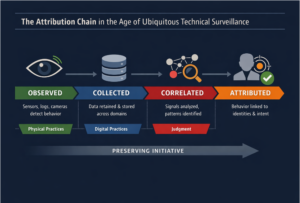
Caption: This diagram visualizes the Attribution Chain under conditions of UTS, showing how behavior progresses from being Observed, Collected/Aggregated, Correlated, and ultimately Attributed. Color-coded overlays indicate where different domains of signature reduction practice—physical, digital, and human judgment—intersect with the chain. The arrow beneath highlights the overarching objective: preserving operational initiative even as actions are monitored and analyzed across domains.
Ineffective Responses to the Attribution Chain
There are myriad responses to the Attribution Chain offer a semblance of control, but which ultimately fail to preserve operational maneuver under conditions of UTS. Four of the most common are discussed here. These responses share a common flaw: They attempt to solve attribution at a single point rather than across the chain.
- Over-reliance on technical solutions: This response is most prominent in the commercialized, technologized West, where cutting-edge commercially developed solutions attempt to buy technology out of the surveillance problem. State actors compromise inherently vulnerable telecommunications data in the continental United States? We’ve got a rapidly venture capital-backed proprietary stack engineered from the ground up to counter every single aspect of the particular threat. Never mind simply offering education and training to inform end-user judgment and behavioral discipline: There are new sensors, new communications, new cyber tools, and new platforms which promise relief from the pressures of UTS, for a modest price and a quick response. Yet this practice violates the fundamental truth of special operations forces, in that quick and easy solutions cannot be rapidly or mass-produced.
Modern technology does not simply observe activity – it fragments it and isolates individual behaviors into discrete data points that become subject to surveillance ecosystems, where it persists, aggregates, and becomes available for correlation and attribution. Individuals and organizations tend to respond in kind, applying technical or policy solutions in isolation. The result is an environment in which attribution systems operate as an integrated whole, while our responses remain fragmented. Signature reduction doctrine exists to restore that unity – aligning human judgment, shaping digital behavior, and physical movement into a coherent response.
To effectively relieve attribution pressure from UTS, deliberate and systematized changes implemented over time proves most durable, consistent, and effective. Without a unifying doctrine to organize our response, myriad particular solutions are received merely in reaction to the myriad threats. The result is a patchwork of poorly cohering and costly technological solutions, each which introduces complexity into our response but without effective signature reduction. By focusing on tools, organizations neglect the behavior that generates the signatures those tools attempt to protect.
- Risk paralysis: This response is fundamentally more human. In response to well-founded fears of UTS conditions, organizations become overly cautious. Operational initiative is drowned out by strong centralized mechanisms of fear-based control, limiting operator travel, limiting contact with commercial industry, and restricting activity. A popular fitness application broadcasts an operator’s run online, revealing a previously undisclosed operating location to the world? The response is to immediately ban the application, and any like it, implementing policy based restrictions on personal and operational access to technology-based tools. While also well-intentioned, this response not only fails to educate and train behavioral discipline, but restricts operator freedom while bolstering a climate of fear. When operators are told more often what they cannot do rather than what they can do, risk becomes the predominant lens through which reality is interpreted. This stifles operational creativity, healthy calculated risk-taking, and further limits access to technology which may otherwise prove operationally beneficial. Operators become compliant, not adaptive.
Signature Reduction doctrine recognizes inherent operational risk and calculates for it, while still maintaining emphasis on operational initiative and human judgment amidst attribution pressures. Risk is willingly and knowingly accepted as a cost of doing business under UTS conditions, and while uncomfortable organizationally, is viewed as a positive pressure which helps inform maneuver.
- Domain fragmentation: The third ineffective response is domain fragmentation, or the failure to respond cohesively with an integrated, systematic approach to UTS pressure. In this response, over-specialization within organizational silos inhibits cross-pollination and unity. Instead of an integrated multi-functional perspective, we hear from cyber teams, human intelligence teams, signals intelligence teams, and force protection teams separately. Even when physically collocated, organizations attempt fusion but remain unable to keep pace with the rapidity and scale at which attribution systems combine data across domains. What is an active and laborious process of integration from organizational standpoints – complete with liaison officers, joint task forces, working groups, committees, and the like – attribution systems integrate passively, continuously, and at scale. Organizations cannot keep pace or coherence with the technologically driven surveillance ecosystems which exploit the individuals within them as it decomposes their behaviors into discrete data points for attribution insights. In this sense, our operationalized responses to UTS pressure proves consistently ineffective, as the cross-domain nature of UTS demands a deeper underlying unity which better equips us to offer an integrated operational response.
Signature Reduction doctrine offers a deeper foundation of integration which extends from each individual within a system to teams to organizations. The discipline, education, and training required for adequate signature reduction begins with the human person. This also points to a core SOF truth: humans are more important than hardware.
- Failure to accept the operational reality: The final ineffective response represents a fundamental misunderstanding of the UTS threat and how to operate under UTS conditions. In a risk-based environment, an organization’s ability to guarantee the greatest minimization of risk possible is the predominant value driving decision-making and thus, operational impact. Yet, the pervasiveness and universality of the UTS environment, driven by the commercial surveillance economy, cannot be understated. Sober assessment of attribution pressure leads to the understanding that mere avoidance of detection is no longer possible, or at the very least, is becoming increasingly prohibitive. Modern surveillance systems are designed to observe, collect, correlate, and attribute the greatest quantity of activity as is meaningfully possible. It is entirely possible to be perfectly “clean” in one domain and still be attributed. Individual and organizational responses can no longer treat exposure as a domain-specific problem but rather one that is cross-domain and behavioral. Avoidance itself is its own observable signature. What is required is a personal system which effectively manages cross-domain correlation and disrupts it.
Signature Reduction doctrine is that personal and systematized response. It acknowledges that, not only has surveillance expanded, but we require a method by which to preserve operational initiative in light of the threat. If attribution follows a chain, then effective response must intervene within it.
Operationalizing Signature Reduction: Intervening in the Attribution Chain
The shift from a reactive risk-based model to a proactive signature reduction posture is as subtle as it is profound. Its power lies in our ability to intervene at the various stages of the attribution chain, thereby affording freedom of maneuver under UTS conditions.
Within the contemporary operating environment it is impossible to prevent observation. We simply cannot not have a physical or digital signature. Both ends of this stage of the attribution chain prove operationally unhelpful – either having no signature whatsoever, or having a signature which can be observed by anyone. As we recognize observation cannot be prevented, we begin to realize the freedom of maneuver which results from how we choose to understand and shape that which is observed. Through digital and physical signature management grounded in signature reduction doctrine, we realize freedom to shape what is observable, how often, and how distinctive it is. For example, definitive practices within digital force protection offer discrete, individual actions which strengthen signature reduction discipline for individuals and organizations. We begin to learn the movements and mechanics of signature management and how to proactively and counter-offensively maneuver with it through digital and physical terrain. Our goal becomes not invisibility or non-attribution, but a sort of non-distinctiveness which affords us maneuver in the gray zone.
Chinese maritime militia operations demonstrate to an extent this sort of non-distinctiveness, in which state vessels operate in commercially normal or generally non-threatening patterns (i.e. in fishing or transit areas) and without distinctive military signatures. Yet, while the physical presence of Chinese vessels is obvious, attribution of their intent remains contested – or at a minimum, highly challenging – as they rely on ambiguous plausible narratives (i.e. positively promoting quasi-coast guard functions) to purchase shaping power through their maneuver. Their aggression remains veiled and non-distinctive while still promoting stated aims. It is this maneuver in the gray zone which directly translates to freedom for action in support of our objectives. Our primary intervention in the attribution chain is how we understand this shaping potential.
A key feature of UTS environments is that whatever is observed generally persists and aggregates with time as it is collected. If everything is collected, our goal is that whatever is collected remains uninteresting and generally insignificant in the broader data and across systems and domains. What we can manage is consistency, reuse, and any linkage among physical and digital artifacts that are observed and collected across these systems and domains. The goal in this intervention is to avoid creating stable identifiers across contexts, or across domains. As technology is the means by which these identifiers are stored and collected, we employ the shaping power of digital signature management to affect what commercial surveillance can see, and thus collect.
The real battleground of the attribution chain is correlation, where digital and physical artifacts which have been observed and collected are analyzed, assessed, and eventually weaponized through attribution. Prior to correlation, risk existed in the attribution chain only in potential. With correlation, risk begins to become actualized. Our patterns, cross-domain artifacts, and their timing are analyzed with the help of technology, to tell a story from the data. Our goal is to fragment, distort, or overload the narrative that correlation attempts to construct. We do this through consistent physical and digital signature management. Adversaries see only that which we intend for them to see, as a calculated risk exercised through our operational judgment. This judgment is informed through a fundamental set of individual actions which begin in seemingly small and even insignificant behavioral disciplines – such as digital force protection – but which yield tremendous and exponential freedom for action over time, particularly in an operational context. We have exercised particular judgment which guides our physical and digital behavior, and this is the stage where that judgment is tested – in the face of really emerging risk potential. Signature reduction doctrine emphasizes the criticality of human judgment at this stage of intervention because it is the decisive factor which informs operational outcomes. The decisive terrain is no longer only physical or digital but within the human person and their judgment itself.
Finally, we reach the attribution stage of the attribution chain. Attribution is what occurs when correlation of data that was observed and collected earlier becomes confidence. Patterns have emerged from observed artifacts over time, and there is potent meaning in them which can determine identity and intent. Outcomes here are informed by the level of confidence which can be attributed to these correlations as indicators of operational activity. Effective signature reduction here provides adequate maneuver within cognitive, narrative, digital, and physical spaces for freedom for action. The key is again, not that we might not be observed at all, but that there should remain competing plausible narratives.
Signature Reduction: The Heart of the Gray Zone
This ambiguity is the heart of the gray zone insofar as it informs and affects human judgment and perception. We do not attempt to be hidden, but that we are not confidently understood in our actions while still being able to attain our objectives. This is the ultimate shaping power of signature reduction under UTS conditions. Signature reduction is not a checklist of precautions – it is a method for shaping how our behavior across digital and physical domains propagates through the attribution chain, and how to intervene successfully within it.