The War Against Iran and the Dissolution of Classical Strategic Categories
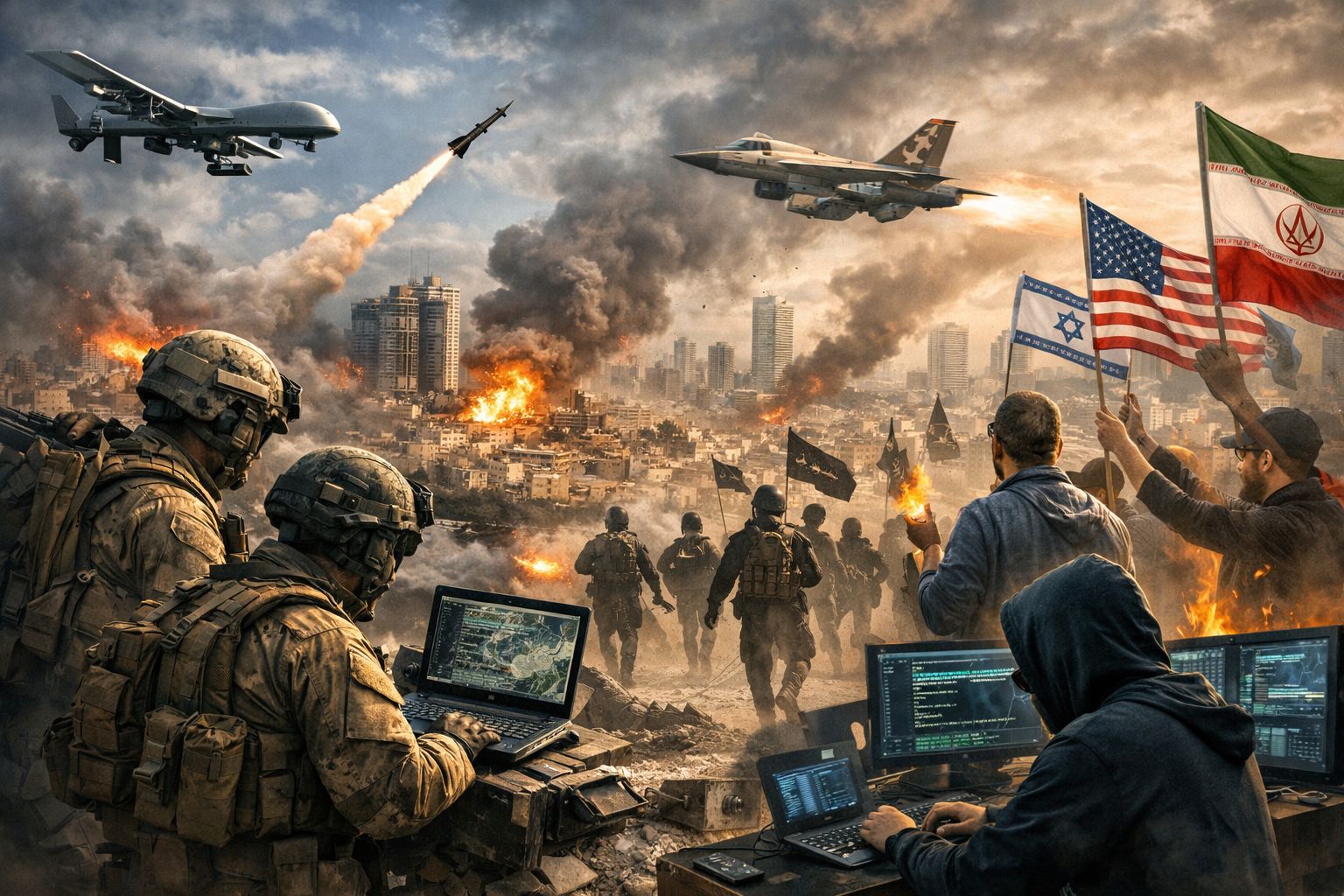

The 2026 US-Israel campaign against Iran reveals a breakdown in the traditional categories used to understand warfare. The distinctions between combatants and civilians, state and non-state actors, and military and non-military instruments are increasingly blurred. These shifts have direct implications for how conflict is understood, managed, and anticipated in contemporary strategic environments.
Introduction
At 06:35 UTC on February 28, 2026, the United States and Israel launched coordinated military campaigns against Iran: Operation Epic Fury on the American side, Operation Roaring Lion on the Israeli side, striking simultaneously nuclear sites, ballistic infrastructure, and the military and political command structures of the Iranian state. Whatever the outcome of the campaign, it cannot be mistaken for coercive diplomacy. Donald Trump explicitly defined the end state as regime change, and military execution followed that logic from the very first hour.
Weeks into the conflict, it already reveals something deeper than its operations. It reveals the simultaneous dissolution of three fundamental categories of classical strategic thought: the distinction between combatants and civilians, the distinction between sovereign states and transnational armed actors, and the distinction between military and civilian instruments. Three classical analyses converge on a single diagnosis: those of General Rupert Smith, of theorist Hedley Bull, and the recent literature on weaponization. This is not the emergence of a new world order. It is the accelerated erosion of the grammar that once allowed the old one to be named and negotiated.
War Among the People and Beyond
In The Utility of Force (2005), General Rupert Smith diagnosed the end of classical industrial warfare and the advent of what he termed war amongst the people, a war where civilian populations are no longer the context of combat but its terrain. Smith was writing from the experience of Bosnia, Kosovo, and Iraq. He described a transformation specific to asymmetric wars, post-bipolar interventions, and prolonged low-intensity conflicts.
The war in Iran ruptures that framework: not by contradicting it, but by extending it to its extreme logic. Smith described a war amongst the population, a situation where the battlefield dissolves into society. What we observe today is a war in which civilian infrastructure becomes a central target of economic coercion, and the population itself is treated as a strategic lever by both sides.
From the first hours of its retaliation, Iran extended its targets well beyond American and Israeli military installations. Residential buildings, commercial and hotel districts in Dubai and Abu Dhabi, and most significantly the major airport hubs of UAE and Qatar were hit. Tehran escalated the next day to energy infrastructure in Saudi Arabia. The escalation is deliberate and methodical. Beyond the Strait of Hormuz, Iranian missiles and drones have struck the economic infrastructure of the entire Gulf region. According to Mona Yacoubian at the Center for Strategic and International Studies (CSIS), by hitting the Gulf where it hurts most, its glittering infrastructure, its developing AI architecture, its wealth-generating energy production, Iran jeopardizes the entire regional economic diversification project and forces the Gulf states to take Iranian interests into account.
On their side, Washington and Jerusalem have opted for an equally de-territorialized logic: the decapitation of the Iranian state apparatus. From the outset of the strikes, targets included not only nuclear and ballistic installations but also the residences of the Supreme Leader, the headquarters of the Islamic Revolutionary Guard Corps, and a long list of military commanders and political officials. The stated objective is to trigger a collapse of the command chain and, ultimately, regime change. This strategy presupposes that war can be won without territorial occupation, by destroying the adversary’s decision-making elite, an assumption that the experience of the past twenty years in Iraq, Libya, and Yemen makes deeply questionable. Yet it illustrates the same dissolution of the category of population: for the United States and Israel, the Iranian population is itself conceived as a potential terrain for a liberation that would follow the regime’s collapse.
Smith identified the structural transformation. What he did not fully anticipate is that war amongst the people would become the general condition of any contemporary conflict, regardless of its formal nature. Both sides today treat the population, their own and their adversary’s, as a strategic resource to be protected or destroyed, rather than as a sanctuary. The boundary between war and peace, between military and civil space, is vanishing: an airport is both a civilian logistics node and a strategic point of entry; a desalination plant is both vital infrastructure for millions of civilians and a target for maximum coercion. War amongst the people is no longer a doctrine. It is a structural constraint.
Fragmented Sovereignty: Bull’s Neo-Medievalism and What He Did Not Fully Theorize
In The Anarchical Society (1977), Hedley Bull sketched out, among several possible futures of the international system, a scenario he called neo-medieval: a world where multiple and competing allegiances, to religious, ethnic, ideological, and transnational entities, would fragment classical state sovereignty, without producing a coherent alternative order. Bull was careful about what he was and was not claiming. He was not predicting chaos. He was posing a harder question: could a neo-medieval world generate its own form of order, a system of overlapping authorities, each legitimate within its own sphere, coordinating selectively around shared interests, or would it produce only ungovernable disorder?
That question is now empirically testable. And the answer this conflict provides is more nuanced than either Bull’s optimistic variant or a simple diagnosis of chaos.
In Beirut, Baghdad, and across the Middle East, a common pattern repeats: a leader is killed, funerals fill the streets, and within weeks someone else gives orders. Despite the setbacks suffered by the regional network of armed groups aligned with Iran that calls itself the axis of resistance, it has not disappeared. But it has fragmented. As Renad Mansour at War on the Rocks has documented, some within Hezbollah prioritize preserving the movement’s domestic position and protecting Lebanon from devastating escalation. Others, who believe their power derives from armed resistance and their transnational ties to Iran, appear more inclined toward continued confrontation. These divisions reflect two broad tendencies: a faction associated with Secretary General Naem Qassem, seeking to prioritize domestic political survival, and a harder-line current that sees Hezbollah’s future as inseparable from the survival of Iran’s regional project.
The Houthis offer the starkest example of the autonomization Bull underestimated. Significantly weakened by sustained US and Israeli pressure, they have maintained their own cost-benefit calculus throughout this conflict, escalating when their interests align with Tehran’s, but not automatically, and not always on Tehran’s timeline. They are not an instrument of Iranian policy. They are an actor that shares certain Iranian objectives and coordinates selectively when coordination serves their own survival. This is not the neo-medieval order Bull imagined, a stable system of overlapping authorities. It is something more unstable: a network of actors that can amplify, redirect, or simply ignore the intentions of the power nominally at its center.
The most striking illustration of this dynamic comes from Iraq. Senior leaders of Iran-backed Iraqi militias have made clear that they do not see themselves as auxiliary forces awaiting integration into the state; they see themselves as the state. A state that does not control an armed actor operating from its territory, with allegiance to an outside power, is the exact definition of Bull’s neo-medievalism. But what these actors are asserting goes further than Bull anticipated: the sub-state entity does not merely claim a competing allegiance. It claims the state itself.
Since February 28, US-Israeli targeting has worked through a long list of senior Iranian officials, missile installations, naval assets, and sites associated with the regime’s security forces. The decapitation of the command does not stop the network logic. Graveyards are full of indispensable men, and the accumulated losses could test the regime’s cohesion without resolving the underlying question: if the proxies are now autonomous enough to survive the collapse of their patron, then eliminating the patron does not eliminate the network. It liberates it from the last constraints that Tehran’s strategic discipline imposed.
This is the deepest revision that the 2026 war forces on Bull’s framework. Neo-medievalism is not a transitional disorder on the way to some future order. It may be a self-reinforcing equilibrium, one in which the erosion of state sovereignty generates actors capable of perpetuating that erosion indefinitely, without either collapsing into full anarchy or crystallizing into a new system of rules.
Weaponization as the New Paradigm
In 1999, two colonels of the People’s Liberation Army, Qiao Liang and Wang Xiangsui, published Unrestricted Warfare, arguing that armed conflict had evolved far beyond Clausewitz’s definition. In its place, they proposed a new paradigm: “using all means, including armed force or non-armed force, military and non-military, lethal and non-lethal means to compel the enemy to accept one’s interests.” The battlefield, they argued, would become unlimited, encompassing financial warfare, trade warfare, environmental warfare, and the systematic weaponization of civilian infrastructure. Twenty-seven years later, the 2026 war against Iran has made their prescription a shared operational reality. Three domains illustrate this shift, each more structurally disruptive than the last.
The first is financial. The closure of the Strait of Hormuz illustrates the mechanism with precision. According to data from Lloyd’s List and the International Group of P&I Clubs, seven of the twelve P&I clubs representing approximately 90 percent of global ocean-going commercial tonnage reclassified the Strait as a maximum war-risk zone on March 1-2, 2026. War-risk premiums surged by more than 1,000 percent. Oil traffic through Hormuz collapsed from a pre-conflict baseline of approximately 138 to 153 vessels per day to three commercial transits on March 7. Iran did not need to sink ships to close the Strait. It was enough for the insurance market to withdraw coverage. The decisive instrument was not naval, it was actuarial, and no existing framework of the laws of armed conflict was designed to address it.
The second domain is the supply chain. The pager attack in Lebanon in September 2024, orchestrated by Israel’s Mossad intelligence service, remains the paradigmatic example: civilian communication devices transformed into weapons by exploiting the supply chain itself. No conventional strike, no front line, no declaration of war, yet thousands wounded simultaneously in seconds. This conflict extends that logic to navigational infrastructure. According to Chatham House, ships began broadcasting false Chinese identifiers to gain passage through bilateral arrangements. GPS spoofing and dark vessel activity have proliferated across the Gulf and into the Indian Ocean, distorting the informational layer that defines maritime reality. CSIS further points out that private US companies such as Microsoft and AWS now find themselves on the front line of this conflict: the boundary between state and private actor in the conduct of war has ceased to be meaningful in practice, whatever it may remain in law.
The third domain is temporal, and it is the most consequential. In Unrestricted Warfare, Qiao and Wang argued that the battlefield of the future would encompass not only military and economic space, but the very systems through which a society projects its power forward in time: its infrastructure, its institutions, its development model. CSIS identifies exactly this logic in Tehran’s current campaign: by striking logistics, energy production, data centers, water, tourism, and finance, Iran is not merely imposing immediate costs on its neighbors. Tehran is not targeting what its adversaries are. It is targeting what they are trying to become: their long-term economic transformation, notably Saudi Arabia’s Vision 2030and the UAE’s We the UAE 2031. The future itself is weaponized.
The cyber dimension operates within this same logic. General Dan Caine, Chairman of the Joint Chiefs of Staff, publicly confirmed that U.S. Cyber Command and U.S. Space Command were “the first movers” in Operation Epic Fury, “layering non-kinetic effects” to blind Iranian communications before kinetic strikes began, a pattern first established in Venezuela. In Qiao and Wang’s framework, cyber is not a separate domain. It is the enabling layer that makes systemic disruption possible across all others. The International Institute for Strategic Studies (IISS) notes in its March 2026 analysis the significant disparity in capabilities between the parties in cyberspace, an asymmetry that formal deterrence theory does not yet adequately capture.
Weaponization, in this sense, is not a set of tools. It is a strategic logic: the systematic exploitation of the systems, financial, logistical, informational, temporal, that make power possible. The battlefield is no longer a space. It is the grammar of the systems that sustain power.
Conclusion: The Lost Grammar of the International System
The United States did not enter this war because it had been attacked or was about to be. It entered after concluding that, once Israel set itself in motion, its own involvement would be inevitable. As Farah Jan documented in War on the Rocks, the debate during Secretary Rubio’s briefing to congressional leaders three days before the strikes was not over whether to fight, but whether the United States should strike alongside Israel or wait for Iran to retaliate against American forces first. The choice was not between armed conflict and peace. It was between two trajectories toward the same war.
The Omani mediator had declared that the nuclear negotiations were close to a breakthrough. The joint military operation was launched after the last rounds of talks, suggesting that the diplomatic and military tracks were running in parallel, and that the alliance with Israel determined which of the two prevailed.
That detail, diplomacy abandoned precisely at the moment it was about to succeed, may be the most revealing thing this conflict tells us about the state of the international system. Hedley Bull, in his analysis of international anarchy, presupposed that even disorder shared a minimal grammar: tacit rules, residual norms, a mutual recognition that certain instruments, negotiation, mediation, signaling, remained preferable to their abandonment. The system was anarchic, but it was not unintelligible. States could still read each other’s intentions, calibrate their responses, and identify exits.
What this conflict reveals is that even that residue is dissolving. Negotiation is abandoned when it is on the verge of success. Proxies act according to their own survival logic, independent of their nominal patron’s directives, and may outlast that patron entirely. A strait is closed by the withdrawal of insurance coverage, not by a naval battle. The destruction of civilian infrastructure has become a legitimate instrument of strategic coercion for both sides. And the United States and Israel may have set in motion a chain of events beyond their control, a worst-case scenario being Iran’s descent into chaotic civil war that would maintain elevated energy prices, trigger a massive refugee crisis, destabilize the broader region, and fuel new terrorist movements whose targets and allegiances no one can yet predict.
This is not a New World Order. It is a world without the grammar of order, and the absence of that common grammar is more dangerous than any clear, even hostile, hegemony, because it deprives all actors, including the most powerful, of the cognitive instruments that allow them to name, to negotiate, and to exit disorder. When war can be launched while peace was within reach, when the boundary between combatants and civilians has vanished, when transnational allegiances blur sovereignty to the point where the sub-state actor claims to be the state, and when the insurance market can close a strait more effectively than a fleet, then no one truly knows what a victory looks like, what an escalation threshold is, or what an exit from this disorder would require. That is the condition this conflict has made visible. Not a world remade. A world unmade.