We Bombed the Wrong Target

Abstract
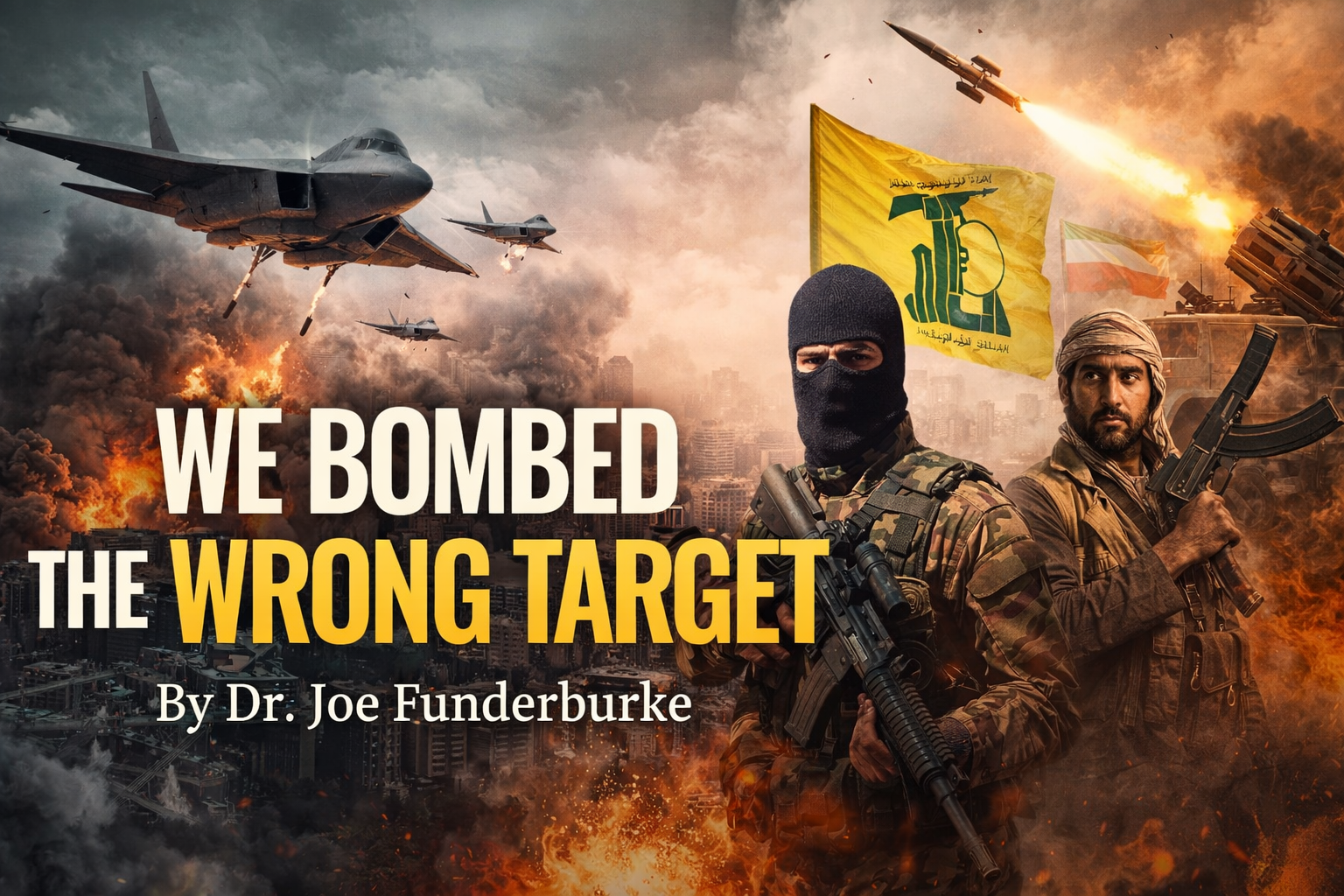
Operation Epic Fury, the joint U.S.-Israeli campaign launched on February 28, 2026, has destroyed significant elements of Iran’s nuclear infrastructure and decapitated portions of its leadership. What it has not destroyed, and what no air campaign alone can destroy, is Iran’s forty-year strategic investment in a distributed proxy architecture spanning Lebanon, Yemen, Iraq, Syria, and Gaza. The nuclear program was always the headline threat; the proxy network is the enduring one. As the Houthis resume attacks on Red Sea shipping and Kataib Hezbollah threatens U.S. bases across Iraq, the morning after Operation Epic Fury reveals a strategic truth that American planners have long resisted: when you remove a state’s conventional deterrent, you do not produce a compliant state, you produce a state with every incentive to fight asymmetrically, indefinitely, and below the threshold of direct confrontation. This article argues that Iran’s proxy network now functions as its primary strategic center of gravity, that the network was specifically designed to survive exactly this kind of decapitation strike, and that the United States must develop a coherent post-kinetic strategy to address it, or risk winning the battle and losing the war.
Introduction: The Strike the Morning After
In the predawn hours of February 28, 2026, Operation Epic Fury began. U.S. and Israeli forces struck targets across Tehran, Isfahan, Qom, Karaj, and Kermanshah, targeting nuclear infrastructure, missile production facilities, and the compound of Supreme Leader Ali Khamenei. The operation followed Operation Midnight Hammer from June 2025 and, as I argued in ‘The Gathering Storm,’ represented not a departure from the maximum pressure strategy but its logical culmination. Trump’s language had been unambiguous for weeks. The carriers were positioned. The F-22s had made their Atlantic transit. The decision, as a source told Iran International, had already been made.
But as smoke rose over Tehran and Iran launched retaliatory ballistic missiles at U.S. bases in Bahrain, Qatar, Kuwait, and the UAE, killing at least one civilian in Abu Dhabi and striking the Navy’s Fifth Fleet headquarters, a harder question emerged from the rubble: what happens next? The nuclear infrastructure may be damaged or destroyed. Khamenei may be dead or incapacitated. But the IRGC Quds Force is still operational. Hezbollah maintains tens of thousands of active combatants in Lebanon. The Houthis have already announced a resumption of missile and drone attacks on Red Sea shipping. Kataib Hezbollah has pledged to begin attacking U.S. bases across Iraq.
This is not a defeated adversary. This is an adversary whose primary strategic instrument, the proxy network, was never the target of Operation Epic Fury at all.
The Architecture of Distributed Deterrence
Iran’s investment in a regional proxy network was not ideological sentimentality. It was a rational strategic calculation made over four decades, accelerated after 2003 when U.S. forces destroyed Saddam Hussein’s army and demonstrated the futility of conventional deterrence against American military power. As the Middle East Forum has documented, the formation of Lebanese Hezbollah in 1982 served as the prototype and model: Iran would establish organizations combining political and military capacity in foreign states, building their strength militarily, financially, and politically. Tehran drew the correct lesson from 2003: a state that fights the United States conventionally loses. A state that fights through distributed, deniable, non-state proxies can impose costs, outlast political will, and survive.
Hezbollah, Iran’s premier proxy, functions as a state-within-a-state in Lebanon with its own military command structure, social services network, political party, and a substantial missile arsenal. Even after Israel’s sustained targeting of Hezbollah leadership, including the killing of Hassan Nasrallah in September 2024, Secretary-General Naim Qassem reconstituted command authority and the organization has rebuilt combat capability. The Foundation for Defense of Democracies documented in February 2026 that Israeli forces continued killing Hezbollah operatives actively involved in the group’s military infrastructure regeneration south of the Litani River as recently as the week before Operation Epic Fury, evidence that Hezbollah was actively rebuilding even as the Iran strikes were being planned.
In Yemen, the Houthis represent a movement transformed over a decade into a force capable of launching ballistic missiles from Yemen into Israel and striking international shipping in the Red Sea. Per one source, the Houthi movement threatened to escalate their Red Sea conflict and resumed missile and drone attacks on U.S. and Israeli-flagged ships within hours of Operation Epic Fury commencing, a pre-positioned response that required no command authorization from Tehran.
In Iraq, the Popular Mobilization Forces (PMF), particularly Kataib Hezbollah, represent Iran’s deepest structural penetration of a neighboring state. Per the same running account of the strikes, a U.S.-Israeli strike on Kataib Hezbollah’s headquarters in the Jurf al-Nasr area of Babil province killed two fighters and wounded three others on February 28, and the group’s response was immediate: a pledge to “soon begin attacking US bases” in response to American aggression.
What distinguishes this architecture from conventional alliance structures is its deliberate design for decapitation resilience. The Combating Terrorism Center at West Point has noted that while Soleimani’s death was significant, the IRGC-QF has directorates in countries across Asia, the Levant, Europe, Africa, and the Americas, and the overall efficacy of the organization has never been entirely contingent on one individual. The network is structured to lose nodes and continue functioning, precisely because Iran anticipated the scenario that is now unfolding.
The Nuclear Program Was the Symptom; the Network Is the Disease
American and Israeli strategic thinking about Iran has for two decades been dominated by the nuclear question. But this focus has obscured a prior strategic reality: Iran’s ability to threaten U.S. interests and destabilize the Middle East was never primarily nuclear. It was always based on proxy forces. The Council on Foreign Relation’s (CFR) immediate post-strike assessment notes that it will take time to assess the full scope of the strikes’ impact, but the proxy threat manifested immediately, without delay, before any damage assessment of Iran’s nuclear sites could even be completed.
Consider the pre-strike record. Between 2019 and 2025, Iran or its proxies were responsible for the drone and missile attack that destroyed 5% of global oil production capacity at Saudi Aramco’s Abqaiq facility, sustained campaigns of harassment attacks against U.S. forces in Iraq and Syria resulting in American casualties, Houthi interdiction of Red Sea shipping that disrupted global supply chains, Hezbollah missile barrages that displaced over 100,000 Israelis from the north, and the October 7, 2023 Hamas attack that killed 1,200 Israelis. None of these actions required a nuclear weapon. All of them were enabled by the proxy network.
A Foreign Policy analysis published the same morning as the strikes frames the proxy dilemma precisely: Iran sees these groups as part of its deterrent against U.S. and Israeli pressure, and many proxies are caught between populations exhausted by war, their own fears about being targeted, and their financial and military ties to Iran. But the analysis also warns that some groups may respond to Iranian calls to act, particularly if the regime feels it is near collapse, at which point restraint breaks down and the network operates on its own momentum.
Operation Epic Fury, if successful in its kinetic objectives, removes Iran’s nuclear deterrent and degrades its conventional missile force. It does not remove Hezbollah’s tunnel networks in southern Lebanon. It does not stop Houthi missiles from flying toward the Bab al-Mandab Strait. It does not dislodge Kataib Hezbollah from its embedded position within the Iraqi state security apparatus. The most difficult problem has been left intact.
The Simultaneity Problem, Now Kinetic
My prior work in these pages, ‘Small Wars in the Strategic Transition,’ identified the simultaneity problem as a looming risk: the United States managing Venezuela, Greenland, Ukraine, and Iran concurrently while maintaining deterrence against China in the Indo-Pacific. That analysis was written when simultaneity was still theoretical. As of February 28, 2026, it is no longer theoretical.
The proxy response is calibrated to exploit exactly this overextension. Houthi resumption of Red Sea attacks imposes immediate costs on global shipping and requires renewed U.S. naval attention in the Gulf of Aden. Kataib Hezbollah attacks on U.S. bases in Iraq would pressure Baghdad to demand U.S. withdrawal, handing Iran a significant political victory even as it suffers military losses. Meanwhile, as Chatham House has analyzed, China is playing a long game: Beijing’s diplomatic restraint must not be mistaken for indifference. For Chinese leaders, this intermittent cycle of contained Middle East escalation serves their objectives by increasing the strategic cost of America’s Gulf posture and distracting Washington from confronting China in the Indo-Pacific.
The Atlantic Council’s immediate expert reaction captures the key proxy question: in Iraq, Kataib Hezbollah has indicated it will strike U.S. facilities, the Houthi movement is expected to resume Red Sea attacks, and Lebanon’s government has warned Hezbollah against dragging the country into conflict, though the organization’s response remains to be seen. Each of these contingencies, individually manageable, collectively constitutes a distributed pressure campaign of exactly the kind Iran’s proxy architecture was designed to execute under decapitation conditions.
What De-Escalation Would Actually Require
Iranian Foreign Minister Abbas Araghchi, hours after the strikes began, declared in an exclusive interview with NBC News: “We are certainly interested for de-escalation. If Americans want to talk to us, they know how they can contact me.” He added that regime change was “mission impossible.” This signal, issued under extreme duress, reflects a pattern in Iranian crisis behavior consistent across decades: willingness to calibrate the intensity of direct conflict while preserving proxy instruments as a durable pressure tool.
The Haaretz account of Araghchi’s statement adds critical context: Araghchi emphasized that the two sides had been close to a deal, decrying the strikes while talks were ongoing. The CNBC report on the final Geneva round confirms that the talks conducted just 48 hours before the strikes were described by Araghchi as “the most intense so far” and that both sides had agreed to meet the following week in Vienna to discuss technical details. The CFR’s Elliott Abrams notes plainly: “It would not be unreasonable for Iranian officials to assume that diplomacy was a mere ruse before the bombs fell.”
The pattern suggests that Iran’s surviving leadership will seek to manage the intensity of direct conflict while activating the proxy network for sustained, deniable pressure. This is not de-escalation. It is strategic repositioning that trades the nuclear program, which Iran was under extreme pressure to constrain anyway, for an accelerated proxy campaign. As Chatham House’s Rob Macaire wrote in immediate post-strike analysis: without diplomatic engagement, a cornered and wounded Iran could undermine longer-term peace, and the pathway to a stable Iran just got narrower.
The Strategic Deficit: No Post-Kinetic Plan
The Chatham House experts’ immediate analysis draws the parallel that American planners have tried hardest to avoid: this is not a short twelve-day war or a contained round of escalation that can be paused and reset. For Tehran, this is existential and clearly about regime survival. The parallel with the 2003 Iraq War is difficult to ignore. That war demonstrated that collapsing or attempting to collapse a regime is far easier than shaping what follows.
Previously analysis on the potential decapitation of the IRGC from Small Wars Journal is instructive here. When Soleimani was killed in 2020, the IRGC-QF did not dissolve, it adapted. Esmail Qaani was promoted within hours. The New Lines Institute documented that while Soleimani’s death left a vacuum that hampered the regime’s management of its proxy network in the short term, the broader institution continued to operate. The question now is not whether the IRGC will survive Operation Epic Fury’s targeting of its senior leadership, but how it reorganizes, and whether that reorganization produces a more or less controllable proxy network.
A Newsweek analysis from January 2026 of the IRGC’s post-12-day-war condition is directly relevant. Despite significant losses at the senior level, the IRGC retained “substantial institutional depth” with an estimated 180,000 personnel. Losses at the senior level did not disrupt command continuity or operational capacity. The Basij, as a mass organization embedded in society, remained intact. “Overall, the war imposed symbolic and strategic costs on the IRGC but did not meaningfully weaken its ability to suppress domestic dissent”, or, by extension, its ability to activate pre-positioned external proxy networks.
The Radio Free Europe/Radio Liberty reporting on decapitation strategy captures the essential analytic point: “Iran’s regional network is glued together through personal, not institutional, connections.” This means that the death of key commanders matters, but it also means that a network that has lost key commanders before and reconstituted has already demonstrated its resilience. The Houthis proved this most dramatically: despite U.S., U.K., and Israeli strikes between 2023 and 2025, they retained power over the majority of Yemen and resumed Red Sea attacks within hours of Operation Epic Fury.
Conclusion: The Network Remains
The United States has demonstrated, once again, that it can destroy what it can find and strike what it can target. The harder demonstration, that it can translate military success into sustainable strategic outcomes, remains unmade. As Chatham House noted before the strikes, U.S. politicians should not pretend that military strikes can alone solve the problem of Iran and its proxies.
Iran’s proxy network predated its nuclear program, was built to survive its nuclear program’s destruction, and will outlast whatever political transition follows Operation Epic Fury. Hezbollah will not disband because Khamenei is dead. The Houthis will not stop launching missiles because Fordow has been struck. Kataib Hezbollah will not vacate its embedded positions in the Iraqi security forces because Tehran’s missile production sites are rubble.
Al Jazeera’s live coverage and National Public Radio’s world reaction report both confirm that even America’s closest partners, Canada, is calling for restraint and diplomacy rather than endorsing an open-ended campaign. The coalition of one dynamic that I flagged as a long-term cost of unilateral coercive action is already manifesting, with Spain, Chile, Russia, China, Turkey, Saudi Arabia, Qatar, and Egypt all voicing concern or condemnation.
The nuclear program was the headline. The proxy network was always the story. The United States has addressed the headline. It now faces the story—and it does not appear to have a strategy ready for it.