





Engineering Options to Intercept “A House of Dynamite” Attack

ABSTRACT
An informal essay proposing engineering designs or options that could help the United States intercept a single missile rogue nuclear attack like that presented in the 2025 Netflix motion picture film A House of Dynamite. Theoretical modern technology designs are presented that the United States Department of Defense (War) and advanced military armament and space organizations can consider for possible near-term and future platforms, including Golden Dome proposals.
Introduction
In the 2025 Netflix motion picture film A House of Dynamite, the public is made aware of the challenges with intercepting even a single ICBM armed with a nuclear warhead. The film does a great job in stressing a key challenge and obstacle – the limited amount of time to intercept and react to a high-velocity missile threat. In a world of random events, and with the daily chaos of human life, the odds of all government systems, communication, monitoring, and escalation processes working seamlessly, in any given approximately 30-minute-long window, is very small. Thus, beyond a vast investment in anti-ballistic missile (ABM) defense systems, we have a real-world problem and a clear and present danger. Note, however, that the existence of submarine launched ballistic missiles (SLBMs) guarantees the threat of retaliation by the United States as a key aspect of our nuclear triad defense strategy, so even the “failure to intercept,” of a single nuclear warhead does not require, per se, an immediate response i.e. a “launch on warning” as somewhat insinuated in the film.
Swarm Coordination
A key challenge with any space-based system, including any anti-ballistic missile defense system, is the cost. This includes the high cost of initial proposals for an American Golden Dome defense system based on the deployment of massive quantities of ground-based interceptor missiles. But there are designs and strategies, even with current technologies, that can reduce the massive spending requirement of an ABM system. Artificial Intelligence (A.I.) that reduces compute resources and allows for complex and extremely fast and precise decision making, targeting, and coordination of fleets of devices, is a modern technology that has reached a level of maturity where it can be deployed to alter the battlespace dynamic.
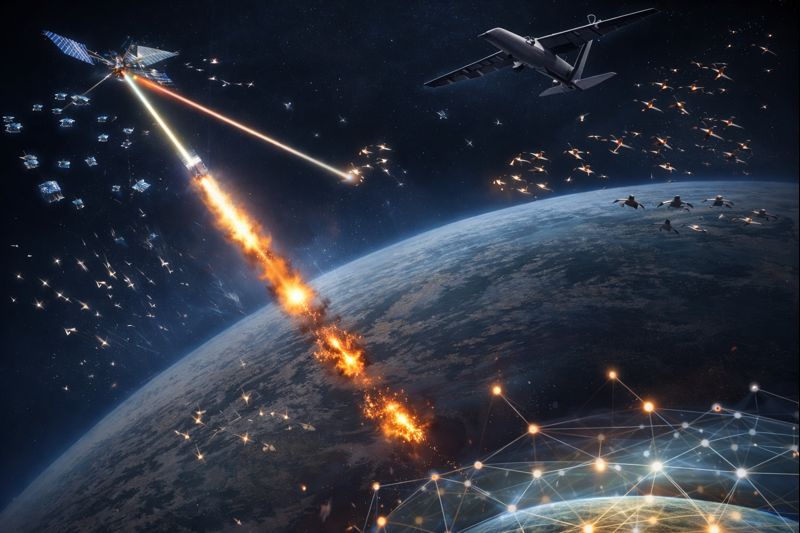
A.I. is a critical component of all theoretical space-based ABM designs, but a larger benefit is likely from the miniaturization of satellites and drones, with both technologies, using A.I. for swarm coordination that enables an extremely fast response time to any incoming threat (see fig. 1). Examples of such small microsatellites, nanosatellites, picosatellites, and femtosatellites include: Agile MicroSat (AMS), Millennium Space Systems, CubeSat, Demeter, Essaim, Parasol, Picard, Microscope, Taranis, Elisa, SSOT, SMART-1, Spirale-A/-B, and Starlink satellites.
Response time is of particular importance given the additional threats that now exist with even less identification and reaction time available from an attack using cruise missiles and hypersonic cruise missiles that never travel above earth’s atmosphere, not to mention new technologies like aeroballistic missiles, hypersonic glide vehicles (HGV) land attack cruise missiles, fractional orbital bombardment system (FOBS), and possible nuclear powered cruise missiles.
Theoretical designs are presented that may help that United States, or any technologically advanced nation, optimize modern aerospace systems to address the threat of a rogue ICBM attack. As a black widow spider spins a web to capture and immobilize its agile victim, we can imagine a system that resembles such a web or an umbrella-style approach to warhead interception i.e., when it begins to rain, we don’t attempt to stop each rain drop, we use an umbrella.
With new extremely fast and lightweight microprocessors, SpaceX has advanced the development of small rocket thrusters for satellite maneuvering much as they advanced rocket technology to the level of landing large rocket boosters on floating platforms in the ocean and returning them to earth after a launch to be “caught” by mechanical arms of the rocket’s launch tower. This level of miniaturization and engineering precision is needed to overcome the challenge, as literally noted in the film’s dialog, of using a missile traveling at hypersonic velocity to strike an incoming re-entry vehicle warhead that is also traveling at hypersonic velocity i.e., of “hitting a bullet with a bullet.”
A Full Mesh of Defensive Lasers
An example space-based ABM design involves a swarm of three or more small satellites, akin to Starlink-sized satellite devices, in a fleet that always has at least three satellites over a given region above the continental United States, preferably in a geostationary orbit. Even with large fleets of small satellites, orbital distances are vast and, while satellite rocket thruster technology is improving as noted, many commercial satellites take a long time to change location. Thus improving rocket thruster power, for satellite maneuverability and to allow them to quickly move large distances, will be a key design requirement for a military defensive system. Progress in this area is already underway even on the commercial side. In 2021 Starlink acquired Swarm Technologies and have begun to deploy their argon-powered Hall thrusters that TechCrunch reported in 2023 will “generate 2.4 times the thrust and 1.5 times the specific impulse than previous Starlink thrusters.” Each satellite in this design would be armed with a defensive laser technology formally described as a directed energy weapon (DEW) or high-energy laser (HEL) system.
This design uses fleets of small satellites separated or stacked in various orbits resembling a “layer cake,” around the planet. The full spectrum of orbital capabilities are covered with dozens or more fleets, from low earth orbit (LEO) at 160-2000 km (with fast orbits of approximately 90 minutes) to fixed positions at high geostationary orbit (GEO) at 36,000 km, akin to a metaphorical “deep shield” (see fig. 2). If an ICBM or MIRV re-entry warhead approaches any United States territory, or even the territory of its allies or forward deployed forces anywhere on the globe, we can imagine high-powered lasers creating a full mesh “web” between each satellite – at least three satellites as a minimum, but scalable to a much larger number of satellites given the amount of time another satellite in the swarm has to reach its maximum distance to join the web full mesh network. This occurs separately, at each orbital altitude in this full mesh “layer cake” approach, via A.I. swarm coordination, (see fig. 3). Note that each satellite is designed with the ability to coordinate the entire swarm as a controller satellite driving inherent resiliency of command, control, and communication for the swarm coordination response.
Layers of Redundancy
The lasers in this vision need to be powerful, but not beyond current technology, as the satellites can maneuver using the aforementioned modern rocket thrusters to reach a location just close enough to create the laser mesh to “catch” the warhead in that mesh “web,” akin to a baseball outfielder catching a pop fly baseball in their glove. The warhead is destroyed as the laser overheats, explodes, or cuts the projectile as it passes through the laser beam mesh. If the first attempt fails, another satellite swarm is already beneath it at a lower orbital altitude creating a stack of more and more “webs” in a vertical cylindrical shaped “tunnel” along the re-entry path of the warhead. Similar to calculations used for single shot kill probability (SSKP) of interception, independent layers for redundancy are necessary to ensure a 100% chance of success.
Failures can occur on any given satellite or layer regarding target detection, target tracking, and target classification probability. All of these factors must be considered at each phase of a missile attack including booster phase, mid-course phase, and terminal phase. Layers of independent space-based satellite swarms are required to ensure warhead interception via redundancy. Only layers of redundancy can ensure a 100% kill probability contrasted against the various causes of ground-based interceptor failures (see fig. 4).
Suborbital Attacks
A separate and increasingly prevalent threat is that of long-range missiles that do not require an orbital trajectory. To address these sub-orbital attack vectors, we can imagine a new design style – akin to the legacy Strategic Air Command Operation Looking Glass – with a fleet of aircraft in flight 24x7x365, naval ships, or even an assortment of tall towers, containing swarms of small drone aircraft ready to deploy in a similar manner, but within our atmosphere. As seen in the ongoing war between Ukraine and Russia, these drones can be armed with small explosives and, even with a reasonably sized swarm, can create a very high-percentage kill success rate. Early detection, as always, is essential in any of these scenarios.
Golden Dome Proposals
Another design option is a single satellite or drone that deploys lasers akin to a spinning fan or dandelion for a similar destructive effect. Also, a satellite, with a nuclear device in it, may be able to spread a flat stream of high-powered X-rays in a horizontal blanket or pancake shape to destroy, damage, or divert any incoming projectile.
Note how all of these designs do not require the creation of new ultra-high powered lasers like a Star Wars “Death Star” aiming at the single incoming warhead.3 Also note that the total cost of these platforms would likely be much less than a vast fleet of ground-based interceptor (GBI) missiles and much faster and also with a higher success rate of interception (see table 1). All of these designs are proposed for the new Golden Dome anti-ballistic missile program established by the Trump Administration and Lockheed Martin including our proposal to “catch” a MIRV missile warhead in a mesh or web of laser beams from small satellite swarms or even using the satellites themselves to directly crash into the warhead.
These ABM designs resemble the classic calculus optimization problem of a drowning swimmer in the ocean and a lifeguard (or dog) attempting to travel down the beach and then swim in the water, in as short an amount of total time as possible, to save the drowning swimmer. The problem is solved via an optimal combination of running time and swimming time e.g., satellite maneuvering or travel time and laser interception time, to achieve the fastest overall interception response.
An assortment of factors come into play in terms of engineering the ability to quickly intercept a high-velocity threat and to ensure the success of the effort. Obviously at a certain point the number or quantity of ground-based interceptors (GBI) or even orbiting satellites (regardless of size) becomes cost prohibitive i.e., to build, launch, track, and maintain so many of them.
The total spherical surface area of any given earth orbit is a vast amount of space to cover, thus even the use of nanosatellites or femtosatellites would still be an enormous challenge to engineer and operate at scale, even with A.I. coordination and miniaturized satellites with powerful and maneuverable thrusters. But, like our calculus ocean analogy, where the optimal solution becomes a “dual path solution” (using X amount of time running down the beach and Y amount of time swimming in the ocean to save the drowning swimmer for a total minimum amount of time of Z = X + Y), we can envision a fleet of small satellites in orbit (with a certain minimum fleet count), with a certain standard distance between each of them, and with an optimal number of orbital levels (each orbital altitude with its own independent satellite swarm fleet). Factors including time-to-identify, the time of a given satellite or swarm to coalesce (get to the warhead or to the point at their orbital level where the warhead will cross) based on the maximum speed of the satellite, the maximum distance of laser efficacy, the maximum distance of swarm communication and coordination by our A.I. system, and the expected lifespan, replenishment rate, and cost of each satellite model, are all engineering constraints that play into any final design (see table 1).
Mirrored Satellites to Create a Laser Mesh
The swarm formation can have a variety of architectures including: a high-powered laser creating a meshed web by reflecting off of a swarm of mirrored nanosatellites, a swarm of small satellites each with various lasers being transmitted around it like a fan or dandelion shape, a swarm of these satellites arranged in a patchwork or quilt formation, or the noted swarm of A.I. coordinated satellites each emitting a small number of laser beams with all of the beams overlapping into an optimal mesh with the power of A.I. adjusting the swarm’s laser-based web shape at extremely high-speed and adjusting to all relevant variables of each satellite – and the warhead telemetry – to ensure interception.
During any interception event, satellites using thrusters, continue to coalesce into a larger and larger swarm formation that the high-speed calculating A.I. engine is able to process and coordinate, including the coordination of fleets at each orbital level, so if the high-altitude initial intercept swarm misses, the next lower altitude levels (with more and more coalescing satellites) has a higher and higher percentage of kill success. Classic kill success calculating approaches like single shot kill probability (SSKP) and circular error of probability (CEP) would be rapidly adjusted and updated in these designs via A.I. processing.
Swarming Kinetic Kill Vehicles
The ability of a satellite or a swarm of satellites to all coalesce using their physical mass as an exoatmospheric kill vehicle (EKV) is another design option. However the only kill advantage in this approach is via the added redundancy gained from the increased quantity of attempts to intercept the path of the warhead analogous to a game of darts with a player given dozens of throws to hit the bullseye center target of the board. This is a possible strategy, but it depends on the quantity of satellites and their ability to maneuver fast enough to directly reach the warhead or the warhead’s path in time. In this approach the satellites are also not reusable as some, or many, will have been lost with the kinetic collision with the incoming warhead. This option also involves a larger program and replenishment cost as any damaged or lost satellites would need to be replaced. This design also impacts the functionality of the larger initiative as the collision debris creates additional hazards to the remaining orbital swarm fleet as even small debris can damage or destroy satellites as described by the Kessler Syndrome.
Conclusion
Thus, it is likely the case that a satellite swarm’s web or mesh of lasers will have an ability to cross the path of the warhead faster than any single satellite or small swarm group of satellites. A laser is faster than any rocket powered device but, given current technology, it will need to already be in orbit. Thus the need for an A.I. coordinated swarm of satellite-based lasers. Akin to the lifeguard optimization problem, the proposal uses both 1) the quantity of a swarm of satellites, and 2) the faster speed, flexibility, and destructive power of laser beam weapons, for an optimal design. We can compare this approach to the evolutionary optimization seen in the ant kingdom.4 In the ant kingdom a sweet spot is found between the strategies of using a large quantity of soldier ants and of using groups of ants with specialization or specific focused abilities, to overcome a threat, regardless of its speed or size.
While many of these design concepts are likely already being considered, all possible methodologies should be researched to solve a problem of such national and existential importance as intercepting a rogue single missile nuclear warhead attack like that presented in the 2025 Netflix motion picture film A House of Dynamite. Design strategies including small satellite swarms, artificial intelligence satellite swarm coordination, satellites with space-based lasers that combine into a mesh network, layers of redundant satellite swarms at various orbital altitudes, defensive laser mesh swarms using satellites with mirrors, and using satellite swarms as directed kinetic kill vehicles, are all concepts that should be researched and tested for Golden Dome and future anti-ballistic missile defense programs.
Figures

Figure 1. The miniaturization and mass production of small and highly maneuverable satellites and airborne drones, with both technologies using A.I. for “swarm coordination,” enables an extremely fast response time to small and high-velocity targets.

Figure 2. A “before and after” style diagram is presented of a fleet of small satellites at a single orbital level. Each small satellite in this design is equipped with a powerful laser beam and each maintains an equidistant position from its peer satellites at this orbit around the globe in its “normal operational state.” Upon identification of an ICBM attack, the artificial intelligence coordinated fleet swarms into action using laser beams to create a mesh at a location in the warheads path that will destroy the warhead re-entry vehicle upon contact.
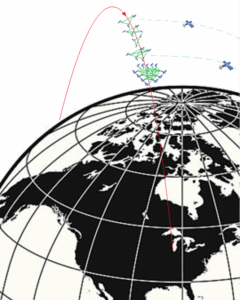
Figure 3. A Golden Dome ABM design proposal using a full mesh of lasers based on A.I. coordinated swarms of small satellites at various orbital altitudes, akin to a layer cake or “deep shield” to ensure successful interception and destruction of any rogue ICBM attack. The “web” of high powered laser beams (green), between highly maneuverable satellites, ensures a successful warhead target interception via the ability to respond exponentially faster than ground-based interceptor rockets – that must reach orbit before attempting a single attempt kill – and via layers of redundancy with small satellite fleets at various orbital levels.
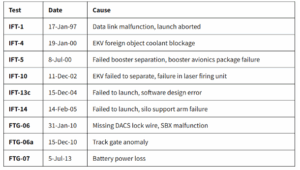
Figure 4. Historical failure root cause examples from ground-based interceptor tests of the Ground-based Mid-course Defense system (GMD).
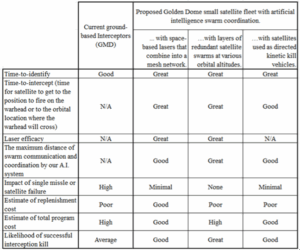
Table 1. Design success factors are assessed and compared between the current ground-based interceptor fleet (GMD) and three options of the proposed Golden Dome space-based small satellite fleets with artificial intelligence swarm coordination.


