Politics, Ethics, and the Human Being in the Culture of Ukraine
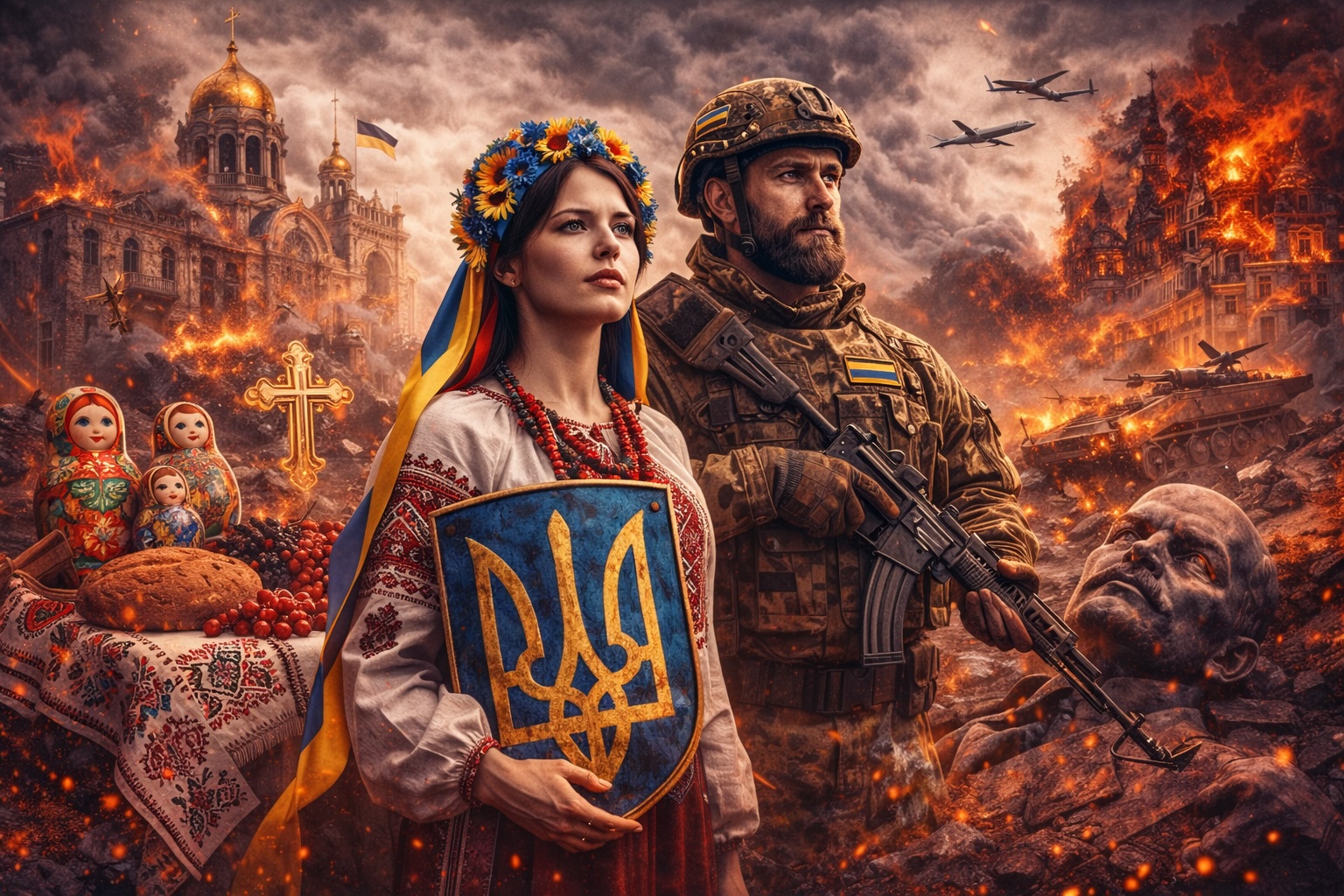

With the outbreak of war in 2022, the patriotic song once again became for Ukrainians a form of collective unity and conscious resistance. This is a stable function of art in times of war. However, when Ukraine’s domestic war has already lasted longer than World War I, it seems that everything has been placed at stake upon the heavy fate of the Ukrainian people: both the choice of the future and the interpretation of the past. The question of the role of culture in the vital rituals by which Ukrainians have lived for almost four years recedes into the shadow of a war that appears to be transforming into an all-consuming fire.
Fate poses a penetrating question: what role does the Ukrainian song occupy in Ukraine today? Does it stand at the tip of the bayonet, or does it sustain life in the rear?
The Risk of Dehumanization
At the beginning of Russia’s invasion in 2022, songs with motifs alluding to the era of World War II became popular in Ukraine. The most vivid example is the song “Ukrainska Liut” (“Ukrainian Fury”) by Khrystyna Solovii, which has garnered over 7 million plays on YouTube Music. The title of the song includes the note “(Bella Ciao Cover).” The melody is indeed taken from the Italian original, while the lyrics are contemporary. The song addresses the outbreak of the war, the destruction of the enemy, the glorification of the Ukrainian army, and the then-popular weapons systems (Javelin and Bayraktar TB2).
The Italian Bella Ciao, a well-known partisan song, symbolizes popular resistance against fascist regimes. Its musical image became canonical and one of the cornerstones of the myth of World War II. In the Ukrainian song, the image of a small people fighting against a vast Russia is adopted, akin to partisans, while the instrumental base of the Italian original reinforces the Ukrainian song with the myth of World War II.
Yet the content of the songs diverges far beyond a shared myth. In the original “Bella Ciao,” there is not a single line about cruelty; the song is devoted to the sacred ideals of love and loyalty, even unto death. The Ukrainian version, by contrast, shifts the emphasis toward the violence of military struggle.
The practical danger is this: such Ukrainian songs distort the motivation for struggle. They cultivate death in war, not in the positive sense of death for the homeland or sacrifice for love, but in a purely negative sense — against the enemy. And while any struggle in war always implies a readiness to die, this framing formulates the song’s idea as “death against the enemy.” Such an idea is reactionary in nature, placing the primary emphasis on hatred rather than on love that seeks wholeness, and contradicting the ideal of military duty.
Beyond the direct promotion of nihilism, the phenomenon of a song becoming a hit also raises the issue of the immaturity of Ukrainian artists in their ethical engagement with military narratives. There is, in part, an explanation for this: the full-scale war began abruptly in 2022, even though it had continued in the background since 2014. However, this in no way diminishes the existing problem of ethical illiteracy within the Ukrainian musical mainstream. On the contrary, the problem shows the potential for further development, as we can observe now, in the fourth year of the war. To the growing tendency toward dehumanization is also added the problem of retreat from reality.
The Loss of Reality in a Fateful Time
The historical scenario of World War II became firmly embedded in people’s minds back in the Soviet Union, where the war functioned as the central ideological construct of the “Great Victory,” almost as a war of independence.
Shortly before the 2022 invasion, decommunization was proclaimed in Ukraine. Ukrainian groups that used the myth of the Second World War to unite the nation and raise morale were forced to turn to motifs from Western songs such as Bella Ciao. Nevertheless, they still reawakened a long-established image of the Second World War in people’s minds — precisely in the Soviet scenario, in which the war ended with the capture of the enemy’s capital and the total defeat of the Wehrmacht.
It is precisely through this myth that Ukrainians imagine the image of victory. The mere halting of the aggressor, or even the return of territories, appears as a far paler idea of victory. In the emotional world of song, it pales in comparison to the image of total annihilation and complete retribution.
A vivid example is the song “Moskva Zghorila y Vtonula” (“Moscow Burned and Sank”) by the band Spiv Brativ, which has amassed over 10 million plays on YouTube Music. The song is built on an extremely simplified metaphor: the city of Moscow is equated with the cruiser of the same name that was sunk in the spring of 2022.
The danger of this pattern lies in the fact that it shapes the narrative of how Ukrainians envision victory or defeat in the war. Increasingly, the word “capitulation” can be heard in the public sphere. Ukrainian military commentators, frightening audiences with the prospect of defeat, have invoked the image of “the Russian flag over Lviv,” echoing the iconic image of “the Soviet flag over the Reichstag.” The harsh reality on the front lines in 2024–2025 has naturally sharpened this narrative. As a result, the myth of World War II has come to be used by propagandists to rally the Ukrainian people not around struggle, but around fear. At the same time, the possibility of stopping the war along the line of contact as a chance to begin implementing a new project for Ukraine’s development — to grow, become stronger, and more culturally vibrant — is not being considered. A victory plan that would make Ukraine more attractive to the many Ukrainians who have left the country would constitute a true victory of peace, not according to the script of the Second World War, but according to the script of Ukraine’s future. However, war-hawk propagandists dismiss this option, placing their bet on a narrative driven by negative motivation and a war fought to the very end.
“At the same time, the world, even while anticipating the next war, offers a chance for political change, for deep reforms, for full recovery, economic growth, and the return of citizens.” — Popular among both the public and the military, General Zaluzhnyi, Liga.Net.
The Anthropology of Fear
Disturbing news from the front can be perceived extremely painfully, especially if someone familiar is fighting in the war. The instinct of psychological self-preservation compels a person to stop watching battlefield maps or reading the news. One distances oneself from the real disposition at the front as from a psychological irritant, all the more so if the front is far away and one’s own life is not under immediate threat.
From this, follow the main characteristic features of songs that influence a society that relies heavily on emotional experience. A person may stop following news from the front, but the habit of living on an emotional high remains. News is then replaced by art and music as one of the most accessible forms of escape and entertainment.
In songs, the dependent individual hears two dimensions that flatter them and construct an informational bubble detached from reality. On the one hand, war songs function as a form of extremity that mobilizes people for struggle. On the other hand, they always contain hope (a law of art described already by Aristotle: tragedy must not be without an exit).
Nevertheless, even under such circumstances, a person remains a human being. And as Aristotle said, the human being is a political animal who realizes their nature by living in the polis, the community, the state, and by participating in shared life.
And when the time comes for referendums or sociological surveys, the individual chooses a position shaped by propaganda and culture — by songs. In songs, even the most dramatic ones, the question is nonetheless posed in heroic terms. Yet this is precisely the problem: the heroism of songs is a myth, while the human being remains detached from reality.
Songs That Shape Ukraine
In 2025, Kyiv officially received the status of a “UNESCO City of Music,” indicating institutional recognition of the role music plays in the city’s cultural life. In cultural publications, Ukraine’s folk song heritage is often described as comprising approximately 15,500 folk verses. This is hardly surprising given Ukraine’s vivid history, which resembles not so much a musical album as an immense catalogue of songs. By primarily intertwining cultures and historical events, Ukrainian songs form a rich and multifaceted image of the Ukrainian world. It is of fateful importance, even amid the fog of war, not to forget this principle of diversity.
Today, Ukraine is rejecting Russian cultural heritage, which, incidentally, in various forms is included in UNESCO’s register of Ukrainian heritage. In doing so, it violates its own historical principle of formation, cultivating within itself the seed of contradiction. Do Ukrainians — who are always ready to defend their traditions — truly allow the arbitrary erasure of the memory of their culture from the Soviet and imperial periods solely because of the aggression of a neighboring state? This undermines multiculturalism as the central factor in Ukraine’s formation. The aggressive actions of the dictator in the Kremlin are merely a catalyst.
Protect the human being — and we will protect culture; Protect culture — and we will protect the human being.
The true threat arises when ethics withdraws from politics. Aristotle wrote of politics as the highest form of association, encompassing all other forms of human existence, including the sphere of culture. Today, when singers become popular opinion leaders, in times of hardship, their creative work begins to exert decisive influence on people, thereby acquiring the power of the highest political good. According to Aristotle: “…the most authoritative of all associations and the one that embraces all the others. This association is called the state, or the political association” (Aristotle, Politics, Book I).
With the emergence of power among artists, immense responsibility also arises. Therefore, when culture borrows the myths of total war and replaces ethics with hatred, it loses its humanizing function and begins to operate as a mechanism of fear and propaganda.
The ethical danger for Ukraine today lies not only in the fact that, in choosing between struggle and capitulation, it risks losing its connection with reality, but also in the possible loss of a part of its own political culture. When activists begin conversations about statehood, heroism, and war, they rarely address in their reasoning the place of the ordinary human being. Today, not only for Ukraine but everywhere where an ordinary person can be destroyed by the immorality of politics, it is more important than ever to raise the question of humanity, of people’s mental health, and of the ethical literacy of opinion leaders — not by restricting culture through censorship, but by establishing a new trend focused on preserving the human being in the unpredictable world of politics.
The defeat of ethics by politics will lead to the demise of democracy. Human consciousness will experience its own insignificance before the steel rain of events, powerless to change anything. In such a case, only philosophers can help politicians by deconstructing the terrifying myths of propaganda and initiating dialogue from the standpoint of traditions, societies, and human beings.
“Compassion is the chief, perhaps the only, law of the existence of all humanity.” — Fyodor Dostoevsky.