The Largest Small War

Introduction
The 2022 US National Defense Strategy classifies North Korea as “the Persistent Threat” due to their long enduring status as an adversary to the US and key allies. Though much attention focuses on a North Korean attack on South Korea, an often-overlooked contingency is a North Korean state collapse where international forces are drawn in to secure this heavily armed and highly militarized country. Though Stand-In Forces and Marine Littoral Regiments are a primary focus of today’s Marine Corps, this piece warns about some of the other likely operations on the spectrum of conflict that Marines must be prepared to conduct. As a state collapse of North Korea portends a witch’s brew of many dangerous operations, a brief overview of the structure and capabilities of this heavily militarized state’s armed forces indicates such a contingency could indeed be the largest small war of the 21st century.
The Persistent Threat
In his initial guidance to the force, 39th Commandant of the Marine Corps General Eric Smith declared, “We prepare for the worst-case scenario – the pacing threat. If the day comes that we must face that threat, we will be ready. We accept some risk now to be ready for the future. This is what professional organizations do: prepare for the future.” The People’s Republic of China (PRC) is without a doubt the pacing threat of the United States of America, and war with the PRC represents the most daunting challenge facing the Joint Force. The Marine Corps is right to set the capabilities and armed forces of the PRC as the high standard to prepare against. Doing so will serve future Marines well, even if they are sent to respond to other contingencies. Despite this, there are other difficult challenges Marines must be prepared to confront. One of the foremost of these is the threat posed by North Korea, or the Democratic People’s Republic of Korea (DPRK). North Korea possesses significant capabilities and combat power. To be sure, many of these are obsolete, but they still remain very lethal. Though not a peer level adversary like the PRC, the sheer sum of North Korea’s capabilities makes it a formidable adversary nonetheless. This is so much so that the 2022 National Defense Strategy characterizes the DPRK as a “persistent threat.”
North Korean Strategic Priorities
The priorities of the DPRK’s security strategy are quite simple. The security of the communist Kim regime presiding over an independent state is the primary strategic objective of North Korea. The DPRK’s secondary strategic objective is to be the dominant actor on the peninsula, and to maintain the capability to exert this influence. Its final strategic objective is to deter an attack by any external actor. To achieve these goals, the DPRK has become the most militarized country in the world with 1.3 million out of 25 million people under arms. Thus, the North Korean People’s Army (NKPA) possesses the fourth largest military in the world. Though the government of the DPRK does not publicize its military budgets, between $7 billion to $11 billion, or the equivalent of 20-30% of national GDP, is estimated per annual expenditure.
Antiquated Arsenal
North Korea is well known for its antiquated arsenal. The NKPA has not seen a major modernization of its military since the collapse of the Soviet Union in 1991, which was their primary supplier and benefactor. In the more than three decades since then, international sanctions have seriously limited the national budget, which inhibits the NKPA’s ability to upgrade and modernize. Most of North Korea’s conventional military forces field aging Cold War era Soviet Bloc or indigenously produced copies of Soviet weapons and equipment. The primary branch to receive resources that enable modernization is the Strategic Force, leaving the other military branches to modernize their capabilities only on the margins.
The Main Effort – Weapons of Mass Destruction
The North Korean People’s Army Strategic Force is perhaps the main effort of the first and second North Korean strategic objectives. Under the Strategic Force, North Korea maintains an arsenal of nuclear, chemical, and biological weapons. They also maintain an inventory of short range, medium range, intermediate range, and intercontinental ballistic missiles with which to deliver these weapons. The Strategic Force’s longest ranging weapons can reach the continental United States. North Korea sees these capabilities as their chief mechanism for deterrence from outside attack, but also references them as powerful tools to threaten and intimidate their neighbors.
Air and Air Defense Forces – The Weakest Link
The NKPA Air Force and Air Defense Forces are organized into a single branch. The mission of the NKPA Air Force is to defend North Korean airspace, conduct deep strikes, provide air support to ground forces, logistical support, intelligence/surveillance/reconnaissance (ISR), and insertion of Special Operations Forces (SOF). Air defenses consist of vintage Cold War systems including radars, surface to air missiles, and anti-aircraft artillery. With 110,000 troops, the NKPA Air Force operates 300 helicopters, 300 transports, and over 900 combat planes. While the newest combat aircraft in its inventory date to the 1980’s, the NKPA still operates aircraft from the 1950’s. Due to fuel constraints, NKPA pilots are limited to only 15-25 hours a year. It is generally accepted that the NKPA Air Force would have a hard time operating in South Korean air space. An area of Air Force modernization is a steady development of Unmanned Aerial Systems.
Naval and Coastal Defense Forces – Area Denial
The NKPA Navy and Coastal Defense Forces are also formed into a single service branch. The mission of the NKPA Navy is the defense of North Korean ports, coastline, and territorial waters, as well as ISR and insertion of SOF. Though with only 60,000 sailors, the Navy is the smallest branch of the NKPA. However, the NKPA Navy operates one of the largest submarine fleets in the world, though they are old and significantly limited compared to modern submarines. The NKPA Navy does maintain a significant mine capability. Combined with submarines and coastal defenses, it is largely an area denial force. One area of modernization is the recent development of a submarine launched ballistic missile capability.
Ground Forces – The Principal Instrument
NKPA Ground Forces provide the Kim regime significant capabilities. With 1,000,000 active duty and 150,000 reservists, NKPA ground forces are the principal instrument of the NKPA and represent the largest threat to South Korea. The ground forces are primarily manned with infantry, but have significant numbers of armored vehicles and large amounts of rocket and howitzer artillery, some of which can range Seoul. However, the ground forces field significantly antiquated equipment from the 1960’s and 70’s. Despite its age, its durability and simple maintenance have enabled such equipment to remain serviceable for long. Some areas of modernization include indigenously made tanks and self-propelled artillery that appear to be comparable to late Cold War Soviet models. Logistics and sustainment are a significant weakness of NKPA Ground Forces. On the other hand, an area of primary concern is vast networks of underground bunkers, tunnels, gun emplacements, and supply points which are often reinforced with concrete and effectively camouflaged. These networks have been constructed and improved over decades and would be quite hard to destroy, likely requiring troops to clear manually in order to ensure their effective neutralization.
Special Operations Forces – The Wild Card
NKPA Special Operations Forces represent a unique threat, as no other countries maintain special forces of such character. Numbering over 200,000, NKPA Special Forces are the largest Special Operations Force in the world, though their equipment and training suggest they are not truly comparable to SOF forces of leading countries. Despite this, they are still equipped with the best equipment North Korea has to offer, are well trained, and are significantly more capable than traditional NKPA Ground Forces. Their mission is the infiltration of South Korea and destruction and assassination of key military as well as civil targets and individuals. The purpose is to disrupt South Korean rear areas to the point of creating a second front to shift South Korean forces, resources, and efforts away from the main front. They train to use multiple methods of insertion over air, sea, and land. Along with the Strategic Force, this branch has experienced the most modernization of NKPA forces.
Reserve and Paramilitary Forces – The Armed Masses
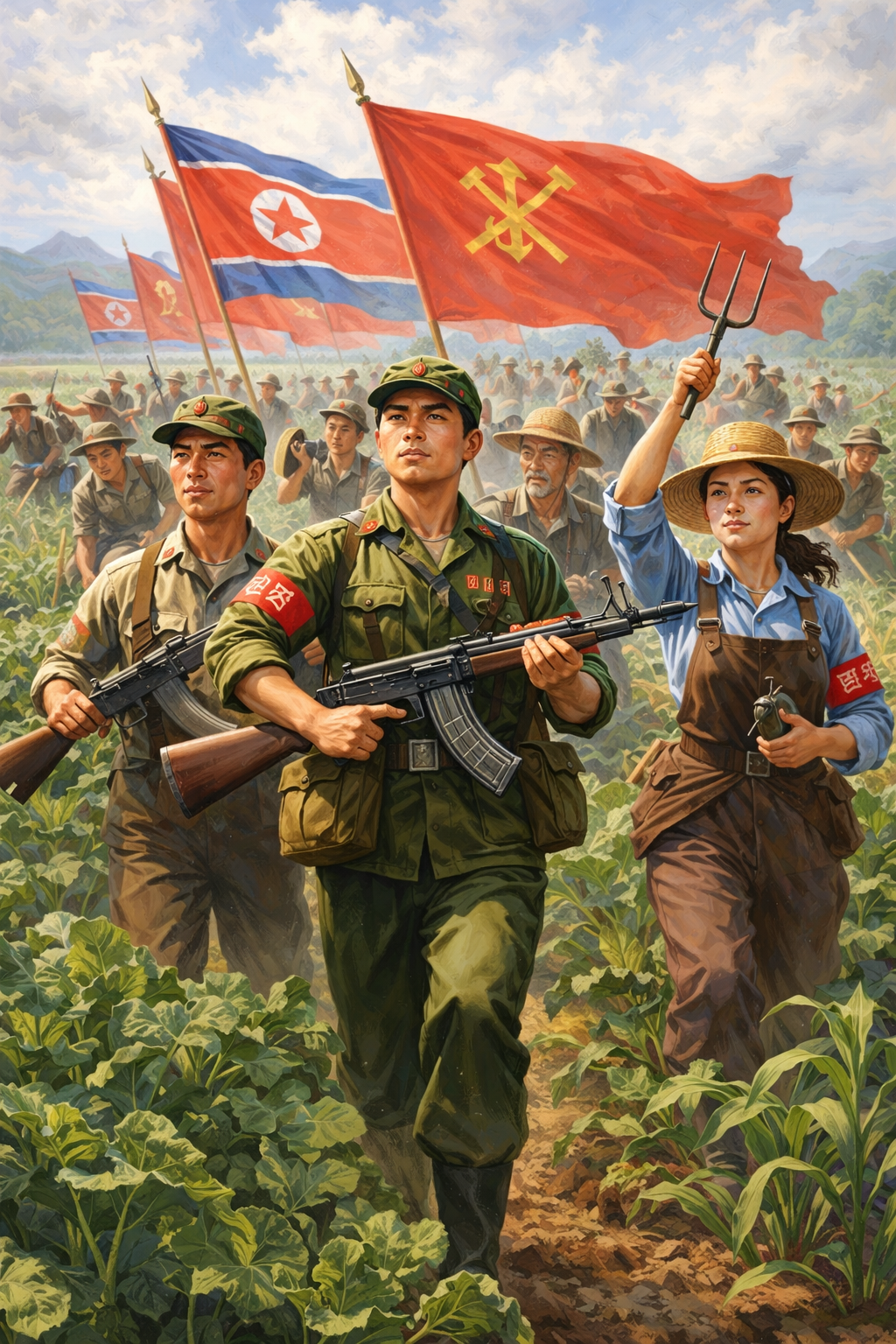
Finally, NKPA Reserve and Paramilitary Forces add a unique dimension to the North Korean military. About 25 percent of the population of North Korea is organized into auxiliary forces that augment NKPA main forces. Among these are the Reserve Military Training Units (RMTU), Worker Peasant Red Guard (WPRG), and Red Youth Guard (RYG). The 600,000 man RMTU’s are infantry and artillery forces organized into divisions, brigades, and regiments with the mission of sustaining proficiency in common skills in order to reinforce active-duty units should the need arise. The 5 million strong WPRG and 1 million strong RYG are structured into regiments and battalions under the control of North Korea’s communist party, the Workers’ Party of Korea (WKP). They are typically used for work projects such as agriculture and construction but include logistics and engineer units for the transportation and maintenance of infrastructure. These auxiliary forces are equipped with small arms and supplied by cache sites to enable a sustained resistance of their locality. North Korean males are discharged from the auxiliary forces at the age of 60.
Factors of Geography
Though the raw data summarizing these capabilities indicate North Korea is a formidable adversary, geographical context will diminish some of these threats. Korea is a peninsula divided by a single border across its neck. Though this border is known as the Demilitarized Zone (DMZ), on either side of it is the most fortified area in the world. Running from North to South along the length of the peninsula is restrictive, mountainous terrain that canalizes movement into three large corridors: the Kaesong-Munsan Approach (the same avenue of approach that North Korean forces used in their 1950 invasion of the South), the Chorwon Approach, and the East Coast Approach. These areas are well defended. Though the mass of the NKPA is formidable, it does not possess the logistical tail to support deep operations. Despite this, North Korea’s 200,000 strong Special Forces are an enormous threat. So too are North Korean weapons of mass destruction to include nuclear, chemical, and biological weapons as well as long-range artillery that can range Seoul from the DMZ and reap untold death and destruction.
Yet, due to the aforementioned inhibiting factors, some have suggested that North Korea realizes this would be a futile effort and will not attempt another invasion of South Korea. The Marine Corps cannot take this assumption for granted and must be prepared to contribute to a defense of South Korea, as any attack from the North will be incredibly violent and highly destructive. Furthermore, Chinese intervention in a future Korean war, like the PRC’s involvement in the last one, cannot be ruled out. It is possible that Korea may be where Marines first encounter the pacing threat, ironically where it was encountered before.
Another Contingency
Even if North Korea never again invades South Korea, there is another possible contingency on the Korean Peninsula that the Marine Corps must be prepared for, that of the North Korean regime’s collapse. Such a collapse could be caused by a number of internal events outside of war, such as an economic collapse like that of the Soviet Union, a military coup against the current government, or a crisis of succession in the Kim family. According to a 2011 study,
“A particularly perilous collapse scenario would feature multiple powerful political and military leaders vying for control. North Korea could quickly become a warlord state, where competing civilian and military leaders claim to rule swaths of the country and battle one another for control of territory or resources.”
Given the aforementioned capabilities of the North Korean military, such an internal contest between competing actors or factions could be a catastrophically violent and destructive civil war, one that could spill outside of North Korea.
The authors of the study offer another “less dangerous” scenario, in an event where,
“North Korea’s civilian and military leaders were not jockeying for power and gathering military units behind them. In this more benign scenario, no one is clearly in control in Pyongyang; government and military leaders are fleeing the sinking North Korean ship and seeking asylum in China or elsewhere. Military units and security services are disintegrating, rather than rallying around particular leaders, and are heading home to their families…. North Korea would be left with a political vacuum and a leaderless and dissolving military.”
In either event, these scenarios might see the country devolve into the most heavily armed failed state in the world. Such a situation may spur outside intervention for a number of compelling reasons. The study lists “the outbreak of starvation and disease in North Korea; mass refugee flows across borders; ‘loose’ nukes and other forms of WMD; and the potential for ongoing insurgency and violence throughout the country,” as serious problems that outside countries have significant cause to contain.
Five Likely Mission Sets
The study identifies five mission sets that would be executed in any intervention in a North Korean regime collapse: “(1) stability operations, including direct humanitarian relief and policing of major cities and roads; (2) border control; (3) elimination of WMD; (4) disarmament of conventional weapons; and (5) deterrence or defeat of any military resistance.” These mission sets overlap in several ways. For instance, effective stability operations that ease suffering on the civilian population may decrease the number of refugees that would seek to flee the country. Border control would be necessary to control refugee flows and prevent conventional weapons and WMD’s from leaving the country. Likewise, WMD’s and conventional weapons would have to be secured before they could be disarmed. Finally, deterrence or defeat of any kind of resistance would be a prerequisite to any of these other missions. Some geographical areas of the country or elements of the former regime apparatus would inevitably be more challenging to submit or secure. With the weapons and capabilities available to former regime elements, insurgents, or criminal opportunists, any active resistance could be difficult to subdue.
The prospects of a North Korean regime internal collapse represent a perfect storm of difficult challenges and epitomize the continued relevance of the 31st Commandant of the Marine Corps, General Charles Krulak’s Three Block War concept. Under this classic concept, Marines can find themselves conducting humanitarian and stability operations in one area while engaging in high-intensity combat operations in near proximity, with ambiguous spaces in between. The unique factors inherent in such a North Korean problem set would undoubtedly present vexing dilemmas for troops on the ground, especially for small unit leaders and young Marines.
The Role of China
Yet still, another dangerous prospect remains in this nightmare scenario. The People’s Republic of China represents a true “wildcard” in any such scenario. Whether or not China intervenes or stays on its side of the Yalu River introduces a whole different set of prospects that are beyond the scope of this piece, though they must be acknowledged. One potential course of action is that the United States and China return to fighting each other on the Korean Peninsula as they did in the 1950’s, though such a conflict could very likely spread to other regions. Likewise, another even more daunting possibility, is a Chinese gambit to seize Taiwan while active hostilities with the United States already exist and American efforts are focused on the Korean Peninsula. In any event, it would be critical for the U.S. and China to cooperate in such an event of a collapse of the DPRK, not only to effectively defuse one volatile situation, but to prevent another one. In the best-case scenario, the pacing threat will act as a stabilizing force in a multinational effort, and American Marines will work with Chinese troops to bring stability to the Korean peninsula.
Conclusion – The Largest Small War
While the Marine Corps prepares to deter America’s pacing threat, North Korea will continue to loom large in the future operating environment. Whether through another attack on the south, or a regime collapse and devolution into a failed state, North Korea will remain a substantial and persistent threat that cannot be ignored. Marines must continue to train for the spectrum of military operations they may operate within on the Korean peninsula. Furthermore, Marines must continue to prepare for small wars, because a return to North Korea under any circumstance could be a return to small war operations. A North Korean contingency could in fact be the largest small war.
Check out all of Small Wars Journal’s great content.