





You Killed the Tool. Not the Problem

Function-First Analysis and the Intelligence Consequences of Successful Intervention
In June 2020, an encrypted communications network told its users to get rid of their phones. The network was EncroChat, an encrypted communications service that used specially modified phones to protect users’ messages and hide their identities. The handsets had their cameras, microphones, GPS, and USB ports removed, and featured a hidden encrypted interface. Users could erase their data instantly with a panic PIN, and repeated incorrect password attempts could trigger deletion. The phones could also be wiped remotely. But the network itself had been compromised.
French and Dutch authorities, with support from Europol and Eurojust, had gained access to EncroChat’s network and were intercepting millions of messages, including some in real time. When EncroChat discovered the penetration in June 2020, it warned its users to dispose of their phones. The criminal networks that relied on EncroChat still needed to contact suppliers, coordinate activities, and maintain relationships without exposing themselves to the authorities. Their trusted means of communication had become dangerous to use, but the work it supported still had to be done.
For intelligence, the penetration had been an extraordinary success. Intercepted messages fed hundreds of investigations across Europe and contributed to arrests, seizures, and the disruption of criminal activity. But once EncroChat warned its users, that success began to change the very environment intelligence had been observing. The interception ended.
The criminal networks needed to find a way to keep coordinating. Intelligence needed to establish how they would do it. The challenge for intelligence after a successful intervention is not simply to identify what replaces a disrupted person, capability, or arrangement, but to establish whether and how the adversary continues to perform the functions that the disrupted element previously supported.
Many EncroChat users later moved to Sky ECC, another encrypted communications platform. By mid-February 2021, authorities were monitoring information flowing between approximately 70,000 Sky ECC users. The move from EncroChat to Sky ECC may look like a straightforward switch between platforms. But the more important question for intelligence is what the criminal networks still needed to accomplish, regardless of how they went about it. An adversary does not necessarily need to replace what intelligence has removed. It still needs to perform the functions that the lost person, capability, relationship, or arrangement previously supported. After disruption, analysts may remain anchored to what disappeared: What will replace EncroChat? Who will replace a removed intermediary? What capability comes next? These are useful questions, but they begin with the lost form rather than the operational requirement that remains.
The same distinction applies beyond technology. When Italian authorities arrested N3, a key participant in the Cicala drug-trafficking network, his removal affected several functions. He maintained supplier relationships, used his transport company to move drugs into Italy, and connected participants across the network. The network’s response involved more than finding someone to take his place. Some relationships disappeared, others survived, and activity continued through different arrangements.
Leadership targeting raises a similar issue. In 2016, coalition forces killed Islamic State leader Abu Muhammad al-Adnani, who headed the group’s propaganda and external operations. A subsequent UN assessment described his death as a significant but temporary setback, noting that responsibilities had been structured so they could pass down the hierarchy.
I call this tendency to focus on the disrupted form “replacement bias” and propose Function-First Analysis (FFA) to counter it. FFA begins with the operational requirement that remains and examines how the actor could realistically meet that requirement. Analysts then identify what evidence would help distinguish among possible responses and use what the actor actually does to revise their assessment. Before intervention, analysts should ask: If this works, what problem will the adversary have to solve tomorrow?
Function, Not Form
FFA begins with a practical question: what did the disrupted person, platform, or arrangement allow the adversary to accomplish? The answer must be specific enough to guide analysis without assuming how the adversary will respond. For criminal networks relying on EncroChat, defining the requirement as “using encrypted handsets” is too narrow because it assumes what a replacement would look like. “Survival” is too broad to guide analysis; almost any response could fit. A more useful definition is maintaining sufficiently secure coordination among criminal partners while limiting exposure to the authorities.
These criminal networks might meet that requirement by moving to another platform, relying on trusted intermediaries, communicating less often, or keeping contacts and activities more compartmentalized. They might also retain only part of their ability to coordinate or abandon the activity altogether. A change in behavior does not necessarily mean capability has been preserved. A network may reorganize yet remain less capable than before. A new intermediary, for example, may lack the relationships that made the previous one valuable.
The limits of targeting individual insurgent leaders became clear during Combined Joint Task Force 82’s 2009–2010 deployment in Afghanistan. Lower-level insurgent leaders were quickly replaced, so removing them often failed to disrupt their networks for long. An approach called Joint Network Targeting broadened the focus to recruitment, training, logistical support, financing, command and control systems, and other functions that sustained insurgent operations. The underlying problem was not simply who had been removed, but how the network could continue operating without them.
FFA focuses on what analysts need to reassess when an intervention changes the system they have been studying. Before intervention, analysts should identify the operational requirements the adversary may still need to meet, consider how it could realistically do so, and identify what they would expect to see under each plausible response. As the adversary responds, analysts assess which functions continue, how well they work, and what now sustains them. They then use what they observe to revise their assessment, including whether the intervention has changed what intelligence can see.
In 2015, coalition spokesman Col. Steve Warren explained that destroying Islamic State headquarters did not eliminate the requirement for a headquarters. Surviving personnel could reposition equipment and establish another headquarters elsewhere, which intelligence would then have to locate. Warren described targeting as a “continuous rolling process.” The coalition could destroy an Islamic State headquarters, but its commanders still needed somewhere to run their operations.
Before the Adversary Answers
FFA is useful at different stages of an intervention, including before the adversary’s response becomes clear. Analysts can apply it when planning an intervention or after a person, capability, or arrangement has been removed or become too risky to rely on.
Disruption need not involve destruction. Infrastructure can remain physically intact while uncertainty about its reliability leads operators to restrict its use. Before his arrest, N3 maintained supplier relationships, used his company to transport drugs, and connected participants across the Cicala network. His removal put all of these functions at risk.
Consider the situation immediately after N3’s arrest. Assume you know which functions he performed, but not how the network will respond. Who still has access to suppliers? What transport is available? How can members coordinate without him? One person might take on some of these functions, or several members might share the work.
Table 1 outlines possible responses, the indicators analysts might look for, and what each response may require.
Table 1. Possible Responses and What to Look For
| Possible response | Observable indicators | What the response may require |
|---|---|---|
| Direct replacement | One participant takes over supplier contacts and coordination | A trusted participant with supplier access |
| Shared responsibilities | Several participants take on supplier contacts and coordination | Trusted relationships and coordination among participants |
| New suppliers | New contacts with potential suppliers | Introductions, trust, and financing |
| Greater reliance on existing suppliers | A greater share of orders or shipments involves existing suppliers | Continued access to those suppliers |
| Alternative transport | Changes in vehicles, routes, or couriers | Other means of moving drugs |
| Indirect coordination | Members communicate through other participants rather than directly | Trusted intermediaries who can pass information between members |
Source: Author.
The table shows what analysts could have considered before the network’s response became clear. It does not represent what investigators assessed at the time. Identifying possible responses and what to look for allows analysts to compare their expectations with what happens and revise their assessment as new evidence emerges. Even when a network finds a way to continue operating, it may struggle to perform the same functions as before. A new supplier may provide smaller quantities of drugs. The network may also decentralize coordination to keep operating, but at the cost of efficiency.
After N3’s arrest, network members lost contact with Romanian suppliers and access to his transport company, whose trucks had carried drugs alongside legitimate goods. They retained their relationships with other suppliers in Spain and began transporting drugs by car. The reorganized network arranged further drug shipments before law enforcement dismantled it. Investigators observed fewer drug shipments during this period, and the network appeared to prioritize security over efficiency.
The network preserved some functions more successfully than others. It retained access to some suppliers, found other ways to transport drugs, and continued to coordinate its activities, but this did not establish that it had recovered its previous capacity. Analysts need to assess which functions survived, how well they worked, how long they lasted, and at what cost.
Figure 1 brings these steps together, tracing the remaining operational requirement through possible responses, observable indicators, and functional outcomes. The figure then distinguishes between two questions: What does the response require, and what does it reveal? The answers help analysts identify changed dependencies and revise their understanding of the actor.
Figure 1. The Function-First Analytical Cycle
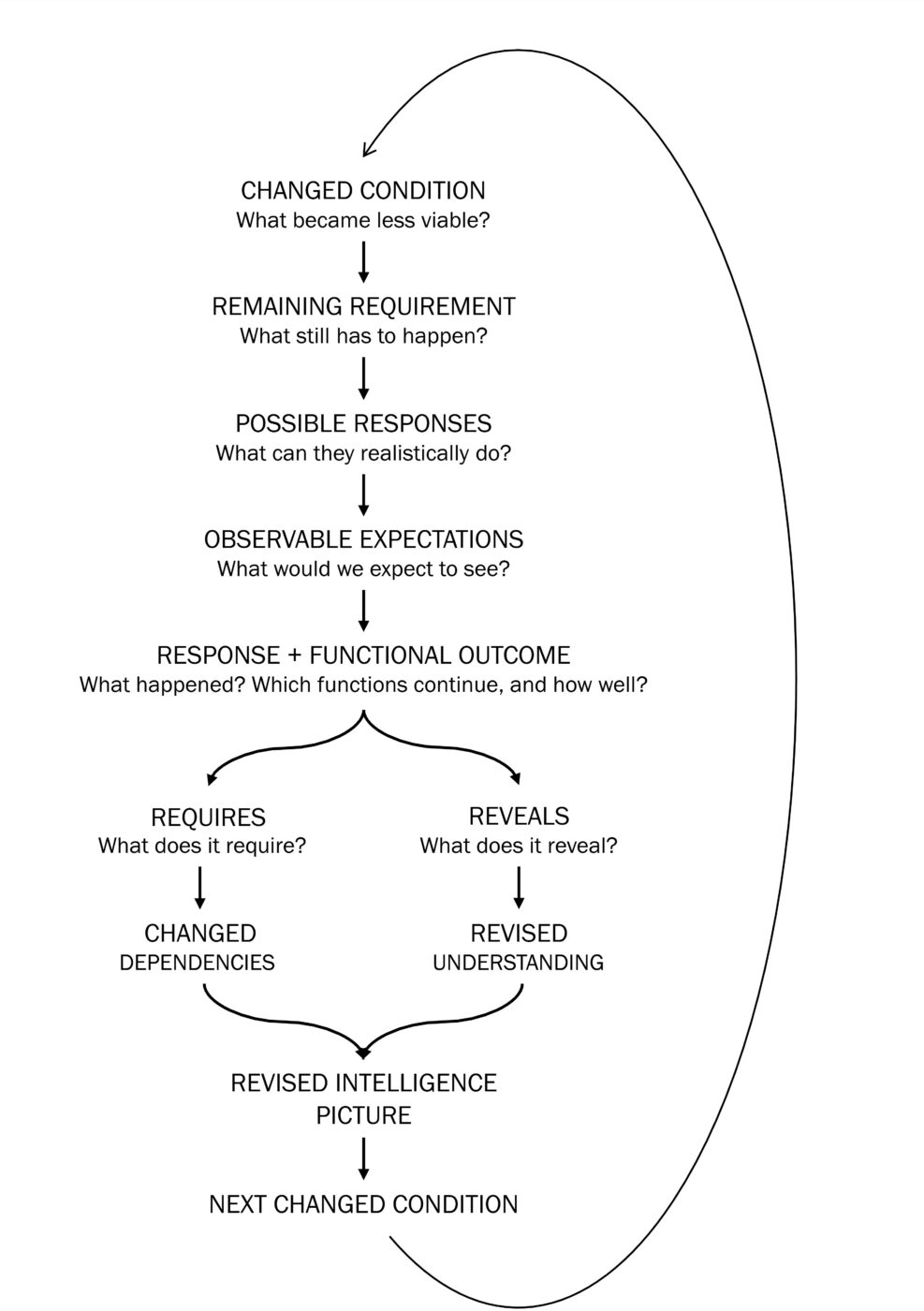
Function-First Analysis follows the operational requirement, not the disrupted form. It asks what still has to happen, what the actor can do next, what intelligence should expect to see, and what the eventual response requires and reveals. The resulting assessment revises the intelligence picture for what comes next.
How Success Changes the Intelligence Picture
After an intervention, continued activity may depend more heavily on relationships, resources, or capabilities that were previously less important. Analysts need to identify what now sustains the activity and assess whether these dependencies create opportunities for further intervention. A dependency is not necessarily an exploitable vulnerability.
The Islamic State’s transition away from territorial control illustrates how these dependencies can change. After the loss of Baghouz in March 2019, the Global Coalition’s Counter ISIS Finance Group described an organization that had anticipated territorial defeat and shifted toward insurgency tactics for managing networks, conducting operations, and raising funds. Losing territory did not eliminate the need for funding. Analysts still needed to establish how the group financed its activities.
The adversary’s response can expose weaknesses in the original intelligence assessment. If an organization continues operating after losing a leader considered essential to its operations, analysts need to identify who is carrying out the leader’s former responsibilities and how much operational capability remains. They should then ask whether they misunderstood the leader’s role or whether the organization has found a new way to operate. Newly observed supplier relationships may reveal gaps in the network picture. Failure to sustain a function matters too. It may reveal limits in the actor’s contacts, resources, or capacity to recover.
Successful intervention can also change what intelligence can see. When authorities disrupt a communications platform, a mapped network, or an intermediary they have been monitoring, they may lose the access that allowed them to follow the adversary. If they then observe less activity, it may be because the adversary is less capable or because intelligence can see less. It could also be both. Analysts need to establish what has changed before judging the intervention’s success.
Adaptation can also create new intelligence opportunities. After the disruption of Phantom Secure, the FBI observed criminal organizations looking for alternative encrypted communications. Working with the Australian Federal Police and a confidential human source, it developed ANOM, a platform whose messages law enforcement could access covertly. As other platforms were disrupted, demand grew, and ANOM eventually reached hundreds of criminal organizations. The continuing need for clandestine coordination gave law enforcement a way to gain access through the very service criminals were seeking. As the EncroChat, Sky ECC, and ANOM cases show, changes in how criminal networks operate can cost intelligence access but may also create new opportunities. Analysts need to consider both when planning an intervention.
Five Shifts in Analytical Practice
FFA calls for five shifts in how analysts approach their work:
- Track functions, not only forms. When a person, capability, relationship, or arrangement becomes unavailable or too risky to rely on, continue to follow the operational requirement it served.
- Plan for the second move. Before intervention, consider what problem success would create for the adversary and how it could realistically respond.
- Identify indicators early. Set out what analysts would expect to observe under each possible response before the outcome becomes clear. Use those expectations to guide collection and assess which responses the evidence supports.
- Follow what the response requires. Identify the relationships, capabilities, resources, and other conditions that sustain the new arrangement. Assess whether these dependencies create vulnerabilities rather than assuming they do.
- Treat the response as evidence. Use both expected and unexpected behavior to reassess the actor’s capabilities, relationships, priorities, and constraints.
These shifts also matter when analysts use generative AI. It can help them develop hypotheses and explore alternatives, but those possibilities can sound convincing even when they are wrong. FFA gives analysts a way to assess them: What remaining operational requirement would this response meet? Could this actor realistically carry it out? What evidence would distinguish it from other responses? These questions do not remove the need to check the information behind an AI-generated suggestion. Analysts still have to judge what the evidence supports and when their assessment needs to change.
Changes in political or security conditions, internal disputes, and resource shortages can also shape behavior after intervention. Analysts need to weigh these factors when assessing the intervention’s effects. Where collection is incomplete, the evidence may not support a firm judgment about what caused the change.
The Problem After Success
The next intelligence problem may begin with an operation that achieves exactly what it intended. A headquarters is destroyed, a key intermediary is arrested, or authorities shut down a communications platform. The operation worked. What happens next may be harder to establish, especially if it also removes the access intelligence had been using to follow the adversary.
The adversary may now struggle to perform the functions the operation disrupted, or it may find other ways to carry them out that intelligence cannot yet see. Both can produce a decline in observed activity. Analysts need to establish which functions continue, how well they work, and what now sustains them. But the evidence they need to answer those questions may be harder to obtain. Intelligence may know exactly what it removed and still be unable to establish what it stopped.


Commenting is available to active SWJ members and staff.