





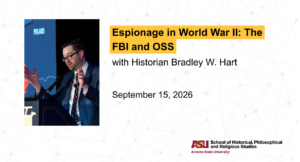
‘Espionage in World War II: The FBI and OSS’ with Bradley Hart


Sep 28, 2026
Dr. Bradley W. Hart, senior historian at the National World War II Museum, traces how the United States built an intelligence community from almost nothing during the Second World War. Before 1939, Washington had no coordinated foreign intelligence service and the institutions that would define American espionage for the next eight decades did not yet exist. Dr. Hart follows two of them through the war and into their contested legacies.
The FBI’s rise came first and came domestically; created in the 1920s to counter interstate bootlegging and later kidnapping, the Bureau moved into counterintelligence as war approached. Its Duquesne ring case remains the largest espionage operation ever uncovered in American history to produce convictions. The Bureau advertises that case far more readily than the Rumrich affair, and the German ring’s scale would have surprised Hoover himself in 1929. Domestic counterintelligence matured quickly. The dilemma became what to do overseas.
William J. Donovan supplied the answer. A Medal of Honor recipient, Wall Street lawyer, and Harvard classmate of Franklin Roosevelt, Donovan argued in July 1941 for a single office to coordinate the information reaching the President. The Office of the Coordinator of Information followed, and Donovan soon controlled the flow of reporting into the Oval Office. State and the Bureau objected immediately. Dr. Hart identifies that bureaucratic rivalry as a thread running to the end of the war and as a direct cause of Donovan’s defeat.
Codebreaking gave American analysts real access to Japanese intentions and the record shows how little that access settled. William and Elizabeth Friedman broke Japan’s Purple diplomatic cipher, and American stations read Tokyo’s traffic into Washington. None of it prevented Pearl Harbor. Ambassador Joseph Grew’s November 1941 warning said something was coming without naming a target. The message intercepted on the morning of the attack ordered the embassy to sever relations, which was neither timely nor specific. Dr. Hart describes a declassified Office of Naval Intelligence annex he examined at the National Archives, which records an instruction to a Japanese ambassador to burn his code books on December 3 and a penciled annotation stating that the admirals were not believed to be with the fleet. The assumption that Yamamoto would lead the strike personally shaped the estimate. Pearl Harbor stands as the most misunderstood episode of the period, and the Japanese decision to attack was itself the analytical problem.
The Office of Strategic Services, stood up after Pearl Harbor, drew roughly 13,000 personnel including 4,000 women. Its ranks held lawyers, professors, athletes, scientists, and filmmaker John Ford. Dr. Hart highlights Virginia Hall as the most decorated woman in American intelligence history and notes that a major league catcher, Moe Berg, was dispatched on a mission aimed at physicist Werner Heisenberg. Congressional oversight was thin. Harry Truman summoned Donovan to testify and was told the subject was classified, a exchange that did not build allies. Donovan’s own judgment about what OSS could accomplish in three years was candid: it could work with local populations and resistance networks, but it had no time to build long standing networks. Some final missions carried a secondary purpose of recruiting assets for the postwar period.
Donovan built the capability and lost the institution. Hoover, alarmed that Donovan might claim permanent turf, leaked to the press in 1945 and the resulting coverage labeled the proposed agency an American Gestapo. Truman pressed Donovan on where the money went and received no answer. On September 20, 1945, ten days after the surrender, Truman signed the order disbanding OSS effective October 1, dispersing its functions to the War Department and State. Donovan microfilmed files on his way out, stored them in an unsecured closet in New York, and eventually returned them to the National Archives. He later served briefly as ambassador to Thailand, a posting Bangkok protested out of concern he would run covert action there. He died in 1959. His Arlington headstone records the Medal of Honor and the First World War and says nothing about OSS. The CIA keeps a statue of him in its lobby, and Eisenhower reportedly said on his death that the country had lost its last hero.
Dr. Hart closes on the questions that still organize the field. How much coordination is enough and how much becomes too much for a constitutional democracy? How do domestic and foreign intelligence and special operations fit into in one service? The Director of National Intelligence, he observes, still occupies an office whose purpose few can define precisely. The lecture should earn attention from anyone who works in or alongside the interagency. The failure it documents belongs to institutions, not to operators. Donovan built a capable organization in three years and lost it to a rival who understood Washington better. Hoover’s leaks, Truman’s budget questions, and the absence of congressional allies decided the outcome. Practitioners who have watched a good program die in a budget cycle will recognize the pattern. The closing questions about coordination, oversight, and the limits of a unified service remain open, and the audience for them is anyone who has to answer them in practice


Commenting is available to active SWJ members and staff.