





The Drone Contact Force – a Cornerstone for the Future Army
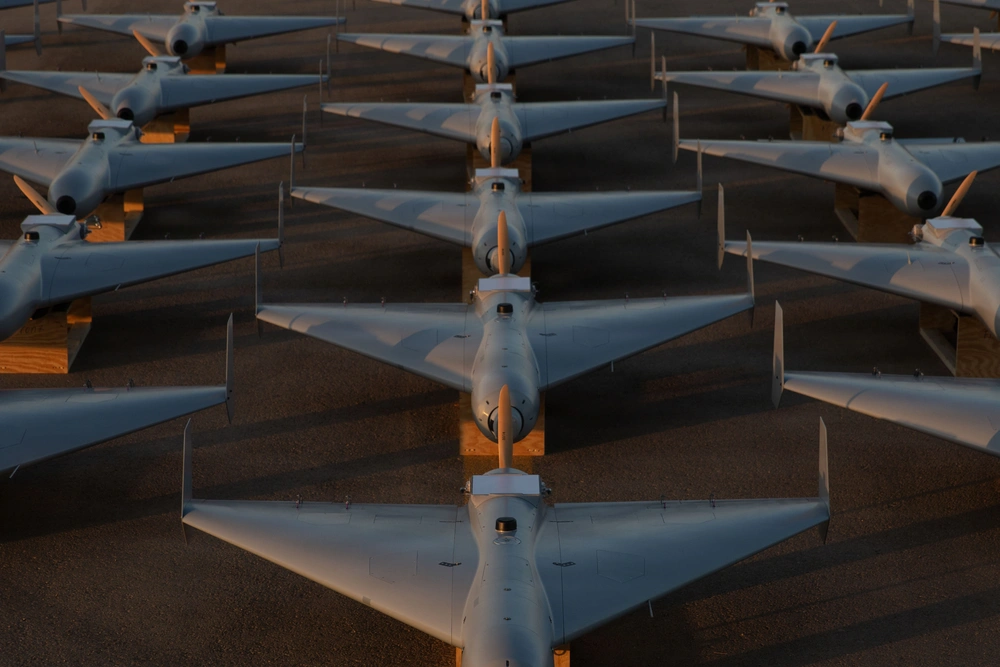

Standoff weapons delivered from joint assets continue to be the preferred tool for the United States to compel enemy action. Their relative ease of use and low risk ensure they remain a top choice for decision makers despite their high cost and overall low probability of enemy compliance. Epic Fury and Operation Rough Rider are the most recent examples of the narrow menu of options that standoff strikes provide. The United States military has committed significant resources to both operations yet remote strikes have failed to yield a diplomatic solution. The joint force is missing a kinetic / operational maneuver option between standoff strikes and personnel on the ground.
The next evolutionary step is an attritable robotic air and ground combined arms formation to support the joint force and enable operational maneuver. An autonomous ground force is the nexus of strike and close battle, two key elements of the recently published How the Army Fights. Drones have demonstrated their tactical effectiveness, and the Ukrainian Armed Forces are moving from using drones as tactical support to a fully autonomous force. The U.S. military continues to experiment with drones but in a supporting tactical role to manned operations like “loyal wingman” or manned unmanned teaming. On 30 September 2026, the Department of War directed the establishment of the Autonomous Warfare Command and shortly after the U.S. Army created its own headquarters. Although these commands are a step in the right direction, a primary focus must not only be streamlined procurement, but an evolutionary step in how the U.S. Army organizes and fights with drones in support of joint operations. Based on the potential of drones and Super Intelligence (SI), it is professionally negligent if an autonomous U.S. force is not the first to make contact in initial engagement of the next conflict. The establishment, testing, and deployment of a drone contact force (DCF) would offer the U.S. President additional kinetic options and provide a joint force commander with operational maneuver approaches. Ground maneuver, manned or unmanned, elicits a different enemy response than a standoff strike. An autonomous ground force provides control of terrain and on ground intelligence with endurance that standoff options cannot provide with the same level of mitigated risk. As outlined in How the Army Fights, “the joint force depends on the Army for decisive land control.” That ground control is not currently an option for senior leaders without committing manned forces. A DCF is only limited by the size and scope of drone development and inventory. A fully developed DCF deployed to the first island chain could provide another form of deterrence and dilemma for Chinese leaders. Its deployment during a Taiwan crisis is a flexible response option with reduced risk to forces, buying time for decision makers.
Based on the potential of drones and Super Intelligence, it is professionally negligent
if an autonomous U.S. force is not the first to make contact in initial engagement of the next conflict.
The Case for Why
In the age of standoff strikes the Army mainly supports the joint force through area support and long-range fires. The focus of How the Army Fights is primarily oriented above the division level and does not provide detail on drone employment in close battle. The threat or potential of these platforms, especially operating as a combined force, is too powerful to leave virtually unmentioned. The tactical application of an autonomous force brings value to the strategic and operational fight because it now opens the land domain in the same manner as standoff strikes. Continuous advancements in technology allow for autonomous ground options like a DCF to temporarily control terrain. As an attritable early entry force, a DCF could penetrate the enemy anti-access / area denial (A2AD) in the ground domain and air littoral in preparation for larger-manned follow-on forces. In tactical action the DCF serves as a supporting effort to protect or maneuver in tandem with manned formations. Today because of the autonomous force gap, the only ground option is a Marine or Army task force. A manned course of action comes at substantial risk to force, cost, and political will with serious historical baggage. This possibly explains the threat of U.S. ground force action against Iran, but no execution.
When considering cost alone, the Center for Strategic and International Studies estimates that a Marine Expeditionary Unit costs $5.8 million dollars a day to operate. Although a DCF does not yet exist, one could make an educated guess that a formation with significantly lower cost platforms and less personnel would cost much less. Execution by a DCF element during operational action with remote operators is a different risk equation. With an autonomous / remote force the operators can control from an offset location (sea, ground, or airborne) or from support areas and are at no more risk than other Soldiers arrayed within the support area. Instead of “boots” in a contested area, attritable robots execute the highest risk large scale ground combat missions.
Using an Epic Fury vignette, imagine a DCF being tasked with an autonomous attack on an oil transfer station on Kharg Island. Small landing craft beach and launch multiple unmanned ground vehicles (UGVs) equipped with various payloads. UGVs with machine guns or missile begin engaging various Iranian targets. They receive targeting data from multiple intelligence, surveillance, and reconnaissance (ISR) group one and two unmanned aircraft system (UAS) providing overwatch and synthesized through SI. These ISR UAS provide guidance to other aerial one-way attack (OWA) drones at specified targets. The UGVs equipped with mine-clearing line charges reduce obstacles and mines, clearing a path from the beach. The tactical Iranian positions built in the traditional method did not fully appreciate the new 360-degree threat. UAS swarm from behind their positions and begin detonating as UGVs press the frontal attack starting a period of very-high-intensity combat for the Iranian defenders. The reports of a possible ground incursion on the island causes the Iranian chain of command to illuminate themselves to joint targeting as they attempt to direct a counter response. In this scenario, the U.S. Army just conducted a ground autonomous attack generating operational effects with limited risk to friendly forces. Ukrainian forces recently executed a much smaller version of this on the Kinburn Spit and continue to integrate all-robotic operations along the line of contact.
Designed to Fight Forward
There would be three key operational missions for the DCF: autonomous attack in a contested environment, initial lodgment for follow-on joint force entry, and establish and maintain a Reduced enemy Drone Activity / Opportunity Area (RDOA) in support of manned forces. Using the Kharg island vignette, UGVs expand the local perimeter, equipped with surface to air missiles, machine guns, relay terminals, or electronic warfare platforms. RDOAs will allow larger traditional manned formations to operate, exploit, and survive within. Comparable to actions after an airfield seizure, the RDOA allows for forces to go on the offensive from a position of relative advantage. Maneuver is only possible and survivability is only maximized once friendly robots and disaggregated forces efficiently set conditions for follow-on operations.
A DCF is comprised of a high mix of ubiquitous drones (air and ground) to a low number of human operators organized into a brigade structure. A company would consist of drone platoons with squads of drones categorized by capability (direct fire, anti-air, mobility, counter mobility) and controlled by operators supported by fires and intelligence personnel. The critical vulnerability for a DCF is the signal link between operator and drone formations. However, this can be mitigated through redundancy, relay, fiber optic control, and mesh networks to ensure operators are offset out of risk. A DCF would be considered an echelon above brigade element and assigned to an Army corps for training, support, and oversight.
The DCF is not designed to replace maneuver brigades, but provides time and decision space for the supported corps or joint task force by executing the most dangerous missions ahead or in lieu of manned formations. DCF employment is similar to the U.S. joint forces use of Low-cost Uncrewed Combat Attack System (LUCAS) to overwhelm Iranian defenses during the opening actions of OEF and preserve combat power. A DCF enters an enemy’s weapons engagement zone (WEZ) eliciting a response that supports shaping from the tactical to operational level, setting conditions for the maneuver of penetration and exploitation forces. The DCF would employ the allocated shaping effects from the supported Corps and joint force to strike enemy formations. The Ukrainians again demonstrated this concept during Operation Vivaldi by landing waves of drones ten kilometers behind Russian lines to facilitate combined arms maneuver. The recent Military Review article on the performance of a US Armor brigade against a Ukrainian drone platoon serving as the opposing force noted that enemy drones generated at least 60% of their casualties during opening engagements. Now imagine a DCF penetration ahead of this brigade to trigger an enemy response. In principle, the DCF is the smallest and most attritable force to gain contact and preserve the human warfighter. Weather and areas of restrictive terrain (jungle, subterranean, urban zones with significant rubble) could limit a DCF’s maneuver and ability to sense for long distance, requiring augmentation from maneuver brigades. However, areas like airfields, beaches, key routes, and other open areas would be hospitable for DCF sense and strike.
The U.S. Navy continues to increase its drone presence in the maritime domain conducting reconnaissance and strike missions in lieu of manned assets on Iranian targets in port. Now, imagine the operational messaging and cognitive warfare potential if UGVs in tandem with Navy drones landed on Iranian shores with minimal risk to U.S. forces. The potential for more UGV DCF autonomous attacks would create operational dilemmas for regional defense and doubt among tactical forces. Instead of Kharg Island, a DCF element could come ashore at other areas along the Strait of Hormuz to attack Iranian counter commerce / shipping elements demanding additional enemy resources and vigilance to defend against. This ability to surprise and attack in the ground domain with limited risk to force should be further explored by U.S. Army autonomous developers and how it applies to lethality and options in a Pacific crisis.
A U.S. Army autonomous drone force would close a significant capability gap and provide attritable ground options to a joint force commander. The creation of this force demonstrates additional relevance for the Army outside of large-scale ground operations. The once fictional drone force is now very much a possibility. To maintain battlefield dominance, the U.S. Army must lead in the development of this concept or risk being on the receiving end of one.


Commenting is available to active SWJ members and staff.