SWJ–El Centro Book Review — States of Exception: Criminal Armed Groups and the Evolution of South American Policing
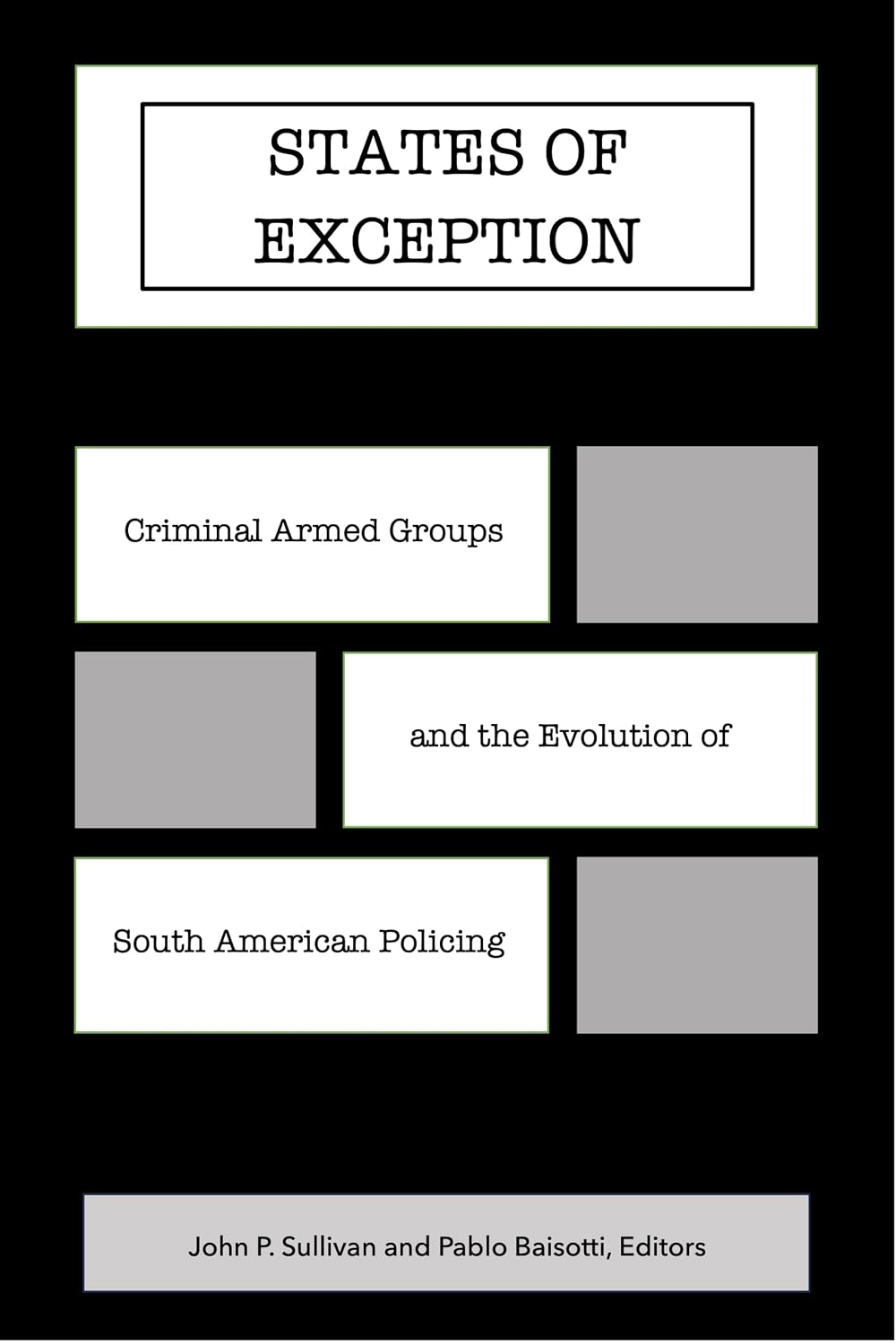

John P. Sullivan and Pablo Baisotti, Eds., States of Exception: Criminal Armed Groups and the Evolution of South American Policing. New York: Defense Press, 2026 [ISBN: 978953327017 Paper; 243 pages; ASIN: B0HKF1DDRG, Kindle, 307 pages]
South America plays a central role in global illicit trade, and changing patterns of organized violence across the region are a growing concern. Criminal networks connect local production areas and border regions to ports and markets around the world. Their activities extend beyond drug trafficking to illegal mining, other environmental crimes, extortion, and human trafficking. Corruption facilitates these operations, while money laundering helps conceal their proceeds. These interconnected activities place growing pressure on state authority and the institutions citizens rely on for protection.
Criminal organizations such as Brazil’s Primeiro Comando da Capital (PCC) and Comando Vermelho (CV), as well as Colombia’s Clan del Golfo, operate through networks that extend across national borders. Alliances between South American criminal organizations and Italian mafias, including the ‘Ndrangheta, Cosa Nostra, and Camorra, further link regional illicit economies to international trafficking and money laundering networks. Understanding these relationships requires attention to local conditions and to the flows of resources that sustain criminal influence across borders.
Criminal governance is central to this analysis. In some urban neighborhoods, prisons, trafficking corridors, and frontier regions, criminal armed groups exercise forms of de facto authority by imposing levies on local commerce, enforcing behavioral codes, settling disputes, and controlling access to services. Their power can depend on coercion, corruption, and accommodation with public officials. Such arrangements place citizens in relationships of dependence and vulnerability that conventional measures of crime may capture only partially. Police and judicial authorities must therefore confront individual offenses alongside embedded ecosystems of criminal control and their connections to state institutions.
States of Exception: Criminal Armed Groups and the Evolution of South American Policing, edited by John P. Sullivan and Pablo Baisotti, examines these relationships through studies of criminal governance, public security responses, and legal frameworks. Its comparative approach brings different dimensions of the problem into view. The chapters explore how criminal organizations acquire influence, how that influence affects citizenship, and how governments respond under pressure to restore public security. The collection also provides a basis for considering why policies adopted in one setting may have different consequences in another.
The collection brings perspectives on criminal governance, third-generation street gangs, and gray-area conflict into dialogue with country studies and legal analyses. These approaches examine how armed criminal organizations develop political influence and how their activities complicate conventional distinctions between policing and other forms of security intervention. They provide tools for assessing criminal power alongside the public institutions and policies that respond to it.
Ecuador, for example, illustrates the importance of changes in the geography of illicit trade. Its transition from a transit country to a logistical center for the global cocaine market has accompanied a deterioration in public security and national stability. The chapter on Ecuador examines the changing security environment and the responses of successive governments. This case directs attention to the relationship between trafficking networks, strategic infrastructure, and the capacity of public institutions to respond to criminal violence.
The South American case studies also show how these challenges take different forms within their national contexts. Questions about the territorial concentration of violence in Uruguay sit alongside Argentina’s legal treatment of criminal association and Chile’s use of armed forces to protect critical infrastructure. The Brazil chapter uses third-generation street gang theory to examine the evolution of violent non-state actors in Rio de Janeiro. These cases invite comparison of the legal and institutional choices through which governments confront organized crime and the consequences of those choices for policing.
The title of the volume draws attention to a recurring tension in security policy: the pressure to respond urgently to violence while preserving the institutions and safeguards on which democratic authority depends. Governments turn to emergency powers and military involvement in domestic security to address urgent threats. These measures also require assessment in terms of accountability, rights, and long-term effectiveness. Several contributions examine the limits and costs of militarized responses. The collection encourages consideration of how operational measures interact with legal reform, institutional coordination, and the conditions that allow criminal organizations to retain power.
The state’s own conduct also demands scrutiny. The study of Venezuela’s Special Action Force examines official vigilantism, while the Bolivia chapter considers the relationship between transnational organized crime, the state, and citizenship. These chapters show why assessments of public security must examine the conduct of state institutions alongside that of criminal organizations. Criminal coercion and abuses committed or protected by state institutions can both undermine citizens’ confidence in the bodies charged with protecting them.
For police leaders, policymakers, defense analysts, international security practitioners, and scholars of Latin America, States of Exception offers a framework for understanding criminal armed groups and assessing the institutions and policies charged with responding to them. Its contribution lies in connecting questions of security effectiveness with the legal foundations, public accountability, and democratic legitimacy of policing.