From Expertise to Effect: The Next Step for Detachment 201

This essay is from the Security & Defence PLuS Emerging Voices Series, which highlights the next generation of scholars and practitioners shaping thinking on strategy, security, and defense. The series brings together perspectives from PhD candidates and early career researchers, grounded in the complex geopolitical realities of the 21st century.
The collection explores a “Latticework of Resilience” that connects often-overlooked sectors, such as subnational diplomacy and critical infrastructure inherent in agriculture security, to the core of national security. Taken together, the essays emphasize the importance of adaptive, multidisciplinary approaches to building resilience in an increasingly complex global environment.
The first event in the Emerging Voices series was held at Arizona State University on 2 March 2026, with events to follow at King’s College London and UNSW. Watch the event recording: The Emerging Voices Series: Strategy, Security & Defence at Arizona State University.
The U.S. Army increasingly relies on technologies whose fastest development often occurs outside traditional defense institutions. Artificial intelligence, autonomous systems, software, cyber capabilities, data science, and advanced logistics are advancing rapidly in the commercial sector. The Army’s 2024 posture statement acknowledged that commercial technology has outpaced military technology in many areas. That forces the Army to be able to procure and adapt commercially available systems faster to gain tactical advantage.
That makes the Army’s technology challenge a talent challenge as well. Traditional officer development remains essential for producing leaders with operational experience, military judgment, and progressively greater responsibility. But it is poorly suited to reproducing expertise accumulated over a decade or more inside technology companies. Direct commissioning offers another route. Bring experienced professionals into uniform and recognize the education and experience they developed outside the military. The Army’s modernized Direct Commissioning Program now targets high-demand fields including cyber operations, data science, artificial intelligence, robotics, advanced logistics, and information warfare. Recent reforms have also reduced application-to-commission timelines to fewer than six months.
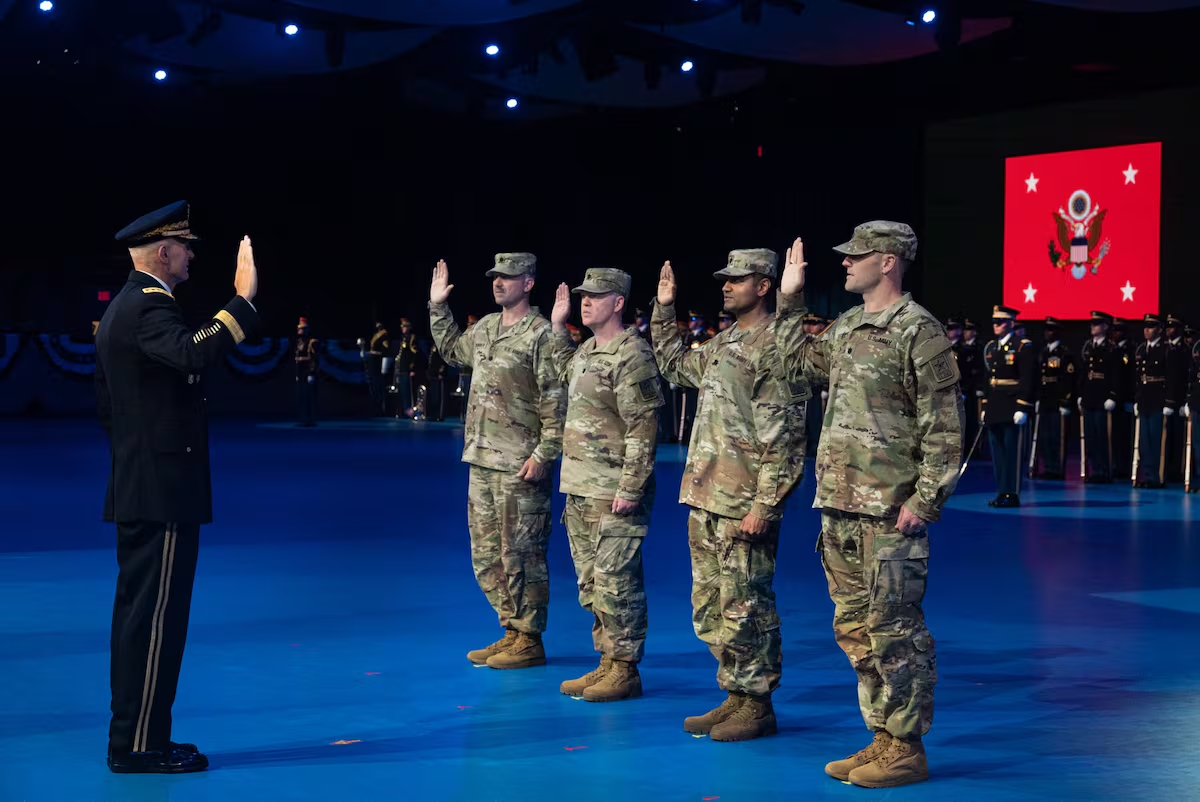
Detachment 201, the Army’s Executive Innovation Corps, is a particularly visible application of that idea. Established in 2025, the Army Reserve organization commissions senior technology executives to serve part-time as strategic advisers on targeted projects intended to help the Army develop and scale technological solutions. Its inaugural cohort included leaders associated with Palantir, Meta, OpenAI, and Thinking Machines Lab, with three additional executives commissioned in 2026. The Army reports that the initial cohort has provided strategic counsel on munitions supply-chain analysis, industrial-base investment, autonomous systems, and counter-drone technologies in its announcement of the second cohort.
The concept is compelling. Rather than attempting to recreate decades of commercial experience inside the Army, bring that experience into uniform. Recruiting exceptional people solves only the first part of the problem. Access to expertise is not the same as the ability to turn that expertise into military effect.
This essay draws in part on interviews conducted by the author in 2026 with individuals familiar with Detachment 201 and defense innovation. Those interviews suggest that the most important challenges now occur not in attracting exceptional talent, but in employing it effectively.
Recruiting Talent Is Only the Beginning
The first challenge is institutional friction. Interviewees described difficulties as basic as establishing computer accounts, obtaining equipment, accessing Army systems, and onboarding geographically dispersed officers. They also described the challenge of balancing military obligations with demanding civilian careers.
These problems may sound mundane, but they matter disproportionately in Detachment 201. The program deliberately recruits senior executives whose time is limited. Every hour spent navigating routine military administration is an hour not spent applying the expertise that justified the commission.
The deeper challenge is translation. A senior commercial executive may understand artificial intelligence, software development, autonomous systems, or large-scale technology organizations at a level that would take the Army years to reproduce internally. What that executive does not automatically possess is the knowledge military officers accumulate through years of service. This knowledge includes how formations operate, how commanders experience problems, where authorities reside, how requirements move through the institution, and which constraints determine whether a promising idea can actually be implemented.
Several interviews pointed to the need for an experienced Army officer who can help a newly commissioned executive identify where that expertise can matter, navigate the institution, and translate between commercial possibilities and operational requirements. The underlying principle is straightforward. Commercial expertise and military fluency are complementary, not interchangeable.
Detachment 201 also faces a more difficult constraint. The same commercial experience that makes its members valuable can limit where the Army can employ them. Public reporting indicates that members must recuse themselves from matters affecting their financial interests, file confidential financial disclosures, complete annual ethics training, and receive legal review of individual work assignments. They are also separated from vendor-selection decisions. DefenseScoop’s reporting on Detachment 201 details those safeguards.
Those protections reflect federal conflict-of-interest law. 18 U.S.C. §208 generally restricts executive-branch officers and employees from participating personally and substantially in particular government matters in which they, or certain associated people or organizations, hold a qualifying financial interest.
These safeguards are necessary. But they create an inherent tension. The closer an Army problem lies to an executive’s civilian work, the more relevant that person’s expertise may be, and the more carefully the Army must manage potential conflicts. One interviewee captured the dilemma by describing it as putting “LeBron James on hockey skates.” The Army can recruit extraordinary talent yet, in some circumstances, struggle to employ that talent where its comparative advantage is greatest.
The answer is not to weaken ethics protections. It is to design Detachment 201 so that it functions effectively within them.
Build Teams Around Problems, Not Individuals
The next phase of Detachment 201 should focus more on organizing expertise around defined Army problems. Three changes would help. Pairing commercial executives with officers who provide military fluency, assigning multiple executives to the same priority problems, and exploring an additional contractual pathway for commercial expertise when that expertise cannot appropriately be exercised through an executive’s military role.
First, major Detachment 201 efforts should include a military integrator. This would be an experienced mid-career Army officer who provides operational context, institutional connectivity, and continuity.
This officer should not simply be an aide. The commercial executive understands what technology can do. The military integrator understands how Army formations operate, how military problems are framed, where decisions are made, and why technically attractive solutions sometimes fail in practice. The relationship allows each person to contribute the expertise the other lacks rather than requiring newly commissioned executives to become Army bureaucratic experts before they can be useful. It also provides continuity when a part-time executive returns to a demanding civilian career.
Second, priority problems should, whenever possible, be assigned to teams of executives rather than individual executives. Interviewees emphasized that collaboration among executives can be especially productive. Another interviewee suggested assigning people from different commercial backgrounds to common problems, allowing different perspectives to challenge one another rather than making the Army dependent on the assumptions of a single executive or company.
The team structure could also make Detachment 201 more resilient to unavoidable conflicts of interest. It would not eliminate an individual member’s conflict, and it should not be presented as doing so. If one executive must recuse from part of a problem, however, the entire effort need not stop. Another member with relevant expertise but different financial interests may be able to continue the work. Cross-company teams also allow the Army to combine perspectives that no single company possesses.
The basic organizational unit should therefore become a problem team. A validated operational problem, an experienced military integrator, and several commercial experts with complementary backgrounds. Detachment 201 would be organized around what the Army needs to solve rather than around whom it has recruited.
Third, the Department should explore a separate contractual pathway to senior commercial expertise. For selected future technology acquisitions, it should examine whether solicitations can require vendors to provide defined access to appropriate senior technical personnel for integration, experimentation, or advisory support associated with the capability being purchased. The government would then be purchasing not only a technology or service, but also a clearly bounded level of access to expertise needed to integrate it effectively.
This would not eliminate the personal conflict-of-interest obligations of an executive who also serves as a government officer. Nor would it allow that executive to perform through a contract work from which he or she must recuse in uniform. Instead, a contract could provide the Army access to appropriate expertise from the company itself when a Detachment 201 member cannot participate personally. The relevant expertise could remain available to the problem even when a particular individual could not provide it in a military capacity.
Any such arrangement would require careful acquisition and legal design. Federal acquisition rules on organizational conflicts of interest require contracting officers to identify and address significant conflicts, while rules governing personal-services contracts generally prohibit unauthorized arrangements in which contractor personnel effectively enter an employer-employee relationship with the government. Any pilot would therefore require clear boundaries between government decision-making and contractor support.
The proposal is not simply to “put Detachment 201 into contracts.” It is to ask a broader question: when the Army needs commercial expertise, must that expertise always be exercised through an individual’s military commission?
In some cases, direct commissioning may be the appropriate mechanism. In others, the Department may gain more useful access to specialized expertise through a properly structured contractual relationship with the company itself. The approaches need not be mutually exclusive. Together, the three mechanisms form a progression. Military integrators provide Army fluency, cross-company teams provide diversity and resilience, and contractual access may preserve access to company expertise when a commissioned individual cannot appropriately participate.
From Expertise to Effect
Detachment 201 is an important experiment because it tests whether the Army can do more than recruit outside expertise. It tests whether the institution can employ it effectively.
The next step should be to move from a collection of exceptional individuals toward teams deliberately built around operational problems. Military integrators can supply the Army fluency commercial executives lack. Cross-company teams can provide broader perspectives and allow work to continue when individual members must recuse. Carefully structured contracts may provide an additional route to expertise that cannot appropriately be exercised through a member’s role in uniform.
Detachment 201 should ultimately be judged neither by the prominence of the executives it commissions nor by the number of engagements it conducts. The more meaningful measure is whether their expertise produces better military outcomes.
The future of direct commissioning should be measured not by whom the Army recruits, but by what their expertise enables soldiers to do.