





Centauri, High Valyrian, and Klingon: Why Advanced Encryption Standards Cannot Replace Low-Density Human Dialects

Abstract
The United States’ heavy reliance on digital Communications Security (COMSEC) introduces critical vulnerabilities to near-peer exploitation, risking total loss of operational advantage and battlefield devastation. If digital encryption and technical systems fail, the U.S. may rely on analog alternatives, including low-density linguist capabilities, to maintain secure tactical voice command and control on contested battlefields. Given the near loss of Navajo Code Talker linguistic capabilities and an overwhelmingly monolingual population, the U.S. faces a severe strategic deficit compared with adversarial states that may leverage their own endangered regional dialects. As a contingency, the U.S. linguistic security apparatus must revitalize endangered regional language isolates as a layered security measure to ensure operational security if COMSEC fails in a modern digitally contested battlefield.
The Threat of the Tech Fallacy
While the United States maintains advanced digital security through electronic mathematical algorithms to ensure high-confidence communication, COMSEC remains vulnerable to exploitation. Accordingly, threat vectors can target and exploit weaknesses in COMSEC architecture, including weak passwords, outdated algorithms, aged systems, or social engineering vulnerabilities. Historical precedent demonstrates the fallibility of digital infrastructures, as evidenced by modern examples, including the U.S.’ now-canceled omni-purpose Joint Tactical Radio System and the failure of Russia’s Era military cryptophone system during the war in Ukraine.
Simultaneously, near-peer proliferation of electronic warfare (EW) and AI-enhanced signal intelligence (SIGINT) systems ensures that any conventional, technocentric digital footprint is inherently compromised in contested advanced theaters. China’s Integrated Network and Electronic Warfare (INEW) doctrine harmonizes EW with Computer Network Operations to disrupt and paralyze an adversary’s command, control, communications, and intelligence (C4ISR) systems during conflict. While not publicly disclosed as an INEW asset, China’s civilian-military fusion national strategy operationalizes commercial infrastructure for national defense objectives, notably espionage. U.S. intelligence suggests that China’s state-owned shipping company, COSCO, leverages hidden onboard equipment to intercept Western military communications globally.
EW as a threat landscape has already almost certainly redefined modern conventional battlefields, as demonstrated by the ongoing war in Ukraine. Near-peer adversaries such as Beijing have notably bolstered their SIGINT and EW ecosystems, while insulating their anti-access/area-denial envelope in the Western Pacific theatre and modernizing their military apparatus in preparation for an eventual armed conflict with the U.S., including interfering with U.S. C4ISR architecture and intercepting secure voice communications.
The U.S. Deficit and the Linguistic Advantage
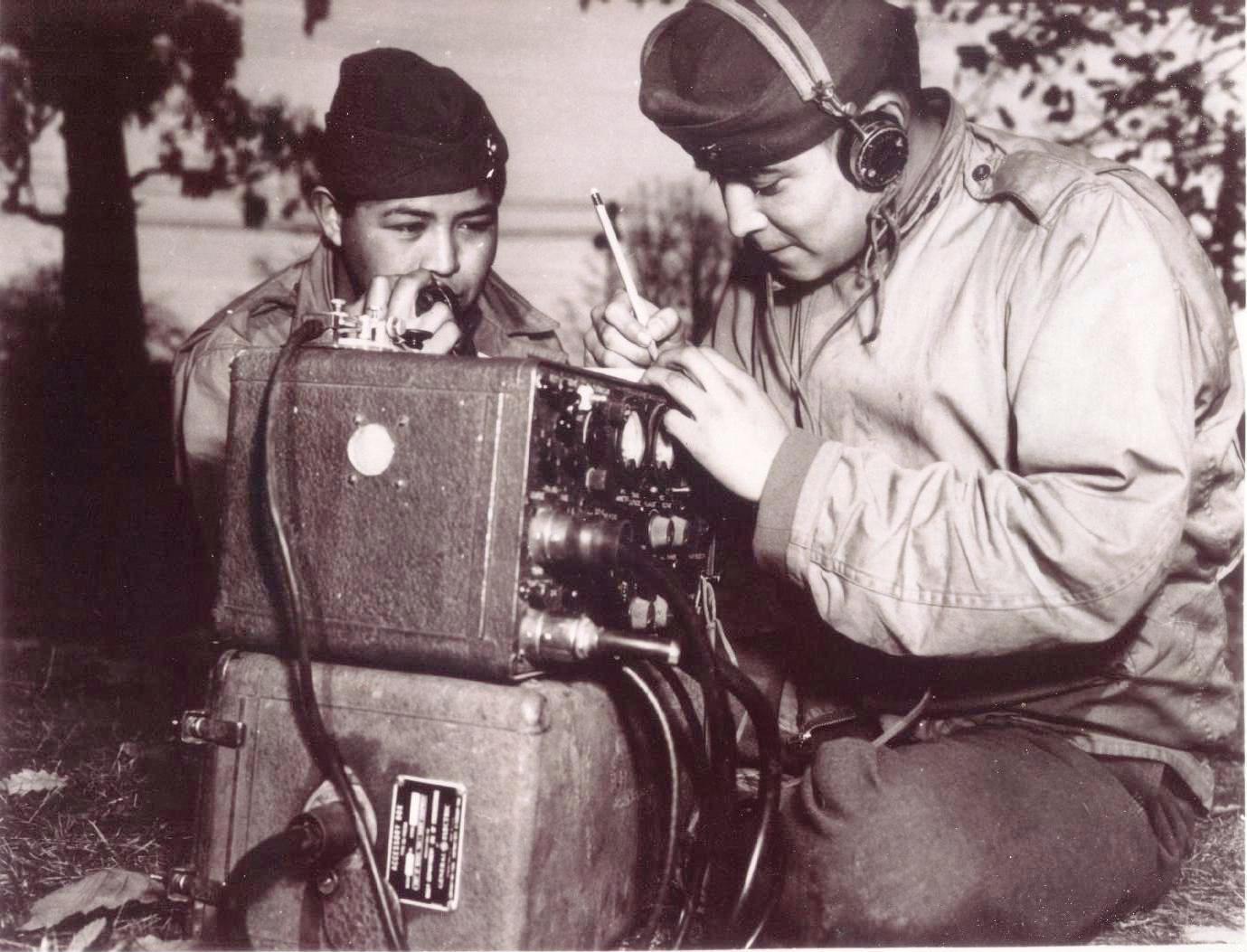
In World War II, the United States, contending with secure SIGINT communications, leveraged the native Navajo language to transmit strategic information; however, since then, the U.S. has not sustained or operationalized the practice despite its battlefield advantage. As a component of the U.S. Army Transformation and Training Command, the Defense Language Institute Foreign Language Center (DLIFLC) offers core foreign languages, including Mandarin, Arabic, and Russian. Although the institution offers lower-density languages under the Emerging Language Task Force (ELTF) to support the Department of Defense’s (DoD) war on terror needs, including Urdu, Dari, and Pashto languages, the facility does not offer domestic indigenous dialects such as Lakota, Cherokee, or Ojibwe, despite their regional uniqueness to the United States.
Unlike high-density global languages like Russian or Mandarin, Native American language isolates are sovereign linguistic assets bound entirely to domestic indigenous populations and therefore lack commercial institutional training frameworks. Geographically bounded dialects such as the Arapaho, Shoshoni, and Zuni remain operationally scarce as endangered languages with limited fluent speakers. Cumulatively, the United States maintains approximately 199 living indigenous languages, with an estimated 6% of native North American language use declining in 2021.
Although both Russia and China maintain endangered native minority languages such as Chukchi and Uyghur, neither government remains vigilant about leveraging such low-density dialects. Instead, both nations enact state-sponsored archival projects while enforcing state-wide assimilation, replacing indigenous languages with Russian or Mandarin. While adversarial states do not prioritize native dialects within their own security apparatus, Russia maintains coordinated relationships with various African nations and has recruited foreign fighters into its military ecosystem. These relationships could provide recruitment networks in the event of a near-peer conflict with the United States. In the Central African Republic, Russian state-sponsored mercenaries, formerly the Wagner Group, now operating under the Ministry of Defense as the Africa Corps, work intimately with local forces. Polyglot nations such as Niger, Burkina Faso, and Mali have highly diverse ethnic populations, unique in their own tribal dialects that could likely be weaponized similarly to the Navajo Code Talkers.
Operational Recommendation
Operationally, the United States should prioritize preserving latent regional language capabilities by establishing designated training pipelines, as demonstrated by the DLIFLC and the ELTF. Because native North American languages remain regionally unique, the DoD can actively recruit and partner with tribal nations to build a pool of native linguists and design a sovereign voice code curriculum. In the event of EW jamming or compromised networks, these linguists can act as a contingency apparatus to provide secure voice communications and deny adversarial exploitation, mirroring the historical tactical success of the Navajo Code Talkers.


