





Battalion Perspectives in Contact: Bridging Tactical Gaps During Transformation

Abstract
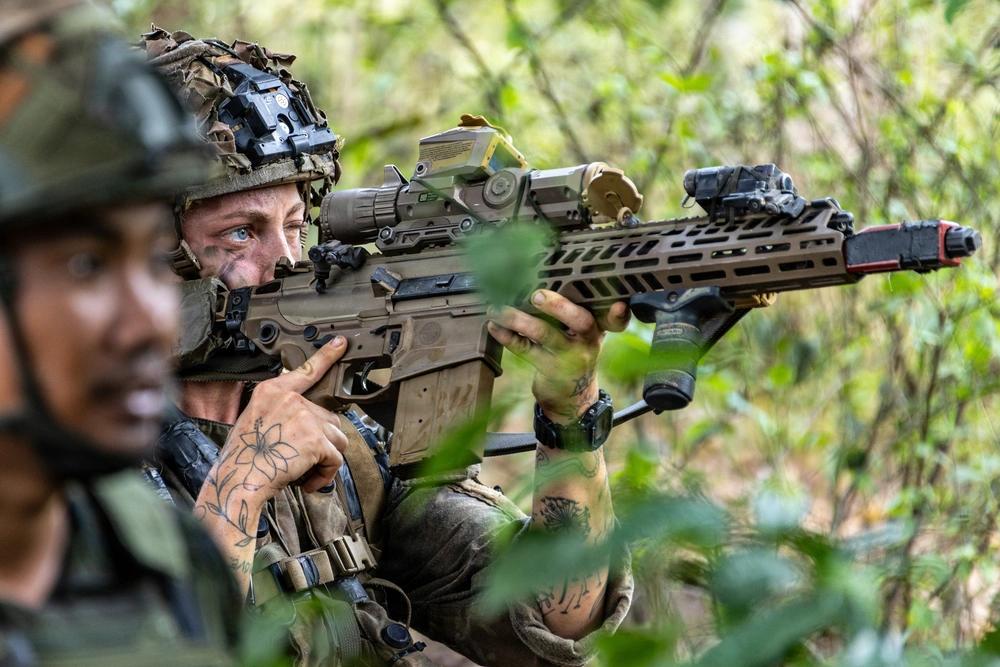
During Joint Pacific Multinational Readiness Center (JPMRC) Rotation 26-01, the 2nd Battalion, 35th Infantry Regiment evaluated the U.S. Army’s Transformation in Contact (TIC) initiative to assess how rapid technological and organizational changes impact tactical execution. The unit’s observations revealed that while modern equipment enhances battlefield capabilities, a critical gap remains between materiel change and the doctrine needed to guide tactical execution. This article outlines emerging imperatives across three vital battlefield functions—sensing, transition, and endurance—and highlights the necessity of adapting fundamental tactical proficiencies on the modern battlefield.
Introduction
One constant in war is that emerging lethality—the innovative application of technology to destroy at range and speed on the battlefield—punishes the unprepared. Effective preparation is built on synergy between tactics, training, and equipment. Like many units experimenting across the Joint Force, 2nd Battalion, 35th Infantry Regiment (2-35IN) “Cacti Blue”—as part of 3rd Brigade, 25th Infantry Division’s (3-25 MBDE) —found itself in an especially adverse environment during Joint Pacific Multinational Readiness Center (JPMRC) Rotation 26-01 in November, 2025. This exercise occurred in conjunction with the U.S. Army’s Transformation in Contact (TIC) initiative. Its purpose was not only to validate the manning and equipping changes, but also to inform necessary doctrinal refinements to the multidomain operations (MDO) concept.
TIC is thus far a successful quest to drive rapid organizational change. However, it lacks the complementary doctrine, particularly at the brigade level and below, to translate technological innovation into tactical success on the modern battlefield. This article examines TIC’s impact on outcomes, techniques, and overall tempo at the battalion level during force-on-force exercises. It considers how specific doctrinal reforms are imperative to allow tactical proficiency to keep up with technological rearmament in new environments. The article focuses on three functions TIC affected most: sensing (intelligence and fires), transition (command and sustain), and endurance (protection and maneuver).
Training Centers, Innovation, and Tempo
JPMRC represents a unique laboratory environment to test the risks and opportunities that technological changes provide at the tactical level. The Army continues to view the combat training center as the flagship proving ground for measuring combat readiness. The Hawaii-based JPMRC—another in Alaska tests combat readiness in arctic conditions—stretches across many islands and training areas. A dedicated training brigade runs the exercise for the entire 25th ID. In this iteration, 2-35IN attacked for five straight days and defended for three consecutive days across a noncontiguous battle space against a free-thinking and modern opposing force.
Tempo—long a cure-all for military theorists and practitioners alike—is an important metric to assess new force structure. Tempo is a key tactical variable occurring at the intersection of equipment, training, and tactics. But as central as it is to the Army’s stated fundamentals as “…the relative speed and rhythm of military operations over time,” it is also fragile. As the U.S. Army layers changes tactical headquarters and equipment, tactical tempo against a live enemy is a true barometer for effectiveness. As Cacti learned, dictating the terms of battle is notoriously difficult. Success required closing the gap between technology and tactics to sense, transition, and endure faster than the enemy.
Sensing: Winning the Recon and Counter Recon Fight (Intelligence and Fires)
TIC fundamentally changed how brigades and subordinate battalions execute intelligence collection and fires. The newly created multi-purpose company (MPC), formerly the mounted weapons company, is the combination of a ground reconnaissance platoon, mortar platoon, and assault platoon capable of medium-range reconnaissance (MRR) with PDW C-100 and Switchblade 600– Low-Altitude Stalk and Strike Ordinance (LASSO). TIC also divested ground reconnaissance squadrons. That loss necessitated adaptation to organize and prioritize the proliferation of sensors for organic reconnaissance and security operations.
Three sensing imperatives emerged from Cacti’s fight:
First, units must train to maintain continuous security zones. MPCs are effective but constrained resources. Cacti delineated unmanned assets between units to maximize sensor span of control between leaders. The MPC focused on MRR and LASSO while rifle companies leveraged Short Range Reconnaissance (SRR) and First Person-View (FPV) drones. Cacti task organized the MPC to fight organically with attached ground-based electronic warfare teams and fires observers. The MPC commander conducting the exercise acted simultaneously as the battalion reconnaissance officer. In the latter role, the commander executed and updated the battalion intelligence collection plan until the battalion Tactical Command Post (TAC) deployed. After TAC deployment, the MPC command post provided sustainment and signal area support for forces in the security zone. This ensured continuity and redundancy of the security fight throughout the transitions in battle periods. Nonetheless, the MPC is generally no more than 3-5km ahead of the main body—the rest of the battalion—for 96-120 hours until resupplied with particular emphasis to mask units in position ready to launch and fire. Units mitigate this vulnerability with cross training. Rifle companies must train to conduct security missions and all leaders must understand key intelligence and fires planning tools such as the collection matrix and target selection standards.
Second, units must fight to observe their deliberate fires missions. Cacti created a dedicated battalion strike cell within its forward tactical command post, manned by intelligence, fires, and maneuver officers This cell allowed the Main Command Post (MCP) to focus on aggregating sensor data and managing larger pre-planned conditions of the operation farther away from contact. Cacti’s framework aggregated dynamic target data well, but its deliberate fires tended to overrely on UAS as a primary observation sensor for preplanned fires. This constrained the unit during inclement weather and limited its potential for dynamic re-tasking.
Infantry units must employ a self-constraining framework for MRR and LASSO capability, be it pre-planned deliberate, dynamic, or reserve planning factors from the aviation and fires community to sustain its sensors for prolonged reconnaissance and security. Units also should leverage all assets for observation. This may include organic subordinate units and attachments, such as electronic warfare teams. The battalion strike cell required continual reassessment of proper sensor coverage, trigger, and delivery platform as the fight progressed.
Infantry battalion-led reconnaissance and battle hand over (RHO/BHO) are essential battle drills to pass refined target custody across unit boundaries. Brigade sensors passed enemy high pay-off targets through battalion command posts via chat. Then, MPC air and ground sensors refined the situation, allowing the battalion staff to pass downloadable data packages with enemy and operations graphics to inform rifle company transitions toward the objective.
Third, units must continuously update probable lines of contact (PLC). The PLC, an assessment where two combatants will clash on the terrain, drives how commanders understand the battlefield. An Infantry Squad Vehicle (ISV)-enabled unit lacks armor to protect the force but has the mobility to rapidly reposition. Cacti successfully controlled the security zone. However, it struggled to exploit restricted terrain in a timely manner as the enemy security zone collapsed. Units must assess their understanding of priority forms of contact, particularly aerial and electromagnetic, regularly to exploit success and mitigate failure.
Transition: Winning the Ability to Pivot (Sustainment and Command)
TIC also changed the ways units manage transitions via sustainment and command. Cacti followed the prescriptions for more survivable command posts and sustainment. It deployed an MCP of three Humvees and one Polaris Ranger as well as a TAC of three other Rangers. Critically, the battalion is enabled by the Integrated Tactical Network (ITN), providing alternative means of voice and data transport through radio, satellite terminals, and edge devices.
Logistically, Cacti benefited from a fleet of ISVs and robotic carriers. This allowed the rifle company five days’ worth of self-reliance, with sufficient food and water, AC/DC power supply, and winch recovery. Combined, this level of effective sustainment and command factors averted the need for compromise, enabling transition by mitigating the need to decisively commit battalion assets. With robust communications options, Cacti nodes stayed dispersed and masked, preventing compromise. With robust company logistics able to provide water, ammo, and fuel during the attack, Cacti logistical trains focused on preplanned single-truck cache operations exclusively for critical munitions without loss.
Several successful sustainment and command techniques emerged. Cacti altered the roles of its battalion command nodes. Able to operate disaggregated longer, the MCP focused on aggregating data across the task force’s sensors and setting conditions to enable the current fight while also planning the next day’s operations. Critically, the MCP became a swivel chair, relaying incompatible digital common operating pictures between brigade and company levels: Maven Smart Systems (MSS) for brigade and Tactical Assault Kit (TAK) for company. The battalion managed this by bridging its chats across the operating systems and adjusting its battle rhythm for twice daily fighting product publication to brigade and company—be it operational graphics, execution matrix, or fragmentary orders. The TAC was deployed surgically during discrete portions of the fight, focusing the strike cell on managing friction between deliberate and dynamic resource requirements. Ultimately, the battalion logistical command posts successfully integrated enablers, provided backup data and voice communications, and conducted preplanned cache operations out of enemy contact.
Two important transition imperatives arise from Cacti’s lessons. Units must match the enhanced mobility of the ISV with sustainment suitable for restricted terrain. Throughput sustainment by support battalion and legacy combat trains is unsurvivable. Furthermore, these methods of resupply cannot match the tempo of mobile infantry where named routes end. While Cacti succeeded in building company sustainment packages to limit asset exposure, it struggled to unite fast moving platoons even with its own company-level logistics during the fight. This greatly diminished Cacti’s ability to exploit a successful offensive. In adverse conditions, logistics must get smaller, multimodal, and more deliberately planned.
Next, units must match the enhanced mobility of the ISV with communications suitable for restricted terrain. Company mobility outpaced the battalion staff’s ability to deliver graphical control measures and enforce necessary coordinating instructions as units converged. Despite robust battalion communications options provided by ITN equipment, company-level data transport constrained the ability of units to manage transitions. Units must plan and train multiple transport layers: satellite, radio, cellular, and line-of-sight. Next, units must deliberately allocate, extend, and secure transport based on the enemy and terrain to ensure control measures move as fast as maneuver forces.
Endurance: Winning the Ability to Exploit (Protection and Maneuver)
Finally, TIC-enabled units must balance protection and maneuver. The ISV’s mobility enables the platoon and company to move further and faster than the battalion and brigade can protect it. Old doctrine and new technology together proved ISV’s ability to allow units to endure at distance. Cacti fielded a suite of counter-UAS systems (CUAS) such as the M4-based SMASH Smartshooter and Stinger for kinetic defeat and the Wingman-Pitbull system for non-kinetic defeat. This suite expanded CUAS coverage, ranging from 150m kinetically to 2km non-kinetically at the platoon level. Crucially, throughout its training cycle, Cacti drilled halting, stashing, and masking its ISVs away from the assessed direct and indirect probable line of contact. Together with maneuver, this balance of protection accounted for a favorable 5:1 drone attrition ratio.
Several protection and maneuver techniques proved essential to the battalion’s endurance. First, ISV-based infiltration operations enabled movement through restricted terrain by assembling combat power along unexpected axis of advance. This required precise planning based on ISV routes, speed, and spacing during roach march or position occupation in both unrestricted and restricted terrain. Second, unit drone airspace control measures must maintain a permissive not restrictive posture. Designated primary and alternate launch points, loitering areas, altitudes, launch target lines are the minimum control measures to synchronize ground and air operations within a prescribed three-dimensional unmanned area. Further, unit marking of UAS such as BARS “bearing, altitude, range, speed” enabled shared understanding of a complicated air space where drone location does not automatically populate on common operating systems.
A lone endurance imperative emerged from Cacti’s fight: Overreliance on sensor technology in terrain analysis can lead to defeat. Thermal, electromagnetic, and full-motion video contact is dispersed across the battlefield. If massed, these forms of contact can directly lead to the defeat in detail of tactical units. Successful units control electromagnetic emissions and exploit thermal sensing to create inefficiencies in enemy targeting cycles and exploit incipient gaps in adversary sensor coverage—areas typically defined by restricted terrain for which both sides compete. During one attack, Cacti advanced along a canalized mounted corridor as the brigade’s main effort enveloped the wider objective. It was an area of operations defined by high altitude, low ceilings, sharp turns, and as a result, sensors gaps in restricted terrain. Based on incomplete terrain analysis that should prioritize key junctions on known avenues of approach, repeated friendly and enemy direct fire ambushes inadvertently dictated Cacti’s rate of advance. Light infantry famously pride themselves over the duel for restricted terrain. However, the proliferation of sensors makes commitment to such terrain as high risk as it is high reward. After all, sensor proliferation can create a false sense of security about restricted terrain.
During another attack, Cacti committed its main axis of advance across a gulch—terrain features notorious for their combination of thick vegetation and sharp slopes. While providing mass from dispersed movement along an unforeseen route, the maneuver also separated combat forces from primary logistics, fires, and communications. Enabled by a jungle-penetrating radar, the enemy quickly adjusted to control canalizing far-side avenues of approach, collapsing the fight into a multi-day battle of attrition. The better analogy for these operations is a gap crossing—the movement of combat power across a linear obstacle. All too often, restricted terrain is figuratively and literally crossed out early in mission analysis but ultimately become the same areas from which decisive tactical combat power emerges. Entering dense or canalizing terrain requires rapid control of restricted avenues, not simply aggressive maneuver. Without this, mobility advantages transform into unsustainable kill zones.
Lethality: The Reward for Those Who Adapt Fundamentals Faster
JPMRC 26-01 provided a vital opportunity to identify risk and opportunity buried in emerging organizational capabilities, techniques, and operating procedures. TIC may very well have changed battalion capabilities faster than doctrine changed battalion tactics. It is therefore imperative that units maintain the ability to adapt military fundamentals to the modern battlefield faster than the enemy. The ability to sense, endure, and transition to new equipment, concepts, and environments enables units to dictate the terms of engagement, and conduct operations at a decisive tempo. Institutional transformation initiatives risk failure when treated as discrete processes, artificially separating technical innovation from tactical adaptation. Codifying and training these battalion-level adaptations will be essential for the U.S. Army to realize the potential of the newest maneuver formations it has envisioned.
Disclaimer: The views expressed are those of the author(s) and do not reflect the official position of the United States Military Academy, Department of the Army, or Department of Defense.


