





Hormuz and Gallipoli: Unheeded Lessons and the Erosion of Accountability

Intro
In 1936, George S. Patton Jr., then a Lieutenant Colonel in the US Army’s territorial command in Hawaii, concluded that through asymmetric counter-offensives, a determined defender willing to endure heavy losses could control a narrow sea passage against a superior power. Now, this logic has reached the Strait of Hormuz.
The risks and potential crises in the event of a major military confrontation between the United States and Iran were not unexpected, but the extent of unpreparedness was.
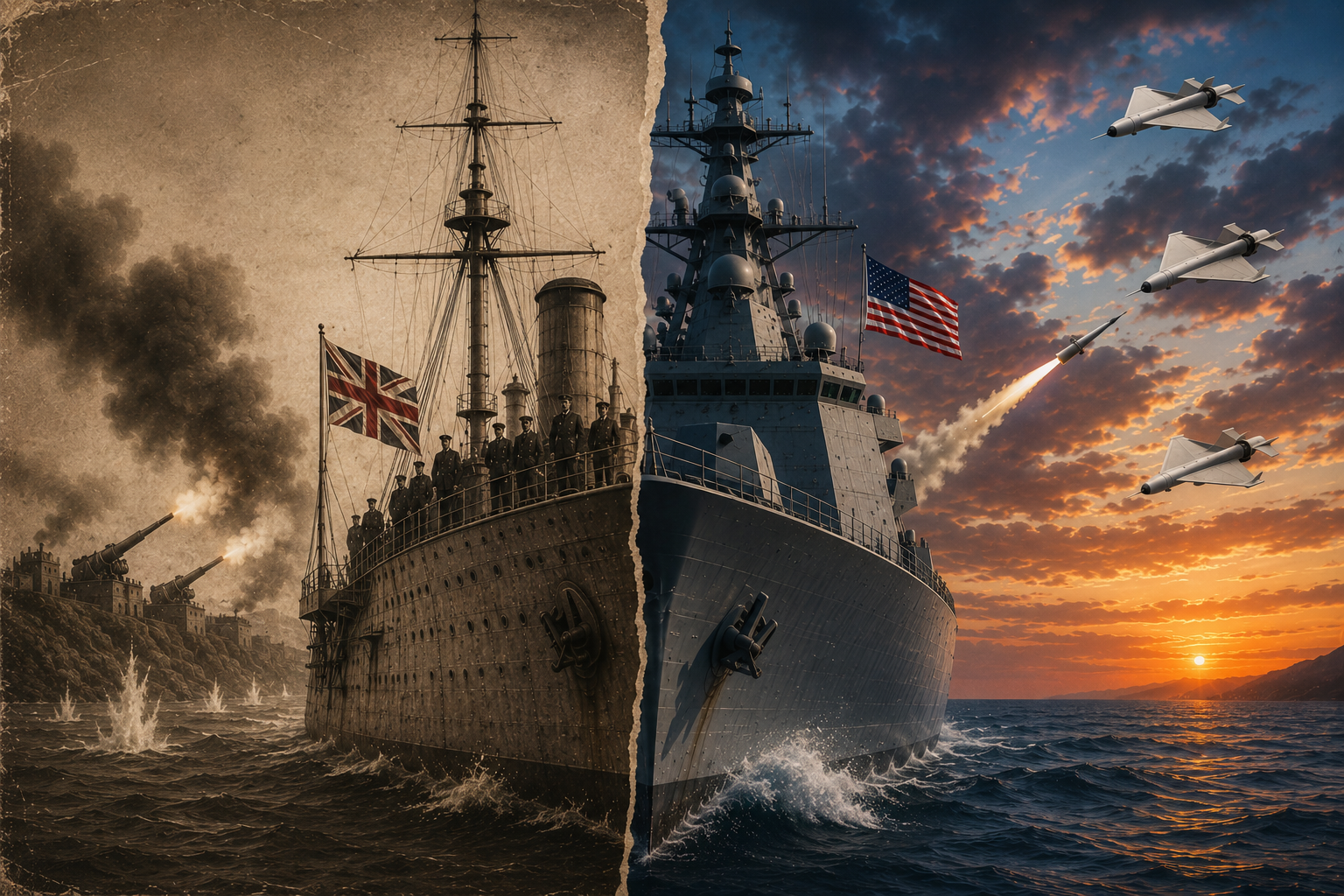
To some military historians, the situation rhymes remarkably with a conflict fought in another strait more than a century ago. The echoes of the Gallipoli Campaign, also a high-stakes gamble in a strategic chokepoint, carry lessons that have been reviewed and tested many times but now seem to have been disregarded in the decision-making process—a failure rooted in the systemic erosion of accountability.
In the wake of the Gallipoli defeat, accountability mechanisms drove structural improvement and lasting lessons. This led to better governance and several victories and achievements. However, the extent of systemic erosion of accountability in US decision-making has prevented meaningful self-auditing in many cases. Moreover, weakened accountability has prompted decision-makers to be less careful and more risk-prone. As a result, critical historical lessons, military simulations, and expert warnings have been ignored. This traps the US in a self-inflicted strategic dilemma and the world in highly disruptive global crises.
A Century-Old Precedent
The Dardanelles Strait, the site of the city of Troy and the Trojan War, is the only sea passage between the Mediterranean and the Black Sea and separates mainland Turkey from the Gallipoli peninsula. It is also where the 1915 Gallipoli Campaign played out.
In 1914, the principal Allied Powers in WWI were the British Empire, France, and the Russian Empire. They were engaged with the Central Powers: the German Empire, the Austro-Hungarian Empire, and the Ottoman Empire. Their main battlefield was the Western Front in Belgium and France. The British, relying on their superior naval forces, were joined by France and decided to force through the Dardanelles Strait to reach the Ottoman capital Constantinople. Victory would force the Ottoman Empire out of the war and provide a secure supply route to the Russian Empire.
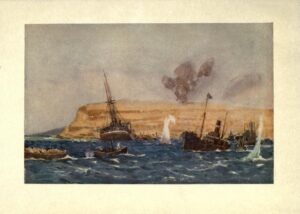
Figure 1: Allied warships maneuvering under Ottoman fire
Failed Naval Campaign
The Allied Powers planned an ambitious naval-only campaign aimed at the Dardanelles Strait. After the naval assault suffered the loss of several battleships and damage to many others, the Allied Powers decided to escalate. The campaign was expanded into a large-scale amphibious invasion of the Gallipoli Peninsula, known as the Gallipoli Campaign. For almost 11 months, Ottoman forces with the support of German officers denied passage and pinned down Allied forces, mainly British, French, Australian, and New Zealand troops. Nearly 46,000 British Empire soldiers and sailors alongside 12,000 French troops died. The Ottomans had around 57,000 official fatalities, though much higher figures are also cited. The campaign ended with the mass withdrawal of remaining Allied forces.
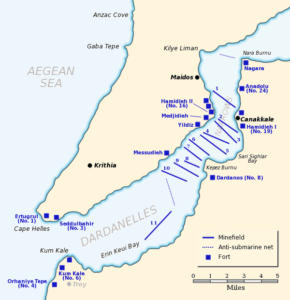
Figure 2: Map of Ottoman Defenses
In the aftermath of the campaign, many British politicians and military commanders lost their posts. Winston Churchill, the main architect and political force behind the campaign, lost his First Lord of the Admiralty position in the cabinet and was demoted to a less influential post.
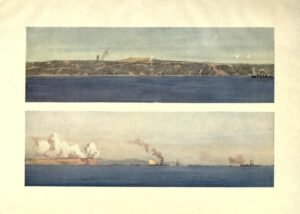
Figure 3: Naval bombardment of the Dardanelles during the Gallipoli Campaign
Lessons Learned
In 1916, the British Parliament passed special legislation and formed the Dardanelles & Mesopotamia Commission, vested with full legal authority by King and Parliament. The Dardanelles Commission was one of the earliest examples of a modern democratic state conducting a rigorous, self-critical inquiry into its own military failures while still engaged in war. The commission’s 1919 Final Report, with its two preceding reports, was comprehensive, inclusive, and detailed. The reports identified significant structural and operational deficiencies, highlighting inadequate preparation, flawed planning, and operational incoherence at various stages of the campaign. These findings prompted significant reforms in British military governance and reorganized the balance of authority between civilian leaders and military commanders. The findings and reforms played a significant role in shaping naval and amphibious military doctrines that were paramount in WWII.
Lessons from Gallipoli
Lt. Col. Patton, in his 1936 study titled The Defense of Gallipoli, analyzed the campaign and outlined critical lessons learned from specific failures. Although his goal was to find ways to fortify Hawaii’s defenses in the case of a naval and amphibious attack, he also outlined general defensive measures that could effectively utilize geography of the theater of war. Patton points out a defender’s advantages in a narrow sea passage and the effectiveness of asymmetric offensives as a measure of defense against a superior force.
In a 2015 Joint Force Quarterly article titled The Gallipoli Campaign: Learning from a Mismatch of Strategic Ends and Means, Lt. Col. Raymond Adams indicated that insight gained from the Gallipoli campaign shaped the Allies’ naval and amphibious campaigns in WWII and resulted in many successful operations. It is widely cited that the trauma of the Gallipoli campaign was a factor in British Prime Minister Winston Churchill’s opposition to the mid-1942 Cross-Channel attack, which was strongly supported by American generals. Instead, Churchill successfully advocated for focusing on peripheral targets, such as North Africa, Sicily, and Italy before launching a full-scale campaign on mainland Europe. His strategy ultimately paved the way for the 1944 Normandy landings on D-Day.
Millennium Challenge 2002
In 2002, the United States conducted Millennium Challenge 2002. It was the most expensive military exercise in US history with a $250 million price tag. The US did not officially name Iran as the adversary. However, the simulation was scripted as a conflict in the Gulf to control maritime routes and strategic islands. Retired Lt. Gen. Paul Van Riper was contracted to lead the opposing Red Team. Van Riper used asymmetric tactics, cruise missile salvos, swarms of small boats and launched a preemptive strike on the US fleet.
The exercise planners were shocked when the Red Team sank a large part of the US fleet, including an aircraft carrier, before the main forces could take part. The exercise director intervened by refloating sunken ships, restricting the Red Team’s firing abilities, and positioning its defensive assets in the open. Eventually, the Blue Team, representing US forces, achieved most of its campaign objectives.
Lessons Ignored
In September 2011, the Center for Naval Analyses (CNA) published Strait Comparison: Lessons Learned from the 1915 Dardanelles Campaign in the Context of a Strait of Hormuz Closure Event. The report warned that mine countermeasures represent one of the US Navy’s weakest capability sets. Furthermore, securing allies’ mine countermeasure capabilities is essential to a US campaign in the Strait of Hormuz. However, prior to the Hormuz conflict, the US administration not only ignored coalition building or consultation with traditional allies, but it had also decommissioned its Bahrain-based minesweepers less than a year earlier.
At the time of the 2011 report, Iran still possessed limited drone and missile capabilities, and analysts considered mines the primary maritime threat. Nevertheless, the report presented several important views: “U.S. civilian decision-makers must ensure they seek out and get the true professional opinions of their senior military experts. This sounds easy in principle; in practice, personalities and politics frequently get in the way.” The report also warned about the possibility for strategic failure, concluding that “it is entirely possible that Iran could emerge from a conflict in the Strait militarily weaker, but politically and strategically stronger, depending on how events played out.”
A few days after the US launched airstrikes against Iran’s nuclear facilities in June 2025, Jonathan Schroden, author of the above-mentioned 2011 CNA report, published a short and summarized update of his original report. His update ends with the following sentence: “Lessons from the Dardanelles can help ensure that today’s strategic chokepoint doesn’t become tomorrow’s strategic catastrophe.”
2026 Iran Conflict
On February 1, 2026, Iran’s then Supreme Leader, Ali Khamenei, warned that any US-initiated war would become a regional war. On February 17, 2026, less than two weeks before the attack on Iran by US-Israeli forces, Iran partially closed the Strait of Hormuz. The temporary closure occurred on the second day of a military exercise, openly code-named “Smart Control of the Strait of Hormuz.” The exercise involved drones, missiles from deep within the country, and fast-attack boats.
Despite documented reports and warnings, the US and Israel attacked Iran. On the first day of the strikes, US and Israel forces killed Ali Khamenei and a large number of senior military commanders. When Iran responded with missile and drone attacks on US assets, targeted regional allies, and closed the Strait of Hormuz, US and Israeli leadership appeared surprised and unprepared. Iran expanded the theater of war and launched persistent counterattacks while enduring heavy and continuous bombing. A strategy that follows a logic similar to Patton’s analysis and tactics similar to the Red Team used during the Millennium Challenge exercise.
Of course, there are profound geographic, navigational, and geostrategic dissimilarities that separate the Strait of Hormuz from the Dardanelles. The conflicts took place in entirely different technological, military, and geopolitical realities. However, both conflicts share several underlying characteristics that point to fundamental failures in the strategic decision-making process. Comparing key features of the two conflicts reveals a common thread.
Gallipoli and Hormuz
| Feature | Gallipoli Campaign (1915-16) | Hormuz Crisis (2026) |
| Strategic Objectives | Secure the Dardanelles Strait to supply Russia and force the Ottomans out of WWI. | Initial reported objectives: Decapitation of the Iranian regime and its military command; dismantling its nuclear, missile, and other offensive capabilities. The objectives have shifted throughout the conflict. |
| Shortcomings | Over-reliance on naval superiority, flawed intelligence and assumptions, poor tactical coordination, inadequate logistics and training. | Over-reliance on air superiority, assumption of swift leadership paralysis, lack of contingency plans, insufficient weapons replenishment turnover. |
| Strategic Misstep | Premature November 1914 Allied naval bombardment alerted the Ottomans, giving them time to expand naval mines and fortify defenses. | Earlier US-Israeli strikes in June 2025 prompted Iran to establish a clear succession plan. Additonally, Iran expanded its force distribution, and pre-delegate authority within a layered structure. |
| The “Mine” Problem | March 18, 1915: Ottoman mines sank three Allied battleships and damaged several others in a single day. This forced Allied Powers to halt the naval offensive and pivot to a full-scale amphibious landing. | Mines have restricted maritime navigation. Iran published a map designating a “danger zone.” This forced ships to use a corridor close to the Iranian coast while targeting vessels that stray from it. The US has since tried to establish a maritime corridor closer to Oman. |
| Ignored Factors and Miscalculations | Allied Powers expected a fragile resistance and overlooked Ottoman militarily reorganization after the Balkan Wars (1912–1913).
Overlooked geographic and asymmetric defensive advantages, proximity to supply, and motivation to protect the homeland. Allied Powers focused on stationary posts and underestimated mobile howitzers and searchlights. |
Underestimated Iranian resilience built through economic hardship, mismanagement, and the Iran-Iraq war.
Overlooked geographic defensive advantages, asymmetric defense strategies, and redundancies within government and military command. Underrated the scale of missile and drone stockpiles, coordinated attack effectiveness, dispersed launch sites, and hardened underground depots. |
| Scale | Arguably the largest naval and amphibious operation of its era. Throughout the war, hundreds of warships, several submarines, aerial reconnaissance airplanes, and 550,000+ Allied personnel took part. | Multiple regional bases. Three of the Navy’s four deployment-ready Carrier Strike Groups (out of a total fleet of 11). Two Amphibious Ready Groups, and the 82nd Airborne Division. |
| Global Consequence | Aggravated Russia’s supply crisis, widely regarded as a major factor in the collapse of the Russian Empire.
Became a defining moment in forging the national identities of Turkey, Australia, and New Zealand. |
Global inflationary effect due to the “double shock” of energy and fertilizer shortages. Further shortages of helium, aluminum, sulfur, and methanol.
Potential to become a defining moment in global fragmentation and geopolitical realignment. |
While the parallels are striking, the incoherence of the US-Israeli alliance introduces an additional layer of instability. Israel’s priorities are often incompatible with, and sometimes disruptive to, those of the United States. This discordance is further amplified by intense domestic political considerations and election pressure on both sides. In contrast, the Allies in WWII, despite their internal disputes, had unified command structures and shared strategic objectives that guided their decisions.
Failure Compounded
The war between the US and Iran did not conclude as quickly as the US expected. Its prolonged disruptive effects have been exacerbated by a lack of preparation and contingency plans. In the US alone, financial costs for consumers have been staggering. A $1 increase per gallon of liquid fuel (gasoline, diesel, and heating oil only) adds over $500 million per day in direct costs to US consumers and businesses. Additionally, not to mention, the cost of jet fuel and other petroleum products. Although the Treasury and Energy Secretaries were key players in the planning and execution of the conflict, interagency debates were sidelined and the potential for economic fallout from an Iranian response was deemed less important. Furthermore, the US State Department had already terminated a substantial number of Middle East experts and oil and gas staffers.
The US administration and advocates for direct military intervention argued that not attacking Iran posed greater long-term risks. Regardless of whether the threat calculus associated with Iran was sound, the insufficiency of preparation and lack of contingency plans for prolonged confrontation indicate separate and compounding failures in the decision-making process.
Legacy-Driven Mindset
In the epilogue of his recently published book, Inflection Point, former Biden administration Special Assistant for Strategic Planning Thomas Wright points to “hubris” and a legacy-driven mindset in the current administration. He argues that these attitudes were primarily caused by the perceived success of the June 2025 strike on Iranian nuclear sites and the ease of capturing Venezuelan leader Nicolás Maduro. Wright argues that this hubris and legacy-driven mindset encouraged the administration to roll the dice.
Be it due to wishful thinking, hubris, domestic political concerns, and/or outside lobbying, the decision to go to war with Iran has created global crises with no clear path to an acceptable resolution. Given the gravity of the decision to go to war, the present situation indicates flaws in the decision-making process rooted in the failure of accountability.
The Cost of Unheeded Lessons
Globally, the US-Israeli war with Iran resulted in crises on multiple fronts. More consequentially for the United States, it created a lose-lose dilemma. A choice between an unstable, ungovernable region that poses enduring regional hostility toward the United States. Or a strategic defeat that reshapes regional dynamics and weakens its sphere of influence. It is a situation that former director of the CIA, General David Petraeus, describes as America’s own strategic cul-de-sac. From which “any route has significant potential downsides.”
After the Gallipoli defeat, the British went through a painful review and restructuring period. The Dardanelles Commission ran a meticulous and inclusive investigation and identified several core problems. The inquiry focused on troop welfare as much as it considered structural, strategic, and tactical shortcomings. It was a significant act of institutional self-examination and prompted a profound restructuring and better governance.
However, after WWII and throughout the Cold War, ideological, political, and partisan concerns gradually influenced safeguard and self-correcting mechanisms. By the end of the Cold War, especially after 9/11, the systemic erosion of accountability accelerated. In recent years, accountability mechanisms have deteriorated to unprecedented levels. Perhaps this is what prompted King Charles III’s reference to checks and balances in his address to Congress, and J.D. Vance’s belief that “If Watergate happened tomorrow, it would be like a 12-hour news story.”
Ultimately, the parallels between Gallipoli and Hormuz reveal more than the enduring realities of geography and asymmetric warfare. The parallels offer a sobering reminder that when history ignores its costliest lessons, they do not disappear. They simply re-emerge at a far greater global cost.


