Commentary: Colombian Elections: Crossroads or Swing of the Pendulum?
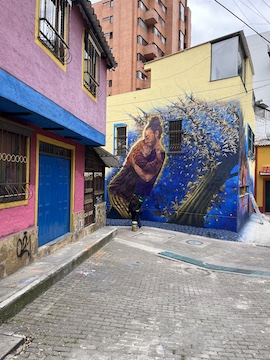

While calling a nation’s political moment a “historical crossroads” is a cliché, it may accurately capture the reality facing Colombia today. Another interpretation, however, is that the latest election represents a familiar swing of the pendulum back to the status quo ante. When Gustavo Petro was elected in 2022, he became the first leftist president in Colombian history. Though elected by a slim margin, his supporters held immense hope that the former revolutionary could transform the nation by delivering peace, social justice, economic prosperity, and ecological harmony. Unfortunately, that vision stalled under a combination of Petro’s own political ineptitude, an intransigent conservative legislature, and (in his view) external pressure from US President Donald Trump.
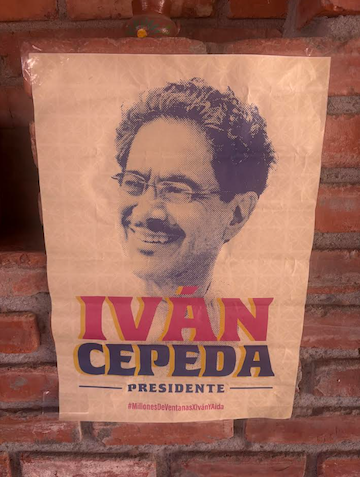
Campaign poster: Bogotá, Colombia. Source: Photo taken by author 29 May 2026, in Bogotá.
In the 31 May 2026, presidential election, Petro’s fellow leftist traveler, Iván Cepeda of the Pacto Histórico coalition (see Figure 1), polled strongly for months but ultimately lost to a relative newcomer: Abelardo de la Espriella. “Abelardo,” as he is widely known, cleverly manipulated modern media to project the image of a miracle-working, ultra-patriotic tough guy. Frequently sporting a cowboy hat and a Colombian national soccer jersey during the World Cup, his campaign closely mimicked the populist, right-wing style of El Salvador’s President Nayib Bukele. Abelardo framed himself as a brilliant outsider who would save Colombia from criminals and irresponsible leftists, restore order, and collaborate with the US administration to finally crush the powerful drug cartels and rebel armies threatening national sovereignty.
While short on policy substance, Abelardo’s campaign was long on marketing glitz and nationalistic slogans. His victory aligns with a broader rightward swing in Peru, Chile, Argentina, Ecuador, and El Salvador. Furthermore, his political direction mirrors the conservative agendas of past Colombian administrations under former Presidents Pastrana, Duque, and Uribe. Rather than a crossroads, this election likely represents continuity with previous conservative regimes—a reflection of the country’s inability to overcome deeply rooted historical problems.
In the long term, the structural issues that have sharply divided the nation since La Violencia—the bloody 1948–1958 civil war between Conservatives and Liberals that claimed 200,000 lives—remain unresolved. These enduring challenges include:
Pervasive Poverty: Extreme economic disparities continue to afflict broad sectors of the population, splitting the nation into “two Colombias:” a well-resourced, protected, urban center versus an underinvested, unprotected rural periphery.
Rampant Insecurity: Crime and violence remain daily realities for many citizens, especially those in the hinterlands and barrios where armed conflicts commonly occur.
Fragmented Sovereignty: Revolutionary groups like the Ejército de Liberación Nacional and remnants of the Fuerzas Armadas Revolucionarias de Colombia right-wing autodefensas (paramilitary self-defense groups), and drug cartels maintain a presence in one-third to one-half of Colombian territory. This seventy-year persistence of non-state armed actors highlights the inability of the Colombian elite, even with US backing, to solve the root causes of regional, economic, and social conflicts through military means.
Regional Instability: Friction with Venezuela’s ultra-left regime is compounded by the social and economic strain of hosting nearly three million poor Venezuelan migrants. However, this conflict has lessened as Abelardo attempts to appease Trump and hardline Secretary of State Marco Rubio, who drives US policy in the region.
Ecological Challenges: Global warming has produced severe droughts in Bogotá and elsewhere. Meanwhile, politicians, entrepreneurs, and citizens debate whether eco-tourism or renewed oil, gas, and mineral production represents the best path forward for Colombia’s economic and environmental future.
These dilemmas and challenges deeply polarize the electorate. Union-oriented working-class sectors, rural farmers, and the university-educated urban intelligentsia broadly support the left-of-center policies embodied by the Pacto Histórico (see Figure 2).
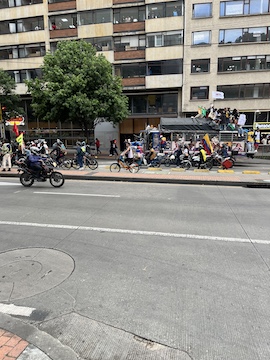
Figure 2: Pacto Histórico Rally in Bogotá, Colombia. Source: Photo taken by author 29 May 2026, in Bogotá.
Conversely, business elites, the ultra-wealthy, informal economy workers, conservative residents of violence-ridden rural areas, and law-and-order-obsessed urbanites back Abelardo and other reactionary forces closely linked to former hardline President Álvaro Uribe.
On the geopolitical stage, Colombia stands out. While far removed from the devastating wars in Ukraine and Iran, it is one of the few nations trapped in a protracted, multi-decade internal conflict. It is also uniquely distinct as the world’s largest cocaine producer, navigating the full spectrum of drug-related social problems from production and internal distribution to foreign exporting. President Trump has promised to help Abelardo combat drug trafficking, leftist revolutionaries, and Venezuelan threats. This assistance, including the bombing of suspected drug boats, continues a long trajectory of heavy-handed US intervention, previously emblematized by the military-heavy Plan Colombia and physically symbolized by the fort-like walls of the enormous US Embassy in central Bogotá. It also coincides with Trump’s overtly interventionist foreign policy. Meanwhile, China has emerged as a growing superpower meddling in Colombian affairs. Beijing is currently constructing Bogotá’s new metro system, expanding mining operations in ecologically sensitive areas, and aggressively investing across the country—reflecting its broader strategy of expanding economic dominance throughout Latin America.
Nonetheless, the US remains the dominant outside influence on Colombian affairs. Abelardo’s willingness to cooperate with the US hegemon, combined with his domestic politics of mano dura (iron fist) law and order, represents a swing of the pendulum back to well-worn conservative policies rather than a new direction. However, the recent deadly earthquake in Colombia serves as a stark reminder that the country’s future is unpredictable. Navigating it will require careful, well-informed leadership that avoids rigidly defending the status quo, kowtowing to heavy-handed US pressure, or relying on the poorly thought-out, improvised policies of self-defined “maverick” politicians.