





Review: Jack Watling’s State Craft
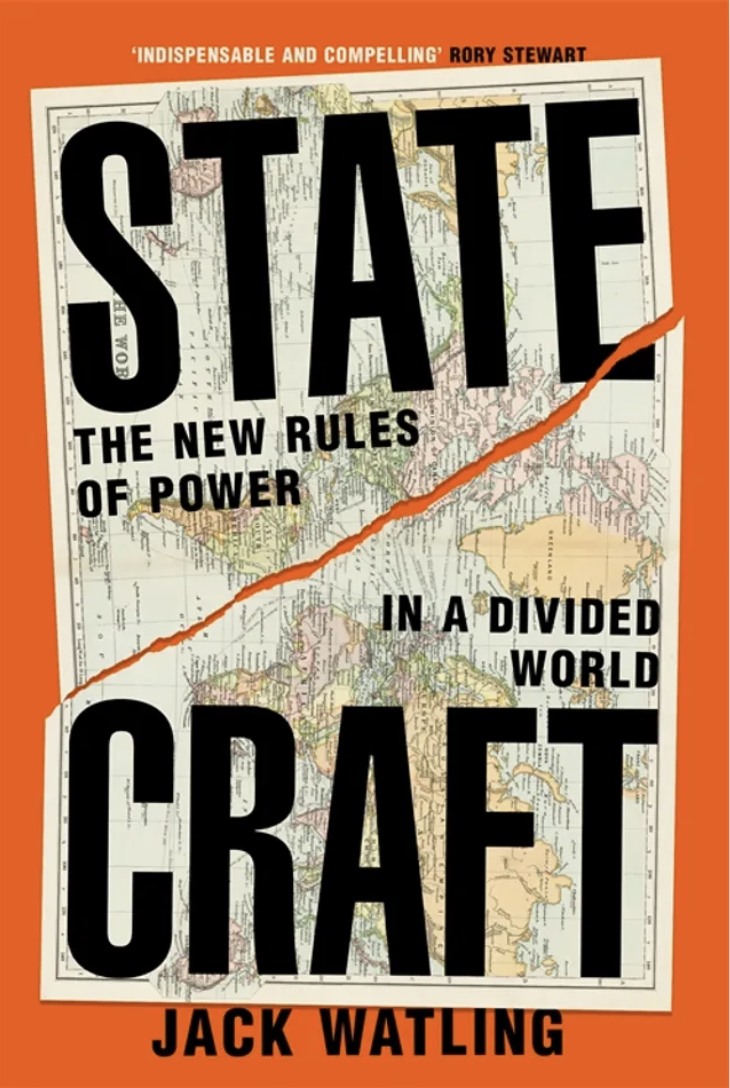

Statecraft: The New Rules of Power in a Divided World by Jack Watling, London: Macmillan UK, pp. 352, ISBN-10: 1035059037, $30.99
The rising complexity of today’s international security environment has led to increasing questions as to whether most countries’ strategic conceptualizations are adequate for responding to current and emerging threats. This debate has become particularly pronounced among Western governments and militaries. Statecraft, by Jack Watling, offers a fresh and very nuanced examination of developing national strategic approaches.
Dr. Jack Watling is a Senior Research Fellow for Applied Military Sciences at the Royal United Services Institute. He is probably best known for his extensive work on the Russo-Ukraine War, where he has conducted extensive field research, from the General Staff level to frontline operations. Statecraft is a much broader canvas for Watling, in which he surveys the current strategic environment and offers recommendations on how strategy can be improved:
“[The] central argument is that there is a fundamental flaw in the process of strategy development and implementation in NATO governments. Instead of trying to investigate the many facets of this problem, the book seeks to illuminate what it is that an effective strategic institution should be able to do. Furthermore, it is not focused on elucidating eternal truths about strategy but rather how these truths manifest in the present strategic environment. Thus, the book sets out to try to explore the dynamics shaping competition today and where within these dynamics states can exert leverage.”
The book is much too nuanced and detailed to completely cover in a brief review, but several topics are particularly prominent. In his chapter titled “Arms”, Watling discusses both equipment and troop capabilities. In many ways this reinforces the old adage of “amateurs talk tactics; professionals talk logistics.” Watling argues that there will almost inevitably be a tradeoff between capabilities – often very expensive – and mass with available assets. Even with the most capable high-tech equipment, quantity still matters.
Perhaps more critically, understanding how to synchronize available personnel and equipment to their maximum effectiveness is the basis for successful military operations. Watling offers a case study of a conflict that likely is unfamiliar to most readers – the 2020 war between Azerbaijan and Armenia – to illustrate this point. He concludes, “[t]he basis of the Azeri victory was that they fielded multiple capabilities against which the Armenians had no answer, used by a military with a clear plan and the training to execute it.” Using the Russian campaign in Ukraine as a case study, Watling argues, “[t]he critical questions that need to be asked are whether more resource means more effective strategy, how the necessary level of resources to produce a desired result are to be determined, and how quickly resources can be spent.”
As Watling describes in the next chapter, “Priorities”, this leads to the necessity to prioritize available resources. This of course becomes particularly complicated when there are multiple simultaneous situations of varying levels of concern that might require the use of military operations of whatever stripe. Therefore, as Watling states, “…the question is not just how a state can set priorities but also how it can hedge in sustaining lower priority lines of effort that can – unexpectedly – become urgently important at the most inconvenient of times.”
In his conclusions, Watling argues again that linear strategies are not the answer to current and future security threats: “The tendency when drafting strategies is to try to define either an objective, or a condition that is to be avoided, with the latter usually being less contentious than the former, without acknowledging the range of possible outcomes.” Instead, the “cone” of possible outcomes should be identified and then divided into “those that must be avoided, those that can be tolerated and those that are most desirable.” Essentially, governments and defense planners should focus on what is actually achievable.
He also notes it is important for strategists to note long-term trends: “Once the range of outcomes are identified it becomes possible to assess the current logic of the environment to establish whether time is trending on an unfavourable or favourable trajectory. In a real sense – and extrapolating from Watling’s discussion – even long-term strategy must be sufficiently flexible to shift as the strategic environment shifts. Watling also argues for the existence of “inflection points” that “…are moments of flux. They are not axiomatically favourable or unfavourable. But they represent moments when the factors underpinning the prevailing trend shift. And the means of pursuing the objective must shift with them.” In Watling’s view, Western governments, in particular, are not handling these well:
“The pattern of policymaking in many NATO members today is one of reactive crisis management…In essence, prior to an inflection point being reached there is no forcing function to bring a decision to policymakers. When the inflection point arrives, the issue suddenly moves to the top of the priority list and consumes government capacity at the expense of everything else, even though it is usually too late to do much except limit the disruption, at great expense. Strategy, by contrast, requires that decisions are made early.”
Statecraft represents one of the most interesting recently published treatments of national strategy. It is very nuanced theoretically, and Watling ties his analysis to the real world with relevant and interesting observations and case studies. Even those who might disagree with some of his observations and conclusions will find much to think about and to debate. As such, this is an important addition to strategic studies, and it is highly recommended.


