The Ground Station Gap: Why Arctic Space Power Runs Through Norway

A Changing Arctic
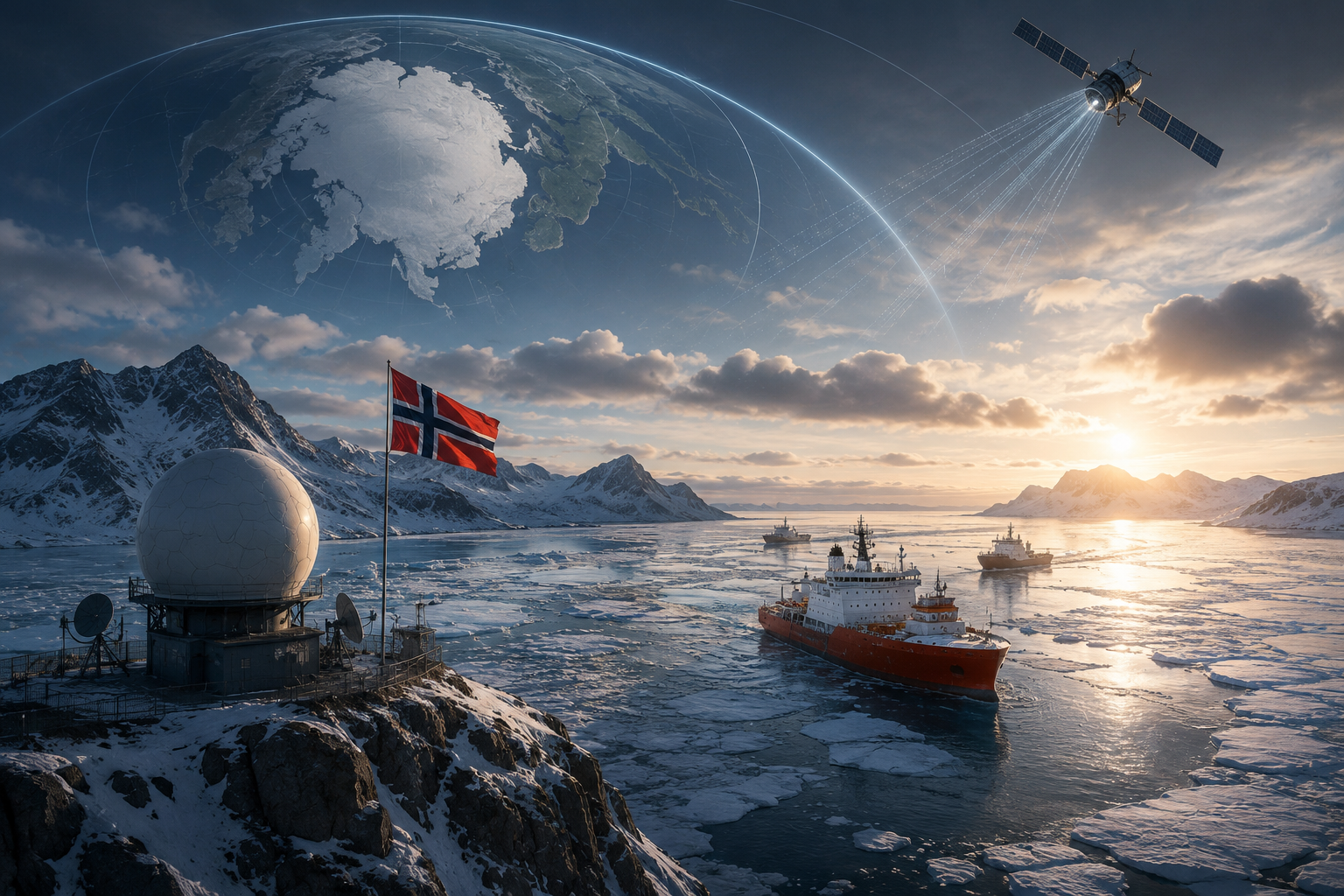
Over the last few decades, global warming has affected the Arctic more than any other region, with its eastern parts warming at nearly four times the global average. Because of higher temperatures and less ice, the Arctic has become easier to access and more contested, as retreating ice opens shipping lanes and seabed resources that have long been out of reach. As a result, there has become increased attention on the region, especially from Russia and China.
Russia has invested heavily along its Arctic coast and rebuilt several old Soviet bases, mainly to secure the Northern Sea Route (NSR), which cuts shipping time from Asia to Europe by around 40 percent. It now operates 13 air bases, 10 radar stations, 20 border outposts, 16 deep-water ports, and more than 40 icebreakers. Russia has also become increasingly assertive in the region, from placing a flag on the seabed at the North Pole in 2007 to pressing more expansive claims over Arctic governance.
China has taken a different approach. Beijing announced its Polar Silk Road project in 2018 and declared itself a “near-Arctic state.” The label carries no formal weight in international law but is a clear signal of Chinese intentions in the Arctic. China has also invested heavily in Arctic research stations, such as the Yellow River Station on Svalbard and the China-Iceland Arctic Observatory at Kárhóll, and in 2025, deployed five icebreakers to the Arctic at once for the first time.
These Arctic capabilities are important and have strengthened both Russia’s and China’s position in the region. Still, without polar-orbiting satellites, which circle the planet from pole to pole, they are vulnerable. That is why Russia has built space-based tools such as satellite reconnaissance, secure communications, and targeting support into its Arctic operations. At the same time, China has expanded its polar satellite program, from the Ice Pathfinder, a wide-view imaging satellite with a field of view larger than NASA’s or the ESA’s equivalents, to a planned synthetic-aperture radar constellation that can see through clouds and long polar nights to monitor the Northern Sea Route.
As activity in the Arctic grows, competition for influence and military advantage increasingly plays out in the space domain, where satellites provide everything from convoy routing, the organizing of ships, to missile warnings. However, the space domain runs through ground infrastructure at high latitudes, stations, launch sites, antennas, and radar that bring all the data down to Earth. As Rolf Skatteboe, the former CEO of Kongsberg Satellite Services (KSAT) said, without ground stations, satellites are just “space junk.”
The United States faces a high-latitude ground-station gap in the Arctic that more money cannot close. Norway already operates the launch sites, ground stations, and radar that polar-orbiting satellites depend on, and no other ally has that full capability. A dedicated agreement under the Supplementary Defense Cooperation Agreement (SDCA) would put infrastructure to work for American operations in the Arctic.
US Positioning
For decades, American Arctic strategy has lagged behind, giving Russia and China time to build up their presence in the region. The result is that the United States has one major base above the Arctic Circle, the Pituffik Space Base in Greenland, three operational icebreakers in the Coast Guard fleet, and limited high-latitude ground station capability.
The United States relies on a small number of antennas concentrated around Fairbanks in interior Alaska at 65°N, plus a single Arctic Circle site at Utqiagvik at 72°N. Fairbanks sits below the Arctic Circle, meaning antennas miss the highest passes, making Utqiagvik the only site with true polar reach. That poses a problem when polar-orbiting satellites are used for essentially everything the US military does in the region, such as communications, navigation, missile warning, command and control, and search and rescue.
This is not a money problem. The FY2026 Space Force budget request totals roughly $40 billion when reconciliation funding, money added through the congressional budget process, is included. That is more than double the $15.4 billion Congress appropriated in FY2021. The Pentagon’s 2024 Arctic Strategy acknowledges that the constraints are geographic. It states that due to limited legacy satellite coverage, the Department of Defense should improve tactical and strategic communications north of 65°N by pursuing technology through commercial partners and agreements with NATO allies and partners.
Norway as a Solution
Norway has been a reliable partner to the United States in the High North and a founding member of NATO since 1949. The 2021 Supplementary Defense Cooperation Agreement (SDCA), ratified by the Storting, Norway’s parliament, gave Washington formal access to Norwegian military facilities, with eight more sites added in 2024, bringing the total to 12. As the US State Department describes it, “The SDCA outlines the legal status of U.S. forces in Norway and provides the necessary authorities for U.S. forces to access specific Norwegian facilities and conduct activities for our mutual defense.”
Trust alone is not what makes Norway irreplaceable here. Norway runs the infrastructure chain that polar-orbiting space operations depend on such as commercial and military downlink stations that receive satellite data, launch facilities, and missile-warning radar that tracks launches and objects in space.
SvalSat, at 78°N, is the world’s largest ground station. It is so far north that it can downlink data from every pass of a polar-orbiting satellite, pulling data during the few minutes a satellite is overhead. The station sits on the Svalbard archipelago, where the 1920 Svalbard Treaty grants Norway sovereignty but limits the islands’ use to peaceful purposes. SvalSat’s data, however, is commercial and dual-use, which is why the station has operated for decades without serious controversy.
Tromsø satellite station, at 69°N, is KSAT’s main hub and can downlink data from polar-orbiting satellites on most orbits. Unlike SvalSat, it is not restricted by the Svalbard Treaty and can be used for military purposes.
Andøya Spaceport, also 69°N, is a launch site optimally positioned in the Arctic. Its open-sea corridor lets rockets fly north without crossing populated land, and its far-northern location suits sun-synchronous orbits, which cross each point on Earth at the same local sun time. No comparable launch site is available to NATO allies, whose other sites sit farther south or are not yet flying orbital missions. In April 2024, Norway and the United States announced a joint satellite station to be built at Andøya, the first of its kind outside the United States, designed to provide NATO with early warning against cruise missiles in the North.
Globus II and III, at 70°N and roughly 50 km from the Russian border, are critical radar stations equipped to surveil Russian intercontinental ballistic missile (ICBM) launches and objects in orbit. The system feeds data into the US Space Surveillance Network and is operated by the Norwegian Intelligence Service in cooperation with the United States.
The Arctic Satellite Broadband Mission (ASBM) was developed by Space Norway with contributions from the US Space Force and commercial partners. It became operational in 2024 and delivers secure broadband communications at high latitudes, closing a capability gap for both countries. It was the first time an operational US military payload flew on a commercial satellite operated by an international partner.
Why Isn’t a Partnership Further Along?
First: the International Traffic in Arms Regulations (ITAR). Export controls slow technology transfer and data sharing between close allies. Compliance overhead, license applications, technical data controls, and re-export approvals can make long-term investments hard to justify. Five Eyes, the intelligence-sharing arrangement among the United States, United Kingdom, Canada, Australia, and New Zealand, and AUKUS, the defense-technology partnership among the United States, United Kingdom, and Australia, show that ITAR can be loosened for trusted partners when there is political will. In 2024, the United States granted ITAR exemptions to the United Kingdom and Australia under AUKUS, removing licensing for most defense trade among them. A targeted exemption for an Arctic space partnership, anchored in the SDCA, would open the door to investment.
Second: classification. The United States imposes strict limits on intelligence and data sharing, which makes it harder to work with international partners. Space surveillance data is often held at clearance levels that allies cannot access, so partners end up duplicating sensors and analysis instead of sharing a common picture. Too often, the result is two organizations doing related work side by side instead of together.
Third: there is no dedicated agreement. The cooperation that exists today is unstructured and project-based. ASBM and the Andøya station were negotiated separately rather than under a single standing framework.
Building an Effective Partnership
A proposed working US-Norway Arctic space partnership requires five things, roughly in this order of priority.
First, a dedicated cooperation agreement, anchored in the SDCA, covering launch access, ground station use, data sharing, and cost allocation. The 2024 inclusion of Andøya in the SDCA expansion is an obvious starting point since it already grants US forces formal rights of access and use, so the legal groundwork for shared space infrastructure exists.
Second, and most important for operations, is the formal integration of Norway’s space infrastructure into US Arctic space operations. SvalSat, Tromsø, and Andøya should be treated as part of the Space Force’s standing operational capability, not as commercial options contracted one job at a time. The cooperation already underway at Andøya and through ASBM is a leading model, since it already pairs Norwegian infrastructure with a US payload under shared governance. Still, cooperation needs a standing framework, a multi-year agreement with pre-agreed access, funding shares, and a regular joint exercise, so that each new project does not require renegotiating the relationship.
Third, a shared classification framework to improve situational awareness in the Arctic. A framework that details which data is shared at what level, and through which channel. This could be drawn from the Five Eyes model and existing NATO arrangements such as the NATO Space Centre at Ramstein and the alliance’s Battlefield Information Collection & Exploitation Systems (BICES) intelligence-sharing network.
Fourth, future budgets should fund joint Arctic ground infrastructure, antennas, ground stations, and radar that make high-latitude coverage possible. The United States should stop building sites that are limited by latitude. Investing together in Norwegian facilities with agreed-upon access provides greater immediate capability than starting from scratch elsewhere, since a new station at a comparable latitude would take years to build and qualify.
Fifth, the United States and Norway need a clear position on dual-use space activity, meaning systems that serve both civilian and military purposes, under the Svalbard Treaty. The 1920 treaty and its restrictions apply only to Svalbard itself, SvalSat included. The focus should be on expanding mainland sites that the treaty does not restrict, and the Svalbard Treaty should not hold back investment in Andøya, Tromsø, and the rest of the infrastructure on the mainland.
Conclusion
The Arctic is heating up, and adversaries have had a decade-long head start. Closing the gap quickly matters because ground stations take years to build and qualify, and every year of delay leaves the United States dependent on ad hoc agreements, not guaranteed access. The cooperation between Norway and the United States is real but unstructured. The ASBM, Globus radars, and Andøya satellite station are all projects built individually, project by project. The infrastructure is already in place, the alliance is durable, and the 2024 inclusion of Andøya in the SDCA marks the obvious starting point. Both countries would gain, and the result would be a more credible position in the Arctic against Russia and China.