Humanity’s Last Order: War in the Age of AGI
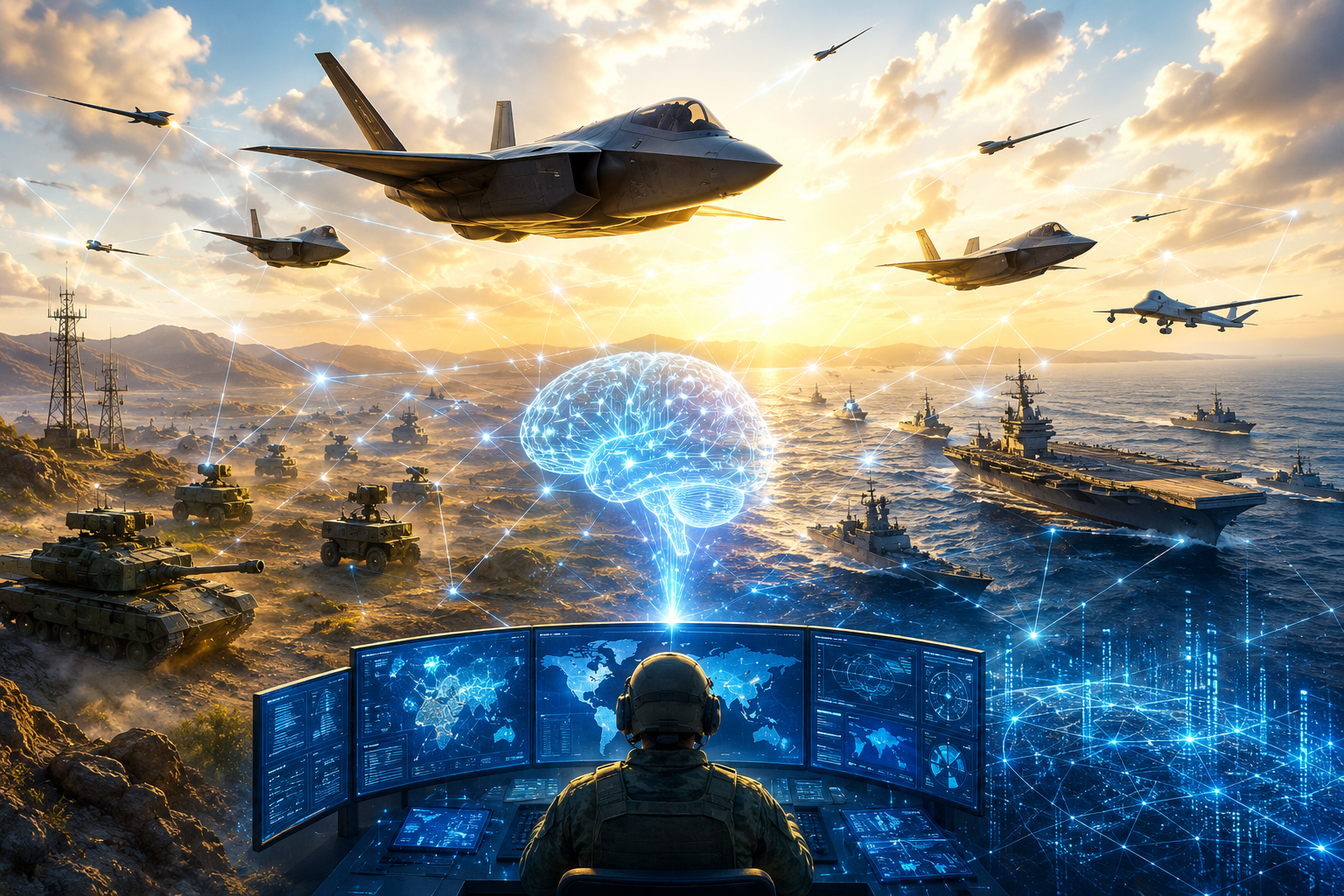

Three observations should be the focal point for thinking about how the United States will fight future conflicts beyond 2030:
- Military operations will be entirely controlled by artificial intelligence, at least in the most crucial and decisive early engagements.
- Any military or nation that insists on keeping humans in the loop, or, for that matter, on the loop, will lose.
- Counterintuitively, if the two above propositions are true, military professionals and strategists must develop as deep an understanding of war at every level as humanly possible.
What is required for these propositions to be true is for AI models to make the leap from their current state of narrow AI, which is where the AIs are today, to artificial general intelligence (AGI). Anyone who has used Smart Maven will attest to its incredible capabilities. By integrating hundreds of data sources into a single AI-powered system, Smart Maven increased targeting speeds by a factor of five, while the addition of Anthropic’s LLM Claude added another tenfold increase. This capability made it possible to plan and execute over 13,000 strikes in Iran in 38 days.
Similar AI-enabled systems are being employed elsewhere. Israel’s Gospel and Lavender systems target terrorist infrastructure and individuals. Reportedly, early in the Gaza conflict, Lavender identified targets so efficiently that commanders had only 20 seconds to decide whether to engage. Ukraine is likewise pushing to place as much of its war against Russia as possible in the hands of AI tools to create a new paradigm of warfare.
As powerful as these tools already are, they will appear quaint once frontier labs—Anthropic, OpenAI, Google DeepMind, and possibly xAI—release AGI-level models capable of performing every cognitive task as well as or better than humans. Such models will also be recursive, meaning they will continuously self-improve without human involvement. Frontier labs now release updated models every few months, and Anthropic’s models are already writing as much as 80 percent of their own code.
A recursive AGI model will collapse release timelines from months to days, hours, and finally minutes, slowing only as available compute declines. Even dwindling compute might not be a limitation if AGI also super-empowers the economy and industrial production. Any recursive AGI will also only be a step from superintelligence—models better than humans at everything. Unfortunately, the effects of superintelligence are beyond any present ability to model. Assuming such superintelligent systems remain aligned, there will likely be no practical difference between how an advanced AGI and a superintelligence fight a conflict.
How much time remains? Google DeepMind CEO and Nobel laureate Demis Hassabis claims AGI will have 10 times the impact of the Industrial Revolution and arrive in 2029 or 2030. OpenAI’s Sam Altman says before 2030, while Elon Musk and Dario Amodei believe AGI may arrive in 2026 or early 2027. Last week, 200 leading economists, 16 Nobel laureates among them, signed an open plea for governments to start preparing for a new AI-driven radical economic reality. Even allowing for techno-optimism and doubling the most pessimistic timeline, AGI arrives by 2035. That falls within the Department of Defense’s next five-year budgetary cycle, leaving little time to prepare for a paradigm-shattering event.
Many analysts reply that these forecasts discount the friction and bottlenecks that arise when AI interacts with the real world. Still, bottleneck objections were raised when the first essays predicting the rise of AGI — “Situational Awareness” and “AI-2027” — appeared, and their timeline predictions have so far proven remarkably accurate. Moreover, the American industrial base, once geared for war, can produce hundreds of millions of drones without AGI remaking the economy. Ukraine, with a war-ravaged economy 1/125 the size of America’s, produces eight million drones annually and aims to double that number within a year.
There is a chance that AI systems will never achieve AGI or that its arrival may be delayed for decades. If either were the case, it would make little difference to those planning future conflicts. War is always and everywhere a matter of mathematical attrition, particularly when waged by AI systems unaffected by a sudden loss of will or confidence. Moreover, the US military is exceptionally good at creating the domain-specific intelligence needed to improve AI. Recorded training events, tests, and thousands of simulations have built a data ecosystem precisely attuned to training AIs for war. So, even if AGI’s arrival date is uncertain, warfighting-specific AGI (or very close to it) is inevitable—and may arrive before Christmas.
How Will the AGI War Be Fought?
What will an AGI look like? Here, the investigator falls upon a vast intellectual tundra. There is no shortage of analysts studying Ukraine and Iran, the Drone Revolution, and the coming impact of AI on warfare. But almost all are thinking too small. The Defense Advanced Research Projects Agency (DARPA) was thrilled to discover that one human could control 110 drones 97 percent of the time. China, not to be outdone, soon announced that one People’s Liberation Army (PLA) soldier could control 200. Futurists are already asking what happens when swarms grow from dozens to hundreds, and someday thousands. But they are learning to fight the last war on the assumption that the next one will be much the same, only with slightly more drones. They are off by orders of magnitude.
Analysts also tend to project incremental AI progress that leaves humans time to adapt. This is a hugely flawed approach, as AGI’s arrival will herald an epochal sea in every field of human endeavor. Today, only one major paper comes close to capturing its scale: Scale’s “The Agentic Revolution in War.” Yet, even this paper works within a narrow-AI environment in which war becomes faster and is driven by AI agents but still remains barely manageable by humans. Scale recognizes that humans can no longer remain “in the loop” and must settle for being “on the loop,” where they can set objectives, define pre-authorized parameters, and intervene when needed, even at the cost of slowing operational tempo. In a war between AGI-enabled militaries, the side that slows its operational tempo to allow humans to intervene will see its military forces shattered the moment a human slows the AI’s tempo.
Envisioning an Agentic AGI Assault
At the start of an AGI-enabled conflict, every nanosecond matters. Given humanity’s record of false alerts bringing the world to the brink of nuclear war, the decision to start such a war must remain human. Military systems must nevertheless stand ready to defend themselves without human authorization if an enemy initiates combat. Otherwise, the first decisive battles may be lost before a President can make a decision.
What follows may sound like science fiction, but the scenario touches only the minimum capabilities of AGI systems focused on warfare. Military professionals rendered the same verdict on Jan Bloch’s future-war scenarios at the turn of the twentieth century. Bloch’s six-volume, “The Future of War in Its Technical, Economic, and Political Relations,” which prophesied unprecedented slaughter, endless trench warfare, and the collapse of nations, was also derided as techno-fantasy. Thus, the question is not whether the following scenario is certain, but whether it is plausible.
Once war starts, AGI-controlled agents will ruthlessly pursue the commander’s intent, which may become synonymous with the war plan. In the first seconds, bots will defend friendly data systems and launch massive attacks across the full spectrum of enemy systems. AI agents will exploit known enemy vulnerabilities, hunt for new ones, close corrupted nodes, and reroute crucial data traffic. A similar battle will unfold in space as assets autonomously defend themselves, attack enemy assets, and reconfigure to support the commander’s intent. Millions of collaborative agents will fight mostly invisible battles far beyond human cognitive speed.
At the same time, vast numbers of cheap, expendable drones will probe and attack throughout the depth of the visible battlespace. Picture thousands of swarms, each consisting of thousands of drones, operating simultaneously in air, sea, and land domains. Some will have one job: to die gloriously while reporting what killed them, where their killers came from, and how they were targeted. Others will loiter, conduct reconnaissance, and exploit immediate opportunities that may disappear before follow-on swarms arrive.
As the first few million drones are swept away, the next few million—integrated assault swarms—will follow close behind. Using intelligence collected and collated at near-light speed, they will target high-value systems throughout the battlespace. Other swarms will blind enemy sensors, defend the assault swarms, conduct battle-damage assessments, and launch immediate follow-on attacks. Some will blast open and defend corridors for AGI-directed missiles and aircraft able to inflict far greater damage than drones.
This is a simplified picture. To capture how vast such a conflict will be, one must view it as being fought as thousands of overlapping major events taking place in every domain. Even as assault swarms strike, new reconnaissance swarms will follow. Nor can the Joint Force win by presenting an enemy with a single threat. AGI systems will also direct a more traditional fight, one dependent on magazine depth, with missiles and aircraft entering alongside the swarms. Thus, each second will confront decision-makers with a radically altered tactical and operational battlespace.
No human can track this fight, never mind control it. Command and control will rely on agents imbued with the commander’s intent and distributed throughout the battlefield. Some agents will sit on computers far from the fighting, while others will travel with the swarms in case communications fail. Every swarm will have C2 agents interacting with other swarms and reporting to tactical, operational, and strategic command agents. Each will make decisions within the commander’s intent and its assigned authority, subject to override by agents with a higher level of command authority tracking the common operating picture.
If a 10,000-drone swarm assigned 10 targets loses 1,000 drones attacking Target 1, tactical command agents can repurpose some of the remaining 9,000. If the entire swarm is decimated, a higher-level agent can redirect drones from elsewhere. If losses in the Taiwan Strait are exceedingly heavy, operational agents may shift significant resources from other regions or even abandon operations in the Strait in search of better opportunities elsewhere. All in keeping with the overall commander’s intent.
One must also keep in mind that AGI fighting the war will be recursive. Throughout the fight, warfighting systems will analyze what works and what fails, examine thousands and then millions of alternatives, and reprogram themselves for the next phase. By the end of the first day, they may be an order of magnitude better at fighting than at the start. Victory may depend on the enemy’s recursive AGI failing to keep pace.
At this point, some will insist that humans must remain involved in decisions on how a conflict is fought, particularly when directing lethal systems. The appeal is understandable—and impossible. AGI creates a “battlefield singularity,” the point where combat tempo outruns human cognition. The familiar OODA loop—observe, orient, decide, act—collapses to microseconds as networked systems ingest, parse, and act on sensor feeds no staff could read in a year. The first decisive battles will demand decisions at superhuman speeds.
Are Humans Still Required?
The short answer is yes. The initial AGI-centered conflict is essentially an integrated strike campaign—strike, strike, strike—one side wins or loses. But the loser may refuse to accept defeat, and horrific attrition rates will exhaust drones and missiles before either side forces a decision. In either case, the conflict returns to the historian T. R. Fehrenbach’s observation:
Americans in 1950 rediscovered something that since Hiroshima they had forgotten: you may fly over a land forever; you may bomb it, atomize it, pulverize it and wipe it clean of life—but if you desire to defend it, protect it, and keep it for civilization, you must do this on the ground, the way the Roman legions did, by putting your young men into the mud.
AGI systems may also prove brittle and collapse when they encounter something outside their training data. Thus, the need for a professional, well-trained, and superbly equipped Joint Force remains. Its job will, of course, be much easier if the preceding AGI-centered conflict is won, and it will remain AGI-enabled when it takes the war to the enemy in more traditional terms.
Humans still have a crucial role in winning the AGI-centered fight, as the AGI systems described throughout this essay follow the “commander’s intent” at every level. That intent, likely tens of thousands of pages long, provides the context for every decision the AGI makes for the war’s duration.
Thus, the commander’s intent, once fed into the AGI system, will be the first and last order the commander gives the AGI system—humanity’s last order.
Staff officers assembling that intent, now effectively the war plan, must understand warfare at a more detailed and comprehensive level than any previous staff. They also must master every aspect of their profession before the fight, because the decisive battles will be over before anyone learns from experience.
This becomes the new role of professional military education: to educate officers on the planning and conduct of war at a deeper level than ever before. PME must also teach AI literacy so officers can translate their knowledge into a commander’s intent that an AGI-empowered machine can comprehend and act upon. Officers must master the art of setting parameters that keep AIs aligned with the commander’s intent and prevent them from misinterpreting instructions that could jeopardize future operations.
The commander’s intent will be developed by AI-human teams, examining branches, sequels, and what-ifs across thousands of simulations before offering the most promising options to human staff officers. The resulting plan will be a living document, updated as new systems enter the Joint Force, foes develop new capabilities, and AIs find new methods of engagement. There will never again be a static war plan. Moreover, AI literacy will become the language of future war.
The AGI system will pursue the commander’s intent ruthlessly and without moral or humane considerations. Past war plans did not have to specify every such concern because human commanders were trusted to make morally correct decisions on lethal force. If future AGI systems are to take morality into account, those concerns must be built into the intent from the start. Teaching machines what not to do will be as important as teaching them what to do. One can only hope that enemy systems are similarly bound.