The Cost of India’s Calibrated Neutrality in the Iran War

Introduction
When the United States (US) and Israel launched their war against Iran on 28 February 2026, most regional and extra-regional powers were forced to declare, by word or by deed, where they stood. India chose a third path. It neither condemned the attack on a country with which it claimed a civilizational friendship nor endorsed the campaign waged by two of its closest strategic partners. New Delhi issued carefully worded appeals for restraint, made selective phone calls, and waited for the storm to pass. This was not silence in the literal sense. It was something more revealing: a calibrated pattern of speaking when the interests of one side were harmed and staying quiet when the other side burned.
The war’s endgame remains unfinished. The Islamabad Memorandum, signed by the American and Iranian presidents on 17 June 2026, formally set out a 14-point framework for ending the war, reopening the Strait of Hormuz, and negotiating a final deal within 60 days. That framework is now faltering: after renewed exchanges of strikes in early July, President Trump declared the ceasefire “over”, even as his negotiators kept the door to talks ajar. Yet whether the truce collapses or is rescued, the strategic ledger of the war is already legible, and the region is taking stock of who stood where during its most consequential conflict in a generation. India will not escape that audit. This analysis argues that New Delhi’s calibrated neutrality rested on a flawed assumption: that Iran would lose quickly, as multiple analysts have observed, and that the costs of ambiguity would therefore be temporary. Iran did not lose. It survived, negotiated, and emerged with its statehood intact. The Iranians, the Gulf capitals, and the wider Global South have all taken note of India’s conduct, and the bill for that conduct has not yet been presented. But it will be.
An Architecture of Dependence
To understand what India placed at risk, one must first appreciate what it had constructed. Over two decades, New Delhi transformed its relationship with the Gulf from a transactional exchange of labor for energy into one of the most sophisticated partnership networks in its foreign policy. The Gulf Cooperation Council (GCC) states became, in the language of Indian diplomacy, the country’s “extended neighborhood,” anchored by strategic partnership councils with Saudi Arabia and the United Arab Emirates (UAE), a landmark trade agreement with Abu Dhabi, and the ambitious India-Middle East-Europe Economic Corridor.
The human and economic foundations of this architecture are formidable, and they cut both ways: the deeper the partnership grew, the deeper India’s dependence became. More than nine million Indians live and work in the Gulf, and their remittances, roughly 38 percent of India’s total inflows, amounted to over $51 billion in the last financial year. India imports nearly 85 percent of the crude oil it consumes from abroad, and a substantial share of those imports transits the Strait of Hormuz. Remittances from the Gulf corridor have financed roughly 42 percent of India’s merchandise trade deficit over the past decade. Few major economies are as structurally dependent on the stability of the Gulf as India.
Iran occupied a distinct place in this design. The Chabahar port project gave India its overland gateway to Afghanistan and Central Asia, bypassing Pakistan. Tehran and New Delhi spoke of civilizational ties, and Indian diplomats cultivated this relationship precisely because it demonstrated strategic autonomy: India could be close to Washington, Tel Aviv, Riyadh, and Tehran simultaneously. That claim was always going to be tested. The war of 2026 was the test, and India’s answer has left every one of those partners with questions.
Energy Security and the Gulf Trade Lifeline
The economic relationship between India and the six GCC states deserves closer examination, because it defines the scale of India’s exposure. Today, the GCC is India’s largest regional trading partner. Bilateral trade reached $178.7 billion in 2024-25, around 15 percent of India’s total global trade, up from $161.8 billion the previous year. The composition of that trade tells its own story: Indian exports to the bloc stood at $57 billion while imports climbed to $121.7 billion, a structural deficit driven overwhelmingly by hydrocarbons. India runs its largest bilateral deficits with the UAE, Saudi Arabia, and Qatar, all rooted in energy purchases. Momentum was building rather than slowing: on 5 February 2026, barely three weeks before the war began, India and the six GCC states signed the Terms of Reference to resume negotiations on a comprehensive Free Trade Agreement after a pause of nearly two decades.
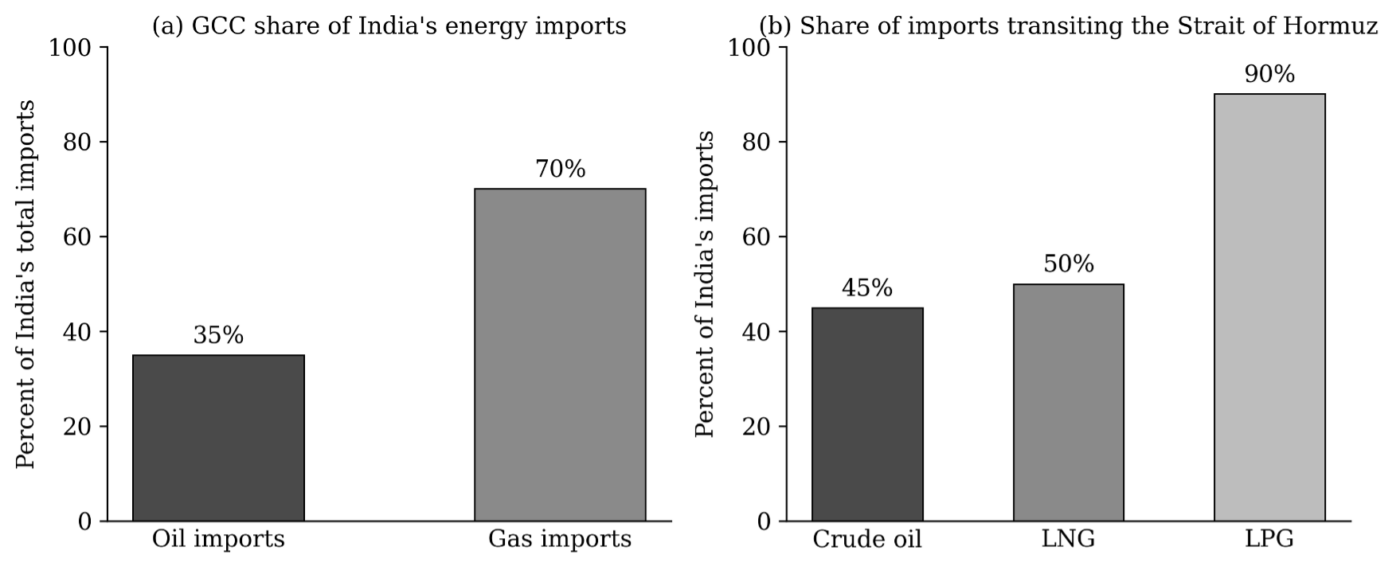
India’s dependence on the Gulf is starker still in the energy dimension than in the trade balance. According to India’s own parliamentary Standing Committee on External Affairs, the GCC supplies around 35 percent of India’s oil imports and 70 percent of its gas imports. Qatar anchors India’s supply of liquefied natural gas (LNG); Saudi Arabia and the UAE, its crude basket; and Gulf sovereign wealth is increasingly embedded in Indian infrastructure, energy, and technology. Nearly all of this is hostage to a single chokepoint: roughly 45 percent of India’s crude imports, half of its LNG, and 90 percent of its liquefied petroleum gas (LPG) transit the Strait of Hormuz. Table 1 and Figure 1 summarize the structure of these dependencies and the routes on which they rest.
Table 1. India’s Energy and Trade Relationships with the GCC States and Iran
| Partner | Energy role in India’s supply | Trade relationship | Principal route and exposure |
|---|---|---|---|
| GCC (bloc) | Around 35 percent of India’s oil imports and 70 percent of its gas imports | $178.7 billion bilateral trade in 2024-25 (about 15 percent of India’s global trade); imports of $121.7 billion against exports of $57 billion; FTA Terms of Reference signed 5 February 2026 | Strait of Hormuz |
| Saudi Arabia | Among India’s top crude suppliers; Strategic Partnership Council | Bilateral deficit of $18.4 billion (2024-25), rooted in crude purchases | Ras Tanura via Hormuz; partial Red Sea alternative via Yanbu |
| UAE | Major supplier of crude and refined products; partner in India’s strategic petroleum reserve | Comprehensive Economic Partnership Agreement (2022); bilateral trade above $100 billion; deficit of $26.8 billion (2024-25) | Hormuz; Fujairah offers a partial bypass |
| Qatar | Anchor of India’s LNG supply under long-term contracts | Bilateral trade of roughly $20 billion; deficit of $10.8 billion (2024-25) | Strait of Hormuz, with no bypass for LNG |
| Kuwait | Significant crude supplier | Energy-dominated import relationship | Strait of Hormuz |
| Oman | Crude and LPG supplier; hub for route diversification | Comprehensive Economic Partnership Agreement (2025); Sohar, Salalah, and Duqm ports | Outside Hormuz; India’s principal wartime workaround |
| Iran | Major crude supplier until 2019, when imports halted under US sanctions; gatekeeper of Hormuz | Chabahar port and the International North-South Transport Corridor anchor India’s connectivity to Afghanistan and Central Asia | Controls the Hormuz chokepoint through which Indian energy flows |
Figure 1. India’s Gulf energy dependence: (a) the GCC’s share of India’s oil and gas imports; (b) the share of India’s crude, LNG, and LPG imports transiting the Strait of Hormuz (PRS Legislative Research; The GCC Edge)
 The war converted this dependence from an abstraction into a national emergency. When Iran closed the Strait, the Indian government was forced into crisis management on a scale unseen since the 1990 Gulf War, invoking the Essential Commodities Act through a Natural Gas Control Order to ration supplies and protect priority sectors, scrambling to reroute crude purchases away from Hormuz, and running refineries above capacity while sourcing oil from an expanded list of suppliers. That a war India refused to take a position on could compel emergency rationing of cooking gas in Indian cities is the clearest possible demonstration of the gap between India’s economic stakes in the Gulf and its political influence over the region’s security. A state with $178 billion of trade, nine million citizens, and two-fifths of its energy imports riding on Gulf stability had every material justification to be at the center of war termination diplomacy. It chose the periphery.
A Visit That Changed the Optics
There was nothing inherently controversial about an Indian prime minister visiting Israel; the controversy lies in the timing, which appeared damning in retrospect once the war began. On 25 and 26 February 2026, Prime Minister Narendra Modi paid a state visit to Israel, addressing the Knesset, upgrading bilateral relations to a special strategic partnership, and signing a package of defense and technology agreements. Barely 48 hours after he departed, American and Israeli aircraft struck Iran, killing Supreme Leader Ayatollah Ali Khamenei in the opening wave.
The sequence set off intense speculation. Was Modi briefed on the coming assault? Israeli officials insisted the final decision had not been taken during his stay, and there is no evidence that India had foreknowledge. But in strategic affairs, perception often matters more than fact. Washington had spent the preceding weeks building up a vast array of military assets in the Arabian Sea, and by the eve of the visit, observers were openly anticipating that strikes would begin as soon as Modi departed. New Delhi chose to proceed with the visit anyway. As analysts observed, whatever the intent, the sequence created the impression that India had aligned itself with the US-Israel camp on the eve of a war against a country it called a friend. Netanyahu’s framing of a new “hexagon” of alliances with India at its center, announced days before the visit, only deepened that impression across the region.
Indian commentators sympathetic to the government have argued that the visit demonstrated, rather than eroded, India’s strategic autonomy, pointing to India’s parallel engagement with Arab states and the Palestinian leadership in January. That defense had merit on paper, though it collapsed in practice the moment the bombs fell, because autonomy that cannot be exercised at the decisive moment is indistinguishable from alignment.
Selective Silence in Practice
India was not ignorant of the war, and it was not entirely mute. The record shows a government that spoke frequently but asymmetrically. The Ministry of External Affairs (MEA) urged all sides to exercise restraint and prioritize civilian safety. Modi telephoned Gulf rulers, condemning strikes on their territory and violations of sovereignty, though pointedly without naming Iran as a victim of the same. Notably, his first call after the strikes went to the UAE, before Israel, a signal of where India now looks for its regional cues. India condemned Iranian retaliation against American bases while offering no comparable words about the far larger campaign against Iranian cities. It declined to condemn the killing of Khamenei, sending its Foreign Secretary to sign a condolence book only days later, and quietly dispatched medical aid to Iran even as it summoned the Iranian envoy over incidents affecting Indian shipping near Hormuz.
The most damaging episode was the sinking of the Iranian naval vessel IRIS Dena. The ship had been invited by India itself to the MILAN naval exercise at Visakhapatnam and was attacked by an American submarine after departing. New Delhi’s response was a study in evasion: slow, minimal, and devoid of protest or regret, with officials eventually suggesting that the vessel’s official invitation had technically lapsed. A state that could not muster a word of objection when a guest of its own navy was destroyed sent an unambiguous message about the limits of its independence. When conspiracy theories about Indian complicity circulated, the MEA was reduced to publicly denying any role in the war, a defensive posture that itself illustrated how badly the narrative had escaped New Delhi’s control.
This is why “silence” is an imprecise charge and “selective silence” a precise one. India’s voice was present throughout the war. It was simply distributed according to a hierarchy of relationships in which Iran ranked last among the parties India claimed to value.
The Assumption That Iran Would Lose
Underlying this calibration was a strategic wager. Like Washington and Tel Aviv, New Delhi appears to have assumed that Iran would be defeated quickly and decisively, that the Islamic Republic might not survive the decapitation of its leadership, and that India could therefore afford to absorb short-term Iranian resentment because there might soon be no Iranian state capable of holding a grudge. On that logic, hedging toward the probable victors was rational. Diplomatic capital spent defending Tehran would have been wasted on a losing cause and would have antagonized the partners who mattered for India’s economic and technological future.
The wager failed. Iran absorbed six weeks of bombardment, closed the Strait of Hormuz, retaliated across the region, and then negotiated an end to the war on terms that preserved its sovereignty and its negotiating dignity, culminating in the Islamabad Memorandum of June 2026. The implementation of that accord has since faltered, but its collapse would not alter the central fact: the Islamic Republic outlasted the campaign that was meant to break it. The state that India’s calculus had written off is still standing, still controls the waterway through which Indian energy flows, and now possesses a detailed memory of who spoke for it and who did not. Iranian officials made their awareness explicit during the war, and Tehran’s post-war diplomacy has already shown a pattern of rewarding those who kept faith. India is not on that list.
The irony is that India suffered enormously from a war it refused to take a position on. Crude prices surged, household fuel costs rose, LPG shortages triggered protests, airlines hemorrhaged money under airspace restrictions, and the $50 billion remittance lifeline from the Gulf came under threat. India paid the costs of a belligerent without exercising the influence of even a bystander. One critic’s verdict was harsh but not baseless: India risked becoming the largest non-hostile casualty of the war while proving unable to affect its course.
The Mediation India Could Have Owned
Here lies the heart of the missed opportunity. If ever a war seemed designed for Indian diplomacy, it was this one. The belligerents were, respectively, India’s most important strategic partners and one of its oldest regional friends. India had functioning channels to Washington, Tel Aviv, and Tehran simultaneously, a position almost no other state enjoyed. It had spent a decade advertising itself as the voice of the Global South and a bridge between rival blocs, and its Prime Minister had famously told President Putin that this is not an era of war. A serious mediation offer, or even sustained, visible shuttle diplomacy through the Gulf, would have been the natural expression of everything Indian foreign policy claimed to be.
Instead, the mediation prize went to Pakistan. Islamabad, working alongside Turkey, Egypt, and Saudi Arabia, brokered the ceasefire between Washington and Tehran, hosted direct US-Iran talks for the first time in nearly five decades, and converted the effort into what the Council on Foreign Relations described as a transformation from perceived pariah to indispensable mediator. Tehran stated openly that it would negotiate in Pakistan and nowhere else, because it trusted Pakistan. Trust is the currency of mediation, and India’s wartime conduct had spent its Iranian reserves precisely when they were most valuable.
For New Delhi, the symbolism could hardly be worse. Its principal regional rival, a state it has labored to isolate diplomatically, emerged as the bridge between the United States and Iran while India welcomed the resulting ceasefire from the sidelines. The contrast was not lost on Indian opposition leaders, regional commentators, or, most importantly, the Gulf capitals that watched a supposed rising power prove peripheral to the resolution of a crisis on its own doorstep.
The Costs Ahead
The costs of selective silence will not arrive as a single dramatic rupture. They will accumulate quietly, in four currencies.
The first is Iranian trust. Whatever government consolidates in post-war Tehran, it will likely remember that India neither condemned the war, nor the killing of its Supreme Leader, nor the sinking of an Iranian warship that had departed an Indian-hosted naval exercise. India’s stake in the Chabahar port, its connectivity corridors through Iran, and its preferential energy arrangements will all now be renegotiated with a Tehran that owes New Delhi nothing and has alternative partners, above all, China and an ascendant Pakistan, actively courting it.
The second is Gulf confidence. The GCC states practiced their own hedging during the war, but they did so while working the diplomatic channels intensely. They observed that India, for all its strategic partnership councils, contributed little to regional crisis management. When a partner valuable in peacetime is largely absent in a crisis, this may invite a quiet recalibration of expectations, a possibility worth considering as the reflex of Gulf capitals to reach for older partnerships under pressure was already visible during the war.
The third is Global South leadership. India has invested heavily in presenting itself as the voice of the developing world, yet when a Global South state of 90 million people was attacked by the world’s most powerful military and its ally, that voice fell selectively quiet. Across capitals that watched Israel’s regional campaign with alarm, India’s posture read not as neutrality but as deference, and the distinction between ambiguous silence and principled restraint was widely noted.
The fourth is the credibility of strategic autonomy itself. Autonomy is proven under pressure, or it is not proved at all. The war revealed that India’s much theorized multi-alignment functions smoothly only when its partners are not shooting at each other. When they are, New Delhi’s autonomy resolves into an unwillingness to displease Washington, purchased at the price of every other relationship. Future partners, including the Gulf states weighing long-term bets, will price that discovery into their dealings with India.
Conclusion
India’s conduct during the Iran War was neither ignorant nor accidental. It was a deliberate strategy of calibrated neutrality that appears to have rested on the assumption that Iran would lose and that ambiguity was therefore cheap. That assumption has collapsed, and with it the logic of the strategy. Iran survived; Pakistan mediated; the Gulf watched; and India’s carefully constructed image as a balancing power with friends on all sides emerged diminished on every side at once.
None of this damage is irreversible. India retains deep structural assets in the region: its diaspora, its market, its energy interdependence, and decades of accumulated goodwill. But repairing credibility will require more than the resumption of business as usual. It will require an early, substantive re-engagement with Tehran, visible investment in regional crisis diplomacy rather than crisis avoidance, and an honest internal reckoning with the question this war has posed: whether India’s strategic autonomy is a policy or merely a posture. The Middle East has drawn its provisional conclusions. The cost of India’s selective silence is now a matter of when, and how much, not whether.