The Limits of Economic Coercion: U.S.-China Irregular Warfare in a Dollar-Centered System

Introduction
Economic coercion is widely recognized as a significant instrument of irregular warfare. Like other forms of irregular warfare, it seeks political and strategic outcomes through indirect means while remaining below the threshold of conventional military conflict. More specifically, economic coercion attempts to influence behavior, impose costs, exploit economic dependencies, and alter decision-making through the manipulation of commercial, financial, technological, and institutional relationships.
Examples of such well-known coercive tactics include:
- Weaponized Supply Chains: Cutting off access to critical minerals, raw materials, or energy supplies to disrupt a targeted state’s industrial production.
- Opaque Regulatory Warfare: Using selective customs delays, regulatory reviews, licensing requirements, or safety inspections to impede trade with a targeted state.
- Boycotts & Embargoes: Abrupt restrictions on imports or exports to impose economic costs and generate political pressure on a targeted state.
- Tariffs: Imposing punitive duties on imports to raise costs, disrupt established trade flows, and generate economic pressure on industries, workers, and consumers within a targeted state.
- Infrastructure & Debt Leverage: Leveraging infrastructure financing and sovereign debt relationships to increase political influence, secure strategic access, or shape the policy decisions of a financially vulnerable target state.
- Illicit Financial Flows: Using covert financial networks, corruption, or illicit funding channels to influence political actors and undermine institutional integrity within a target state.
- Technology Denial: Restricting access to advanced technologies, critical software, or specialized manufacturing equipment to slow a targeted state’s economic, industrial, or military development.
One coercive tool stands apart from all others because it can be used to restrict an adversary’s access to the global financial system itself:
- Financial Sanctions: Restricting access to international payment systems, banking networks, capital markets, or reserve assets to isolate a targeted state from global commerce and finance.
This tactic is the most severe because it targets participation in the global financial system itself rather than merely imposing costs within it. While its implementation often requires the cooperation of allied nations and major financial institutions, no comparable measure can presently be imposed without the active participation of the United States because of the central role that the US dollar continues to play in global finance. To understand the breadth and scope of this tactic, and the role of the United States within it, one must first have a high-level conceptual understanding of the global financial system whose central organizing feature remains the US dollar. This will be laid out in the following section.
For now, it is sufficient to note that:
- Because of its severity, this tactic has generally been reserved for nations broadly viewed by the United States and its allies as persistent threats to international security (such as Iran and North Korea), or nations whose conduct triggered an unusually broad international response following a high-salience event (such as Russia following its invasion of Ukraine and Iraq following its invasion of Kuwait).
- Both the United States and China, for very different reasons, are constrained within the US dollar-centered global system.
- Although the United States may appear to have the power to unilaterally and significantly cut off China’s access to material portions of the US dollar-centered global system, that power is constrained by practical realities that significantly limit its use.
- The United States is constrained by the need to avoid undermining the stability and liquidity of the US dollar and US dollar-based liquid assets.
- China’s ability to maintain a tightly managed exchange-rate system is facilitated by its continued participation in a global financial structure anchored by highly liquid US dollar-denominated assets and dollar liquidity.
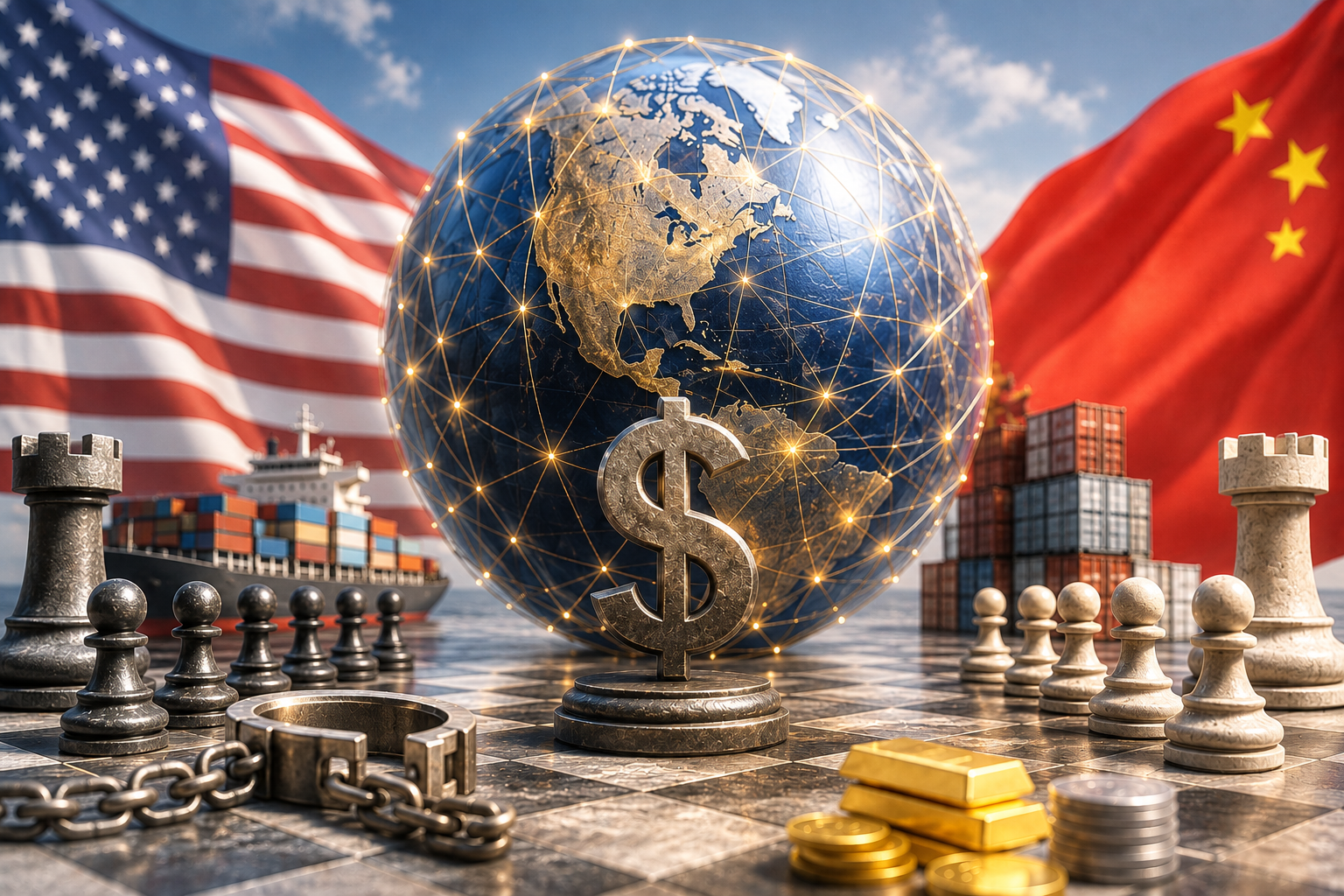
As will be discussed in the sections that follow, these realities create a strategic paradox. The United States possesses extraordinary economic leverage through its central position within the dollar-centered global system, yet its ability to fully weaponize that leverage against China is constrained by the very system from which that leverage is derived. China, meanwhile, seeks greater strategic autonomy, yet remains unable to eliminate the risks associated with continued participation in that same system. Understanding this paradox is essential to understanding why economic coercion between the world’s two largest economic powers has thus far produced friction, adaptation, and short-term costs, but not decisive long-term strategic outcomes.
The Dollar-Centered Global System and the Limits of Financial Coercion
a. An Overview of the Modern Global Financial System
The ability of the United States to impose severe financial sanctions is rooted in the structure of the modern global financial system itself. Understanding that system is therefore essential to understanding both the power and the limits of economic coercion.
The overview that follows synthesizes the operation of the modern global financial system from four authoritative institutional sources:
- The International Role of the US Dollar – 2025 Edition (Federal Reserve Board);
- Currency Composition of Official Foreign Exchange Reserves (COFER): World Aggregates, First Quarter 2026 (International Monetary Fund);
- International Monetary System: Currencies in a Changing World (International Monetary Fund);
- International Finance Through the Lens of BIS Statistics (Bank for International Settlements).
International trade, cross-border investment, sovereign reserves, and financial settlements are not conducted through a collection of independent national systems. Rather, they are interconnected through a broader financial architecture in which the US dollar continues to function as the world’s principal reserve currency, international settlement currency, and source of liquidity during periods of financial stress.
The importance of this role is often misunderstood. Modern economies depend upon reasonably stable currencies. Significant currency instability can increase inflation, discourage investment, raise borrowing costs, and undermine public confidence. During periods of economic uncertainty, investors frequently move capital away from countries perceived to be at greater risk. As capital leaves, currencies can weaken rapidly, creating additional economic and political pressures.
Governments and central banks attempt to counter these pressures by supporting their currencies and reassuring markets that they can continue to meet financial obligations. Doing so requires reserves that can be mobilized quickly and converted into purchasing power during periods of stress. For example, if investors begin rapidly selling a country’s currency, the central bank may seek to stabilize its value by purchasing that currency in foreign-exchange markets. To do so, it must possess reserve assets that can be readily sold or exchanged for cash on short notice.
For decades, US Treasury securities and other dollar-denominated assets have performed this role more effectively than most alternatives because they remain highly liquid, broadly trusted, and widely accepted throughout the international financial system.
The result is a global financial structure that resembles a wheel, with the dollar at its hub. Countries conduct their own economic affairs independently, but many continue to rely upon dollar-denominated reserves, dollar liquidity, and dollar-based financial channels when financial conditions deteriorate. Participation in the system is therefore not merely a matter of convenience. For many states, it remains closely connected to economic stability itself.
Understanding these structural characteristics is essential because they shape not only the day-to-day operation of the international financial system but also the strategic options available to states that seek to employ economic coercion.
b. Strategic Implications of the Dollar-Centered Global Financial System
The practical importance of these dynamics can be illustrated by examining how China manages its currency. Unlike currencies that are permitted to float freely in response to market forces, the Chinese renminbi operates within a tightly managed exchange-rate system. Chinese authorities do not simply allow the currency to find its own market value. Rather, they actively seek to maintain exchange-rate stability through a combination of capital controls, monetary policy, and intervention in currency markets.
When investors seek to move capital out of China, downward pressure can develop on the renminbi. If Chinese authorities conclude that the resulting depreciation threatens financial stability or broader economic objectives, they may intervene to support the currency. Doing so requires the ability to purchase renminbi in foreign-exchange markets, which in turn requires reserve assets that can be readily mobilized and converted into purchasing power.
Historically, a substantial portion of China’s foreign-exchange reserves has been invested in highly liquid dollar-denominated assets, including US Treasury securities and other dollar-based reserve instruments. In practical terms, those assets can be sold or exchanged for dollars, which can then be used to purchase renminbi and support its value. The deeper and more liquid the reserve asset, the easier it becomes to conduct such interventions on a meaningful scale.
This does not mean that China is dependent upon the United States for the day-to-day management of its currency. It does mean, however, that China’s ability to maintain a tightly managed exchange-rate system has long been facilitated by participation in a global financial structure anchored by dollar liquidity and highly liquid dollar-denominated reserve assets. That reality helps explain why reducing exposure to the dollar-centered system is far easier than replacing the functions that system currently performs.
That central position creates a form of strategic leverage that is unparalleled in the modern international financial system. Access to dollar-based financial channels, settlement systems, and liquidity can be restricted or denied. The United States has demonstrated this capability repeatedly. Financial sanctions imposed against Iran significantly constrained its access to international commerce and the international financial system. Following Russia’s invasion of Ukraine, the United States and its allies imposed sweeping financial restrictions that limited Russian access to important components of the international financial system. Similar measures have been employed against North Korea, Syria, Libya, Venezuela, and other states viewed as posing significant threats to international security or international stability.
Those examples demonstrate that the leverage created by the dollar-centered system is real. Yet they also reveal an important common characteristic. In each case, the target state was either relatively isolated from the broader global economy, widely viewed as a rogue actor, or the subject of unusually broad international consensus following a high-salience event. The costs imposed on the targeted nation, while substantial, were not expected to threaten the stability of the global financial system itself.
China presents a fundamentally different challenge. Unlike Iran, North Korea, Libya, Syria, Venezuela, or even Russia, China is deeply integrated into virtually every major component of the global economy. It is a leading trading nation, a critical participant in global manufacturing and supply chains, a major holder of dollar-denominated assets, and an essential economic partner for many of the same nations that would be expected to participate in any large-scale sanctions regime.
The result is a paradox. The same system that gives the United States extraordinary financial leverage also creates powerful incentives against fully weaponizing that leverage against a nation as deeply integrated into the system as China. Measures capable of inflicting severe damage on China could also produce significant disruption for allies, trading partners, financial markets, and the broader global economy. The greater China’s integration into the system, the greater the potential costs associated with attempting to exclude it from that system.
This does not mean that the United States lacks economic leverage over China. Nor does it mean that China is free from the risks associated with dependence on a dollar-centered global system. Rather, it means that both countries operate within a structure that simultaneously creates opportunities for coercion and limits on its use.
Understanding those competing realities is essential to understanding the economic coercion that has emerged between the United States and China. Both nations possess meaningful sources of leverage. Both have employed them. Yet neither side has succeeded in translating these tactical gains into decisive strategic outcomes. The reason lies not in the absence of economic leverage, but in the ability of modern economic systems to adapt to sustained coercive pressure.
Why Economic Coercion Has Not Produced Decisive Strategic Outcomes
Although the United States and China increasingly employ economic tools against one another, their strategic objectives are not identical. Nor are they seeking outright economic destruction of the other. Rather, both are attempting to shape the strategic environment in ways that favor their own long-term national interests.
For the United States, the objective is not to remove China from the global economy. Such an outcome would impose enormous costs on the United States, its allies, and the broader international system. Rather, US policy has generally sought to constrain China’s ability to convert economic strength into technological, military, and geopolitical advantages that could undermine American interests or alter the existing balance of power. Export controls, technology restrictions, investment screening, and targeted sanctions are therefore better understood as efforts to slow, shape, or limit particular forms of Chinese advancement rather than attempts to produce economic collapse.
China’s objectives are different. Beijing is not seeking to dismantle the dollar-centered global system from which it has derived enormous economic benefits. Nor is it attempting to sever its ties to global commerce. Instead, China seeks greater strategic autonomy within that system. Its long-term objectives include reducing vulnerability to US economic pressure, securing access to critical technologies and resources, expanding its global influence, and increasing its ability to pursue national objectives without fear of external economic coercion. Restrictions on critical minerals, regulatory pressure on foreign firms, supply-chain leverage, and efforts to expand alternative financial arrangements can therefore be understood as measures designed to reduce dependence and increase freedom of action rather than to destroy the existing system outright.
Both countries have achieved partial successes. US export controls have complicated Chinese access to certain advanced technologies. Chinese restrictions on critical materials have highlighted vulnerabilities within global supply chains and Western dependence in strategically important sectors. Yet neither side has succeeded in translating these tactical gains into decisive strategic outcomes.
One reason is adaptation. Economic systems are rarely static. Firms adjust sourcing decisions. Supply chains relocate. Governments develop substitute suppliers. Capital seeks alternative channels. Technology restrictions encourage domestic innovation efforts. Financial restrictions generate incentives to create workarounds. While such adaptations often involve significant costs, they can reduce the effectiveness of coercive measures over time.
These adaptive responses arise because economic relationships differ fundamentally from military engagements. Production can be relocated, suppliers can be replaced, financing can be redirected, and technological capabilities can be developed domestically over time. None of these adjustments occurs without cost. However, they often allow targeted states to absorb pressure while preserving their ability to pursue core strategic objectives. As a result, economic coercion frequently changes the cost of a policy without necessarily changing the policy itself.
The history of US-China economic coercion increasingly reflects this pattern. Measures imposed by one side often succeed in creating friction, disruption, delay, or increased expense. Yet the targeted side typically responds through adjustment rather than capitulation. The result is a continuing cycle of pressure and adaptation rather than a decisive change in strategic behavior.
More fundamentally, the strategic objectives being pursued by both nations may exceed what economic coercion can realistically deliver, regardless of how effectively individual coercive measures are implemented. The United States seeks to preserve advantages in technology, security, and geopolitical influence without destabilizing the global economic system upon which much of its own prosperity depends. China seeks greater strategic autonomy and reduced vulnerability to external pressure without sacrificing the benefits it derives from continued participation in that same system. Neither objective is fully compatible with the complete economic defeat or isolation of the other.
This reality helps explain why economic coercion between the United States and China has produced persistent friction but not decisive victory. The tools employed by both sides can impose costs and shape incentives. They are far less capable of compelling the type of fundamental strategic transformation that would constitute a clear and lasting victory. The result is an ongoing contest characterized by competition, adaptation, and constraint rather than resolution.
Conclusion
Economic coercion has emerged as one of the most significant instruments of modern irregular warfare. It offers nations the ability to impose costs, influence behavior, create dependencies, and shape strategic outcomes while remaining below the threshold of conventional military conflict. Yet as the experience of the United States and China demonstrates, the effectiveness of economic coercion is shaped not only by the tools available to policymakers, but also by the structure of the global system within which those tools are employed.
The dollar-centered global financial system provides the United States with a form of leverage unmatched by any other nation. At the same time, that leverage is constrained by the very system from which it is derived. The United States possesses the ability to impose severe financial pressure on adversaries, but the costs and risks associated with employing its most powerful coercive tools against a nation as deeply integrated into the global economy as China would extend far beyond the intended target.
China faces a different challenge. Beijing seeks greater strategic autonomy while continuing to benefit from participation in the existing system. Although China has taken steps to diversify financial relationships, expand renminbi usage, and reduce specific dependencies, it remains deeply connected to a global financial structure whose central organizing feature continues to be the US dollar.
For either side to achieve something approaching a decisive strategic outcome, the underlying structure of the system would likely need to change. China would need to foster far greater international use of the renminbi, develop reserve assets capable of achieving levels of trust and liquidity comparable to US Treasury securities, and embrace forms of capital-account liberalization that could reduce the state’s ability to tightly manage financial flows and exchange-rate stability. The United States, meanwhile, would need to demonstrate a willingness to accept levels of economic disruption, financial uncertainty, and systemic risk that it has historically sought to avoid.
At present, neither development appears likely. As a result, economic coercion between the United States and China is likely to continue producing friction, adaptation, and incremental shifts in behavior rather than decisive strategic resolution. The contest will remain consequential, and the tools employed by both sides will continue to evolve. So long as both nations remain deeply embedded within the same dollar-centered global system, the constraints imposed by that system are likely to prove every bit as consequential as the leverage it creates.